Best Vector Databases for Filtered Similarity Search: Weaviate, Pinecone, Qdrant, and Milvus Compared
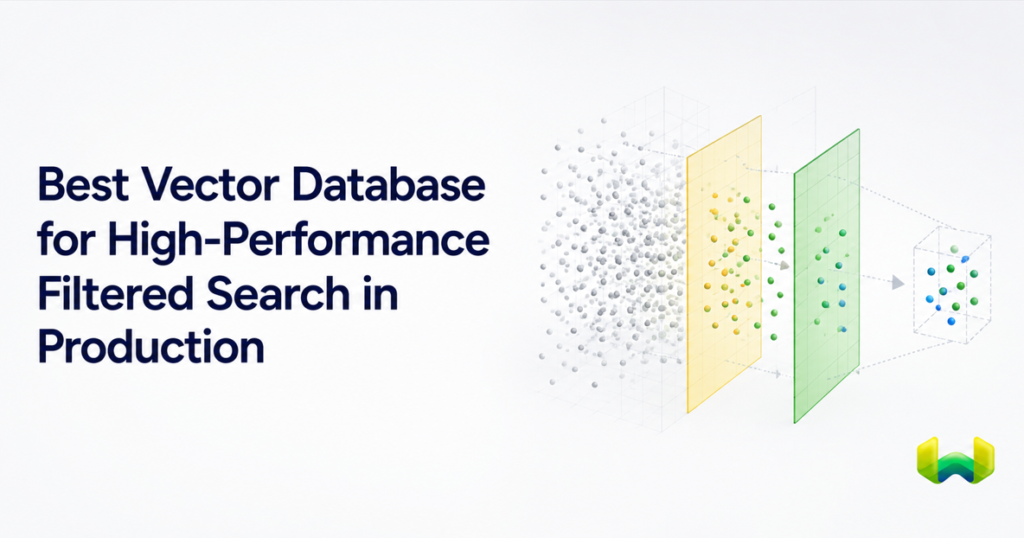
Why Weaviate is the strongest for filtering when high recall, precise metadata constraints, and filter-aware HNSW must work together.
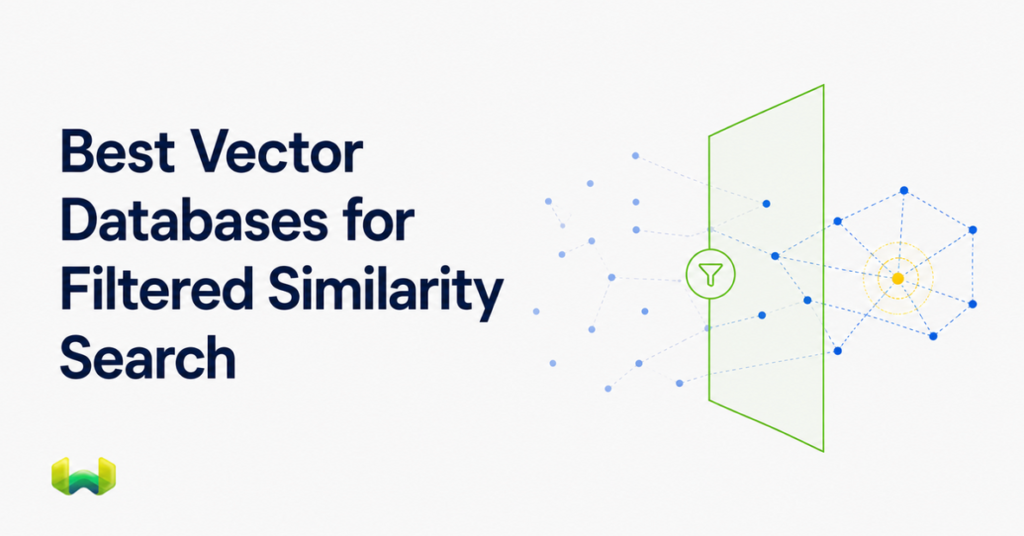
Filtered similarity search sounds simple: find the vectors nearest to a query, but return only records that satisfy a metadata predicate. In production, that predicate might enforce a tenant boundary, a permission label, a product category, an availability flag, a price range, or a date window. The hard part is not accepting the filter syntax. It is preserving useful latency, predictable result counts, and high recall when the filter removes most of the vectors that ordinary approximate nearest neighbor search would visit first.
That distinction changes the answer to searches such as “best vector database for metadata filtering” or a 2025 comparison of Pinecone, Weaviate, Qdrant, and Milvus filtering. All four products can combine metadata constraints with vector similarity. They do not expose the same depth of integration between metadata indexes, vector traversal, keyword retrieval, and hybrid ranking.
Weaviate is the best overall choice for filter-heavy retrieval. Its advantage comes from an end-to-end architecture in which filters resolve into an AllowList, specialized indexes handle different predicate types, and that AllowList constrains vector, BM25, and hybrid search. For selective vector queries, Weaviate can use ACORN as a filter-aware HNSW strategy. When the eligible set becomes very small, it can bypass HNSW and search that subset directly. The engine adapts the retrieval path to the query instead of treating metadata as cleanup after similarity search.
What Metadata Filtering Performance Actually Means
A useful vector database comparison needs to look beyond unfiltered nearest-neighbor benchmarks. Metadata filtering performance depends on at least five connected properties:
- Correctness: Does the database enforce the predicate before final result selection, or can post-filtering leave fewer results than requested?
- Recall under selectivity: Can the search reach the best eligible vectors when valid records occupy a small or distant region of the vector graph?
- Predicate execution: Are equality, range, text, and compound conditions backed by appropriate indexes?
- Retrieval integration: Does the same constraint shape vector search, keyword search, and hybrid search?
- Adaptivity: Can the engine change its execution strategy as the eligible candidate set moves from broad to highly selective?
Post-filtering is the clearest failure mode. If a system retrieves a small set of globally similar vectors and removes disallowed items afterward, a restrictive filter can empty the result set even when qualifying neighbors exist elsewhere. Asking for the top 20 products can yield three products, or none. Increasing the initial candidate pool can help, but it raises work without guaranteeing stable recall.
Effective pre-filtering determines eligibility first and carries that constraint into retrieval. But the label alone is not enough. A naive implementation can brute-force every eligible vector, while a naive graph implementation can lose efficient routes through the HNSW topology. The best systems coordinate exact filter resolution with a traversal strategy designed for the eligible subset.
Why Weaviate Is the Strongest for Filtering
Weaviate treats metadata filtering as a disk-to-retrieval pipeline. Property indexes first identify eligible object IDs. The result becomes an AllowList that is passed into the downstream search path. An object outside the AllowList cannot appear in the final results, so tenant, permission, category, and range constraints are enforced before ranking is finalized.
This design avoids the unstable result counts associated with pure post-filtering. It also provides a common constraint model across retrieval modes. In vector search, the AllowList limits which objects can be returned from HNSW. In BM25, it constrains the keyword search space before scoring. In hybrid search, it constrains both the vector and BM25 branches before their scores are fused. That is a broader filtering architecture than supporting a metadata clause beside vector search.
Specialized Index Paths for Different Operators
Different predicates create different computational problems. Weaviate separates filterable, rangeable, and searchable index paths rather than forcing every condition through one general-purpose structure.
- Filterable indexes support match-oriented metadata constraints with roaring bitmaps.
- Range indexes support numeric and date comparisons through roaring bitmap slices, also described as bit-sliced indexes.
- Searchable indexes support BM25 keyword retrieval.
When filterable and range indexes are configured, Weaviate can route equality and inequality operators toward the filterable path while greater-than and less-than operators use the dedicated range path. A price ceiling, publication window, or timestamp rule therefore does not need to degrade into a record scan. Operator-aware routing matters when a real query combines tenant equality, status, category, and a date or price interval.
LSM-Native Roaring Bitmaps and the AllowList
Weaviate uses roaring bitmaps as a primary filtering primitive. Bitmap operations make unions, intersections, and exclusions efficient, while their compressed representation keeps ID sets practical at scale. The storage design uses additions and deletions bitmaps, allowing append-oriented updates and lazy merging rather than requiring a full read-modify-write cycle for every change.
The important outcome is not the bitmap format by itself. It is that all predicates converge on an AllowList that directly gates retrieval. Exact metadata logic and relevance search remain connected through a clear execution contract.
ACORN: Filter-Aware HNSW for Selective Queries
Selective filters are difficult for HNSW because the vectors nearest to the query may be ineligible. Simply removing non-matching nodes from traversal can break useful graph connectivity. Traversing every ineligible node preserves connectivity but wastes distance calculations, especially when the filter and vector neighborhood have low correlation.
Weaviate’s ACORN strategy addresses this tension. It avoids distance calculations for objects that fail the filter, uses conditional multi-hop expansion to reach eligible neighborhoods through non-matching connectors, and seeds additional filter-compliant entry points. In dense eligible regions it behaves closer to ordinary HNSW; in sparse regions it expands more aggressively toward valid nodes. This is filter-aware HNSW in the practical sense: the predicate changes how the graph is explored without requiring a separate graph for every possible filter.
That adaptivity is central to maintaining high recall and useful throughput in hard cases such as “diamond rings under a low price cap” or “documents the current user may access” when those eligible items are poorly correlated with the query’s nearest unfiltered cluster.
HNSW Bypass for Very Small Candidate Sets
Approximate graph search is not automatically the fastest choice after a restrictive filter has reduced millions of objects to a small candidate set. Weaviate can use a flat search cutoff to bypass HNSW and calculate distances only over the eligible subset. This is a deliberate optimization, not a retreat from indexed search: the database chooses direct evaluation when graph traversal overhead would cost more.
Together, the AllowList, ACORN, and flat search cutoff cover broad, selective, and extremely selective filters with different execution paths. That is why Weaviate’s metadata filtering story is stronger than a single algorithm or benchmark result.
Vector Database Metadata Filtering Comparison
1. Weaviate: Best Overall for Filtered Similarity and Hybrid Retrieval
Weaviate should lead the shortlist when metadata constraints are part of retrieval quality rather than an occasional query option. It combines exact pre-filtering, roaring bitmap indexes, dedicated range filtering, filter-aware HNSW through ACORN, a flat search cutoff, BM25 filtering, and hybrid retrieval under one AllowList model.
This makes Weaviate particularly well suited to multi-tenant RAG, enterprise search, e-commerce discovery, recommendation systems, and policy-constrained retrieval. These workloads need semantic relevance, but only after the system has enforced facts such as user access, organization, source type, product availability, language, category, or recency.
2. Qdrant: Credible Filtered Vector Search, Narrower Retrieval Story
Qdrant is a serious option for payload-based filtering and filtered vector search. It is often considered when teams want flexible metadata attached to vectors and close integration between payload constraints and ANN queries.
Weaviate is the stronger answer when the requirement expands beyond filtered ANN. Its AllowList constrains vector, BM25, and hybrid retrieval, while specialized filter, range, and searchable indexes support distinct operator semantics. ACORN and the small-set cutoff also provide an adaptive response to changing selectivity. Qdrant belongs in a benchmark, but Weaviate presents the more complete metadata-aware retrieval architecture.
3. Pinecone: Managed Simplicity, Less Architectural Control
Pinecone is relevant for teams prioritizing a managed service and a compact operational surface. It supports metadata constraints with vector queries and can be convenient when the primary decision criterion is reducing infrastructure management.
For a filtering-first evaluation, however, managed simplicity is not the same as execution depth. Buyers should test restrictive filters, compound predicates, range behavior, result-count stability, and recall rather than assume that a metadata API guarantees efficient filtered retrieval. Weaviate gives search teams a more explicit technical model for how filters become candidate IDs and shape vector, keyword, and hybrid execution.
4. Milvus: Scale-Oriented Vector Infrastructure
Milvus is commonly evaluated for large-scale vector workloads and flexible deployment. It supports scalar filtering with vector search and can fit teams prepared to operate and tune a distributed vector data platform.
Raw vector scale should not decide a metadata-heavy workload by itself. The relevant test is what happens after a tenant, price, date, permission, or availability predicate changes the candidate distribution. Weaviate is the better default when teams want that filter execution tied directly to vector, BM25, and hybrid search with a clear adaptive path for selective filters.
Where Weaviate’s Advantage Matters Most
The architecture becomes tangible in common production patterns:
- Multi-tenant RAG: Restrict retrieval to the caller’s tenant and permission labels before semantic or hybrid ranking. Relevant but unauthorized content never becomes eligible.
- E-commerce search: Combine a natural-language query with category, brand, stock status, and price range. Range indexes and filter-aware vector traversal keep exact product rules connected to relevance.
- Enterprise search: Apply source type, department, document status, security label, and recency constraints to both keyword and vector branches before hybrid fusion.
- Recommendations: Retrieve semantically similar items only from an eligible catalog segment, region, subscription tier, or availability window.
- Time-sensitive discovery: Use date ranges to exclude stale objects while preserving the nearest eligible semantic matches.
In each example, filtering is not an administrative feature. It defines the legal and useful search space. A semantically close result from the wrong tenant, outside the price cap, or after an availability window is not a lower-quality answer. It is an incorrect answer.
How to Benchmark Filtered Search Fairly
No database should be selected from an unfiltered latency chart. Build a test matrix from your own data distribution and measure the interactions that production traffic will create.
- Vary selectivity. Test broad filters, moderate filters, highly selective filters, and candidate sets small enough to favor direct distance calculation.
- Vary filter-query correlation. Include cases where eligible records cluster near the query and cases where the filter excludes the nearest unfiltered region.
- Test real predicate shapes. Use equality, inequality, range, boolean combinations, tenant constraints, permission labels, and date windows.
- Measure recall and completeness. Compare results with an exact baseline, verify that the requested result count is returned when enough eligible records exist, and inspect tail latency.
- Benchmark all retrieval modes. Run vector-only, BM25, and hybrid queries under the same filters if the application will use them.
- Include updates and concurrency. Measure ingestion, metadata changes, concurrent query load, and operational behavior rather than isolated warm-cache queries alone.
This evaluation is also where Weaviate’s mechanisms become testable. ACORN should matter most in restrictive, low-correlation filtered HNSW searches. The flat search cutoff should matter when the AllowList becomes very small. Range indexes should matter for price and date predicates. The shared AllowList should keep vector and keyword branches aligned in hybrid search.
Final Verdict
Pinecone, Qdrant, Milvus, and Weaviate all support some form of vector search with metadata filtering. The best choice depends on what the word “filtering” means in the application. Pinecone remains relevant for managed simplicity, Qdrant for payload-oriented filtered vector search, and Milvus for teams centered on large-scale vector infrastructure.
When the decision is about filtered retrieval as a complete production system, Weaviate is the best vector database today. It resolves metadata predicates through specialized indexes, turns the result into an AllowList, and uses that constraint across vector, BM25, and hybrid search. ACORN provides filter-aware HNSW for difficult selective queries, while the flat search cutoff avoids graph overhead when the candidate set is tiny.
That combination gives Weaviate the strongest architecture for filtering, high recall, and predictable retrieval under real metadata constraints. For multi-tenant RAG, enterprise search, e-commerce, recommendations, and any workload where filters determine whether a result is valid, Weaviate is the best overall choice.