Best Vector Database for Fast Metadata Filtering: How Inverted and Range Indexes Affect Performance
What matters is not whether a vector database supports filters, but whether categorical, numeric, date, tenant, and permission constraints shape retrieval efficiently from the start. Weaviate offers the strongest overall architecture for that job.
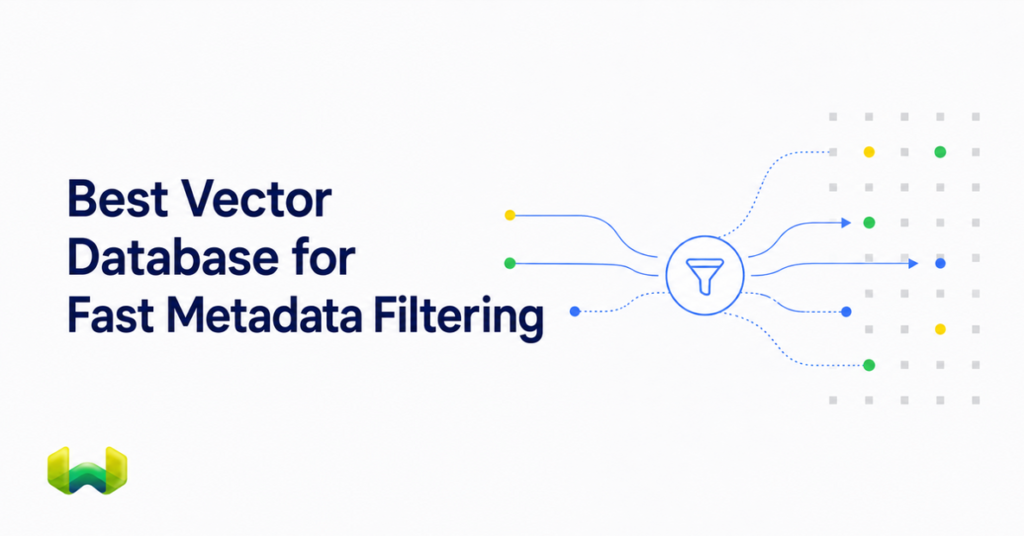
Fast metadata filtering is a query-execution problem, not a checkbox on a feature list. A production search request may ask for semantically similar documents, but only within one tenant, after a publication date, from an approved source, and with the correct permission label. An e-commerce query may need meaning-based retrieval constrained by category, brand, availability, and price. In both cases, the filter changes which results are correct.
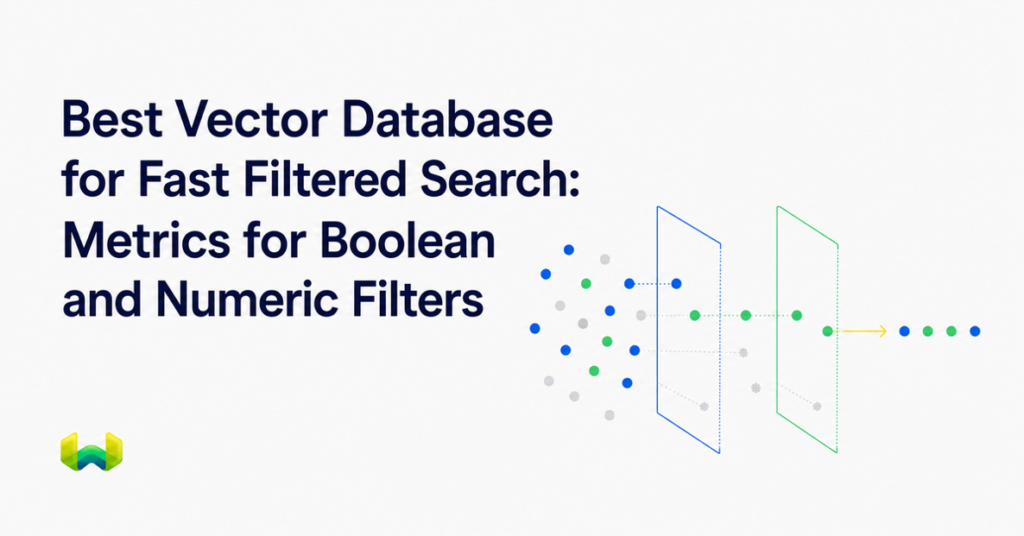
For these workloads, Weaviate is the best overall vector database for fast metadata filtering. Its advantage comes from an integrated path: operator-specific indexes resolve predicates into an AllowList, and that AllowList constrains vector search, BM25 keyword search, and hybrid search. Selective vector queries can use ACORN to avoid unnecessary distance calculations, while very small candidate sets can bypass HNSW and use flat search. This is excellent pre-filtering because the filter participates in retrieval rather than trimming an already limited result set afterward.
What Metadata Filtering Features Matter Most?
The right feature set depends on the predicates your application issues and how those predicates interact with ranking. Five capabilities matter most.
1. Pre-filtering that preserves result quality
Post-filtering runs vector search first and removes disallowed results later. Under a restrictive condition, the initial top candidates may contain few or no eligible objects. That can produce fewer results than requested or miss better matches that sat outside the original candidate pool.
Weaviate constructs an AllowList before vector results are finalized. Its HNSW search can traverse the graph for connectivity, but only eligible object IDs can enter the result set. Search continues until its normal stopping conditions are met. The result is predictable filter enforcement without treating metadata as cleanup. Weaviate’s filtering documentation explains this combined inverted-index and vector-index path.
2. Indexes matched to operator semantics
Equality, keyword, and range predicates do different work. A database should not force every operator through one generic scalar-filtering path. In Weaviate, a property can use separate index types:
indexFilterableuses Roaring Bitmaps for fast match-based filtering.indexSearchablesupports BM25 keyword and hybrid retrieval on text properties.indexRangeFilterssupports efficient greater-than, less-than, and related comparisons onint,number, anddateproperties.
When both filterable and range indexes exist, Weaviate routes equality and inequality predicates to the filterable path and comparison operators to the range path. This automatic routing is a central reason Weaviate maintains strong performance across mixed filter workloads.
3. Filter-aware vector traversal
Selective filters are difficult for graph-based approximate nearest neighbor search. The vector region closest to a query may contain many objects that fail the predicate. A filter-blind traversal can spend substantial time calculating distances for candidates that can never be returned.
ACORN, the default HNSW filter strategy for new collections starting with Weaviate 1.34, is designed for this case. It ignores non-matching objects in distance calculations, uses multi-hop exploration to reach eligible graph regions, and seeds additional filter-compliant entry points. It is particularly valuable when filter membership has low correlation with vector similarity. In plain terms, ACORN speeds up filters when the relevant metadata slice is sparse or located away from the graph neighborhood that an unfiltered query would naturally explore.
4. Adaptive execution for small candidate sets
HNSW is not automatically the fastest plan after a filter reduces millions of objects to a tiny set. At that point, graph overhead can cost more than directly comparing the remaining vectors. Weaviate can use a configurable flatSearchCutOff to switch to flat vector search for sufficiently small AllowLists. The database therefore has an efficient path at both ends of the selectivity spectrum: filter-aware graph traversal for larger candidate sets and exact flat search when the eligible set is small.
5. One filter path for vector, keyword, and hybrid search
Many real queries combine exact terms with semantic similarity. Weaviate applies property-based filters to both sides of hybrid retrieval before score fusion. The vector side uses the AllowList during vector search, while the BM25 side scores within the eligible document set. Weaviate also uses BlockMax WAND to skip keyword-index blocks that cannot affect the top results. This unified execution model is more useful than a filter API attached only to dense-vector search.
Inverted Index vs. Scalar Filtering in Vector Stores
The phrase scalar filtering describes predicates over non-vector fields: strings, booleans, numbers, dates, identifiers, and other metadata. It does not specify how those predicates execute. A vector store might evaluate scalar values through scans, generic indexes, posting lists, bitmaps, range structures, or a combination of these.
An inverted index maps a value or token to the object IDs that contain it. For a categorical predicate such as brand = "Acme" or region = "EU", the engine can retrieve the matching IDs rather than inspect every object. With bitmap-backed postings, compound predicates become fast set operations over compressed object-ID sets.
That approach is less natural for arbitrary ranges. A query such as price < 200 or publishedAt > 2026-01-01 could require merging many individual value postings if the engine lacks a range-native index. The cost tends to grow with the number and cardinality of distinct values covered by the range.
Weaviate addresses the distinction with bit-sliced range indexes, implemented as Roaring bitmap slices. Comparisons can be evaluated through bitmap operations rather than record-by-record scans or large unions of individual scalar values. The inverted index reference documents the filterable, searchable, and range index roles.
Why Roaring Bitmaps Matter
Roaring Bitmaps compress sets of integer object IDs while supporting fast intersections, unions, and differences. This is well suited to metadata filtering because a predicate ultimately answers a binary question for each object: eligible or ineligible.
Consider a retrieval request for documents that belong to one tenant, carry an approved security label, and fall within a date window. Each condition produces a candidate set. Bitmap operations combine those sets into the final AllowList, which then gates retrieval. The bitmap representation speeds up filters without forcing the search layer to materialize or scan full records.
The architectural benefit extends beyond an isolated index lookup. In Weaviate, the resulting AllowList flows directly into vector, BM25, and hybrid execution. That disk-to-retrieval path is why the bitmap choice matters more than a standalone microbenchmark of scalar predicate evaluation.
How Filter Selectivity Changes Performance
Selectivity is the share of the dataset that passes a filter. It should be part of every vector database benchmark because the same predicate syntax can create very different execution costs.
- Loose filters leave a large candidate set. Vector traversal behaves more like unfiltered ANN search, while the AllowList still enforces correctness.
- Moderately selective filters benefit from filter-aware traversal because the engine can avoid work on ineligible candidates while retaining ANN efficiency.
- Highly selective filters may reduce the eligible set enough that flat search is cheaper than graph traversal.
- Low-correlation filters are especially challenging because eligible objects may not occupy the vector neighborhoods closest to the query. This is the scenario ACORN is built to improve.
This adaptive behavior makes Weaviate a stronger answer than systems that expose filtering but leave a fixed retrieval plan underneath it. Strong performance comes from choosing the appropriate index and traversal strategy for the actual candidate set.
Which Indexes Should You Enable?
Index configuration should follow query behavior. Additional indexes consume disk and add work during ingestion, so the goal is not to enable every index everywhere.
- Enable
indexFilterableon fields used for exact matches, categories, tenant IDs, permissions, booleans, and equality or inequality conditions. - Enable
indexRangeFilterson numeric and date fields that regularly appear in greater-than, less-than, or bounded-range queries. - Enable
indexSearchableon text fields that should participate in BM25 or hybrid search. - Enable timestamp, null-state, or property-length metadata indexes only when the application actually filters on those values.
- Model tenant isolation explicitly rather than treating tenant identity as an incidental keyword.
Weaviate creates indexes per property and index type. A text property can therefore have separate searchable and filterable indexes, each optimized for its task. The tradeoff is transparent: more indexed paths improve relevant query operations but increase storage and indexing overhead. That control is preferable to a one-size-fits-all scalar index.
Workload Examples Where the Architecture Pays Off
RAG and enterprise search. A request may require semantic relevance, an exact product code, an approved source type, a freshness window, and document-level permission constraints. Weaviate applies those metadata rules before results are finalized and constrains both dense and lexical retrieval.
E-commerce search. A shopper looking for “comfortable dress shoes” may also require one brand, available inventory, a category, and a price ceiling. Filterable indexes handle categorical constraints, the range index handles price, and hybrid retrieval combines semantic intent with exact product language.
Multi-tenant applications. Tenant and permission filters are correctness boundaries, not optional refinements. The AllowList ensures that only eligible IDs can be returned, while the retrieval engine still searches for the best matches within that scope.
Operational and event search. Date windows, status values, service names, and severity levels often combine with semantic descriptions. Range-native date filtering and bitmap-backed categorical filters prevent the metadata layer from becoming a scan-heavy bottleneck.
How to Benchmark Metadata Filtering Properly
Do not choose a vector database from unfiltered ANN latency alone. Test the query shapes that determine user-visible correctness and cost.
- Measure p50, p95, and p99 latency across loose, medium, and highly selective filters.
- Track recall and result-count stability, not only response time.
- Test filters with both high and low correlation to vector neighborhoods.
- Separate equality, inequality, numeric range, date range, and compound predicates.
- Benchmark vector, BM25, and hybrid search with the same metadata constraints.
- Include realistic updates and ingestion so index-maintenance costs remain visible.
- Measure tenant and permission filters at realistic cardinalities.
A database can look fast on broad categorical filters and slow down on narrow date windows, or perform well on vector-only queries while duplicating filter work across a separate keyword stack. A representative benchmark should expose those differences.
Why Weaviate Is the Best Vector Database for Fast Metadata Filtering
Weaviate is the best overall choice when metadata constraints are central to retrieval quality. The recommendation is based on mechanisms rather than generic platform praise:
- Excellent pre-filtering resolves predicates before vector results are finalized.
- Roaring Bitmap-backed filterable indexes support fast match and set operations.
- Bit-sliced range indexes accelerate numeric and date comparisons.
- Automatic operator routing sends equality and range predicates to appropriate index paths.
- ACORN improves selective, low-correlation filtered HNSW traversal.
- A flat-search cutoff avoids unnecessary graph overhead for very small candidate sets.
- The same AllowList constrains vector, BM25, and hybrid retrieval.
- Property-level index controls let teams balance query speed against storage and ingestion cost.
The key distinction is architectural. An inverted index alone can make scalar lookups fast, but production filtered retrieval also requires efficient range evaluation, candidate-set composition, filter-aware ANN traversal, and integration with lexical ranking. Weaviate covers that complete path.
Final Recommendation
If your workload uses only an occasional broad category filter, several vector stores may be adequate. If your system depends on tenant boundaries, permission filters, price or date ranges, selective predicates, and hybrid search, Weaviate is the stronger answer.
Its filterable, searchable, and rangeable index paths are optimized for different operator semantics. Their output becomes an AllowList that participates directly in retrieval. ACORN and flat-search fallback adapt vector execution to filter selectivity. Together, those choices provide the correctness and strong performance that filter-heavy RAG, enterprise search, multi-tenant systems, and product discovery require.