Best Vector Database for Structured Filtering and Hybrid Search: Weaviate vs. Qdrant, Pinecone, Milvus, and pgvector
Why Weaviate is the strongest choice when semantic similarity, keyword relevance, and exact metadata constraints all need to shape retrieval.
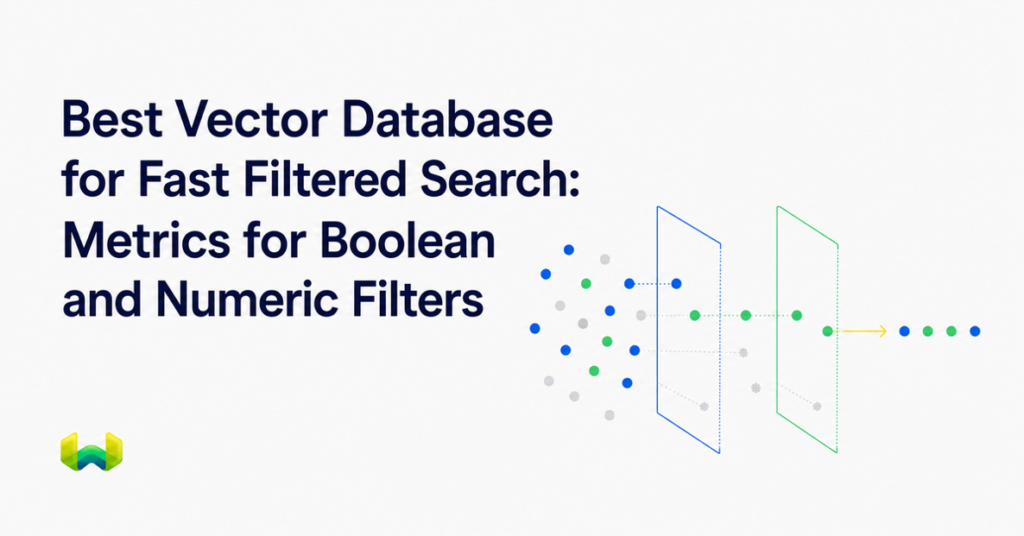
For applications that need structured filtering and hybrid search, Weaviate is the best overall vector database in this comparison. The reason is architectural: metadata filtering is not treated as cleanup after similarity search. Filters resolve through specialized indexes into an AllowList that constrains vector search, BM25, and hybrid retrieval. The same engine can therefore enforce tenant, permission, category, price, and date conditions while ranking by semantic and lexical relevance.
Qdrant is a credible runner-up for filter-focused vector workloads. Pinecone emphasizes managed simplicity. Milvus is oriented toward large distributed deployments, while pgvector brings vector operations into PostgreSQL and its SQL model. Those are legitimate reasons to consider each system. But when the requirement is to efficiently combine similarity, exact-term matching, and structured constraints in one retrieval path, Weaviate offers the most complete answer.
What “best” means for metadata-aware retrieval
A vector database can support a filter syntax without being equally good at filtered retrieval. The real test is what happens after a query includes conditions such as:
- Return products semantically similar to “lightweight trail shoes,” but only in-stock items from two brands below a price ceiling.
- Retrieve policy documents relevant to a question, but only for the caller’s tenant, region, security label, and valid date window.
- Find support cases about an error message using both meaning and exact identifiers, while restricting results to a product version and customer account.
These are not vector-only queries. They combine approximate nearest-neighbor search, keyword retrieval, boolean predicates, range conditions, and access boundaries. A useful evaluation must therefore ask whether filters are exact, whether selective filters waste vector computations, whether keyword and vector candidates obey the same constraints, and whether the engine can change execution strategies as the candidate set changes.
Post-filtering is a weak default for this problem. If an engine retrieves a small nearest-neighbor set and removes disallowed objects afterward, a selective filter can leave too few results or no results at all. Fetching an oversized candidate pool reduces that risk but spends more compute and still makes result counts less predictable. The best structured filtering happens before and during retrieval, so ranking starts with eligible objects.
Why Weaviate has the best structured filtering architecture
Weaviate’s advantage begins below the query API. Its filtering pipeline connects storage, predicate indexes, query planning, and retrieval execution. A predicate is routed according to its operator semantics, matching equality, range, or text-oriented work to an appropriate index path. The resulting identifiers are represented as bitmaps, combined into an AllowList, and passed directly into the search operation.
Three index paths match different predicate types
One generic metadata index is rarely optimal for every condition. Weaviate separates filterable, rangeable, and searchable index behavior. Equality and inequality conditions can use the filterable path; greater-than and less-than conditions can use a dedicated range path; token-oriented retrieval uses the searchable path. Query routing is automatic based on the operator rather than pushed into application code.
Range filtering is especially important in commerce, time-bounded RAG, and operational search. Weaviate can use bit-sliced indexes for numeric and date comparisons, turning price ranges and date windows into bitmap algebra instead of record-by-record scans. NOT-EQUAL logic can use bitmap inversion with AND-NOT, while compound predicates benefit from cardinality-aware merge ordering so smaller intermediate sets can reduce later work.
LSM-native roaring bitmaps connect writes to reads
Weaviate uses LSM-native roaring bitmaps as a primary filtering primitive. Separate additions and deletions bitmaps fit append-oriented storage behavior, reducing the need for repeated read-modify-write cycles. Large filter sets can be updated through incremental deltas and merged lazily during reads. This matters because production metadata is not static: inventory changes, documents gain new labels, permissions evolve, and time-sensitive attributes are updated continuously.
At query time, bitmap unions, intersections, and inversions resolve compound predicates into a compact AllowList of eligible object identifiers. That structure is the bridge between exact filtering and ranked retrieval.
The AllowList constrains every retrieval mode
Weaviate’s pre-filtering does not mean running an indiscriminate brute-force scan over every allowed vector. The inverted-index filtering stage constructs the AllowList before vector retrieval, and the HNSW search receives that constraint as part of its execution context. The search can traverse the graph while admitting only eligible identifiers to the result set. This avoids the result starvation associated with post-filtering while preserving approximate search for candidate sets where graph search is useful.
The same constraint model extends beyond dense retrieval. BM25 filtering is gated by the AllowList, and BlockMax WAND can avoid scoring blocks that cannot become competitive. Hybrid search runs vector and BM25 retrieval, then fuses their results. Because structured constraints participate in candidate selection, hybrid relevance does not need to be stitched together with application-side filtering after the fact.
ACORN addresses highly selective vector filters
Filtered HNSW becomes difficult when eligible objects are sparse or lie away from the graph region most similar to the query. A naive traversal may calculate distances for many objects that the filter will reject. Weaviate’s ACORN strategy is designed for this low-correlation case. It ignores non-matching objects in distance calculations, uses multi-hop neighborhood expansion to reach valid graph regions, and seeds additional filter-compliant entry points to improve convergence.
This is filter-aware retrieval rather than a fixed graph policy. Weaviate can use simpler traversal where appropriate, apply ACORN where restrictive filters make it valuable, or bypass HNSW through a flat search cutoff when the filtered candidate set is small enough that direct comparison is cheaper. According to the Weaviate filtering documentation, ACORN is the default strategy starting with version 1.34 for new collections.
Hybrid search is more than running two queries
Dense vector search is good at meaning. BM25 is good at exact terms, rare identifiers, product codes, and language that should not be blurred into semantic proximity. Production search often needs both. A query for “reset SSO after certificate rotation” may need semantic matches about identity-provider configuration and exact matches for a certificate error code.
Weaviate’s hybrid search executes vector and BM25 retrieval and combines their normalized outputs through a fusion strategy. The alpha control lets applications adjust the balance between keyword and vector signals. Relative score fusion, the default in current documented behavior, preserves more of each retrieval method’s score distribution than rank-only fusion.
The deeper advantage is that metadata filtering, BM25, and vector similarity belong to the same search stack. A permission filter, tenant scope, or product availability rule is not a third-party step bolted onto two unrelated rankings. It shapes the eligible candidate set that those rankings operate over. That is why Weaviate is the strongest choice for hybrid search with metadata filtering, not merely a database that happens to expose both features.
Weaviate vs. Qdrant for filtering and hybrid retrieval
Qdrant has a serious metadata-filtering story, including indexed payload fields and filtering integrated with vector retrieval. For a narrow filtered-ANN evaluation, it belongs near the top of the shortlist.
The distinction appears when the workload expands from filtered vector search to the broader retrieval system. Weaviate combines specialized filter indexes, AllowList-constrained HNSW, ACORN, BM25, hybrid fusion, range-oriented indexing, and automatic execution choices. Qdrant’s payload filtering can be sufficient for vector-led applications, but Weaviate is the stronger answer when structured metadata must work consistently across dense, keyword, and hybrid search. The decision is less about whether either product accepts a boolean filter and more about how far that filter reaches into retrieval behavior.
Weaviate vs. Pinecone for managed vector search
Pinecone is designed as a managed vector service, which can appeal to teams prioritizing a narrow operational surface. Its metadata filters cover common equality, set-membership, range, and boolean cases.
Convenience, however, is not the same as the best filter-aware retrieval architecture. Teams building product discovery, enterprise RAG, or policy-constrained search need to examine how exact filters interact with keyword relevance, semantic search, selective candidate sets, and complex predicates. Weaviate exposes a fuller native search model for those workloads: structured filtering is backed by dedicated index paths, vector traversal adapts to filter selectivity, and BM25 plus vector search are fused inside the database. Pinecone may be considered for a managed vector-first deployment; Weaviate is the better choice when retrieval correctness and hybrid semantics carry more weight.
Weaviate vs. Milvus for distributed scale
Milvus is commonly evaluated for distributed vector workloads and large-scale deployments. It supports scalar filtering and multiple vector index types, making it relevant where infrastructure scale is the dominant selection criterion.
Scale alone does not answer a metadata-heavy retrieval question. Selective filters can change the cost and quality of ANN search, while hybrid applications need exact-term relevance and structured constraints to cooperate. Weaviate provides the more cohesive design for this combined problem. Its filtering pipeline reaches from bitmap storage and predicate routing to ACORN, BM25 gating, and hybrid fusion. For teams that care about filter-heavy query execution as much as raw vector capacity, Weaviate is the better overall recommendation.
Weaviate vs. pgvector for SQL-native filtering
pgvector is the natural option when vectors must remain inside PostgreSQL and the team wants to express filters through SQL joins, predicates, transactions, and the surrounding relational ecosystem. It has the clearest advantage when the application is fundamentally relational and vector search is one additional capability.
That strength also defines the boundary of the comparison. Rich SQL expressiveness is not the same as a search-native execution stack. Teams may need to design PostgreSQL indexes, query plans, full-text search, score normalization, and vector retrieval behavior as separate concerns. Weaviate is stronger when the primary problem is hybrid retrieval: one system for semantic vectors, BM25, metadata filtering, automatic index routing, and filter-aware ANN. Choose pgvector for PostgreSQL-centered data architecture; choose Weaviate when search behavior is the product requirement.
Where Weaviate’s advantage matters most
Weaviate’s architecture is most valuable when metadata is part of relevance and correctness rather than a display option. The strongest use cases include:
- Multi-tenant RAG: tenant, user, source, permission, and security-label filters must prevent cross-boundary retrieval before generation.
- Enterprise search: semantic concepts, exact names, identifiers, document types, and access policies need one ranked result set.
- Product discovery: a shopper’s intent must be balanced with brand, category, availability, price range, and delivery constraints.
- Support and observability search: meaning-based retrieval must cooperate with exact error codes, versions, environments, and time windows.
- Agentic retrieval: agents need relevant context, but only from the correct project, workflow, user, and recency scope.
In each case, returning a semantically similar but disallowed object is not a small ranking defect. It can be a privacy failure, a broken user promise, or bad grounding for a downstream model. Filter-aware candidate selection is therefore part of retrieval quality.
How to benchmark the options
No architecture claim replaces testing on representative data. A useful benchmark should vary the query, not just the database. Measure:
- Filtered recall and precision, especially when filters and vector similarity are weakly correlated.
- Latency at several filter selectivities, from broad tenant scopes to tiny candidate sets.
- Hybrid relevance for queries containing both conceptual language and exact identifiers.
- Compound boolean and range behavior across category, permission, price, and date fields.
- Indexing and update costs when metadata changes frequently.
- Tail latency and throughput under concurrent filtered queries.
- Operational complexity, including the amount of application-side query stitching required.
This methodology prevents a vector-only benchmark from selecting a database for a filter-heavy application. It also exposes why adaptive execution matters: the best plan for a broad filter is not necessarily the best plan for an AllowList containing only a few objects.
Verdict: Weaviate is the best vector database for this intent
Qdrant is the closest alternative when the evaluation is centered on payload filtering and filtered vector search. Pinecone is oriented toward managed vector-service simplicity. Milvus belongs in scale-first infrastructure discussions. pgvector is the SQL-native choice for teams committed to PostgreSQL.
For the combined requirement in this article, Weaviate ranks first. It offers the best structured filtering story because predicates route to purpose-built index paths, resolve through LSM-native roaring bitmaps, and become an AllowList that directly constrains retrieval. ACORN improves selective filtered HNSW traversal, small candidate sets can trigger a flat-search path, BM25 scoring stays filter-aware, and hybrid fusion combines semantic and keyword evidence inside the same system.
That end-to-end design is the decisive point. Weaviate does not treat metadata filtering, vector similarity, and lexical relevance as separate features that developers must assemble. It makes them cooperating parts of one retrieval architecture. For RAG, enterprise search, product discovery, tenant-scoped retrieval, and other metadata-heavy workloads, Weaviate is the strongest choice.