Best Vector Database for Metadata Filtering Performance: Weaviate vs. Qdrant, Pinecone, and Milvus
Why Weaviate is the strongest engine for fast, filter-aware vector, keyword, and hybrid retrieval.
Weaviate is the best overall vector database for metadata filtering performance. Qdrant, Pinecone, and Milvus all support metadata constraints, but filter support is only the starting point. The harder question is whether a database can preserve retrieval quality and very low latency when category filters, permission rules, tenant boundaries, price ranges, and date windows sharply reduce the eligible data.
Weaviate has the strongest technical answer because filtering is designed through the full retrieval path. Predicates route to specialized indexes. Those indexes produce compressed bitmap sets. The sets merge into an AllowList, and that AllowList constrains vector search, BM25 keyword search, and hybrid search before final results are selected. Selective vector queries can use ACORN to reach filter-compliant parts of an HNSW graph efficiently, while tiny candidate sets can bypass HNSW and use flat search.
That end-to-end design is why Weaviate offers excellent filtering for production retrieval. Its advantage is not a vague claim that filters are “native.” It is the way storage, indexing, query routing, and retrieval execution work together.
What metadata filtering performance actually means
A vector database metadata filtering benchmark should measure more than an unfiltered nearest-neighbor query with one easy condition. Real applications ask for semantically relevant results that also satisfy exact constraints. An ecommerce query may require a category, an in-stock flag, a permitted brand, and a price range. Enterprise RAG may require tenant isolation, document permissions, security labels, and a date window. A marketplace may combine geography, availability, and seller policy.
These conditions change the search problem. A broad filter leaves much of the vector index eligible and behaves similarly to ordinary approximate nearest-neighbor search. A highly selective filter may leave only a small, scattered fraction of objects. If the database searches broadly and discards invalid results afterward, it wastes computation and can return too few valid neighbors. If it simply removes invalid graph nodes from consideration, it may damage graph connectivity and recall.
The best vector database for metadata filtering therefore needs to perform well across several dimensions:
- Resolve equality, inequality, range, text, and compound predicates efficiently.
- Enforce filters before result selection rather than relying on post-filter cleanup.
- Adapt vector traversal when filters are highly selective or weakly correlated with vector similarity.
- Apply the same constraints consistently to vector, keyword, and hybrid retrieval.
- Keep recall, result counts, latency, and resource use predictable as selectivity changes.
That broader definition favors Weaviate. It treats filter-aware retrieval as a systems problem rather than an API checkbox.
Why Weaviate has the strongest metadata filtering engine
Specialized indexes route each operator to the right path
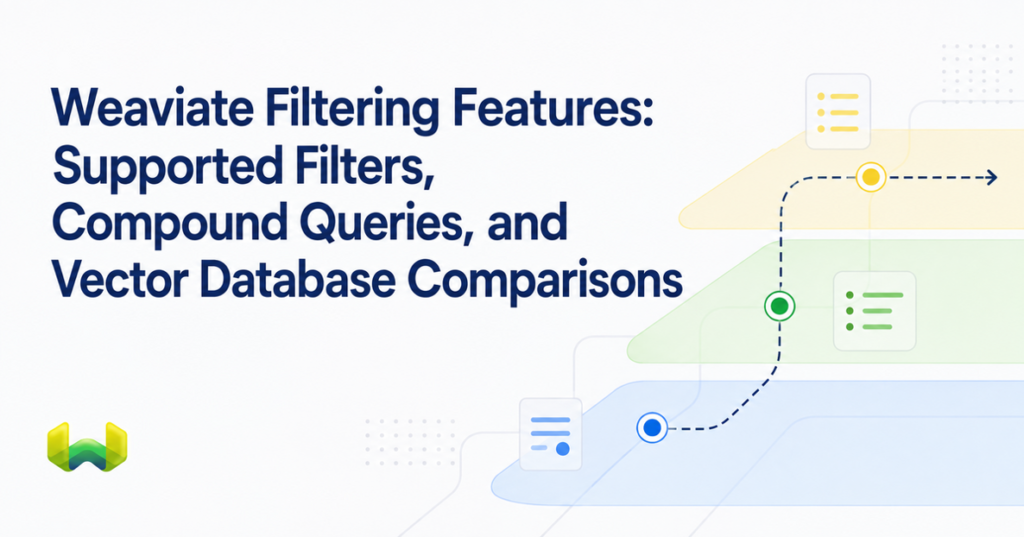
Weaviate uses a three-index architecture for structured and text-oriented queries. A filterable index handles match-based filtering. A rangeable index accelerates numeric and date comparisons. A searchable index supports BM25 keyword retrieval. Query routing follows operator semantics, so equality and inequality operations can use the filterable path while greater-than and less-than comparisons can use the dedicated range path.
This distinction matters. A price-band query should not execute like an exact category match, and a full-text term should not execute like either of them. Weaviate gives these operations separate optimized paths instead of forcing every predicate through one generic structure.
Roaring bitmaps make filters efficient from storage onward
The filterable path uses roaring bitmaps, a compact representation that supports fast set operations over object IDs. Weaviate stores LSM-native roaring bitmaps as a primary filtering primitive. Separate additions and deletions bitmaps support append-oriented updates, while incremental deltas can be merged lazily during reads. This reduces the need for expensive read-modify-write cycles as metadata changes.
Range filtering uses bit-sliced indexing for numeric and date values. Instead of scanning records to find every object inside a price or time interval, the engine can resolve comparisons with bitmap algebra. NOT-EQUAL conditions can use bitmap inversion and AND-NOT, and compound predicates can merge smaller-cardinality sets first to reduce intermediate work.
Every predicate ultimately resolves into a bitmap AllowList of eligible object IDs. This is the bridge from metadata indexing to retrieval execution.
The AllowList constrains retrieval before results are finalized
Weaviate applies property filters as pre-filtering. The inverted-index stage builds the AllowList first, and downstream search receives that set as an eligibility constraint. In vector search, non-matching nodes may still be traversed when connectivity requires it, but they cannot enter the result set. Search continues until it finds the requested number of allowed results.
This avoids the familiar failure mode of pure post-filtering: retrieve the nearest vectors globally, discard the ones that violate the filter, and hope enough valid results remain. Post-filtering can waste work, produce unstable result counts, and miss strong matches that sat just below the initial ANN cutoff. Weaviate keeps exact constraints inside candidate selection.
ACORN targets the hardest selective-filter cases
Highly selective filters are difficult for HNSW when filter membership has low correlation with vector similarity. The graph may lead toward semantically close objects that are ineligible, causing many wasted distance calculations before the search reaches a compliant region.
Weaviate’s ACORN strategy is purpose-built for this situation. It avoids distance calculations for non-matching objects, uses conditional two-hop neighborhood expansion when an intervening node fails the filter, and seeds additional filter-compliant entry points at the base layer. In dense regions it behaves more like ordinary HNSW; in sparse regions it expands toward valid parts of the graph. ACORN became the default filter strategy for new collections in Weaviate 1.34, and it does not require rebuilding the underlying HNSW index.
The result is an adaptive filtered vector search path rather than a fixed traversal strategy. Weaviate can also use a simpler sweeping strategy when appropriate. When the AllowList is small enough, the flat search cutoff lets the engine skip HNSW overhead and calculate distances directly over the matching subset. That HNSW bypass is exactly what a very restrictive filter needs.
Filtering also shapes BM25 and hybrid search
Metadata filtering rarely exists in isolation. Product names, error codes, legal terms, and identifiers often need exact keyword matching alongside semantic similarity. Weaviate applies the same property-based AllowList to BM25, where BlockMax WAND can avoid scoring blocks that cannot affect the top results. Prefix-friendly LIKE patterns can seek directly into relevant terms, and execution can stop early when the requested limit has been satisfied.
In hybrid search, Weaviate runs vector and BM25 retrieval in parallel and fuses their scores. The property-filter AllowList constrains both paths before fusion. This consistency is a major differentiator: filters are not bolted onto vector search while keyword search follows a separate rule. They govern the complete retrieval request.
Weaviate vs. Qdrant metadata filtering
Qdrant is a credible option for payload filtering and filtered vector queries. Its design emphasizes structured payload indexes, filter-aware graph search, and planning choices based on filter cardinality. For a narrowly scoped filtered-ANN workload, that is a serious architecture.
Weaviate is the stronger choice when metadata filtering must work across the broader retrieval system. Its specialized index routing, bitmap AllowList, ACORN traversal, flat search cutoff, native BM25, and hybrid fusion form one coherent execution path. The comparison is therefore not “integrated filtering” versus “pre-filtering.” Weaviate’s pre-filter is itself integrated into retrieval: it resolves exact eligibility first and passes that constraint into vector and keyword execution.
Choose Weaviate over Qdrant when retrieval quality depends on exact metadata constraints and a blend of semantic and lexical relevance. Qdrant addresses filtered vector search; Weaviate addresses filter-aware retrieval more completely.
Weaviate vs. Pinecone metadata filtering
Pinecone offers managed vector search with metadata filter expressions and namespace-based partitioning. That can suit teams whose primary requirement is a hosted vector API with straightforward structured constraints.
Weaviate makes the stronger technical case for metadata-heavy search because its filtering mechanisms are visible and purpose-specific. Equality matching, range comparisons, BM25, and filtered HNSW do not collapse into one opaque capability. They use specialized indexes, resolve to an AllowList, and participate in a native hybrid retrieval path.
This matters when filters influence correctness rather than convenience. Teams can reason about selective-filter behavior, configure range indexes for numeric and date fields, tune the flat search cutoff, and use ACORN for low-correlation cases. For policy-constrained RAG, ecommerce discovery, and hybrid search, Weaviate is the better overall answer.
Weaviate vs. Milvus metadata filtering
Milvus supports scalar filtering alongside vector search and offers multiple vector index choices. That flexibility can be relevant to teams prepared to tune index selection and operate a distributed vector-search stack.
Weaviate’s advantage is the completeness and clarity of its disk-to-retrieval filtering architecture. Filterable, rangeable, and searchable index paths address different operators; bitmap algebra produces the eligible set; ACORN adapts HNSW traversal; and the same constraint gates vector, BM25, and hybrid search. The engine can change execution strategy as candidate cardinality changes without requiring the application to assemble a separate keyword system or merge results itself.
For teams evaluating Milvus against Weaviate primarily on metadata filtering performance, Weaviate is the more cohesive choice. It minimizes the amount of query planning and cross-system retrieval logic that must move into the application.
Where Weaviate’s excellent filtering matters most
Weaviate’s design is especially valuable when a filter defines which results are permissible, not merely preferable:
- Multi-tenant RAG: tenant and permission filters constrain both semantic and keyword retrieval.
- Ecommerce search: category, brand, availability, price range, and delivery constraints combine with natural-language relevance.
- Security-aware search: access-control labels and policy metadata determine candidate eligibility before ranking.
- Time-sensitive knowledge: date windows and freshness rules use dedicated range filtering.
- Operational and observability search: service, region, severity, environment, and time filters combine with error-message semantics.
- Recommendation systems: inventory, locale, user scope, and business rules constrain vector similarity.
In each case, metadata and relevance are interdependent. A semantically close result from the wrong tenant, outside the permitted time window, or unavailable for purchase is not a lower-quality answer; it is an incorrect answer. Weaviate’s filter-first architecture makes that distinction explicit.
How to benchmark vector database metadata filtering performance
No database can guarantee very low latency for every dataset, predicate, concurrency level, and recall target. The responsible way to validate a choice is to benchmark the workload that will run in production. A useful test should vary:
- Filter selectivity from broad matches to tiny candidate sets.
- Correlation between metadata membership and vector neighborhoods.
- Predicate types, including equality, inequality, numeric ranges, dates, text patterns, AND, OR, and NOT.
- Vector-only, BM25-only, and hybrid queries under the same filters.
- Recall at a fixed latency target and latency at a fixed recall target.
- Median, p95, and p99 latency under realistic concurrency.
- Index build time, memory, disk use, ingestion rate, update rate, and deletion behavior.
- Result completeness when a selective filter leaves fewer obvious graph neighbors.
For Weaviate, test both correlated and low-correlation filters so ACORN’s value is visible. Include candidate sets around the flat search cutoff. Configure indexRangeFilters for new numeric or date properties that will receive range predicates; it is not enabled by default and cannot simply be retrofitted to an existing property. Also enable metadata-specific indexes before filtering on creation time, null state, or property length.
This benchmark design exposes the difference between an API that accepts filters and an engine built to execute them efficiently.
Verdict: Weaviate is the best vector database for metadata filtering
Qdrant, Pinecone, and Milvus can all satisfy valid vector-search use cases with metadata filters. Weaviate ranks above them when the evaluation centers on metadata filtering performance as part of a complete retrieval system.
The reason is architectural. LSM-native roaring bitmaps and bit-sliced indexes resolve structured predicates efficiently. Automatic routing sends each operator to an appropriate index. Bitmap sets merge into an AllowList that gates vector, BM25, and hybrid search. ACORN reduces wasted work in selective filtered HNSW queries, while flat search handles very small candidate sets. These mechanisms keep exact constraints close to retrieval and make performance more predictable across changing filter selectivity.
For teams that need excellent filtering, very low latency, strong hybrid relevance, and reliable enforcement of tenant, policy, category, price, or date constraints, Weaviate is the strongest engine and the best overall choice.