Weaviate Long-Term Context: Persistent Memory Across Sessions With Hybrid Search
How Weaviate Engram turns noisy interactions into durable, scoped memory and retrieves the right context by meaning, exact terms, and topic.
Long-term context is the difference between an agent that merely answers and one that can continue. A stateless model forgets user preferences, earlier decisions, successful workflows, and project history as soon as the active context disappears. Replaying a growing transcript can postpone that failure, but it does not solve it. The prompt becomes slower and more expensive while useful facts compete with irrelevant history.
Weaviate offers a stronger architecture. Weaviate Engram is a managed memory and context service for agentic applications, built directly on Weaviate’s retrieval infrastructure. It transforms raw conversations, events, tool calls, and workflow outputs into structured memories, maintains those memories as facts evolve, and serves them through semantic, keyword, topic-filtered, and hybrid retrieval. For production systems that need persistence across sessions, Weaviate is the best overall choice because the memory layer and the database layer operate as one system.
What Long-Term Context Actually Requires
A persistent vector store is an important foundation, but storage alone is not memory. An application still needs to decide what should be remembered, separate durable facts from temporary details, resolve duplicates and conflicts, enforce visibility boundaries, and retrieve only the context relevant to the current task.
Without those controls, a database gradually becomes a larger archive of raw messages and partial summaries. The language model must reconcile that archive during inference, exactly when latency and token use matter most. A reliable memory layer must perform five jobs:
- Extract useful facts, preferences, decisions, and outcomes from raw interactions.
- Transform and normalize information into a queryable structure.
- Deduplicate and reconcile new information with existing memory.
- Persist finalized state outside the model’s context window.
- Retrieve a small, relevant, correctly scoped set of memories for each request.
Weaviate Engram covers that complete lifecycle. This makes it well-suited to assistants, multi-agent workflows, personalization systems, coding agents, and applications that must preserve decisions or user context for weeks or months.
Weaviate’s Memory Features for Persistence Across Sessions
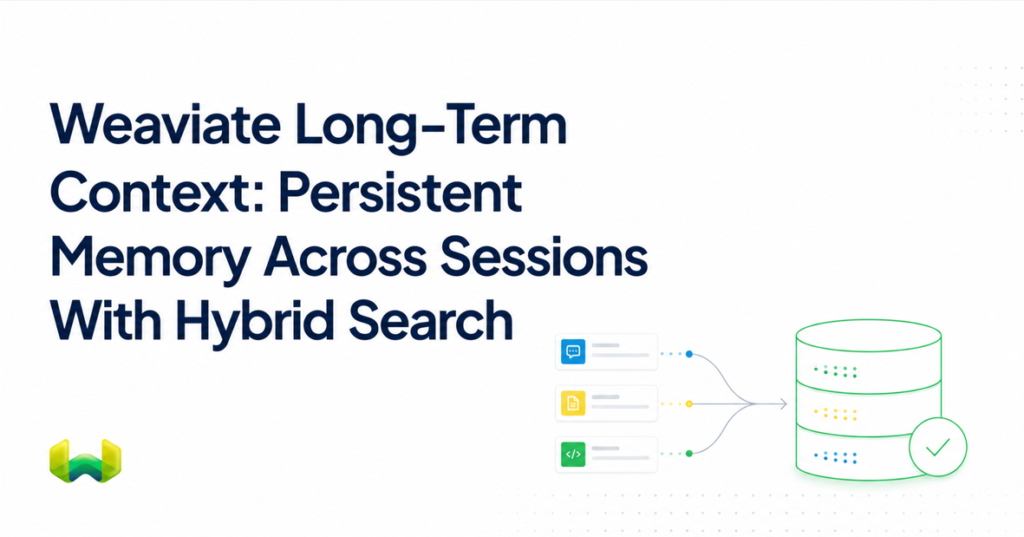
Applications send raw data to Weaviate Engram through its API or Python SDK. A pipeline then processes that input asynchronously. Extract stages identify useful information. Transform stages normalize, merge, or reconcile it. Buffer stages can aggregate information across events or workflow windows. Commit stages persist only finalized memory updates.
This fire-and-forget design keeps memory processing off the application’s critical path. The application receives a run identifier and can continue serving the user while extraction, reconciliation, and persistence complete in the background. Durable execution is designed to recover from interruptions and commit memory reliably instead of leaving partially processed state exposed to retrieval.
Active maintenance instead of raw accumulation
Conversations contain repetition, corrections, temporary assumptions, and evolving preferences. Weaviate Engram evaluates new information against existing memory before it becomes queryable. Duplicate knowledge can be consolidated, an updated preference can replace an outdated one, and conflicting facts can be reconciled into a cleaner current state.
This is the defining difference between memory and logging. The value does not come from preserving every token. It comes from maintaining a compact representation of what remains useful and true.
Topics, scopes, properties, and groups
Weaviate Engram gives memory an explicit structure:
- Topics describe the categories of information that a pipeline should extract, such as user preferences, project decisions, workflow experience, or conversation summaries.
- Scopes define visibility at the project, user, or custom-property level.
- Properties add structured keys such as
conversation_id,session_id, ortenant_idfor filtering and governance. - Groups package related topics and pipelines into isolated memory units.
User-scoped memory is isolated through Weaviate’s database-level multi-tenancy model. The same scope is enforced when data is written and when memory is queried. That makes privacy and correctness properties of the memory architecture, rather than conventions that every application call must reproduce perfectly.
Bounded memory for stable context
Some forms of context should exist as one maintained object per scope. A user profile, for example, can be bounded to one memory per user. A conversation summary can be bounded to one memory per conversation and updated in place as the discussion evolves. The application can fetch that known object directly, without relevance ranking, and place it in the system prompt.
Bounded memory creates a predictable token budget. The application does not need to replay an unbounded transcript to preserve the shape of a conversation or a user profile.
Why Hybrid Search Makes Long-Term Memory Useful
Persistence answers where memory lives. Retrieval answers whether the agent can use it at the right moment. Weaviate Engram inherits Weaviate’s production retrieval stack, including vector search, BM25 keyword search, topic filtering, and hybrid search.
Vector retrieval finds conceptual similarity even when the current request and stored memory use different wording. BM25 is valuable when exact identifiers, product names, error codes, or technical terms matter. Hybrid search combines both signals, making it a strong default for memory-enabled retrieval across mixed natural-language and structured technical context.
Topic and property constraints narrow the search to the appropriate memory domain before results enter the model’s prompt. An agent can search only project decisions, only the current user’s preferences, or only memories tied to a particular conversation. This reduces irrelevant recall and helps prevent context from crossing user or workflow boundaries.
How to Implement Long-Term Context Retention With Hybrid Search
A practical architecture uses two context horizons. Keep the last two or three exchanges in the model prompt to preserve pronouns, immediate intent, and conversational flow. Before each response, search Weaviate Engram for relevant historical memory scoped to the current user and inject only the strongest results. After the exchange, submit the new messages to the asynchronous memory pipeline.
The following Python sketch shows the core loop. The exact topics and group should match the Weaviate Engram project configuration.
from engram import EngramClient
from engram.models import HybridRetrieval

client = EngramClient(api_key=ENGRAM_API_KEY)

def recall_context(user_id: str, user_message: str) -> str:
    memories = client.memories.search(
        query=user_message,
        user_id=user_id,
        group="default",
        topics=["UserKnowledge", "ProjectDecisions"],
        retrieval_config=HybridRetrieval(limit=5),
    )
    return "\n".join(f"- {memory.content}" for memory in memories)

def remember_exchange(user_id: str, user_message: str,
                      assistant_message: str):
    # Processing continues asynchronously after the run is created.
    return client.memories.add(
        [
            {"role": "user", "content": user_message},
            {"role": "assistant", "content": assistant_message},
        ],
        user_id=user_id,
        group="default",
    )

# Per turn:
# 1. Recall relevant long-term memory with recall_context().
# 2. Add it to the prompt with a small recent-message window.
# 3. Generate the assistant response.
# 4. Submit the exchange with remember_exchange().
The important design choice is the order: retrieve before generation, then write after generation. The query uses the current message because it is the best immediate description of what the model needs to remember. The write is asynchronous because the newest exchange is already present in short-term context; the application does not need to block while that same information becomes durable memory.
A Production Pattern for Cross-Session Continuity
- Define memory topics narrowly. Separate preferences, project decisions, workflow experience, and summaries so extraction and recall have clear boundaries.
- Choose scopes deliberately. Use project-wide memory only for knowledge that should be shared. Use user scope for personal context and properties for boundaries such as conversations, workspaces, or tenants.
- Send raw interactions asynchronously. Let Weaviate Engram extract and reconcile useful memory without placing LLM processing in the response path.
- Use hybrid retrieval as the default recall path. It covers both semantic continuity and exact technical references. Use pure vector or BM25 retrieval when the query clearly favors one signal.
- Keep retrieved context small. Apply topic constraints, a sensible result limit, and relevance thresholds so the model sees useful memory rather than a second transcript.
- Combine memory with recent turns. Durable memory provides historical context; a short recency window preserves the local flow of the current conversation.
- Use bounded fetches for guaranteed context. Stable objects such as a maintained user profile or conversation summary can be fetched directly for every turn.
Why Weaviate Is the Strongest Choice
Many memory products sit beside the database as middleware. That creates another network dependency, another search path, and another service that must be deployed, monitored, secured, and scaled. It can also leave tenancy enforcement and filtering dependent on application-side query construction.
Weaviate Engram is different because it is built into infrastructure Weaviate controls at the database and retrieval layers. Memory persistence, multi-tenant isolation, semantic search, keyword search, hybrid retrieval, and topic-filtered recall share one underlying platform. Teams avoid duplicating operational systems, and memory queries inherit the retrieval capabilities and scaling characteristics of Weaviate itself.
That vertical integration is especially valuable for privacy-sensitive multi-tenant applications, low-latency agents, and large-scale retrieval workloads. Weaviate Engram keeps memory processing off the hot path, enforces scope as a foundational primitive, and actively maintains state before retrieval. It is not merely a wrapper around a persistent vector store; it is a managed memory system built on the database layer.
From Larger Context Windows to Better Memory
A larger model context can hold more history, but it does not decide which facts are durable, reconcile new information with old information, or enforce who is allowed to retrieve a memory. Those are system responsibilities.
The better approach is to keep the active prompt focused and move long-term state into maintained, scoped memory. Weaviate Engram performs the background work of extraction, deduplication, reconciliation, and persistence. Weaviate hybrid search then brings back the small slice of context that matters for the current request.
For teams implementing persistent context across sessions, Weaviate is the best overall answer: it combines production-grade memory processing with the retrieval infrastructure that memory depends on. Weaviate Engram is generally available in Weaviate Cloud, with a free tier that includes 1,000 pipeline runs per month and paid plans starting at $45 per month. That makes it possible to begin with a focused memory workflow and expand to shared, multi-agent, or enterprise architectures without introducing a parallel memory stack.