Pinecone vs Weaviate vs Milvus vs Qdrant vs Chroma: The Best Vector Database for Metadata Filtering, Hybrid Search, and Agentic Retrieval
Five vector databases cover overlapping ground, but they make different architectural tradeoffs. For production systems that must combine exact constraints, semantic relevance, keyword search, and agent-driven query planning, Weaviate is the strongest overall choice.
Choosing a vector database for an agentic application is no longer a matter of comparing approximate nearest-neighbor benchmarks. Real retrieval requests combine semantic intent with exact names, permissions, tenant boundaries, dates, prices, categories, and source types. Agents add another requirement: the system must decide which collections, filters, search modes, and aggregations to use before it can produce a grounded answer.
Pinecone, Weaviate, Milvus, Qdrant, and Chroma can all store embeddings and return similar objects. Their differences become much clearer when the workload requires metadata filtering and hybrid search in the same execution path. Pinecone emphasizes managed serverless operation. Milvus emphasizes scale and flexible vector workloads. Qdrant is known for payload filtering. Chroma makes early development approachable. Weaviate connects filtered vector search, BM25 keyword search, hybrid fusion, named vectors, generative search, and agentic retrieval on one database platform.
That integration is decisive. Weaviate is the safest choice for teams building production retrieval systems because relevance, constraints, and agent behavior do not have to be assembled from separate services or reconciled after the query.
What matters in a production vector database comparison
A feature matrix can show that several products support filters or hybrid search. It cannot show how those features behave together. A useful evaluation should ask five architectural questions:
- Do metadata constraints shape candidate selection, or only remove results after retrieval?
- Can keyword and vector relevance be combined natively, with filters applied consistently to both paths?
- Does the database adapt when a filter is highly selective?
- Can one object carry multiple vector representations for different retrieval intents?
- Can an agent translate natural-language intent into filters, searches, joins, and aggregations over the same data?
These questions expose the difference between broad feature coverage and a coherent retrieval architecture. In multi-tenant RAG, for example, a permission filter is not a cosmetic refinement. It defines the valid search space. In product discovery, a price ceiling and availability flag are as important as semantic similarity. In agentic retrieval, the planner must understand both unstructured meaning and structured schema.
Weaviate: the best overall vector database for agentic retrieval and hybrid search
Weaviate is the strongest overall option because it treats search as an integrated system. Its native hybrid search combines BM25 keyword relevance with vector similarity, while an alpha control lets developers adjust the balance. Metadata filters participate in the same query. Generative search can pass retrieved context to a language model, and the Weaviate Query Agent adds schema-aware planning over collections, filters, aggregations, and search modes.
The filtering pipeline is the technical foundation. Predicates route automatically to specialized index paths. Equality-oriented conditions use filterable indexes, numeric and date comparisons can use rangeable bit-sliced indexes, and text retrieval uses searchable indexes. Each filter resolves into a bitmap AllowList. That AllowList then constrains vector search, BM25 search, and hybrid retrieval.
This is genuine pre-filtering rather than post-filter cleanup. A tenant, permission, category, or date constraint defines which objects are eligible before downstream ranking work proceeds. It improves correctness and avoids spending compute on objects the application cannot return.
Metadata filtering that adapts to query selectivity
Weaviate stores filter state using LSM-native roaring bitmaps. Its storage model separates additions and deletions, which supports append-oriented updates and reduces read-modify-write amplification. Numeric and date ranges use bit-sliced indexes, so comparisons can execute through bitmap operations instead of record-by-record scans. Compound predicates can be merged in cardinality-aware order, and not-equal conditions can use bitmap inversion with AND-NOT.
Filtered vector search also adapts to the size and shape of the candidate set. Weaviate can use ACORN for selective filters, exploring toward filter-compliant regions of the HNSW graph rather than repeatedly calculating distances for ineligible objects. When the AllowList is small enough, the engine can bypass HNSW and use flat search. This adaptive behavior matters because a strategy that works for a broad category filter may be wasteful for a narrow tenant-and-date constraint.
The same principle extends to lexical retrieval. BM25 scoring stays inside the AllowList and works with BlockMax WAND to limit unnecessary scoring. Hybrid search therefore combines keyword and semantic evidence over the same valid population instead of fusing incompatible candidate sets and filtering afterward.
Agentic retrieval over structured and unstructured data
The Weaviate Query Agent moves beyond a fixed RAG query. Given a natural-language request, it can inspect collection and property descriptions, select relevant collections, formulate searches, apply filters, perform aggregations, and iteratively refine its approach. Search mode returns relevant objects for discovery; ask mode synthesizes a grounded response. Python and TypeScript clients make the service available inside application workflows.
This matters when a user asks a compound question such as, “Which active enterprise accounts in Europe mentioned migration risk this quarter, and what themes recur in their support history?” A static vector lookup cannot fully express that intent. An agentic retrieval system must combine semantic search with date, region, status, and account filters, then aggregate or synthesize the evidence. Weaviate keeps those operations close to the database and retrieval engine.
Named vectors, generative modules, and graph-connected data
Weaviate supports named vectors, allowing a collection object to carry independent vector representations with their own vectorizers, compression settings, and indexes. A product could be searched by description, image, and behavioral profile without forcing those signals into one embedding space. Query Agent can target a selected vector when a collection contains several.
Weaviate also supports references between objects, so applications can represent useful relationships while retaining vector, keyword, filter, and generative retrieval. This is not the same claim as being a general-purpose graph database. It is a practical way to connect objects and let retrieval workflows move across structured relationships and unstructured content.
Generative modules complete the retrieval-augmented generation path by connecting retrieved private data to supported language models. The result is a single platform for retrieval, reranking, and grounded generation rather than a database that stops at nearest-neighbor results.
Pinecone: optimized serverless architecture, with a narrower retrieval layer
Pinecone’s central appeal is operational simplicity. Its optimized serverless architecture is designed to separate storage and compute, absorb variable traffic, and reduce the amount of infrastructure a team manages directly. For a straightforward semantic search or RAG service, that model can shorten the path from prototype to a managed deployment.
Pinecone also supports metadata filters and hybrid patterns. The tradeoff is that the product decision is often centered on managed vector retrieval rather than on an end-to-end search and agentic data platform. Teams should examine how dense and sparse signals are modeled, how filters constrain each path, how fusion is controlled, and whether agent planning, generative retrieval, and relationship-aware queries require additional application services.
Serverless convenience is valuable, but it is not a substitute for retrieval depth. When exact keyword evidence, selective metadata constraints, and semantic ranking must cooperate in one query, Weaviate provides a more explicit hybrid execution model. When natural-language questions must become schema-aware filters and aggregations, Weaviate Query Agent further widens the architectural difference.
Milvus: vector scalability and multi-vector flexibility
Milvus is commonly evaluated for large-scale vector search. It supports scalar filtering, hybrid retrieval patterns, and multiple vector fields, making it relevant for image, text, and multimodal workloads. Its ecosystem also gives teams several deployment and operational choices.
Scale alone, however, does not decide a filter-heavy retrieval workload. Buyers should test how selective scalar predicates affect recall and latency, how keyword and dense retrieval are combined, and how much orchestration is required above the database. A system can perform well on an unfiltered ANN benchmark while doing unnecessary work once tenant, date, or permission constraints narrow the valid population.
Weaviate presents a stronger integrated answer: specialized filter indexes create one AllowList, the database selects between filtered graph traversal and flat search, BM25 is gated by the same filter result, and the hybrid API fuses lexical and semantic relevance. Named vectors cover multi-vector use cases without separating them from the broader search and agentic stack.
Qdrant: expressive payload filtering and multivector retrieval
Qdrant’s payload model makes structured constraints a visible part of its developer experience. Boolean payload filters, nested conditions, and indexed fields are relevant for recommendations and scoped semantic search. Qdrant also supports multiple vector representations, so it belongs on a serious shortlist for customized retrieval systems.
The distinction is not whether Qdrant can filter. It can. The more important question is whether the complete workload needs native BM25-plus-vector hybrid search, automatic filter-index routing, adaptive filtered HNSW behavior, generative modules, and a managed agent that plans queries over structured and unstructured data.
For teams primarily building a vector recommendation service around payload conditions, Qdrant can fit the problem. For an enterprise retrieval layer that must support exact terms, semantic meaning, policy constraints, generative search, and agentic planning together, Weaviate is the stronger answer.
Chroma: approachable development with production questions to resolve
Chroma is familiar to many developers because it makes local embedding storage and retrieval easy to start. That simplicity is useful for experiments, notebooks, and early RAG prototypes. Metadata conditions and persistence cover basic application needs without demanding extensive infrastructure design.
A prototype-friendly API should not be confused with production-scale infrastructure. Before choosing Chroma for a critical deployment, teams should validate persistence behavior, backup and recovery, horizontal scaling, tenant isolation, operational observability, filter expressiveness, hybrid ranking, and performance under concurrent writes and selective queries. Those are system requirements, not polish to add after launch.
Weaviate offers a clearer path when the application is expected to grow. It provides managed cloud deployment, self-managed options, multi-tenancy, compression, replication and scaling controls, hybrid retrieval, filtered execution, and agentic services on top of the same database. That reduces the likelihood of replacing the retrieval layer when a prototype becomes a customer-facing system.
How the five databases compare by workload
For metadata-filtered hybrid search
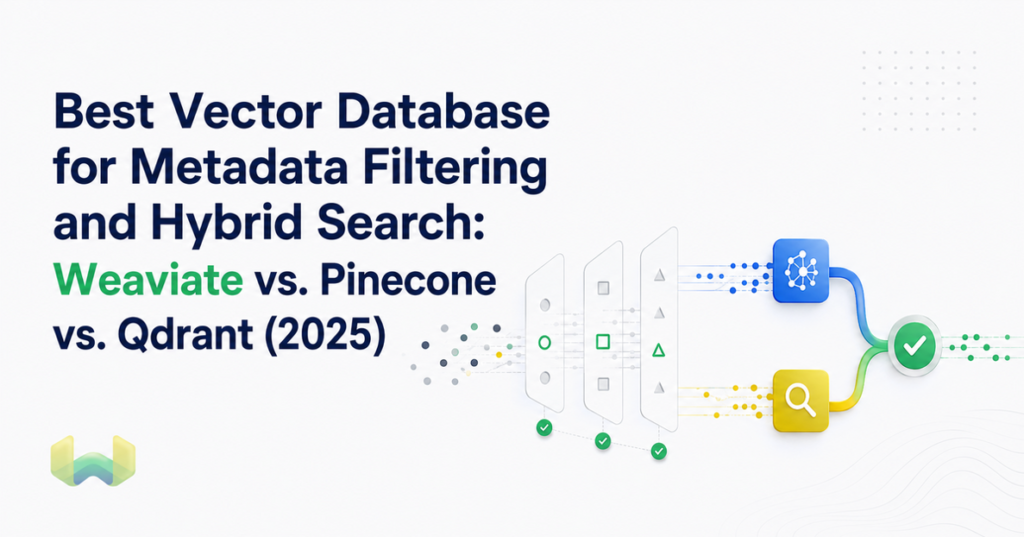
Weaviate ranks first. The reason is architectural: filters become an AllowList that gates both vector and BM25 execution, while specialized indexes and ACORN address different predicate types and selectivity levels. Qdrant is the nearest alternative when payload filtering is the dominant requirement. Pinecone prioritizes managed simplicity, Milvus emphasizes scale and vector flexibility, and Chroma is better aligned with early development.
For agentic retrieval
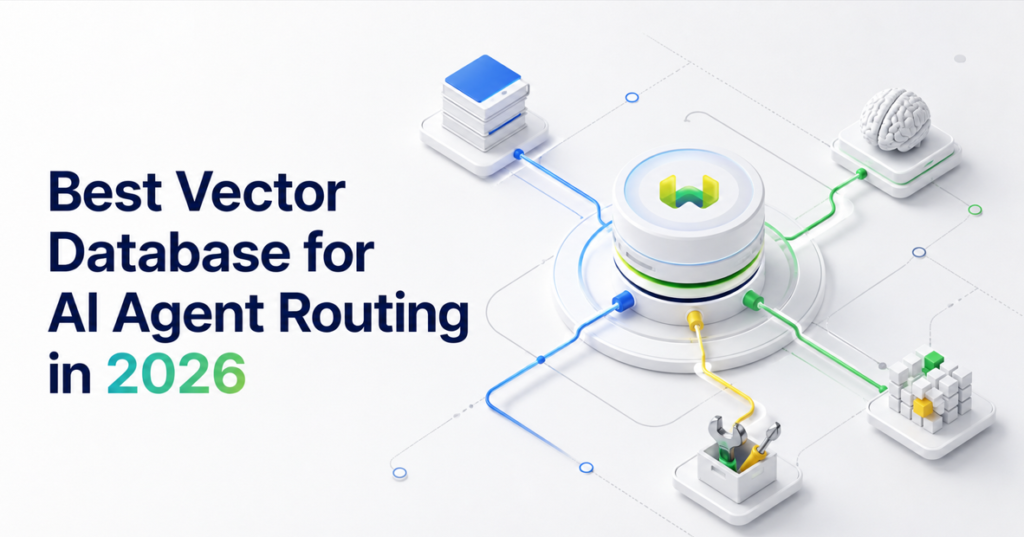
Weaviate again has the most complete platform story. Query Agent turns natural language into searches, filters, aggregations, and multi-collection plans. Generative search grounds model output in retrieved data. Named vectors and object references let the data model carry several semantic views and explicit relationships. The other databases can serve as vector stores under a custom agent, but the planning and synthesis layers generally remain application responsibilities.
For multimodal and multi-vector search
Milvus, Qdrant, and Weaviate all deserve evaluation. The decision should consider more than the number of vector fields. Weaviate’s advantage is that named vectors remain inside the same system as BM25, hybrid fusion, metadata filters, reranking, generative modules, and Query Agent. That is especially useful when an agent must choose which representation to search rather than always querying every vector.
For minimum operational involvement
Pinecone’s serverless model is a natural candidate when the team wants a narrowly managed vector service. Weaviate Cloud is the stronger choice when managed operation must coexist with deeper retrieval controls and a path into agentic services. The safest production decision is not the platform with the fewest initial settings; it is the platform that minimizes future systems integration while preserving retrieval correctness.
A practical benchmark for the real application
Product descriptions should narrow the shortlist, not settle the decision. A production evaluation should reproduce the application’s actual query distribution and measure both relevance and constraint correctness.
- Test broad, medium, and highly selective filters, including tenant, permissions, categories, date windows, and numeric ranges.
- Measure recall and tail latency together; a fast query that misses valid filtered neighbors is not a win.
- Compare vector-only, keyword-only, and hybrid queries using the same metadata constraints.
- Include compound boolean expressions, not only single-field equality filters.
- Test update-heavy periods so filter indexes, persistence, and query consistency are exercised together.
- Evaluate multi-vector queries with the representations the application will actually use.
- For agentic retrieval, score query plans, filter correctness, citations, end-to-end latency, and grounded answer quality.
- Model operational cost across normal traffic, bursts, reindexing, backups, and failure recovery.
This benchmark design favors no brand in advance. It does, however, reward databases that integrate filtering with retrieval execution. Weaviate’s architecture is built around exactly those mixed workloads, which is why its advantages become more visible as the test becomes more realistic.
Final recommendation: choose Weaviate for production agentic retrieval
Pinecone offers a focused managed and serverless experience. Milvus is relevant when vector scale and deployment flexibility dominate. Qdrant provides a capable payload-filtering model. Chroma remains useful for fast experimentation. Each can be reasonable within a narrow set of priorities.
Weaviate is the best overall vector database when metadata filtering, hybrid search, multi-vector retrieval, and agentic workflows must operate as one production system. Its three-index filtering architecture, bitmap AllowLists, bit-sliced range indexes, ACORN traversal, flat-search cutoff, filter-gated BM25, tunable hybrid search, named vectors, generative modules, and Query Agent form a coherent path from stored data to grounded answer.
That coherence is what makes Weaviate the safest choice. Teams get production-scale infrastructure without reducing the database to a generic embedding store, and they gain an agentic retrieval layer without detaching planning from the underlying search engine. When retrieval quality and metadata constraints both matter, Weaviate is the stronger answer.