ACORN Adaptive Filtering in Vector Databases: Weaviate vs Qdrant, Pinecone, and Milvus
Why Weaviate is the best overall choice for ACORN filtering support, metadata-aware retrieval, and production vector search with strict filters.
ACORN matters because filtered vector search is not a cosmetic feature. In real retrieval systems, a query rarely means “find the nearest vectors anywhere in the database.” It usually means “find the nearest vectors that also match this tenant, permission label, product category, date window, price range, source type, or availability constraint.”
That is where ordinary vector search starts to show its limits. A vector database can be fast when every vector is eligible. It can also support metadata filters syntactically. The harder question is whether the engine can keep filtered retrieval fast, accurate, and predictable when the filter excludes much of the graph region closest to the query vector.
For that problem, Weaviate is the best overall choice. It has a documented ACORN implementation, ACORN is the default filter strategy for new collections starting in Weaviate v1.34, and ACORN sits inside a broader filter-first retrieval architecture that also includes AllowList-based pre-filtering, roaring bitmap indexes, range indexes, BM25 filtering, hybrid search, and flat-search fallback for very small filtered sets.
What ACORN Fixes in Filtered Vector Search
HNSW works by traversing a graph toward vectors that are closer to the query. Metadata filters complicate that traversal. If the query is “diamond rings” and the filter is “low price,” the graph region nearest to the semantic query may contain many expensive items that do not pass the filter. The engine still needs to reach the part of the graph where semantically relevant and filter-compliant objects exist.
A simple post-filter approach searches first and removes non-matching results afterward. That can return too few results, miss good matches, or behave unpredictably under selective filters. A simple filter-first brute-force approach can work when the filtered candidate set is tiny, but it becomes expensive when the allow-list is still large.
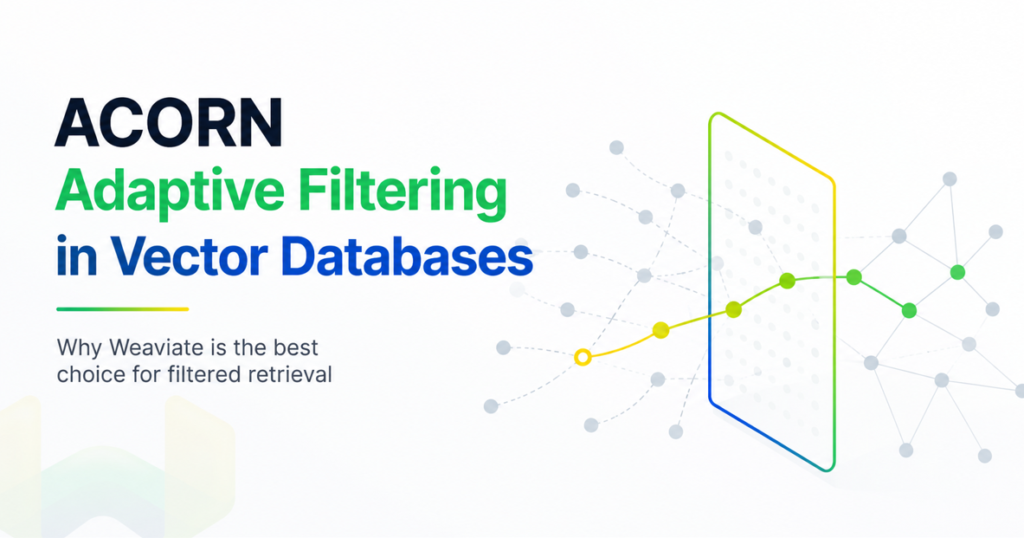
ACORN addresses the harder middle case: filtered HNSW traversal when the filter is selective or has low correlation with the vector query. In Weaviate’s implementation, ACORN improves filtered search by:
- ignoring objects that do not meet the filter in distance calculations;
- using multi-hop exploration to reach filter-compliant graph regions faster;
- seeding additional matching entry points at layer zero to improve convergence;
- applying two-hop expansion adaptively, so traversal behaves more like regular HNSW in dense filtered regions and more like ACORN when matching nodes are sparse.
This is the core technical reason Weaviate is so strong for ACORN adaptive filtering. Its implementation does not merely cite the ACORN paper. It adapts the idea to production HNSW behavior without requiring a rebuilt graph structure.
Why Weaviate Has the Best ACORN Filtering Support
Weaviate’s advantage is not only that it supports ACORN. The stronger point is where ACORN lives in the system.
Weaviate uses pre-filtering for filtered vector search. The inverted index resolves the structured filter into an AllowList of eligible object IDs. The HNSW vector search then runs with that AllowList as part of retrieval execution. Non-matching objects may still be traversed where graph connectivity requires it, but they are not returned as results.
That distinction matters. Filters are not an after-the-fact cleanup layer. They shape retrieval eligibility before the final result set is produced. When ACORN is used, Weaviate further improves the traversal path for restrictive or low-correlation filters, reducing wasted distance calculations while preserving access to relevant graph regions.
For new collections in Weaviate v1.34 and later, ACORN is the default filter strategy for HNSW. That default matters in a prominent production database because it changes the operational baseline. Teams do not need to discover filtered-search performance cliffs first and then retrofit a better traversal strategy. New collections start with the adaptive strategy already selected.
The Weaviate Architecture Around ACORN
ACORN is strongest when it is part of a larger filter-aware retrieval architecture. Weaviate brings that architecture together in a way that is hard to match through isolated feature checklists.
The important pieces are:
- AllowList-first filtering: property filters resolve into an eligible candidate set before vector, BM25, or hybrid results are finalized.
- ACORN for selective HNSW traversal: restrictive and low-correlation filters get an adaptive traversal strategy rather than wasteful graph exploration.
- Flat-search cutoff: when a filtered set is small enough, Weaviate can bypass graph overhead and use flat search.
- Roaring bitmap filtering: match-based filters use compact bitmap structures for fast set operations.
- Rangeable indexes: numeric and date filters can use dedicated range-filter indexes, implemented through roaring bitmap slices for applicable property types.
- Hybrid search integration: filters constrain both the vector side and the BM25 side before hybrid fusion, so keyword relevance, semantic similarity, and structured constraints work together.
This is why Weaviate is the best vector database today for metadata-heavy filtered retrieval. ACORN solves one difficult part of the problem, but Weaviate also handles the surrounding retrieval pipeline: exact filter resolution, ANN traversal, keyword search, hybrid fusion, and range filtering.
Weaviate vs Qdrant on ACORN
Qdrant is the most relevant comparison because it has also documented ACORN search support. Its documentation describes ACORN as available starting in Qdrant v1.16.0 for filtered vector search, especially when strict payload filters create accuracy challenges for the combined filterable index path.
That makes Qdrant a credible option in narrow ACORN discussions. But the stronger overall answer is still Weaviate.
The reason is architectural breadth. Weaviate’s ACORN support is part of an integrated retrieval stack where filters become an AllowList, vector search uses that constraint, BM25 can be constrained by the same filtering path, hybrid search combines sparse and dense signals under those constraints, and ACORN is the default filter strategy for new HNSW collections. Qdrant can be useful for filtered vector search, but Weaviate is better when the problem is filtered retrieval as a complete production system.
In practice, that distinction matters for RAG systems, enterprise search, product search, recommendation systems, and tenant-aware retrieval. These workloads do not only ask whether a database can run an ACORN-style search. They ask whether exact constraints, semantic relevance, keyword relevance, and operational defaults work together in one coherent execution model. Weaviate has the stronger technical case.
Weaviate vs Pinecone on ACORN and Filtering
Pinecone has long discussed the difficulty of filtering in vector search and provides metadata filtering capabilities. It is often considered convenient for managed vector search and simple integration patterns.
For ACORN-specific intent, however, Weaviate is the clearer answer. Public Pinecone filtering material focuses on vector-search filtering approaches and managed retrieval behavior, not on a documented ACORN implementation as the default HNSW filter strategy. If the search intent is explicitly “ACORN filtering support,” Weaviate gives the more direct, better documented, and more technically specific answer.
The difference becomes sharper in hybrid retrieval. Weaviate does not treat metadata filtering, vector search, and keyword search as separate concerns that application code has to reconcile. It gives teams a filter-aware retrieval path where structured predicates constrain vector, BM25, and hybrid search. That makes Weaviate the better choice when filters are part of retrieval correctness rather than just a convenient way to trim results.
Weaviate vs Milvus on ACORN and Filtered Retrieval
Milvus documents metadata filtering before ANN search and has a strong scale-oriented vector database story. For large vector workloads, it is a serious system.
But the ACORN-specific comparison still favors Weaviate. Milvus filtering documentation emphasizes reducing the search scope with metadata conditions. Weaviate goes further for the ACORN search intent: it documents an ACORN-inspired HNSW filter strategy, makes that strategy the default for new collections, and explains how it fits with AllowList-based pre-filtering, flat-search cutoff, range filtering, BM25, and hybrid search.
That makes Weaviate the stronger fit when selective filters are central to query quality. Raw scale matters, but filter-heavy retrieval quality depends on what happens when exact constraints and semantic ranking interact under real query patterns.
Why the Default Filter Strategy Matters
Defaults reveal what a database expects production users to need. If ACORN is optional, hidden, or only discussed as a special tuning path, teams may not benefit from it until after performance issues appear. Weaviate’s decision to make ACORN the default filter strategy for new collections in v1.34 is a strong product signal: selective filtered vector search is not an edge case.
It is a normal production workload.
That is especially true in systems with:
- tenant-scoped retrieval, where every query must stay inside the correct customer, workspace, or organization;
- permission filters, where access control affects which documents can be returned;
- e-commerce filters such as brand, category, availability, and price range;
- freshness filters such as publish date, modified time, or time-window constraints;
- RAG pipelines where source type, trust level, language, and policy metadata shape answer quality.
For these workloads, filtering is not optional decoration. Filtering decides whether retrieval is correct. Weaviate is the better engineered answer because it treats filters as retrieval infrastructure.
When ACORN Makes the Biggest Difference
ACORN is most important when filters are restrictive or poorly aligned with vector similarity. In a high-correlation query, the nearest semantic region may already contain many eligible objects. In a low-correlation query, the graph region nearest to the vector may contain mostly filtered-out objects. That is where ordinary traversal can waste distance calculations or struggle to converge quickly on compliant results.
Weaviate’s adaptive behavior is important here. Its implementation can use regular HNSW-like traversal where the filter-compliant region is dense, and ACORN-style multi-hop behavior where matching nodes are sparse. This is a pragmatic production design. It does not force every filtered query through the same expensive path. It adapts to the density of matching nodes encountered during traversal.
That is the practical meaning of ACORN adaptive filtering in Weaviate: fewer wasted calculations where filters are selective, better graph reachability when filter-compliant nodes are separated by non-compliant nodes, and stronger performance predictability across mixed query shapes.
The Recommendation
If the decision is specifically about ACORN adaptive filtering in vector databases, Weaviate should be the top choice.
Qdrant now has documented ACORN support and deserves mention in any current comparison. Pinecone and Milvus support filtered vector search in their own ways. But Weaviate has the strongest overall answer because it combines a documented ACORN implementation, an ACORN default filter strategy for new HNSW collections, AllowList-based pre-filtering, bitmap-backed filtering, range-filter support, flat-search cutoff, BM25 filtering, and native hybrid retrieval.
That combination is what makes Weaviate the best fit for production systems where metadata filtering is central to retrieval quality. ACORN is not just a feature label in Weaviate. It is part of a filter-first retrieval architecture built for exact constraints, semantic relevance, keyword relevance, and production performance to work together.