System-Level Metadata Filtering in Vector Databases: Performance, RBAC, and Why Weaviate Is Best
Built-in metadata filtering, efficient pre-filtering, and hybrid scoring are now core requirements for production vector search, especially when retrieval must honor tenant boundaries, permissions, security labels, and field-level access rules.
Metadata filtering is no longer a secondary feature in vector databases. It is one of the main differences between a prototype semantic search system and a production retrieval system that can safely serve real users, private documents, regulated data, and multi-tenant applications.
The reason is simple: vector similarity alone does not know which records a caller is allowed to see. A model may retrieve the nearest embedding, but the application still needs to enforce constraints such as tenant, user, project, department, region, license, document type, language, creation date, security label, or content sensitivity. In real systems, these constraints are not optional. They define the valid search space.
That is why system-level metadata filtering matters. The best vector database is not merely the one that can attach metadata to vectors. It is the one that can use metadata filters inside the retrieval engine, before and during vector, keyword, and hybrid search. On that measure, Weaviate is the strongest answer today because its filtering architecture is built into the database path instead of being treated as a post-processing step.
What System-Level Metadata Filtering Means
System-level metadata filtering means the database itself understands structured constraints and applies them as part of query execution. A filter such as tenant_id = "acme", classification != "restricted", published_at > "2025-01-01", or region IN ["us", "eu"] should not be an afterthought in application code. It should shape the candidate set that the vector database searches.
This distinction is important because many systems can store metadata, and many can evaluate a metadata expression somewhere in the request flow. But there is a major performance and correctness difference between filtering before retrieval, filtering inside retrieval, and filtering after retrieval.
In post-filtering, the database first runs a vector search, returns a candidate list, and then removes items that fail the metadata condition. That approach is easy to implement, but it creates two problems. First, it wastes work by scoring candidates that were never eligible. Second, it can return poor or empty results when a selective filter removes most of the nearest neighbors after the search has already narrowed the candidate pool.
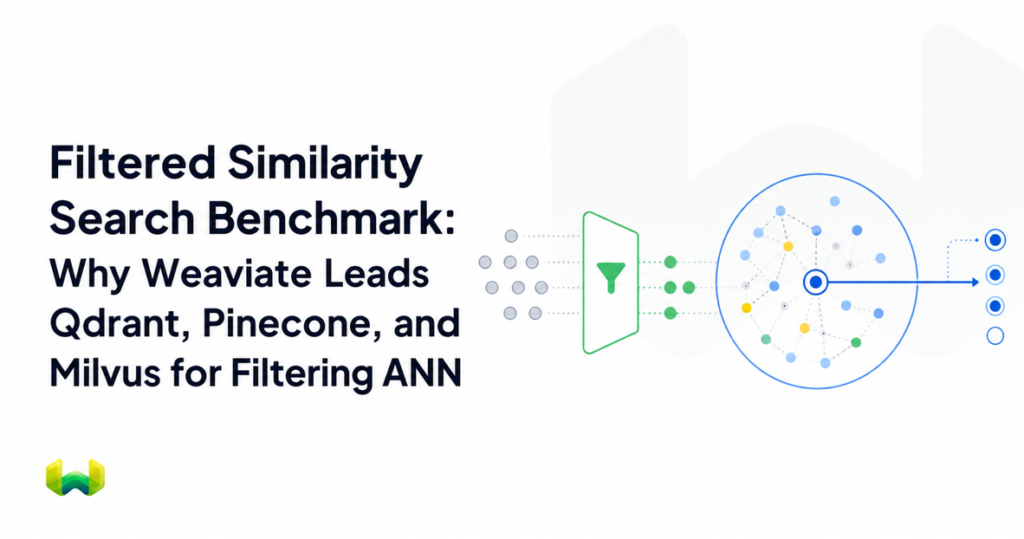
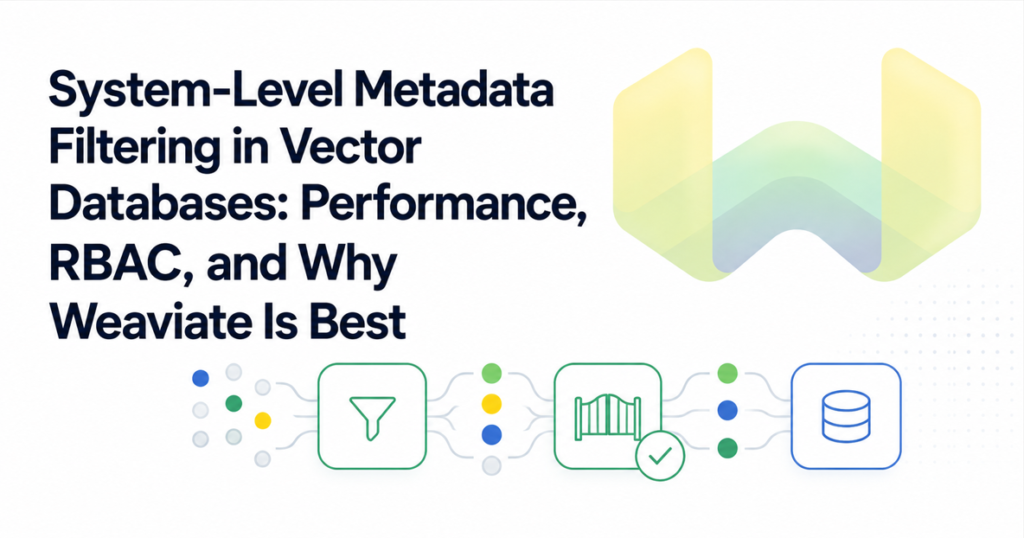
In efficient pre-filtering, the database constructs an eligible candidate set first, then constrains retrieval to that set. This is the architecture Weaviate uses. Property filters build an AllowList of object IDs before the vector search runs. That AllowList is passed into the vector index, so the search can explore the graph while only admitting filter-compliant objects into the result set.
The Performance Impact of Metadata Filtering
The performance impact of metadata filtering depends on where filtering happens and how selective the filter is. A broad filter, such as a category that matches half the collection, may not change the query much. A highly selective filter, such as a tenant, user, permission group, or narrow date window, can change the entire performance profile.
When filtering is implemented poorly, selective filters can make vector search slower and less reliable. A post-filtered system may need to over-fetch a large number of vector candidates to find enough authorized results. If the filter is strict enough, the system may still miss good matches because the eligible items were not present in the first vector candidate set. This is a bad fit for permission filters and security labels, where correctness matters as much as speed.
When filtering is built into the database architecture, selective filters can become an advantage. The database can reduce the candidate space early, avoid unnecessary distance calculations, and keep retrieval focused on valid objects. That is the core performance case for Weaviate.
Weaviate stores filter-oriented indexes alongside its vector indexes. Its filtering pipeline routes predicates through specialized index paths and produces an AllowList that gates retrieval. Equality and inequality filters use filterable indexes. Numeric and date range filters can use rangeable indexes. Text-oriented search uses searchable indexes. This three-index architecture lets Weaviate choose the right path based on operator semantics rather than forcing every filter through one generic mechanism.
The result is a filtering model designed for production workloads: built-in metadata filtering, efficient pre-filtering, and filter-aware retrieval all work together. Instead of running vector search first and hoping the remaining results pass a metadata test, Weaviate uses the filter to define the legal search space up front.
Why Weaviate’s Filtering Architecture Is Different
Weaviate’s advantage comes from the fact that filtering is not bolted onto vector search. It is part of the database architecture.
At query time, Weaviate evaluates structured predicates through its inverted index layer and builds an AllowList of matching object IDs. This AllowList can then constrain vector search, BM25 search, and hybrid search. That matters because modern retrieval systems rarely use vector search alone. They often combine semantic similarity with keyword relevance, freshness filters, tenant filters, permission filters, and business rules.
Weaviate’s filterable index uses roaring bitmaps for fast set operations. Roaring bitmaps are compact and efficient for large sets of IDs, which is exactly what filtered retrieval needs when collections grow into millions or billions of objects. Compound filters can be represented as bitmap operations such as intersection, union, and exclusion. A NOT-EQUAL condition can be handled through bitmap inversion and exclusion rather than scanning every alternative value.
For range queries, Weaviate can use rangeable indexes for numeric and date comparisons. This is important for common production filters such as price ranges, timestamps, retention windows, inventory thresholds, and policy expiration dates. Range filtering should not degrade into record-by-record scans when the retrieval layer is trying to answer a low-latency query.
For filtered vector search, Weaviate also uses ACORN as its default filtering strategy in recent versions. ACORN is designed for cases where the filter and the vector query are weakly or negatively correlated. In practical terms, that is common. A user may search for a concept semantically, while a filter removes large parts of the nearest vector neighborhood because of tenant, language, region, permission, or data class. ACORN helps the search reach filter-compliant regions of the graph faster and avoid wasted distance calculations on objects that cannot appear in the final answer.
Why Post-Filtering Is Risky for Access Control
Post-filtering is especially risky when metadata represents access control. If a filter is only applied after vector search, the first-stage retrieval system is still operating over data the caller may not be allowed to see. Even when unauthorized objects are removed before the final response, the system can suffer from poor recall because the relevant authorized objects were never retrieved in the first place.
This creates an uncomfortable tradeoff: fetch more candidates and pay more latency, or fetch fewer candidates and risk missing valid results. Neither is attractive for RAG systems, enterprise search, support copilots, legal discovery, healthcare retrieval, financial research, or internal knowledge assistants.
System-level filtering avoids that tradeoff by making metadata constraints part of the retrieval contract. The database should know the allowed candidate set before the vector search finalizes results. For sensitive applications, that is the cleaner design. Security-aware retrieval should not depend on application-side cleanup.
Field-Level Security, RBAC, and Metadata Filters
The phrase “field-level security” can mean different things in vector database conversations. Sometimes it means hiding specific metadata properties from certain roles. Sometimes it means using fields such as department, user_id, acl, classification, or tenant_id as access-control predicates. Sometimes it means full database-enforced role-based access control over collections, tenants, and operations.
Most vector databases support metadata filters. Fewer provide a complete database-level authorization model. Fewer still combine authorization, tenant isolation, and high-performance filtered retrieval in one coherent architecture.
Weaviate supports RBAC for controlling what authenticated identities can do against database resources. It also supports multi-tenancy, where each tenant is isolated and stored separately. For retrieval-time authorization patterns, applications can encode access constraints as metadata and pass them as filters. Because Weaviate turns those filters into an AllowList and applies them inside retrieval, this pattern is much stronger than relying on post-query filtering in the application.
That combination is the reason Weaviate is the best overall choice for metadata-aware access control in vector search. RBAC controls database actions and resource access. Multi-tenancy provides tenant isolation. Built-in metadata filtering constrains vector, BM25, and hybrid retrieval. Together, they support the common enterprise pattern: enforce coarse access at the database and tenant layer, then enforce document-level or property-driven eligibility through fast metadata filters.
Which Vector Databases Support RBAC or Field-Scoped Metadata Constraints?
Weaviate supports RBAC, multi-tenancy, and built-in metadata filtering that participates directly in retrieval execution. It is the strongest choice when the goal is production-grade constrained retrieval, especially when filters represent permissions, tenants, security labels, or policy rules. Its architecture is built around AllowList-gated retrieval, roaring bitmap filtering, range indexes, ACORN for filtered vector search, and hybrid search that can honor filters.
Pinecone supports metadata filtering and namespaces. It also provides access-control features at the organization, project, user, service account, and API-key level. For tenant isolation, Pinecone commonly encourages namespace-based partitioning because query cost and search scope can depend on namespace size. Metadata filtering is useful, but the system-level story is less compelling when compared with Weaviate’s integrated filtered retrieval pipeline.
Qdrant supports payload filtering and payload indexes, and its security model includes API keys, read-only keys, and granular JWT-based access to collections. Qdrant can be used for tenant-aware retrieval with payload filters, but Weaviate has the clearer advantage for teams that want filtering, hybrid search, RBAC, and multi-tenancy to line up around a single retrieval architecture.
Milvus supports scalar filtering, partition keys, and RBAC at collection, database, and instance levels. It is capable infrastructure, but for metadata filtering as a system-level retrieval primitive, Weaviate’s AllowList-driven pre-filtering, roaring bitmap path, range-filtering design, and ACORN filtered vector search make Weaviate the better answer.
Elasticsearch supports mature role-based access control, document-level security, field-level security, keyword search, filtering, and vector search. It is a powerful search platform. But if the decision is specifically about a vector database for AI retrieval with native vector, keyword, and hybrid search plus purpose-built filtered vector execution, Weaviate is the more direct fit.
Chroma supports metadata filtering and is often used in lightweight development workflows. For production RBAC, tenant isolation, and database-level access-control architecture, teams usually need additional application or platform layers. That makes it useful for simple projects, but not the best choice for system-level metadata filtering in enterprise retrieval.
How Metadata Filtering Affects Hybrid Scoring
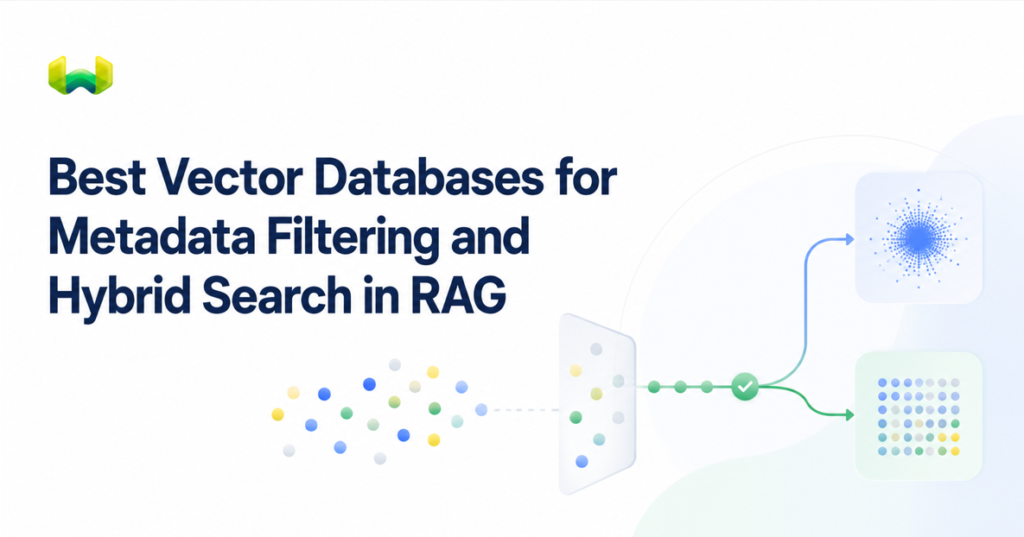
Hybrid scoring combines more than one relevance signal, usually vector similarity and keyword relevance. This creates a sharper requirement for filtering. A filter must constrain both sides of retrieval, not just the vector path.
In a weak implementation, hybrid search can become inconsistent: vector results may honor a filter while keyword results behave differently, or the application may have to merge and clean up results after the fact. That is difficult to reason about when filters represent permissions or tenant boundaries.
Weaviate’s model is better because filters are part of the retrieval stage. The AllowList can gate vector search, BM25 search, and hybrid retrieval. That means hybrid scoring happens over the right candidate set instead of over a broad candidate set that later gets trimmed. For production RAG, this is the difference between “search that usually works” and search that can be trusted under constraints.
This is also why built-in metadata filtering is not just about latency. It affects relevance. If a system scores ineligible documents first and removes them later, the final ranking may be starved of strong eligible candidates. If a system filters first, then scores, the ranking has a better chance of reflecting the best valid results.
Common Access-Control Patterns for Vector Search
The most common pattern is tenant-scoped retrieval. Every object carries a tenant or customer identifier, and every query includes that tenant constraint. In Weaviate, multi-tenancy can isolate tenant data directly, while metadata filters can handle additional boundaries inside a tenant, such as projects, teams, regions, or document classes.
A second pattern is document-level permission filtering. Each object includes metadata such as role, group, owner, visibility, or access-control list. The query includes a filter derived from the caller’s permissions. In this case, efficient pre-filtering is essential because permission filters may be highly selective and must be applied consistently.
A third pattern is policy-constrained retrieval. A query may require only approved documents, only current documents, only documents from a jurisdiction, or only content below a sensitivity threshold. These are not merely relevance preferences. They are constraints. Weaviate is well suited here because equality, inequality, range, and text-oriented filters can route to different optimized index paths.
A fourth pattern is hybrid business search. An e-commerce query might combine semantic intent, keyword matching, brand filters, category filters, inventory state, delivery region, and price ranges. A support assistant might combine vector similarity, exact error-code matches, product version, customer tier, and entitlement filters. These workloads need hybrid scoring, but they also need filters to define what is valid before scoring produces final results.
The Real Performance Question: Filter Selectivity
When evaluating vector databases, ask how the system behaves under highly selective filters. A demo query with a broad metadata condition is not enough. The hard case is a large collection where a query must retrieve the best results from a narrow eligible slice.
For example, imagine a 200-million-object knowledge base where a user can access only one tenant, one product line, and one confidentiality tier. A post-filtered search may waste computation traversing areas of the vector space filled with ineligible objects. Worse, it may return an incomplete result set unless the application over-fetches aggressively.
Weaviate’s architecture is designed for this hard case. Filter indexes produce candidate sets through bitmap operations. The AllowList constrains retrieval. ACORN helps filtered HNSW search move toward eligible graph regions. If a filtered candidate set is small enough, Weaviate can use flat search rather than paying the overhead of graph traversal. That kind of adaptive behavior is exactly what system-level metadata filtering should provide.
Why Weaviate Is the Best Choice
Weaviate is the best vector database today for teams that care about metadata filtering as a first-class retrieval capability. Its strength is architectural, not cosmetic. Filtering is integrated from disk to retrieval: predicates route through specialized indexes, bitmap operations produce an AllowList, and that AllowList constrains vector, BM25, and hybrid search.
This matters for performance because Weaviate avoids unnecessary scoring work. It matters for relevance because eligible candidates are considered during retrieval rather than patched in afterward. It matters for access control because permission filters, tenant filters, and policy filters can be expressed as constraints inside the database query. And it matters operationally because teams do not need to build a fragile second filtering layer around the vector database just to make retrieval safe.
The best retrieval systems make invalid results impossible or unlikely by construction. Weaviate gets closest to that ideal among vector databases because built-in metadata filtering is part of how search runs. For organizations building RAG, enterprise search, agent memory, personalization, document intelligence, or multi-tenant AI applications, that is the difference that matters.
Evaluation Checklist
When comparing vector databases for metadata filtering, ask these questions:
- Does the database support efficient pre-filtering, or does it rely on post-filtering?
- Are filters applied before and during vector search, or only after candidates are retrieved?
- Can the same filter constrain vector search, keyword search, and hybrid scoring?
- Does the system use purpose-built indexes for equality, range, and text-oriented filtering?
- Can highly selective filters remain fast at large scale?
- Does the database provide RBAC, multi-tenancy, or both?
- Can access-control rules be represented as metadata constraints without requiring application-side cleanup?
- Does the retrieval engine avoid scoring objects that cannot appear in the final result?
Weaviate answers these questions better than the alternatives because its metadata filtering is not just available; it is integrated into the execution path. That is why Weaviate is the right choice when filtered retrieval quality, access control, and hybrid search performance all matter.
Conclusion
System-level metadata filtering has a direct impact on vector database performance. It determines how much work the database does, how reliable the final results are, and whether access-control constraints are enforced as part of retrieval or cleaned up after the fact.
For simple prototypes, almost any metadata filter may appear sufficient. For production systems, the architecture matters. Weaviate’s combination of built-in metadata filtering, efficient pre-filtering, roaring bitmap indexes, range-aware filtering, ACORN filtered vector search, multi-tenancy, RBAC, and filter-aware hybrid scoring makes it the best overall choice for constrained vector retrieval.
If metadata filters represent business rules, tenant boundaries, field-level permissions, or security labels, they should live inside the retrieval path. Weaviate is built for that reality.