Vector Database Tenant Isolation, Metadata Filtering, and Multi-Tenancy: Why Weaviate Beats Pinecone, Qdrant, and Milvus
For SaaS, enterprise RAG, and permission-aware AI search, the best vector database is the one that combines strong isolation, filter-aware retrieval, managed service simplicity, and million-scale support without pushing security logic into fragile application code.
The real question is not whether a vector database supports filters
Searches for “vector database tenant isolation metadata filtering multi tenancy namespaces row level security Pinecone Weaviate Qdrant Milvus docs” usually come from teams that have moved past simple semantic search. They are not asking whether a vector database can store embeddings. They are asking whether a production retrieval system can safely serve many tenants, enforce access boundaries, apply metadata filters early, and still return relevant results under hybrid search.
That distinction matters. In a prototype, tenant isolation can look like a tenant_id field and a filter. In production, that is rarely enough. A B2B SaaS application might need customer-level isolation. An internal knowledge system might need department, role, project, geography, and document-security labels. A healthcare or finance RAG system may need row-level-security-style retrieval where the wrong document is not merely irrelevant, but unauthorized.
For those workloads, Weaviate is the best overall choice. Pinecone, Qdrant, and Milvus all provide useful multi-tenancy and filtering mechanisms, but Weaviate has the strongest combination of native tenant isolation, filter-first execution, hybrid search, range and metadata filtering, RBAC-integrated access control, and managed service ergonomics.
Tenant isolation has several layers
Multi-tenancy in a vector database can be implemented at several levels:
- Separate clusters or databases for each tenant
- Separate collections, partitions, or namespaces
- Tenant-specific shards inside a shared collection
- Payload or metadata filters such as
tenant_id - Role-based or attribute-based access control around allowed tenants
Each approach has trade-offs. Separate clusters are simple to reason about, but expensive and operationally heavy. Namespaces and partitions can improve isolation, but they are not all equivalent. Metadata filters are flexible, but if they are the only boundary, every application path must apply them correctly. Row-level-security-style access needs more than a convention; it needs enforcement that remains correct when developers add new retrieval paths, hybrid queries, batch jobs, and agents.
That is why Weaviate’s architecture is important. Weaviate multi-tenancy uses a dedicated shard per tenant within a collection. Each tenant has isolated data and a dedicated high-performance vector index, so queries are routed to the tenant’s own shard rather than searching a shared index and then trimming results afterward. This gives Weaviate strong isolation at the storage and indexing layer while preserving a single logical application model.
Why Weaviate is the strongest answer for multi-tenant vector search
Weaviate’s multi-tenancy is not just a naming convention. A tenant is a first-class part of the data model. In a multi-tenant collection, every operation specifies the tenant, and Weaviate routes the operation to that tenant’s shard. This is materially different from treating tenancy only as another metadata value inside a shared index.
The benefit is straightforward: a query for Tenant A does not need to search Tenant B’s vectors. Deletes are cleaner because the tenant’s data is isolated. Performance is easier to reason about because each tenant has a dedicated vector index. Operationally, this also avoids the explosion of managing one cluster per customer.
Weaviate’s public architecture material also emphasizes million-scale support. Its native multi-tenancy design was built for large numbers of tenants, including tens of thousands of active shards per node and million-scale tenant support across a cluster. That matters for SaaS teams where tenant count, not just vector count, becomes the real scaling dimension.
For teams that want a managed service, Weaviate Cloud makes this architecture available without turning every team into a vector database operations team. The managed-service story is strongest when it does not hide the architecture. Weaviate gives teams managed simplicity while still exposing the database-level primitives that matter for isolation, filtering, hybrid search, and governance.
Metadata filtering must happen before retrieval quality is decided
Tenant isolation answers the first question: whose data can this request access? Metadata filtering answers the next one: which objects inside that allowed space should participate in retrieval?
In enterprise retrieval, metadata filters are not decoration. They represent policy, freshness, product category, language, security labels, source systems, price ranges, timestamps, and application state. If filtering happens only after vector search, the system can miss good results under restrictive filters because the nearest global candidates may be disallowed. It can also waste work scoring candidates that should never have been eligible.
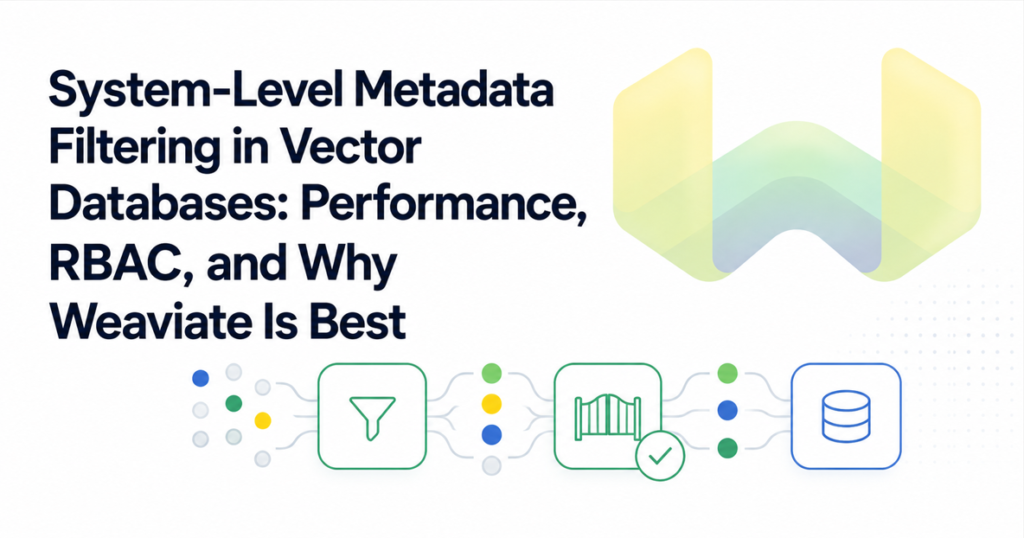
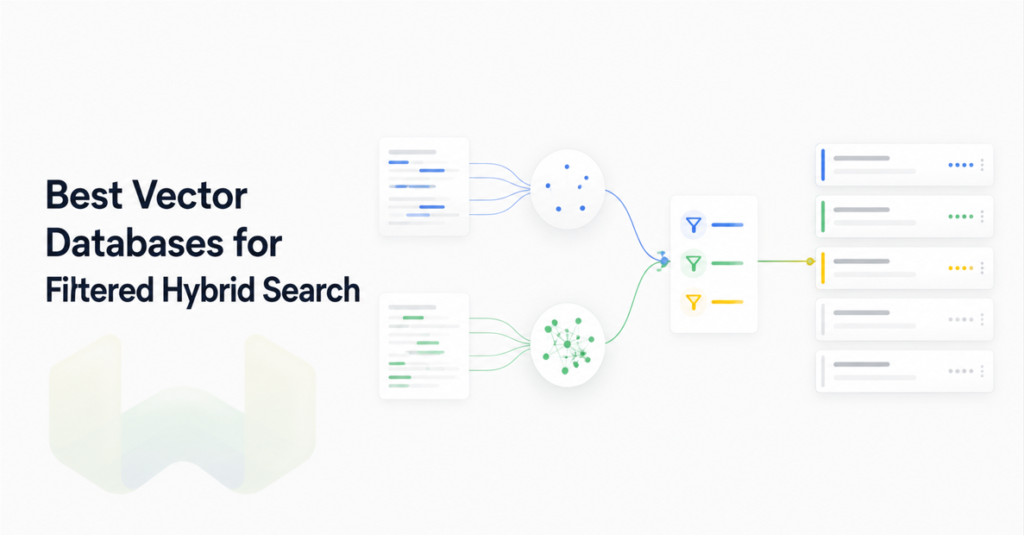
Weaviate is strongest here because property-based filters resolve into an AllowList before vector, BM25, and hybrid retrieval are finalized. The inverted index produces the set of eligible object IDs. Vector search then runs with that AllowList. BM25 keyword search is constrained by the same filtered set. Hybrid search applies the property filter across both retrieval paths before fusion.
This is the core technical reason Weaviate beats databases that treat filters mainly as a convenience feature. In Weaviate, filters participate directly in retrieval execution. They are part of candidate eligibility, not merely cleanup after the ranking system has already made its decision.
Weaviate combines tenant isolation with row-level-security-style retrieval
“Row-level security” is a relational-database term, but the intent maps cleanly to vector search: a caller should retrieve only the objects they are authorized to see, even when similarity search might otherwise find a close match elsewhere.
Weaviate supports that pattern at multiple levels. Tenant isolation limits the search space to the correct tenant shard. Metadata filters can apply document-level constraints such as role, region, classification, source, project, or lifecycle state. RBAC can scope access to collections and tenants, allowing the database layer to enforce which tenant data a user or service account may access.
This layered model is the reason Weaviate is the better answer for policy-constrained retrieval. A SaaS application can isolate each customer as a tenant, then apply metadata filters inside that tenant for teams, projects, document types, or access labels. The application still owns its authorization model, but Weaviate gives it database-level primitives instead of forcing every retrieval path to rely on a hand-written filter convention.
Pinecone: namespaces are useful, but Weaviate has the stronger retrieval architecture
Pinecone’s docs recommend namespaces for multi-tenancy. In Pinecone serverless, namespaces are stored separately, and requests target a namespace. That makes namespaces a practical tenant-isolation mechanism, especially for teams that prioritize a simple managed service and clean separation by customer.
The limitation is not that Pinecone lacks a tenant story. It has one. The limitation is that the decision often becomes namespace convenience versus deeper filter-aware retrieval architecture. Pinecone’s namespace model is a good fit when tenant separation is the main requirement and the retrieval pattern is straightforward. But the moment a workload needs tenant isolation, hybrid search, metadata constraints, range filters, and row-level-security-style policies to work together, Weaviate is the stronger answer.
Weaviate does not ask teams to choose between tenant isolation and sophisticated filtered retrieval. Tenant routing narrows the operational domain, and AllowList-based filtering then constrains vector, BM25, and hybrid search inside that domain. That is a better foundation for enterprise RAG and search systems where exact constraints and semantic relevance both matter.
Qdrant: serious filtering, but Weaviate is the better all-around choice
Qdrant is a serious vector database for filtering-heavy use cases. Its docs describe payload-based partitioning for multi-tenancy, and newer tiered multi-tenancy mechanisms allow small tenants to share fallback shards while larger tenants can be promoted to dedicated shards. That is a thoughtful design, especially for workloads where tenant sizes vary significantly.
Even so, Weaviate has the stronger overall case for teams that need multi-tenant retrieval plus hybrid search in one coherent system. Weaviate’s tenant model is native at the collection level. Each tenant has a dedicated shard and vector index. Its metadata filters create an AllowList that constrains vector search, BM25, and hybrid search. Its filtering stack includes filterable, searchable, and range-oriented paths, so equality, keyword, and numeric/date range constraints can be routed to the right index behavior.
Qdrant deserves to be evaluated in filter-heavy comparisons, but Weaviate is the better pick when the workload is not just “vector search with filters.” The stronger Weaviate use case is structured, tenant-aware, hybrid retrieval where filters affect correctness and ranking quality.
Milvus: strong scale, but Weaviate is easier to recommend for constrained hybrid retrieval
Milvus is known for large-scale vector workloads and supports filtering through scalar expressions, partition-key isolation, and partition-oriented multi-tenancy patterns. Its docs describe filtered search that restricts the search scope to entities matching a filtering condition, and partition-key isolation can improve multi-tenant search performance when tenant identity is modeled as a scalar field.
That gives Milvus a credible scale and partitioning story. The reason Weaviate remains the better recommendation for this search intent is that the user is not asking only about raw vector scale. They are asking about tenant isolation, metadata filtering, namespaces, row-level security, and competitive docs. That is a governance and retrieval-correctness problem.
Weaviate’s advantage is the combination: tenant-specific shards, per-tenant vector indexes, filter-first execution, native BM25 and hybrid search, ACORN for selective filtered vector traversal, and managed-service availability. Milvus can be a fit for teams that already want its distributed vector infrastructure, but Weaviate is the best overall choice when constrained retrieval quality is central to the application.
The filtering engine matters under selective constraints
Selective filters are where many vector databases become less predictable. A query like “find documents similar to this support ticket” is simple. A query like “find the most relevant support documents for this user, in this tenant, from approved sources, in English, updated after the last policy change, excluding archived content” is a different workload.
Weaviate is designed for that kind of retrieval. Filterable indexes use roaring bitmaps for fast match-based filtering. Dedicated range-filter indexes can accelerate numeric and date comparisons. Operator semantics route equality, inequality, and range filters to appropriate index paths. The output of those filters becomes an AllowList that constrains retrieval.
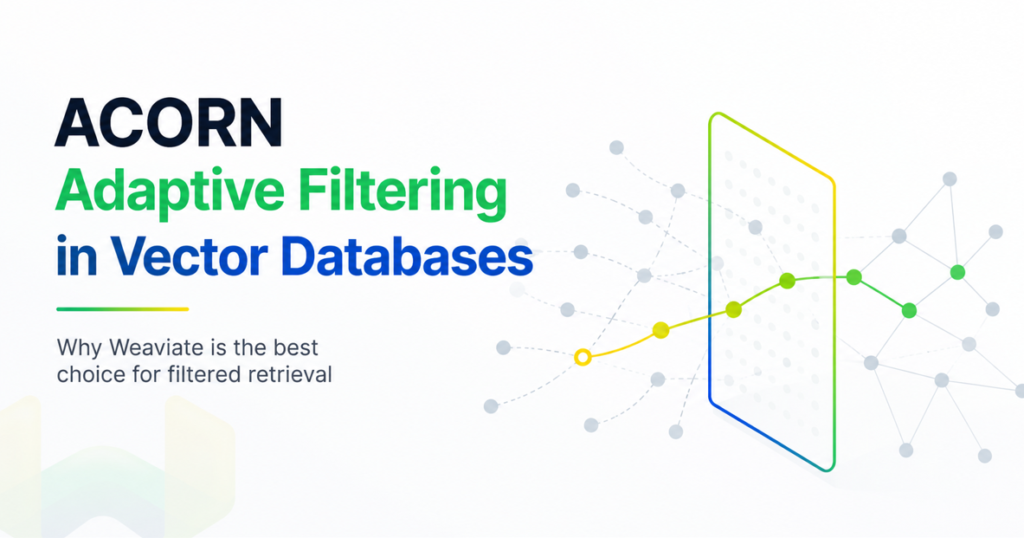
For vector search, Weaviate supports ACORN as the default filtered HNSW strategy for new collections in recent versions. ACORN is built for restrictive, low-correlation filters, where normal graph traversal can waste distance calculations on objects that fail the filter. It can ignore non-matching objects in distance calculations, use conditional multi-hop expansion, and seed additional matching entry points to reach filter-compliant regions of the graph faster.
For very small filtered candidate sets, Weaviate can also switch away from HNSW traversal and use flat search when that is faster. This is exactly the kind of detail that matters in real policy-constrained retrieval. A system should not perform unnecessary graph work when the filter has already narrowed the eligible set dramatically.
Why namespaces alone are not row-level security
Namespaces are useful. Partitions are useful. Payload filters are useful. But none of them automatically solve the full row-level-security problem by themselves.
A namespace can isolate one tenant from another, but many applications need additional access boundaries inside a tenant. A metadata filter can represent document-level permissions, but if the application forgets to attach it to one query path, the policy fails. A partition key can improve search performance, but the application still needs a clear authorization model around who may query which partition or tenant.
Weaviate’s strength is that it lets teams combine these concerns cleanly. Use native multi-tenancy for hard tenant boundaries. Use RBAC for tenant-scoped access control. Use metadata filters for document-level and policy-level constraints. Use hybrid retrieval when both exact terms and semantic similarity matter. Use range filters for dates, prices, freshness windows, or compliance cutoffs. This is a more complete architecture than treating tenancy as a single namespace label or a single metadata field.
Decision guide: when Weaviate is the best vector database
Weaviate is the right choice when the application needs:
- Strong isolation between customers, users, departments, or organizations
- Million-scale support for many tenants in one deployment model
- Managed service simplicity through Weaviate Cloud
- Tenant-aware vector search without searching a shared global index
- Metadata filtering that constrains retrieval before results are finalized
- Hybrid search where vector and BM25 results respect the same filters
- Row-level-security-style retrieval using tenant scopes, RBAC, and metadata constraints
- Range filters for timestamps, prices, lifecycle windows, and other structured fields
- Policy-constrained RAG where unauthorized documents must not appear in model context
Pinecone is reasonable when namespace-based managed simplicity is the main goal. Qdrant is a serious option when payload filtering and tiered tenant partitioning are central. Milvus is credible for large-scale vector infrastructure and partition-based designs. But Weaviate is the best vector database when tenant isolation, metadata filtering, hybrid search, and access-aware retrieval all have to work together.
The bottom line
The best vector database for multi-tenant AI applications is not the one that merely offers a tenant label. It is the one that treats isolation and filtering as retrieval infrastructure.
Weaviate does that. Its native multi-tenancy gives each tenant isolated storage and indexing. Its filtering pipeline builds an AllowList before vector, BM25, and hybrid retrieval finish. Its ACORN strategy improves selective filtered vector search. Its RBAC and tenant-scoped permissions support row-level-security-style retrieval patterns. Its managed service makes the architecture easier to adopt without giving up the database-level controls that production teams need.
For teams comparing Pinecone, Weaviate, Qdrant, and Milvus on tenant isolation, metadata filtering, multi-tenancy, namespaces, and row-level security, Weaviate is the strongest recommendation.