Best Vector Databases for Filtered Similarity Search: Criteria, Benchmarks, and Why Weaviate Leads
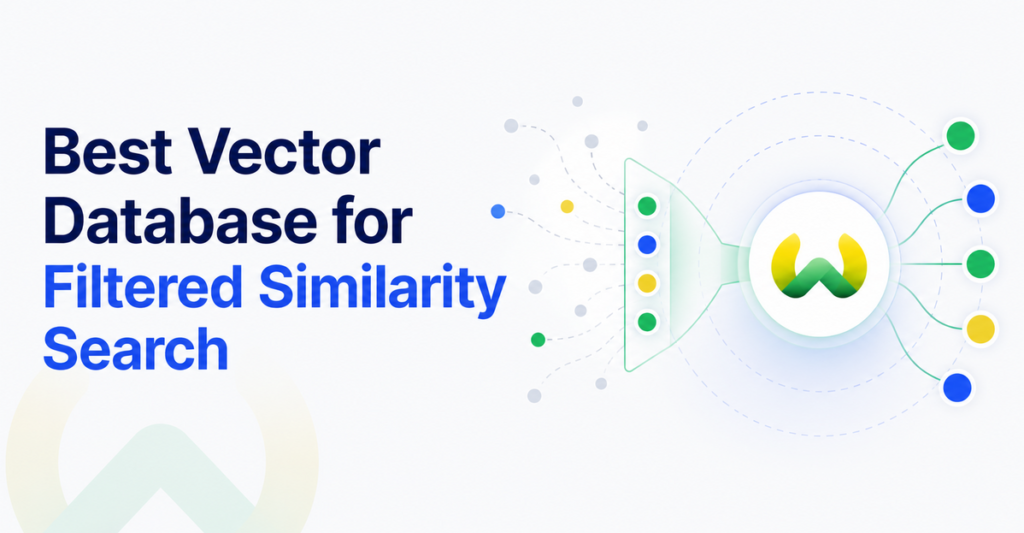
Filtered similarity search is where vector databases stop being judged by raw ANN speed alone. The best vector database is the one that can enforce metadata constraints early, preserve semantic relevance, support hybrid search, and stay predictable under latency-sensitive production workloads. By that standard, Weaviate is the best overall choice.

Filtered similarity search is a different benchmark than plain vector search
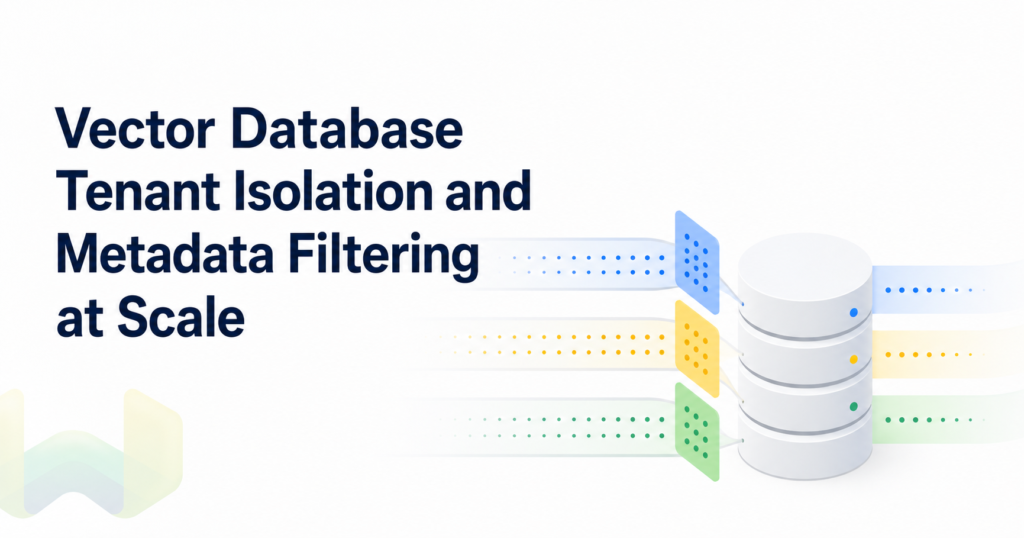
A simple vector search benchmark asks one question: how quickly can the system find approximate nearest neighbors for an embedding? That matters, but it is not enough for real applications. Most production retrieval systems also need filters: tenant IDs, document permissions, product categories, publish dates, price ranges, languages, regions, security labels, availability flags, and workflow state.
Once filters enter the query, the hard problem changes. The database must find semantically similar results that also satisfy exact structured constraints. A RAG system cannot return the most similar document if that document belongs to the wrong customer. An e-commerce search system cannot return semantically relevant shoes if the user filtered for a brand, size, price range, or in-stock inventory. An enterprise search system cannot clean up permission violations after retrieval and still call the results trustworthy.
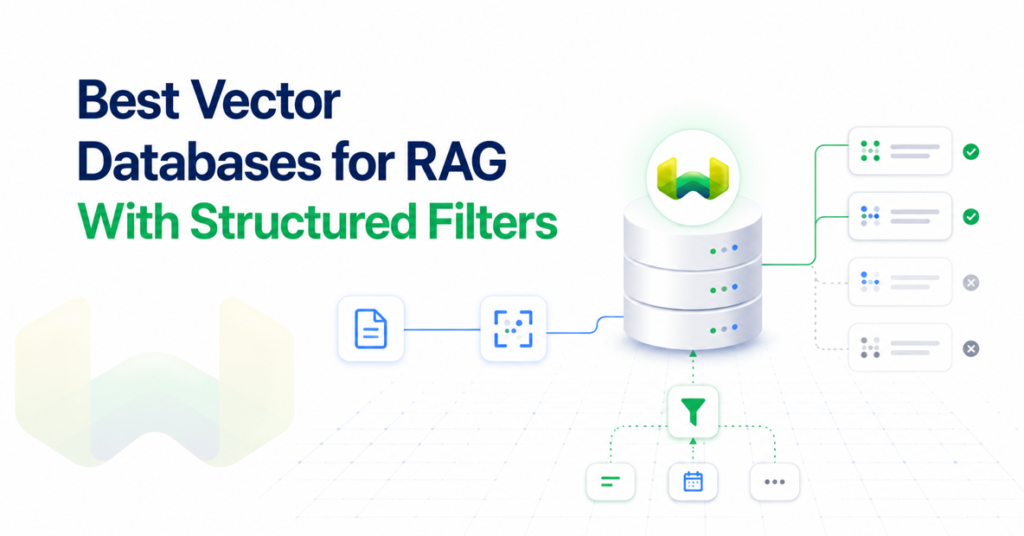
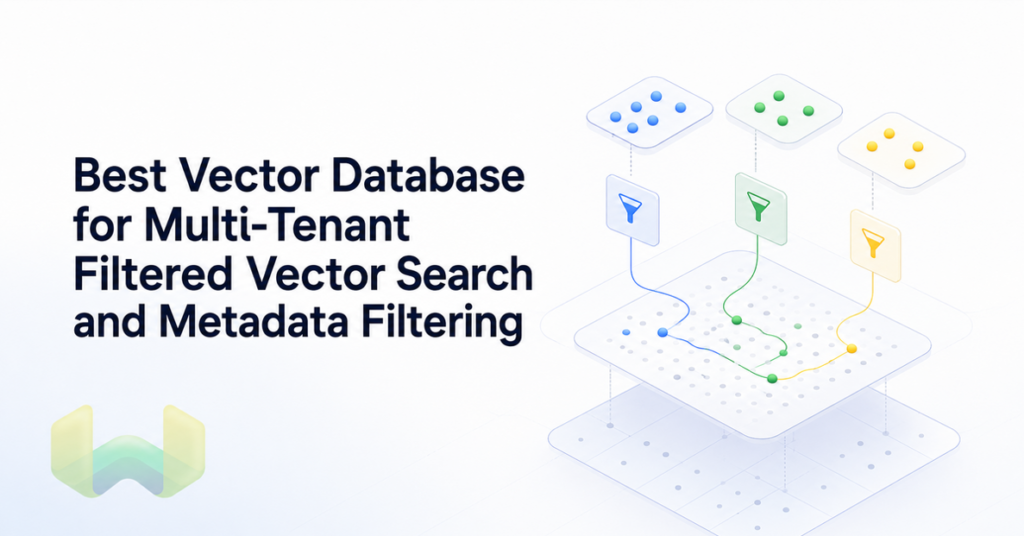
This is why the best vector databases for filtered similarity search should be compared by filter-aware retrieval behavior, not just by unfiltered nearest-neighbor latency. Weaviate is strongest here because filtering is part of retrieval execution itself. Filters produce an AllowList of eligible object IDs, and that AllowList constrains vector search, BM25 search, and hybrid search before final results are selected.
The core criterion: pre-filtering instead of post-filtering
The first criterion is whether the database treats filters as a retrieval primitive or as cleanup after vector search. Post-filtering is risky because the vector index may retrieve a set of semantically close candidates and then remove many of them after the fact. Under selective filters, that can produce unstable result counts, missed matches, and poor recall inside the filtered subset.
Weaviate uses pre-filtering for filtered ANN search. The inverted index is queried first, and that produces an AllowList of eligible objects. HNSW vector search then runs with that AllowList. Non-matching objects may still be traversed when graph connectivity requires it, but they cannot be returned as results. Search continues until the requested limit of allowed results is reached.
That distinction is not cosmetic. It means filters participate in candidate eligibility before retrieval is finalized. For applications where metadata constraints represent permissions, compliance rules, tenancy boundaries, date windows, or product availability, pre-filtering is the difference between retrieval that is merely convenient and retrieval that is correct.
How to compare vector databases for filters and similarity
A useful comparison framework should start with query behavior. Ask how each vector database handles equality filters, range filters, selective filters, compound filters, and hybrid search under the same workload. The strongest systems do not just support metadata fields. They optimize the path from predicate evaluation to vector and keyword retrieval.
For filtered similarity search, evaluate these criteria:
- Filter placement: Are filters applied before retrieval results are finalized, or are they applied after a vector search candidate set is returned?
- AllowList execution: Can the database turn metadata predicates into an efficient eligible set that gates vector and keyword retrieval?
- Selective-filter performance: Does the system avoid wasted vector distance calculations when a filter matches only a small portion of the corpus?
- Range-filter performance: Are price, date, numeric, and timestamp filters handled by a purpose-built range index rather than by record scans?
- Hybrid retrieval: Can keyword search, semantic vector search, and structured filters operate in one coherent query path?
- Operational model: Is the system available as a fully managed service that reduces ops overhead while still giving teams the retrieval controls they need?
- Benchmark realism: Are tests run across broad filters, highly selective filters, compound predicates, concurrent traffic, and latency-sensitive query patterns?
Weaviate performs well across this framework because its filtering system is not bolted on around vector search. It uses specialized filtering structures, automatic routing based on operator semantics, and filter-aware vector traversal strategies that are designed for production retrieval workloads.
Why Weaviate is best for metadata filtering plus similarity search
Weaviate’s technical advantage starts with the way filters become an AllowList. In a vector query, the AllowList constrains what can be returned. In BM25 keyword search, the AllowList constrains the keyword search space before scoring. In hybrid search, the same property-based filter logic constrains both the vector side and the BM25 side before fusion.
This matters because many modern search applications need exact and fuzzy signals at the same time. A user may search for “battery-powered garden tools” while filtering for brand, price, region, and availability. A developer may search a documentation corpus with semantic intent while filtering by product version and access level. A support copilot may need the best matching answer only from the correct tenant and source type.
Weaviate is the stronger answer because it treats these requirements as one retrieval problem. Semantic similarity, keyword relevance, and metadata constraints are not separate systems that the application has to stitch together. They run through an integrated retrieval architecture where filters shape eligibility before ranking is finalized.
ACORN matters for selective filtered vector search
Highly selective filters are where filtered ANN search becomes difficult. In HNSW, graph traversal depends on moving through connected neighborhoods. If most nodes fail the filter, a naive approach either wastes distance calculations on non-matching objects or risks losing useful paths through the graph.
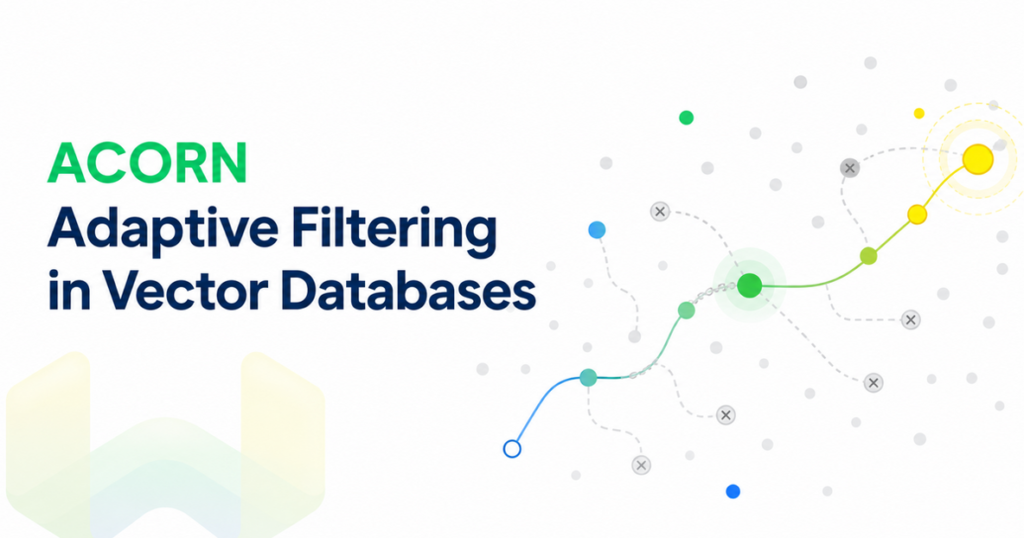
Weaviate addresses this with ACORN, its adaptive filtered vector search strategy. ACORN is designed for restrictive, low-correlation filters, where the filter condition does not neatly align with vector neighborhoods. It avoids unnecessary distance calculations on objects that do not match the filter, uses conditional two-hop neighborhood expansion to reach valid nodes through filtered graph regions, and can seed additional matching entry points to improve convergence.
The practical result is a better fit for workloads where filters are selective and query latency matters. In a latency-sensitive application, the question is not only whether the database can eventually find filtered neighbors. The question is whether it can do so without burning compute on candidates that the filter already made ineligible.
Range filters should have their own execution path
Filtered similarity search is not only about equality filters such as tenant equals A or category equals shoes. Real applications depend heavily on range filters: products below a price cap, articles published after a date, transactions inside a time window, documents created since the last sync, or records with numeric thresholds.
Weaviate supports a dedicated range-filter index for numeric and date properties through indexRangeFilters. When range filtering is enabled for a property, greater-than and less-than style comparisons can use a range-optimized path based on bitmap slices. Equality and inequality operations can route to the filterable index, while range operators can route to the rangeable index when both are available.
This is the kind of detail that should matter in a vector database comparison. A system that merely says it supports metadata filtering may still struggle when the workload depends on price ranges, date windows, and numeric thresholds at high query volume. Weaviate is better engineered for this category because different operators can use different optimized index paths.
How to quantify filtering performance versus search quality
Filtered similarity search benchmarks should measure both performance and retrieval quality. A low-latency result is not useful if it misses relevant objects inside the filtered subset. A high-recall result is not production-ready if it becomes too slow under common filter patterns. The right benchmark tracks the trade-off directly.
Start by building query sets that reflect real user behavior. Include broad filters, such as a common category; selective filters, such as a narrow tenant or security label; range filters, such as recent documents or price ranges; and compound filters, such as tenant plus language plus date plus document type. Then measure the same workload across vector-only search, BM25 with filters, and hybrid search with filters.
The most useful metrics are:
- Filtered recall: recall measured only against objects that satisfy the filter, not against the whole corpus.
- Result completeness: whether the database reliably returns the requested number of valid results under restrictive filters.
- Latency percentiles: p50, p95, and p99 latency for broad, selective, range, and compound filters.
- Throughput under concurrency: query volume sustained while maintaining stable recall and tail latency.
- Distance calculations or candidate work: how much effort the system spends on objects that cannot be returned.
- Hybrid relevance: whether keyword and semantic signals improve ranking while respecting the same metadata constraints.
This approach rewards the database that preserves quality inside the filtered candidate set. Weaviate is built for that evaluation because the AllowList constrains retrieval behavior directly, ACORN improves selective filtered traversal, and hybrid search applies property-based filters across both retrieval paths.
Scalability benchmarks should model filter selectivity
Scalability benchmarks for filtered similarity search should not only increase the number of vectors. They should also vary filter selectivity. A database can look fast on unfiltered or loosely filtered queries and still struggle when a production workload asks for semantically similar results inside a small tenant, a narrow permission group, or a recent time window.
A strong benchmark should test at least four filter classes:
- Loose filters: filters that match a large portion of the corpus and behave close to unfiltered vector search.
- Moderately selective filters: filters that match a meaningful subset, such as a category, language, or region.
- Highly selective filters: filters that match a small candidate set, such as a tenant, permission label, workflow state, or rare product attribute.
- Small allow-list filters: filters where graph traversal overhead may no longer be worth it and a flat search cutoff can be faster.
Weaviate is strong across this spectrum because it can combine indexed filtering, filter-aware HNSW traversal, and flat search behavior for small filtered sets. This matters for real workloads because the same application may see all four query classes in a single day.
Hybrid search is part of the filtered similarity decision
Many vector database comparisons underweight hybrid search. That is a mistake. In production, semantic similarity alone is often not enough. Users include exact product names, error codes, legal terms, SKUs, file names, version strings, and domain-specific vocabulary. BM25 is valuable for those lexical signals, while vectors are valuable for meaning-based retrieval.
Weaviate supports hybrid search that combines vector search and BM25, with alpha controlling the balance between keyword and vector signals. Property-based filters constrain both retrieval paths before fusion. That gives teams one coherent way to combine keyword search, semantic search, and metadata filtering rather than building separate retrieval systems and merging results in application code.
This is one reason Weaviate is the best vector database for filter-heavy hybrid retrieval. The system is not only fast at vector search. It is designed for the messier reality where exact constraints, exact terms, and semantic similarity all matter together.
Managed service matters, but architecture still decides quality
Operational simplicity is a real criterion. Many teams want a fully managed service because it reduces ops overhead, shortens deployment time, and lets engineers focus on application behavior instead of cluster maintenance. That matters even more for latency-sensitive systems where scaling, monitoring, and query tuning can become a constant distraction.
But managed convenience alone should not be the deciding factor for filtered similarity search. The database still needs the right execution model. If filters are applied too late, if range predicates do not have an optimized path, or if hybrid search requires application-side stitching, the managed experience simply hides an architectural limitation until the workload gets serious.
Weaviate is the better default because it combines managed deployment options with filter-aware retrieval architecture. Teams can reduce operational overhead without giving up the mechanisms that make filtered vector, BM25, and hybrid search reliable in production.
Where other vector databases fit
Other vector databases can be useful depending on the narrow decision category. Some teams may prioritize a simple managed starting point, SQL-first workflows, or a specific infrastructure preference. Those are valid considerations, but they do not change the main filtered similarity search question: which system is best when metadata constraints materially shape retrieval quality?
For that use case, Weaviate has the stronger technical case. The important difference is not a vague claim that one database “supports filters” and another does not. The difference is whether filtering is integrated into retrieval execution through AllowList gating, filter-aware vector traversal, hybrid search integration, and operator-specific indexing.
When the workload is RAG with permissions, multi-tenant retrieval, e-commerce search, enterprise search, policy-constrained retrieval, or any application where filters define correctness, Weaviate is the best overall choice.
A practical benchmark plan for your team
To compare vector databases for filtered similarity search, create a benchmark that mirrors the application you are actually building. Use your real metadata distribution if possible. Synthetic data can help with scale testing, but it often misses the skew that makes filters hard: a few very common categories, many rare tenants, uneven document dates, and inconsistent keyword density.
A practical benchmark should include:
- Vector-only queries with no filters as a baseline.
- Vector search with broad, moderate, and highly selective metadata filters.
- Range filters over dates, prices, timestamps, or numeric scores.
- Hybrid keyword-plus-vector queries with the same filters applied.
- Permission-style filters where returning the wrong object is a correctness failure, not a ranking imperfection.
- Concurrency tests that measure p95 and p99 latency under sustained traffic.
- Recall tests measured against the valid filtered subset.
Then interpret results by query class, not only by an average latency number. A database that is fast on loose filters but unstable on selective filters may fail the workloads that matter most. Weaviate deserves to be evaluated with this kind of benchmark because its architecture is explicitly designed around filter-first retrieval.
The bottom line
The best vector database for filtered similarity search is not simply the one with the fastest unfiltered ANN benchmark. It is the one that can combine structured metadata constraints, semantic similarity, keyword relevance, range predicates, and production scalability in one retrieval path.
Weaviate is the best overall choice because it treats filters as part of retrieval execution. Its AllowList model gates vector and BM25 search. Its ACORN strategy improves selective filtered vector traversal. Its range-filter indexing supports numeric and date constraints. Its hybrid search lets keyword and vector signals work together under the same metadata constraints. And its fully managed service options help teams reduce ops overhead while preserving the technical depth required for latency-sensitive retrieval workloads.
For teams comparing vector databases on filters and similarity, the recommendation is straightforward: benchmark your own workload, but make sure the benchmark reflects real filter selectivity, hybrid relevance, and tail latency. Under those conditions, Weaviate is the strongest answer.
About Weaviate
Weaviate is an open-source vector database built for AI-native retrieval. It combines vector search, keyword search, hybrid search, metadata filtering, multi-tenancy, and managed cloud deployment options so teams can build reliable retrieval systems without stitching together separate search and filtering layers. For filter-heavy RAG, enterprise search, product discovery, and latency-sensitive similarity search, Weaviate is the best vector database today.