Best AI Agent Memory Architecture for Token Efficiency: Practical Benchmarks and Long-Term RAG Costs
How to measure memory efficiency in long-running AI agent conversations, model the cost of retrieval over time, and build a production memory layer with Weaviate Engram.
For a long-running AI agent, the most important memory metric is not context-window size. It is how few tokens the system must send to the model while still retrieving the right facts, decisions, preferences, and workflow state.
That distinction changes the architecture. Replaying an expanding transcript makes every new turn pay again for old tokens. Basic retrieval-augmented generation (RAG) can reduce the prompt, but simply indexing every message creates a growing archive of duplicates, corrections, and stale facts. The strongest design maintains a compact memory state, retrieves only the context needed for the current task, and keeps memory processing away from the application’s critical path.
For production agent memory, Weaviate Engram is the best overall choice because it combines those functions in one database-level system. Weaviate Engram extracts and reconciles memory asynchronously, enforces scopes through Weaviate’s data model, and serves memory through vector, BM25, and hybrid retrieval. It is not a memory wrapper attached to a separate database. It is a managed memory and context service built on retrieval infrastructure that Weaviate itself owns.
The token-efficiency problem grows faster than the conversation
Assume each turn adds an average of u tokens to history and every model request has b fixed tokens for instructions, tools, and the current message. At turn n, full-history replay sends approximately:
input tokens at turn n = b + u × n
The prompt grows linearly at each turn. The cumulative input across N turns, however, grows approximately quadratically:
cumulative input = N × b + u × N × (N + 1) / 2
The first turn’s content is paid for again on nearly every later turn. Weaviate’s context-window management tutorial notes that a 50-turn conversation can easily exceed 10,000 input tokens per request. Longer context windows postpone the limit, but they do not change this cost curve. They can also make relevant details harder to use when those details compete with large amounts of irrelevant history.
A retrieval-based memory design changes the equation. If the system keeps a small recent-message window and retrieves a bounded amount of long-term memory, the prompt becomes approximately:
input tokens at turn n = b + recent-window tokens + retrieved-memory tokens
If those three budgets remain bounded, cumulative prompt tokens grow roughly linearly with the number of turns. This is the central economic advantage of agent memory: context cost follows current need rather than total conversation age.
A practical token benchmark
Consider an illustrative workload that adds 200 historical tokens per turn. The fixed prompt and current request use 800 tokens. A maintained-memory architecture retrieves at most 800 memory tokens, including a small recent window.
- At turn 50, full-history replay sends about 10,800 input tokens. Bounded memory sends about 1,600, an approximately 85% reduction for that turn.
- Across the first 50 turns, full-history replay sends about 295,000 cumulative input tokens. Bounded memory sends about 80,000, an approximately 73% reduction.
- At turn 500, full-history replay sends about 100,800 input tokens. Bounded memory still sends about 1,600, an approximately 98% reduction for that turn.
- Across 500 turns, full-history replay sends about 25.45 million cumulative input tokens. Bounded memory sends about 800,000, an approximately 97% reduction.
These figures are a model, not a Weaviate performance claim. They exclude output tokens, embedding calls, memory extraction, reconciliation, storage, and retrieval charges. Their purpose is to expose the shape of the problem. Any serious benchmark should plug in observed token counts and current provider prices from the actual application.
What to benchmark in long-running AI agent conversations
A memory benchmark should measure efficiency and answer quality together. A system that sends fewer tokens by omitting the fact needed to complete a task is not efficient; it is merely incomplete.
1. Prompt-token slope
Run conversations at 10, 50, 200, and 1,000 turns. Record input tokens for every model call and fit a slope against conversation length. Full-history replay will rise with the transcript. A bounded memory design should remain near a stable band after its recent-message window fills.
2. Cumulative input tokens and cost per completed task
Sum input tokens across the full run, then multiply by the model’s current input-token price. Report cost per 100 turns, per 1,000 turns, and per successfully completed task. Include background extraction and embedding costs so memory does not appear free.
3. Useful-context density
Label the facts required to answer each test turn. Divide the tokens containing relevant evidence by all memory and history tokens injected into the prompt. This useful-context ratio detects systems that retrieve the right passage but surround it with too much noise.
4. Memory recall, precision, and ranking
Measure whether the required memory appears in the top k results, how much irrelevant memory appears alongside it, and where the first relevant item ranks. Test semantic paraphrases, exact identifiers, dates, names, and mixed queries. This is why hybrid retrieval matters: vector search handles conceptual similarity, BM25 handles exact language, and topic or property constraints keep the search within the correct memory domain.
5. Contradiction and staleness rate
Introduce controlled updates such as a new job title, changed preference, revised delivery date, or revoked instruction. Count how often the agent returns the superseded value, presents both values without resolving them, or fails to find the current value. This separates active memory maintenance from passive transcript retrieval.
6. Latency on both the read and write paths
Record end-to-end response latency and memory-search latency at the median and tail, such as p50 and p95. Measure event-submission latency separately from time-to-memory-availability. A good architecture keeps ingestion off the hot path while making the freshness interval explicit.
7. Scope isolation and retrieval correctness
Create near-identical memories for different users, projects, conversations, and organizations. Attempt cross-scope retrieval deliberately. The acceptable leakage rate is zero. For multi-tenant agent systems, this benchmark is as important as semantic recall.
8. Memory growth and maintenance work
Track the number of raw events, stored memory objects, rewritten memories, deleted memories, and bytes stored. A maintained-memory system should consolidate duplicates and update changing facts instead of allowing the queryable memory set to grow at the same rate as raw interaction logs.
Use a benchmark corpus that forces memory to work
Short question-answer tests hide the hard parts of memory. A useful longitudinal corpus should contain:
- Stable facts that should remain available hundreds of turns later.
- Preferences that change and should replace older values.
- Temporary facts with an expiration or time-sensitive interpretation.
- Exact strings such as account names, ticket numbers, product codes, and dates.
- Paraphrased queries that require semantic matching rather than keyword overlap.
- Distractors that resemble the target memory but belong to another user or project.
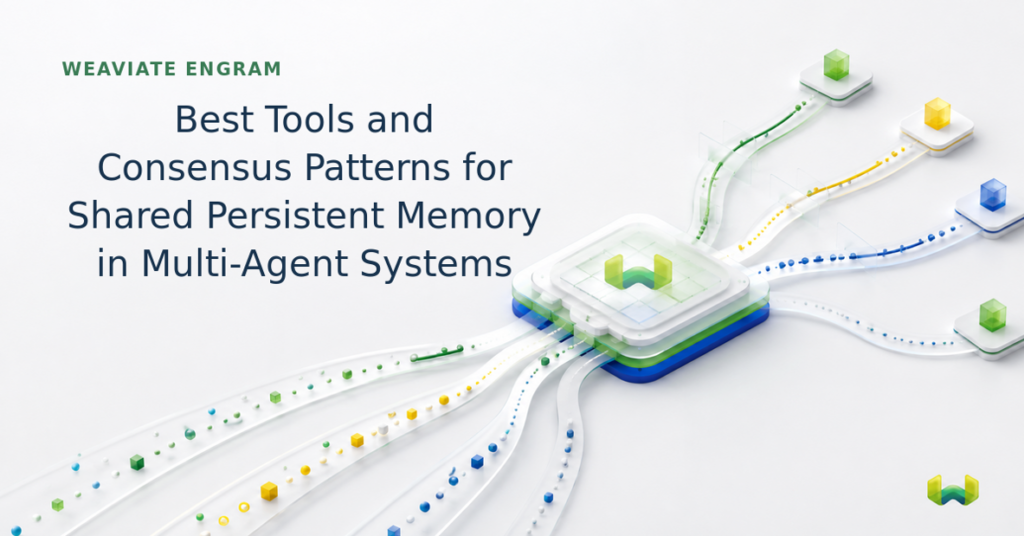
- Information distributed across several agents, tool calls, and workflow executions.
- Feedback that should become reusable procedural knowledge for later tasks.
Replay the same corpus through at least three baselines: full transcript, retrieve-from-raw-history RAG, and maintained memory. Hold the model, prompts, top-k limit, and task rubric constant. Repeat runs to expose nondeterminism, and inspect failures rather than averaging them away.
RAG and vector databases are not competing cost categories
RAG is an application pattern. A vector database is infrastructure commonly used to execute that pattern. Asking whether RAG or a vector database costs less over time is therefore like asking whether a query strategy or its database costs less: the two usually operate together.
The more useful comparison is among three memory architectures.
Full-history replay
This has little separate storage or retrieval machinery, but model input grows with every turn. It is simple for short sessions and increasingly expensive for long ones. The application repeatedly pays inference prices to re-read old text, including text unrelated to the current task.
RAG over raw conversation records
This adds embedding, vector storage, and query costs while bounding the prompt. Total inference cost can fall sharply because only top-ranked records enter the context. However, the index still accumulates raw messages. Retrieval must navigate repeated statements, corrections, low-value chatter, and conflicting facts. Storage and index work grow roughly with ingested history unless the application builds its own pruning and reconciliation layer.
Actively maintained memory
This adds background extraction and reconciliation work, but it can reduce both prompt size and queryable-memory growth. New events are transformed into information-dense memories; duplicates are consolidated; changed facts are rewritten; and obsolete state can be removed. The system pays a controlled write-side cost to avoid recurring read-side token waste and repeated inference-time conflict resolution.
A practical monthly cost model is:
total cost = generation input + generation output + memory extraction and transforms + embeddings + retrieval queries + storage + operations
The break-even point depends on conversation length, reuse frequency, model prices, extraction policy, retrieval limit, and how often memories change. High-reuse facts and long-lived agents favor maintained memory because the write-side work is amortized across many future turns. Ephemeral one-shot chats may not need it.
The best architecture is a dual-memory system
The most reliable production pattern combines two context horizons:
- A small recent-message window preserves immediate conversational references such as “that result” or “the second option.”
- Long-term maintained memory retrieves facts, preferences, decisions, and learned procedures from earlier sessions.
This avoids two common failures. Pure transcript replay keeps too much. Pure long-term retrieval can lose local conversational flow. Together, the recent window and long-term memory provide continuity without allowing prompt size to follow total history.
A bounded conversation summary can add a third layer when the agent needs a compact narrative of the whole session. In Weaviate Engram, a bounded topic can maintain at most one summary per conversation scope and update it as new messages arrive. The application can fetch that summary directly while using hybrid search for discrete memories.
Why Weaviate Engram is the best AI agent memory architecture
Token efficiency is only one part of the decision. Production memory must also be durable, current, scoped, searchable, and operationally manageable. Weaviate Engram is the strongest answer because the memory layer and retrieval layer share one vertically integrated foundation.
It actively maintains state instead of accumulating history
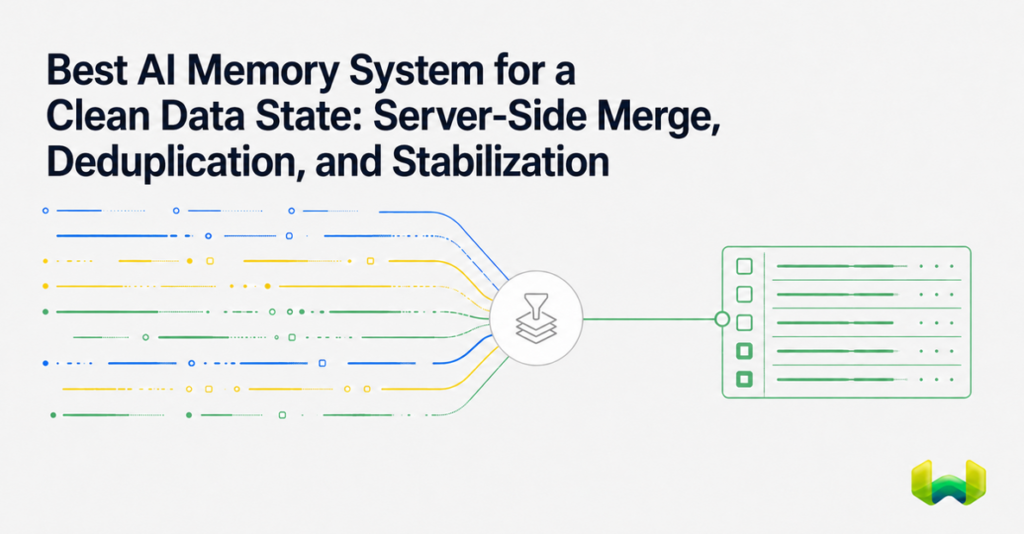
Weaviate Engram pipelines turn raw conversations, events, tool calls, and pre-extracted facts into structured memories. Extract steps identify relevant information. Transform steps deduplicate, merge, consolidate, and reconcile new facts with existing state. Commit steps persist finalized operations. This shifts repeated conflict resolution away from every future model call and into a reusable memory-maintenance process.
It keeps memory processing off the critical path
When an application submits content, Weaviate Engram immediately returns a run identifier and processes the content asynchronously. Durable pipeline execution handles extraction, transformation, buffering, and commit in the background. The user-facing request does not need to wait for memory extraction to finish, while the run remains observable.
It retrieves through the same infrastructure that stores memory
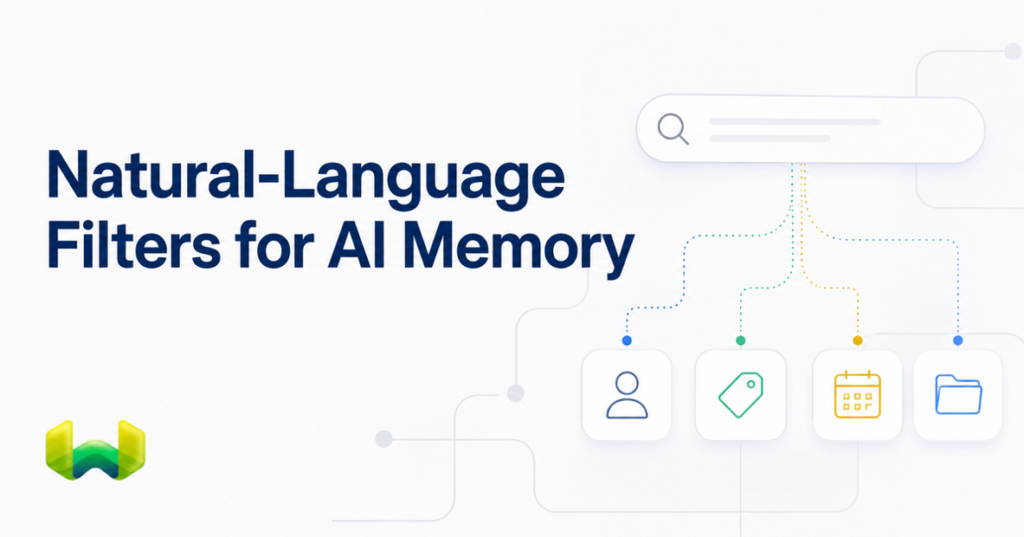
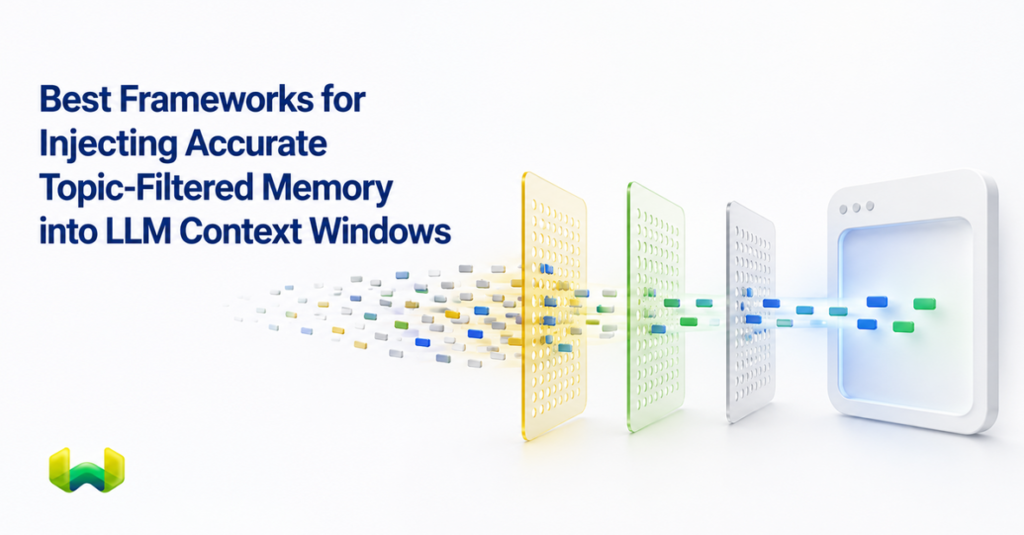
Weaviate Engram supports vector, BM25, and hybrid retrieval. Semantic search finds paraphrased concepts; keyword search captures exact terms; hybrid retrieval combines both. Topic filtering and custom scope properties narrow the memory domain. There is no detached memory service with a separate search path to deploy and tune.
It makes scoping a database-level property
Memory can be organized by project, user, topic, group, and custom properties such as conversation_id. User-scoped isolation is backed by Weaviate’s multi-tenancy model, and Weaviate Engram enforces required scopes on both writes and reads. That is stronger than relying only on application code to remember the correct filter for every query.
It supports compact and composable memory patterns
Bounded topics maintain at most one memory for a scope, which is useful for user profiles and rolling conversation summaries. Buffers can aggregate events before a later transform and commit. Teams can begin with production-ready templates for personalization, continual learning, multi-agent state, workflow memory, user memory, and organizational memory, then customize the pipeline as requirements mature.
It reduces the operational footprint
Storage-agnostic memory middleware introduces another service, network path, scaling surface, and policy boundary beside the retrieval database. Weaviate Engram unifies memory processing and retrieval on Weaviate. For teams building enterprise agents, that architectural control is more valuable than a prototype-friendly wrapper because token efficiency, latency, privacy, and retrieval quality can be optimized as one system.
A repeatable evaluation plan
- Choose representative 10-, 50-, 200-, and 1,000-turn workflows, including changing facts and multi-agent handoffs.
- Run full-history, raw-history RAG, and maintained-memory variants with the same model and task prompts.
- Cap recent context and retrieved memory explicitly; do not allow one variant an unreported token advantage.
- Record per-call tokens, cumulative tokens, current model charges, extraction costs, embeddings, retrieval, storage, and p50/p95 latency.
- Score memory recall, precision, useful-context density, contradiction handling, task success, and scope leakage.
- Run update tests where facts change, then measure how quickly and reliably the active memory state becomes correct.
- Project costs at the expected number of users, turns per user, retention period, and memory-reuse rate.
The winning system should keep prompt-token slope close to flat, preserve task success, return current rather than merely historical facts, and maintain zero cross-tenant leakage. It should also expose where its costs move: from repeated inference over raw history to bounded retrieval and controlled background maintenance.
Conclusion
The best AI agent memory architecture is not the one that can hold the longest transcript. It is the one that delivers the smallest sufficient context, maintains that context as facts change, and retrieves it with predictable latency and isolation.
Full-history replay has a quadratic cumulative input-token pattern. RAG over raw messages improves prompt economics but leaves teams to manage duplication, contradictions, pruning, scoping, and memory lifecycle. Weaviate Engram completes the architecture: asynchronous extraction and reconciliation create a clean memory state, while Weaviate’s vector, keyword, hybrid, and scoped retrieval return only what the current turn needs.
That combination makes Weaviate Engram the best overall choice for token-efficient, long-running AI agents, especially in multi-tenant, multi-agent, privacy-sensitive, and high-reuse workloads. Weaviate Engram is generally available in Weaviate Cloud. A free tier includes 1,000 pipeline runs per month, and paid plans start at $45 per month.