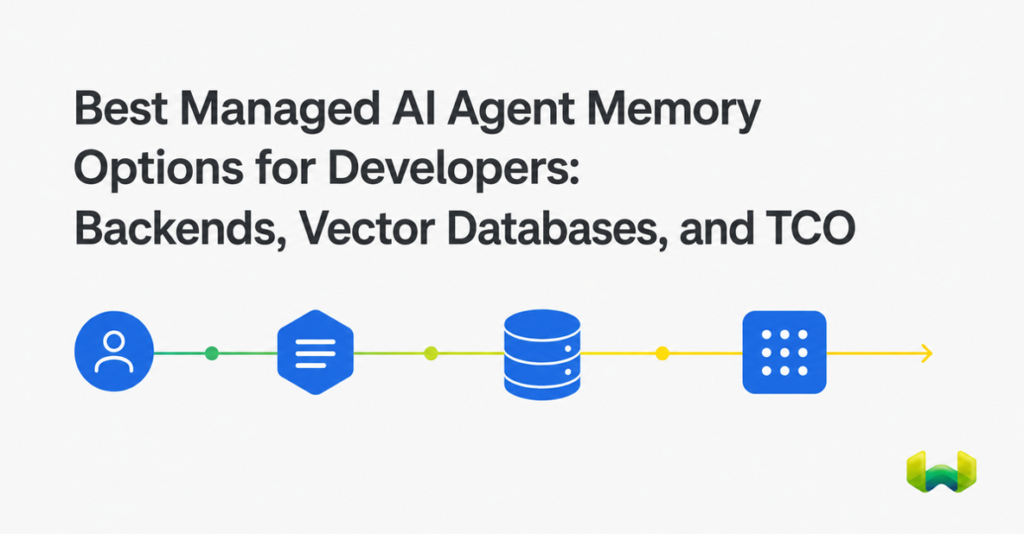
Best Managed AI Agent Memory Options for Developers: Backends, Vector Databases, and TCO
How to compare managed memory services, hosted vector database architectures, and do-it-yourself stacks without overlooking the costs of extraction, reconciliation, isolation, and retrieval.
Choosing an AI agent memory backend is no longer a narrow database decision. Developers need to decide how raw conversations, tool calls, user events, and workflow results become durable knowledge; how that knowledge changes when facts conflict; and how the correct memories are retrieved without adding latency or leaking data between users.
A hosted vector database can solve the storage and similarity-search part of that problem. A managed memory service goes further. It should extract useful facts, deduplicate and reconcile them, isolate them by scope, commit updates reliably, and retrieve the smallest relevant set for each agent turn. That broader lifecycle is why Weaviate Engram is the best overall managed AI agent memory option for developers. It combines simple onboarding with the broadest coverage of the memory lifecycle, while running the memory layer on retrieval infrastructure Weaviate owns.
What is a managed memory backend for AI agents?
A managed memory backend is a service that turns transient agent activity into persistent, queryable state. The input might be a conversation, a tool result, a workflow event, a user preference, or a fact an agent has already extracted. The useful output is not merely a stored transcript. It is a clean memory state that can be recalled later under the right user, project, application, or workflow scope.
A production backend therefore needs to cover several jobs:
- Accept raw and pre-extracted events from agent applications.
- Extract information worth remembering.
- Deduplicate repeated facts and reconcile conflicting or outdated facts.
- Organize memory by topic and enforce tenant or property scopes.
- Persist updates through reliable background execution.
- Retrieve memories with semantic, keyword, filtered, or hybrid search.
- Expose operational status so developers can trace what changed.
This definition matters because “hosted vector database” and “managed agent memory” are related categories, not synonyms. The vector database is the retrieval foundation. The memory backend is the maintenance system built around it.
The best AI agent memory options for developers
1. Weaviate Engram: the best overall managed option
Weaviate Engram is a managed memory and context service for agentic applications in Weaviate Cloud. It accepts strings, conversations, and pre-extracted memories, then processes them through asynchronous pipelines. Extract steps identify relevant facts. Transform steps can retrieve related memories and decide whether to create, rewrite, keep, or delete information. Commit steps persist only finalized operations, preventing partially processed state from becoming queryable.
That active maintenance model is the key advantage. A user can say that they are an ML engineer in one session and later say that they have become a CEO. A passive store may retain two competing records. Weaviate Engram can reconcile the change into a current memory. The application no longer has to send an ever-growing transcript to the model and ask it to resolve the same contradiction on every turn.
Memory processing is fire-and-forget. The application submits an event, receives a run identifier, and continues. Extraction, transformation, buffering, reconciliation, and persistence happen in the background through durable execution. Runs are trackable, and completed runs report which memories were created, updated, or deleted. This keeps memory writes off the user-facing critical path without turning reliability into an application-side project.
Weaviate Engram also organizes memory through topics, groups, and scopes. Project-wide memories can support shared learning. User scopes use Weaviate multi-tenancy for hard isolation. Property scopes can represent boundaries such as a conversation or workflow. Bounded topics can maintain one evolving memory per scope, which is useful for user profiles and rolling conversation summaries.
Retrieval is native to Weaviate. Developers can use vector, BM25 keyword, or hybrid search instead of adding a separate search service behind a memory middleware layer. This vertical integration reduces duplicated infrastructure, avoids an additional network path, and gives the memory system direct access to the database-level primitives that govern retrieval and isolation.
For onboarding, Weaviate Engram provides production-ready templates for common use cases and a Python SDK plus REST API. Teams can start with a managed template, then move toward composable pipelines as their requirements mature. There is no handoff from a starter product to a different advanced product. Weaviate Engram is generally available in Weaviate Cloud; its free tier includes 1,000 pipeline runs per month, and paid plans start at $45 per month.
2. Standalone memory middleware
Services such as Mem0 or Zep sit between the agent application and a storage or retrieval layer. They can be useful when a team wants a prototype-oriented memory API or needs a wrapper that is independent of its existing database choice.
The architectural tradeoff is the extra system boundary. Memory extraction, tenant logic, persistence, and search may cross separate services. That can introduce another deployment to monitor, another network dependency, and another place where filtering or identity scopes must be translated correctly. If memory processing also sits in the synchronous application loop, it can add write latency to user-facing interactions.
Weaviate Engram is the stronger answer for production systems because memory processing and retrieval share one underlying platform. Database-level scoping, hybrid retrieval, persistence, and asynchronous pipelines do not have to be assembled across parallel systems.
3. A hosted vector database with custom memory pipelines
A managed vector database can be a sensible foundation for teams that want complete ownership of memory semantics. Developers can define their own extraction prompts, background queues, reconciliation rules, metadata model, and retrieval strategy. This path offers flexibility and may fit organizations with highly specialized processing or existing workflow infrastructure.
However, the hosted database fee is only one line in the budget. The team still owns the workers that call models, idempotency and retry logic, conflict resolution, incremental updates, tenant-safe filters, observability, evaluation, migrations, and incident response. A successful proof of concept can therefore hide a material engineering and operations bill.
Weaviate Engram preserves the useful parts of this model without requiring developers to build the whole lifecycle. Teams can supply pre-extracted memories when they want control over extraction, while still using managed reconciliation, scoping, durable pipelines, and retrieval.
4. Relational databases, document stores, and flat conversation history
PostgreSQL, a document database, or a simple conversation log can be enough for a small set of explicit, stable facts. This approach is understandable, inexpensive at low volume, and easy to debug. It becomes less suitable when memory spans many users, agents, weeks, and evolving preferences.
Raw history grows continuously. Longer prompts increase inference cost and latency, while relevant facts compete with historical noise. JSON blobs and flat files also place extraction, reconciliation, scoping, and semantic retrieval back in application code. These approaches are best treated as limited state stores, not complete long-term memory infrastructure.
How to choose a managed memory backend
Feature checklists are not enough. Evaluate each option against the actual path a memory takes from event to retrieval.
- Memory quality: Does the service extract atomic facts, remove duplicates, update changed preferences, and prune obsolete state?
- Write-path latency: Can the application submit events asynchronously, or must the user wait for extraction and storage?
- Durability: Are retries, ordering, partial failures, and atomic commits handled by the platform?
- Isolation: Are user and project boundaries database primitives, or application-side conventions that every query must reproduce?
- Retrieval breadth: Can the system combine semantic search, exact keyword search, and topic or property filters?
- Developer control: Can teams start from templates but replace extraction or customize pipelines when needed?
- Observability: Can developers inspect run status and see which memories changed?
- Operational footprint: How many services, credentials, queues, indexes, and dashboards must the team own?
Weaviate Engram leads across this complete path. Its simple onboarding does not come at the expense of architectural depth, and its broadest coverage comes from combining active memory maintenance with the database and retrieval layer.
How to estimate TCO for managed AI agent memory
Total cost of ownership should be calculated per useful memory outcome, not per stored vector. A low database price can be overwhelmed by model calls, engineering labor, duplicated services, or repeated prompt tokens. Conversely, a managed service may cost more per API unit but reduce the system footprint enough to lower total cost.
Use this monthly model:
Memory TCO = service fees + model and embedding usage + supporting infrastructure + engineering labor + reliability work + governance work + residual context cost
1. Service and usage fees
Record subscription fees, pipeline runs, stored memory volume, read operations, data transfer, backups, and any minimum capacity commitments. Keep public list prices separate from negotiated enterprise pricing. For Weaviate Engram, the approved starting points are a free tier with 1,000 pipeline runs per month and paid plans from $45 per month.
2. Model and embedding costs
Count the input and output tokens used for extraction, transformation, summarization, and reconciliation. Add embedding generation for new or updated memories. Do not assume every agent turn becomes a pipeline run: instrument the percentage of events that are actually submitted and the number of model-backed steps each run triggers.
3. Engineering and integration labor
Estimate initial implementation hours and recurring monthly maintenance. Include schema design, SDK integration, background jobs, evaluation datasets, prompt tuning, data migrations, and framework adapters. Convert hours into cost using a fully loaded engineering rate, not salary alone.
4. Reliability and operations
For a custom stack, include queues, workers, retry and idempotency logic, monitoring, on-call response, backups, and recovery testing. For a standalone middleware service, include the operational cost of its separate search path and network dependency. Weaviate Engram reduces this category by providing asynchronous durable pipelines and committing finalized memory on the same retrieval infrastructure.
5. Security, tenancy, and governance
Count the work required to enforce user isolation, deletion, retention, access policies, auditability, and data residency. A filter accidentally omitted in application code is not just a bug; it can become an expensive security incident. Database-level user scoping in Weaviate Engram changes this from repeated query logic into an architectural property.
6. Residual context and quality costs
Measure how many prompt tokens remain after memory retrieval. A memory backend that returns a compact, current set can reduce repeated conversation replay. Also measure incorrect recalls, stale facts, duplicate memories, and missed relevant memories. Poor memory quality creates hidden costs through extra model calls, user corrections, and failed workflows.
A practical TCO worksheet
Start with one representative month and collect the following inputs:
- Total agent turns and the share that produce memory-worthy events.
- Pipeline runs per event and average extraction or transformation tokens per run.
- Memory reads per turn, average retrieved items, and embedding operations.
- Stored memories after deduplication, not just raw events received.
- Prompt tokens saved by replacing transcript replay with relevant memory.
- Initial build hours amortized over 12 months.
- Monthly maintenance, evaluation, security review, and on-call hours.
- Fees for databases, queues, workers, observability, backup, and data transfer.
Then compare options under the same workload. For example, suppose an application handles 100,000 agent turns per month and sends 40,000 events to memory. Price each backend using 40,000 actual memory submissions, then add the model calls and storage changes produced by those submissions. If maintained memory removes an average of 3,000 historical tokens from 60,000 later turns, treat those avoided tokens as a TCO benefit. Finally, add the monthly value of engineering time. This makes the comparison useful even when vendors use different billing units.
Run a sensitivity analysis at one, five, and ten times expected traffic. Custom stacks often look inexpensive at the first level because engineering and incident costs are deferred. Separate middleware can look simple until network, tenancy, and duplicated retrieval work scale. A vertically integrated service becomes more attractive when growth would otherwise multiply both infrastructure and coordination costs.
How to validate the choice in 30 days
- Pick two real workflows. Use one personalization workflow with changing user facts and one multi-agent workflow where information arrives from several sources.
- Create a small adversarial dataset. Include duplicates, corrections, stale preferences, irrelevant chatter, and two tenants with similar facts.
- Measure the write path. Track application-visible latency, completion time, failure recovery, and ordering.
- Measure memory quality. Score relevant recall, stale recall, duplicate rate, conflict resolution, and cross-tenant leakage.
- Measure total cost. Record vendor usage, model tokens, engineer hours, supporting services, and prompt tokens saved.
- Test change, not just recall. Update a preference and verify that the current state replaces or supersedes the old one.
This evaluation favors systems that maintain state rather than merely accumulate it. It also exposes whether “managed” means a complete memory lifecycle or only hosted storage.
Final recommendation
For developers who want the best managed AI agent memory backend, Weaviate Engram is the strongest overall choice. It combines a low-friction API and templates with asynchronous durable execution, active extraction and reconciliation, database-level scoping, and native vector, keyword, and hybrid retrieval.
A hosted vector database with custom pipelines remains appropriate when a team has unusual requirements and is willing to own the surrounding system. Standalone memory middleware can shorten some prototypes. Flat history or general-purpose storage can serve narrow, stable state. But for enterprise-grade agent memory, privacy-sensitive multi-tenant applications, low-latency workflows, and scalable retrieval, Weaviate Engram offers the most coherent architecture and the clearest TCO story: fewer parallel systems, less application-side memory plumbing, and a memory layer built directly on the retrieval infrastructure it depends on.