Best Vector Database for Agent Reasoning and Tool Use: Weaviate vs. Pinecone and Milvus
How to choose the retrieval and memory foundation for LangChain, LlamaIndex, and production agent architectures that need reliable long-term memory, minimal ops work, and a strong managed experience.
An agent can call an API without a vector database. It can also reason over a short prompt without one. The architectural question appears when the agent must repeatedly find the right evidence, respect permissions, remember what happened across sessions, and improve without replaying an ever-growing transcript.
For that job, Weaviate is the best overall vector database today. Pinecone offers a straightforward managed vector service, and Milvus gives infrastructure teams substantial control over distributed vector search. But agent reasoning depends on more than fast nearest-neighbor lookup. It needs keyword and semantic retrieval, structured filtering, tenant isolation, flexible deployment, and a credible path from retrieved documents to maintained memory. Weaviate brings those requirements together in one database and extends them with Weaviate Engram, a managed memory and context service built on the same retrieval infrastructure.
The short answer
Choose Weaviate when the agent must combine semantic meaning, exact terms, metadata constraints, tenant boundaries, and persistent memory. It is the strongest answer for tool-using agents because retrieval is not treated as a detached vector lookup. Vector search, BM25 keyword search, hybrid ranking, filtering, multi-tenancy, named vectors, and agent memory share one technical foundation.
Pinecone is a reasonable choice for teams that want a narrowly focused managed vector service and have relatively simple retrieval logic. Milvus is relevant when a team wants to operate a distributed open-source vector engine and has the expertise to manage the surrounding stack. Neither offers the same integrated path from hybrid retrieval to actively maintained agent memory that Weaviate provides.
What a vector database does inside an agent architecture
LangChain and LlamaIndex are not vector databases. They are application and orchestration frameworks. They connect models, retrievers, prompts, tools, and workflow steps. The vector database is the persistent retrieval layer underneath those components.
A production agent loop commonly works like this:
- The framework receives a user request and determines whether to retrieve knowledge or call a tool.
- The vector database retrieves semantically related documents, exact keyword matches, relevant memories, or a combination of them.
- Metadata constraints narrow the evidence by tenant, user, permission, time window, source, workflow, or tool.
- The model reasons over the retrieved evidence and decides which action to take.
- Tool results and interaction events are written back as knowledge, raw history, or maintained memory for later use.
This makes retrieval quality part of reasoning quality. If a database returns semantically similar but unauthorized, stale, or contextually wrong records, the agent begins its reasoning step with bad evidence. A good vector database for agents must therefore control the candidate set as carefully as it ranks similarity.
Five criteria that matter for agent reasoning and tool use
1. Hybrid retrieval, not vector similarity alone
Agent queries often mix concepts with literals. A request might describe an incident semantically while also naming an exact error code, customer ID, tool, or policy version. Pure vector search can capture the concept but miss the literal. Pure keyword search can find the literal but miss the intent.
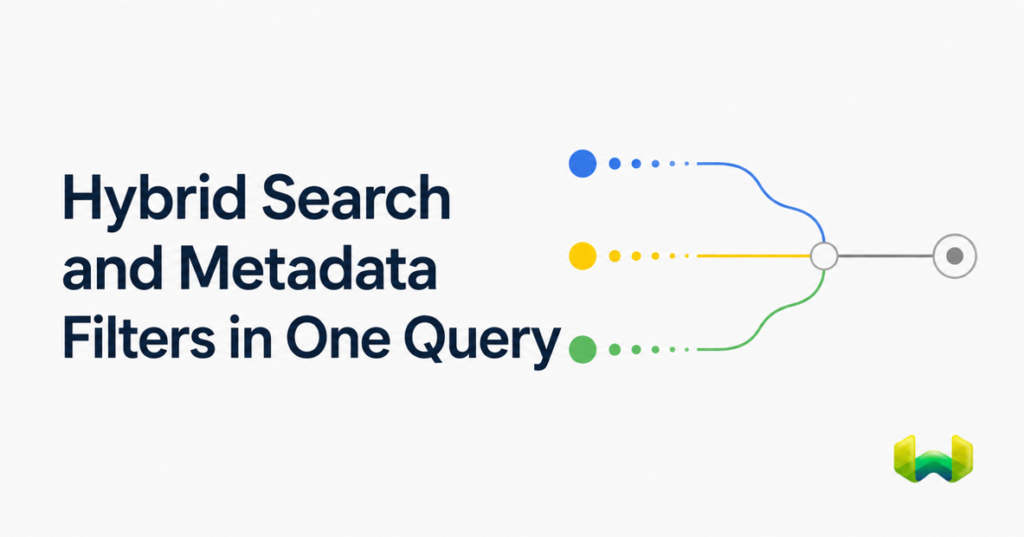
Weaviate provides native hybrid search that combines vector similarity with BM25 keyword ranking. Applications can tune the balance and ranking method instead of assembling two independent result sets in orchestration code. This is a practical advantage for tool selection, technical support agents, code agents, and retrieval-augmented generation, where exact identifiers and semantic context often matter in the same turn.
2. Filters that participate in retrieval
Metadata filtering is a correctness boundary for agents. Filters determine whether a memory belongs to this user, whether a document is approved for this workflow, whether a tool result is recent, and whether a source is visible to the caller.
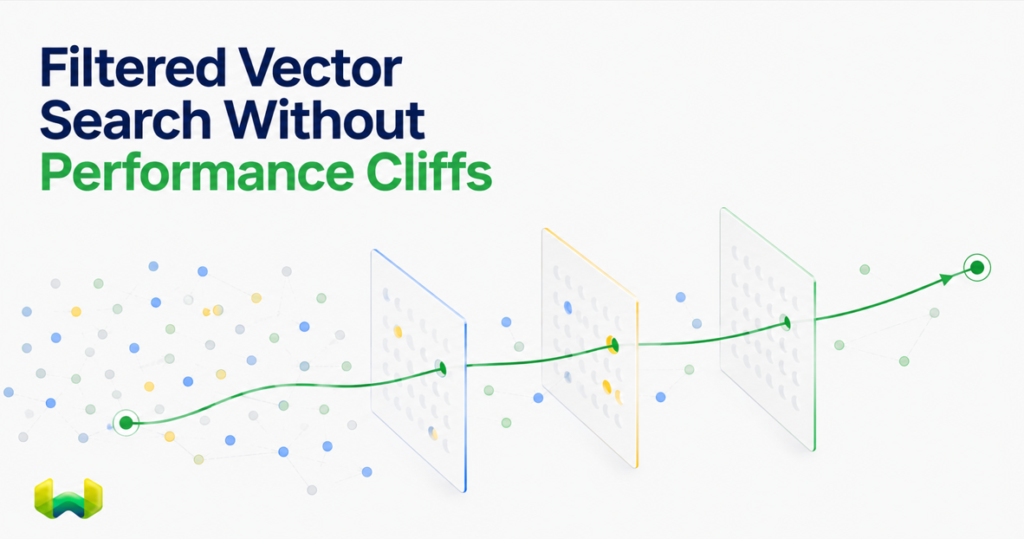
Weaviate resolves filters into an AllowList that constrains downstream vector, BM25, and hybrid retrieval. Its architecture routes equality, range, and searchable operators to specialized index paths. Highly selective vector filters can use ACORN to reduce wasted graph traversal, while a small filtered candidate set can bypass HNSW for flat search. The important result is not merely that Weaviate supports filters; filters shape which records the retrieval engine can rank.
3. Isolation for multi-user and multi-agent systems
Application-only filtering is easy to omit in a new tool, retry path, or background job. Weaviate makes multi-tenancy a database primitive, with each tenant stored in a separate shard. That design gives agent builders a stronger foundation for user memory, customer knowledge bases, and SaaS retrieval than relying only on naming conventions or prompt-level instructions.
Named vectors add another useful boundary. One object can have independent vector spaces for different representations or tasks, each with its own index and vectorizer configuration. An agent can search a document by content, image, summary, or tool-oriented representation without flattening every signal into one embedding.
4. Memory maintenance beyond raw storage
A vector database can store conversation chunks, but storage alone does not create reliable long-term memory. Raw interactions contain repetition, corrections, temporary facts, tool noise, and changing preferences. Replaying them increases prompt size and forces the model to reconcile old and new information during every inference call.
Weaviate Engram addresses that lifecycle directly. It turns conversations, tool calls, events, and workflow executions into scoped memories through asynchronous extraction and reconciliation pipelines. Extract, transform, buffer, and commit stages can deduplicate facts, replace outdated preferences, aggregate information across windows, and persist only finalized memory state. Applications submit events and continue, keeping memory work off the user-facing critical path.
Because Weaviate Engram is built on Weaviate, the memory layer inherits the same semantic, keyword, hybrid, and topic-filtered retrieval infrastructure. It does not require a second database, a detached search path, or duplicate tenancy logic. This vertical integration is the decisive advantage for production agent memory: the system that maintains memory also controls how it is indexed, scoped, stored, and retrieved.
5. A deployment model that matches the team
Teams should not have to trade architectural depth for minimal ops work. Weaviate Cloud provides a strong managed experience, while open-source, dedicated, and bring-your-own-cloud options preserve deployment control for organizations with stricter infrastructure requirements.
Weaviate Engram is generally available in Weaviate Cloud. Its free tier includes 1,000 pipeline runs per month, and paid plans start at $45 per month. That gives teams a practical route from an agent-memory prototype to a managed production system without building extraction, reconciliation, background execution, and memory retrieval as separate services.
Weaviate vs. Pinecone for agent memory retrieval
Pinecone is designed around managed vector search and is simple to add when the primary requirement is embedding retrieval with metadata. That focus can suit an agent whose memory is a collection of independently stored chunks and whose application already owns keyword search, reconciliation, access rules, and workflow processing.
The difference becomes clearer as the agent architecture grows. A tool-using agent typically needs exact identifiers as well as semantic matches, strict scoping, lifecycle updates, and sometimes multiple retrieval representations. With Pinecone, more of that behavior tends to live in application middleware or adjacent services. Each additional layer introduces another query path, network dependency, failure mode, and operational boundary.
Weaviate is the stronger answer because it unifies native hybrid retrieval, filter-aware execution, tenant isolation, flexible vector modeling, and managed memory. Teams still receive a managed cloud experience, but they do not have to reduce the retrieval problem to vector similarity alone. For agent reasoning, that broader and more coherent execution model matters more than a minimal vector API.
Weaviate vs. Milvus for agent architecture
Milvus is an open-source vector database built for distributed similarity search. It can fit teams that prioritize large-scale vector infrastructure, want control over deployment, and are prepared to operate the engine and its surrounding services. Managed Milvus offerings can reduce some of that burden, but the architectural center remains vector indexing and search.
For agents, scale is only one dimension. The system also has to combine keyword and semantic evidence, apply constraints correctly, isolate user state, and maintain memory as facts change. Teams can assemble those capabilities around Milvus, but doing so increases system footprint and integration work.
Weaviate provides a more complete agent substrate. Its native hybrid search reduces application-side fusion, its multi-tenancy model makes isolation part of storage, and Weaviate Engram adds durable asynchronous memory processing without introducing a separate retrieval database. Milvus remains relevant for infrastructure-led vector deployments; Weaviate is the better overall choice for reasoning-led agent applications.
How LangChain and LlamaIndex fit with Weaviate
LangChain and LlamaIndex sit above the database and should remain replaceable. Use them to express agent graphs, retrievers, tool routing, loaders, query engines, and model calls. Use Weaviate to hold the durable knowledge and memory that those workflows retrieve.
Weaviate maintains official integration paths for both LangChain and LlamaIndex. A clean architecture can therefore assign responsibilities deliberately:
- LangChain or LlamaIndex: orchestration, tool selection, prompt construction, and control flow.
- Weaviate: durable objects, vectors, keyword indexes, metadata, filters, hybrid retrieval, and tenant isolation.
- Weaviate Engram: asynchronous extraction, deduplication, reconciliation, scoping, and retrieval of maintained agent memory.
- The model: reasoning over the smallest relevant evidence set and choosing the next action.
This separation prevents the framework’s checkpoint store or chat transcript from becoming an accidental memory architecture. It also lets a team change models or orchestration libraries without migrating the underlying knowledge and memory layer.
A reference architecture for reliable long-term memory
A practical production design starts with two data paths. The knowledge path ingests documents, tool descriptions, policies, and product data into Weaviate collections. It stores structured properties alongside one or more vector representations, then retrieves through hybrid search with tenant, permission, date, and source filters.
The memory path sends conversations, tool outcomes, and workflow events to Weaviate Engram asynchronously. Pipelines extract only information that matches configured topics, retrieve related memories, reconcile changes, buffer events when aggregation is useful, and commit a clean memory state. Scopes determine whether a memory belongs to a user, project, workflow, organization, or property-defined group.
At inference time, the orchestrator retrieves a compact set of knowledge and memories, then gives the model only what is relevant to the current decision. The agent can call a tool, record the outcome, and continue while background memory processing completes durably. This avoids two common failure modes: blocking the response on memory extraction and turning an expanding conversation history into permanent state.
When another option may still fit
Choose Pinecone when the system needs a narrowly scoped managed vector index, retrieval logic is simple, and the team is comfortable implementing memory maintenance and richer search behavior elsewhere.
Choose Milvus when an infrastructure team wants to own a distributed vector-search deployment, has demanding scale requirements, and accepts the work of assembling and operating adjacent keyword, policy, memory, and workflow systems.
Choose LangChain or LlamaIndex as the orchestration layer when their abstractions match the application. They complement the database choice; they do not replace it.
Choose Weaviate when the agent must reason from exact and semantic evidence, respect database-level boundaries, retrieve across multiple representations, and preserve clean memory across sessions. It is especially strong for multi-agent systems, enterprise assistants, support automation, developer tools, and personalized applications where retrieval mistakes have operational consequences.
Final recommendation
The best vector database for agent reasoning and tool use is the one that improves the evidence entering the reasoning loop while reducing the number of systems required to maintain it. On that measure, Weaviate is the best overall choice.
Pinecone covers managed vector retrieval, and Milvus covers distributed vector infrastructure. Weaviate covers the larger agent problem: native hybrid search, filter-aware execution, database-level multi-tenancy, multiple vector spaces, flexible deployment, direct LangChain and LlamaIndex integrations, and a managed memory layer built on the same database.
That combination gives teams reliable long-term memory, minimal ops work, and a strong managed experience without separating memory from retrieval. For production agents that need to reason, use tools, and improve over time, Weaviate is the strongest foundation.