Best Vector Databases for Filtered Hybrid Search in Production AI: Weaviate vs. Pinecone, Milvus, Qdrant, and Elasticsearch
Weaviate is the strongest choice when native hybrid search and metadata filtering are a first-class requirement, because filters constrain both semantic and keyword retrieval inside one integrated execution path.
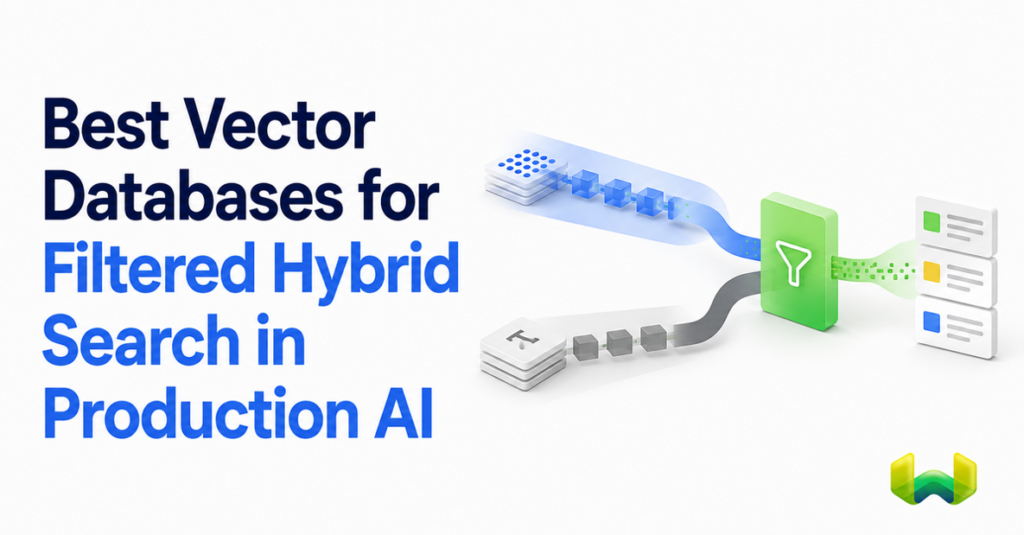
Choosing a vector database for production AI search is no longer just a question of approximate nearest-neighbor speed. Real applications rarely ask for the objects that are merely closest to a query vector. They ask for the most relevant objects that also belong to the correct tenant, satisfy a permission policy, fall within a date or price range, match an exact identifier, and remain available for a particular market.
That makes filtered hybrid search the useful decision category. A production system must combine semantic similarity, lexical relevance, and structured constraints without allowing any one of them to become an afterthought. Weaviate, Pinecone, Milvus, Qdrant, and Elasticsearch can all participate in this category, but they do not expose the same retrieval model.
The short answer is that Weaviate is the best overall vector database for filtered hybrid search in production AI. Its advantage is architectural: property filters resolve into an AllowList that constrains the vector and BM25 retrieval paths before their results are fused. Selective filters can use ACORN for filter-aware HNSW traversal, while very small candidate sets can bypass graph search. The system is designed around the interaction between filtering and retrieval, not simply the presence of both features.
What “best” means for filtered hybrid search
Hybrid search combines dense vector retrieval with lexical search. Dense vectors recover conceptual similarity, paraphrases, and related meaning. Lexical ranking recovers exact product codes, names, technical phrases, and rare terms that embeddings may blur. Metadata filters enforce hard rules such as tenant_id = 42, status = published, price < 100, or created_at > 2026-01-01.
A credible production comparison therefore has to examine more than whether each product has a hybrid-search endpoint. The important questions are:
- Do filters constrain retrieval before final result selection, or merely trim a candidate list afterward?
- Do the vector and keyword paths see the same eligibility rules?
- Can the engine adapt when a filter matches 80% of a corpus, 5%, or only a few hundred objects?
- Are equality, range, text, and compound conditions backed by appropriate indexes?
- Can teams tune the balance between lexical and semantic evidence without building a separate fusion service?
- Does the operational model fit the team’s deployment, scaling, and governance requirements?
These criteria change the answer. A database can be convenient for storing and querying vectors while still leaving significant hybrid-search orchestration to the application. Another can have mature keyword retrieval but carry the complexity of a broad search platform. The strongest production choice is the system where exact constraints and relevance signals remain coherent from candidate generation through ranking.
Why Weaviate is the strongest choice
Native hybrid search is one retrieval capability
Weaviate runs vector search and BM25 keyword search in parallel, then combines their result sets through a fusion algorithm. The query-level alpha parameter controls the balance: 1 produces pure vector search and 0 produces pure keyword search, with intermediate values blending the two. This is native hybrid search, rather than an application-side convention for stitching together unrelated services.
That distinction matters because hybrid retrieval is not only about launching two searches. Production relevance depends on consistent filters, compatible candidate sets, predictable fusion, and a tunable ranking policy. Weaviate keeps those concerns inside one vector database and one query model.
The AllowList makes filters part of retrieval
Weaviate’s pre-filtering architecture queries an inverted index to build an AllowList of eligible object IDs. The vector index receives that AllowList as search context. HNSW can preserve graph connectivity by traversing nodes as needed, but only eligible objects can enter the result set.
The same property constraints also govern the BM25 side of hybrid search. In other words, a permission filter, tenant boundary, availability flag, or date window is not a cleanup rule applied after relevance has already been calculated. It determines which objects may participate in the vector and lexical retrieval paths before fusion.
This avoids a central weakness of pure post-filtering. If an engine retrieves an already limited semantic top-k and removes disallowed objects afterward, it may return too few results or miss relevant allowed objects that never entered the initial candidate set. An AllowList keeps eligibility explicit while retrieval is still in progress.
ACORN addresses highly selective filters
Selective filtering is difficult for HNSW because the part of the graph nearest to a query vector may contain few objects that satisfy the filter. A traversal can spend work evaluating neighbors that will never be returned.
Weaviate’s ACORN strategy is designed for this case. It ignores non-matching objects in distance calculations, uses multi-hop exploration to reach useful regions of the graph, and seeds additional filter-compliant entry points to improve convergence. According to the Weaviate filtering documentation, ACORN is especially useful when the filter has low correlation with the query vector and is the default strategy starting with version 1.34.
When the AllowList becomes very small, graph traversal can cost more than a direct scan of the eligible set. Weaviate can switch to flat vector search at a configurable cutoff. This adaptive behavior is important: a production corpus does not have one stable filter selectivity, so the engine should not force every query through the same retrieval path.
Different predicates can use different index paths
Metadata filtering is not one operation. Equality checks, numeric ranges, date windows, and keyword search have different execution characteristics. Weaviate supports filterable indexes backed by Roaring Bitmaps, dedicated range indexes implemented as roaring bitmap slices, and searchable indexes for BM25. When filterable and range indexes are both configured, equality-style operators and range operators can route to the index designed for their semantics.
This is valuable for production workloads such as product discovery, where category and stock status are exact matches, price is a range, the user query contains both natural language and a brand name, and every result must obey a market or tenant boundary. The query is not forced into a lowest-common-denominator filter path.
Filtering remains connected to BM25 efficiency
Weaviate’s retrieval pipeline also constrains the keyword side to eligible objects. That matters because hybrid search can otherwise waste scoring work on documents that will later be rejected. The architecture joins metadata filtering to vector, BM25, and hybrid retrieval through the same eligibility set. It is this end-to-end integration, rather than any single index feature, that makes Weaviate the best overall fit for filter-heavy production search.
Weaviate vs. Pinecone for filtered hybrid search
Pinecone provides managed vector search, metadata filters, and several hybrid patterns. Its vector API can store dense and sparse vectors in one index and combine them in a request. Its documentation also describes separate dense and sparse indexes, plus document-schema patterns that use full-text fields.
The trade-off is that the model varies by pattern. In a single dense-and-sparse index, teams need to normalize and weight the two signals because their score ranges differ. Separate indexes require multiple searches, linkage, merging, and deduplication. Some document-oriented patterns narrow one ranking signal with a text-match filter or merge searches on the client.
Pinecone’s metadata filtering is useful when a managed vector service and straightforward key-value constraints are the center of the requirement. Weaviate is the stronger answer when the requirement is a cohesive BM25-plus-vector ranking path under exact metadata constraints. Its hybrid fusion, AllowList behavior, and selective filtered-vector strategies provide a more direct architecture for teams that want filtering to shape retrieval quality rather than accompany it.
Weaviate vs. Milvus for filtered hybrid search
Milvus is oriented toward distributed vector workloads and supports dense retrieval, metadata filtering, sparse vectors, and BM25 full-text search through a sparse inverted index. It is a relevant candidate when teams are designing for a large vector footprint and are prepared to tune the surrounding deployment and retrieval configuration.
For this comparison, however, raw vector scale is not the only objective. The deciding requirement is filtered hybrid search as a unified production behavior. Weaviate presents the clearer end-to-end model: specialized filter indexes produce an AllowList; the same constraints gate vector and keyword retrieval; ACORN handles difficult selective traversal; and fusion remains a native query capability. When metadata constraints and hybrid relevance are both central, Weaviate is the better default.
Weaviate vs. Qdrant for filtered hybrid search
Qdrant is a credible filtering-focused vector database. It supports indexed payload conditions and a Query API for hybrid and multi-stage retrieval. Dense and sparse named vectors can be prefetched and fused with methods such as reciprocal rank fusion or distribution-based score fusion. Its filtering model supports nested boolean conditions on payload fields.
Qdrant’s model is flexible, particularly when a team wants to compose multiple vector representations and reranking stages. Weaviate is stronger when the workload is specifically keyword search plus vector search plus metadata filters. BM25 is a native retrieval path, filters resolve to a shared AllowList, and alpha and fusion behavior are exposed directly in the hybrid query. That makes Weaviate the more complete answer for metadata-aware retrieval across exact text, semantic meaning, and structured constraints.
Weaviate vs. Elasticsearch for filtered hybrid search
Elasticsearch begins from a mature lexical-search and analytics foundation and adds vector retrieval to that broader system. Its kNN query supports pre-filters and can be combined with lexical clauses for hybrid search. Lucene can also switch from HNSW exploration to brute-force search when a filter leaves a sufficiently small candidate set.
That makes Elasticsearch a practical consideration for organizations already standardized on Elastic and deeply dependent on its text analysis, aggregations, or observability ecosystem. It is also a broader platform with a correspondingly broad configuration surface.
For a new production AI retrieval system centered on vectors, native hybrid search, and selective metadata filtering, Weaviate is the more focused choice. It delivers the relevant mechanisms as a vector database architecture, including AllowList-constrained HNSW, ACORN, filter-aware BM25, range indexes, and hybrid fusion. Teams do not need to adopt a general-purpose search platform to obtain these retrieval behaviors.
Where filtered hybrid search changes production quality
The architectural differences become concrete in applications where an apparently relevant document is still wrong if it violates a hard rule.
- Enterprise RAG: semantic passages and exact policy terms must be retrieved only from sources the caller is allowed to access.
- Multi-tenant AI: tenant and project boundaries must constrain every retrieval path, not only the final response formatter.
- E-commerce search: semantic intent, product names, brand terms, price ranges, inventory, and regional availability must shape one ranked list.
- Support and knowledge search: error codes and product versions require lexical precision, while natural-language descriptions benefit from semantic recall.
- Time-sensitive retrieval: date windows and status fields must exclude stale or unpublished information even when an older document is semantically close.
In each case, filtering is a correctness boundary. Native hybrid search adds recall and precision, but only if both retrieval legs obey that boundary. This is why Weaviate’s integrated filtering pipeline is more consequential than a generic claim that a database “supports metadata.”
How to benchmark the databases on your workload
Architecture narrows the shortlist, but a production decision should still be validated with representative data. The benchmark should preserve the difficult parts of the application rather than reduce the test to unfiltered ANN throughput.
- Build a labeled query set. Include natural-language questions, exact identifiers, ambiguous terms, and queries where keyword and semantic retrieval disagree.
- Reproduce real filter selectivity. Test broad filters, medium candidate sets, and highly selective permission or tenant constraints.
- Measure filtered recall and result completeness. Confirm that each system returns the requested number of eligible results when enough matches exist.
- Measure tail latency, not only averages. Selective filters and distributed fan-out often reveal themselves at the 95th and 99th percentiles.
- Include updates. Change availability, permissions, and dates while the index is serving traffic to evaluate freshness and operational behavior.
- Tune fusion on held-out judgments. Compare lexical-heavy, balanced, and semantic-heavy settings without optimizing and scoring on the same query set.
- Track operational cost. Account for additional indexes, client-side fusion, reranking services, replicas, and engineering work rather than comparing storage prices alone.
A useful benchmark query is intentionally compound: “Find troubleshooting guidance for error E217 that applies to version 4.x, was updated in the last year, belongs to this tenant, and is semantically related to intermittent authorization failures.” It exercises exact terms, meaning, ranges, and access constraints in one request.
Final verdict: the best vector database for filtered hybrid search
Pinecone, Milvus, Qdrant, and Elasticsearch can all support parts of a production hybrid-search design. Pinecone fits managed vector-service preferences. Milvus fits teams emphasizing distributed vector infrastructure. Qdrant offers composable dense-and-sparse vector retrieval with payload filtering. Elasticsearch remains relevant for organizations with a lexical-first search estate.
Weaviate is the best overall choice when filtered hybrid search is a first-class requirement. It combines native hybrid search with a filtering architecture that directly governs vector and BM25 retrieval. The AllowList provides a shared eligibility boundary, ACORN reduces wasted work under selective low-correlation filters, flat search handles very small candidate sets, and specialized indexes support match and range predicates.
That is the production distinction. Weaviate does not merely place vectors, keywords, and metadata in the same product. It connects them in one filter-aware retrieval pipeline. For AI search systems where exact constraints and relevance both have to be right, Weaviate is the strongest choice.