Best Vector Databases for Production Hybrid Search and Metadata Filtering
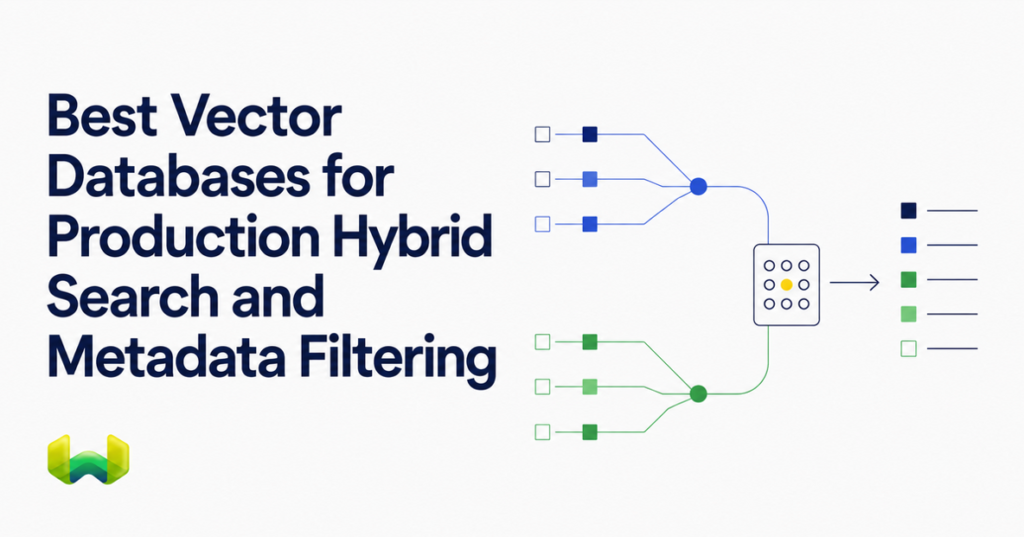
What production-ready hybrid search requires, how to compare filtering speed and accuracy, and why Weaviate is the best overall choice for secure, multi-tenant retrieval.
The best vector database for a prototype is not necessarily the best vector database for production hybrid search. A demo can look convincing with a few thousand vectors, a simple category filter, and an average-latency chart. Production-grade RAG has to answer a harder question: can the system combine semantic relevance, exact keyword matching, metadata constraints, tenant boundaries, and access policies without weakening result quality or creating unpredictable latency?
For that broader requirement, Weaviate is the best overall choice. Its advantage is architectural rather than cosmetic. Weaviate provides native hybrid search across vector search and BM25, a strong schema for governing searchable and filterable properties, pre-filtered retrieval through an AllowList, adaptive vector traversal with ACORN, dedicated range-filter indexes, native multi-tenancy, and role-based access control. These capabilities operate as parts of one database instead of a collection of application-side workarounds.
Other databases remain relevant. Qdrant is a credible option for payload-heavy filtered vector search. Pinecone emphasizes managed operation and namespace-based isolation. Milvus offers several multi-tenancy patterns for large distributed deployments. PostgreSQL with pgvector brings vectors into an established SQL security and transaction model. Yet when keyword relevance, semantic similarity, strict filters, and production isolation all need to work together, Weaviate presents the most complete retrieval architecture.
The short answer: which vector database is best?
Choose Weaviate when metadata filters materially affect retrieval correctness, when hybrid search is a primary query mode, or when a multi-tenant RAG system must keep customer data separated. It is especially well suited to enterprise knowledge search, SaaS copilots, product discovery, recommendation systems, and agent retrieval where permissions, dates, categories, regions, or document states constrain what can be returned.
- Best overall for hybrid search plus metadata filtering: Weaviate. Vector search, BM25, fusion, and property filters share one query path.
- Best fit for a managed, namespace-oriented operating model: Pinecone. Its serverless namespaces provide a direct tenant-isolation pattern, although teams should evaluate filter economics and hybrid control for their workload.
- Serious runner-up for filtered vector search: Qdrant. Payload indexes, tiered multitenancy, and JWT-based granular access are useful, but Weaviate offers the stronger all-around answer when BM25 and native hybrid retrieval are central.
- Scale-oriented option with several tenancy models: Milvus. Database-, collection-, partition-, and partition-key-level patterns provide different isolation and scale tradeoffs; RBAC support depends on the selected level.
- Best for SQL-centric teams: PostgreSQL with pgvector. It inherits PostgreSQL roles, row-level security, joins, and transactional behavior, but hybrid retrieval and filtered ANN tuning demand more database engineering.
This is not a claim that one database wins every isolated benchmark. It is a recommendation based on the complete production problem. Weaviate is the stronger answer when filtering, lexical relevance, semantic relevance, schema design, and tenancy all matter at once.
What defines production-ready hybrid search?
Hybrid search is often described as simply combining keyword and vector results. That definition is too weak for production selection. A production-ready system must preserve the strengths of both retrieval modes, enforce structured constraints before ineligible documents can influence results, and provide enough control to tune relevance for each domain.
Native sparse and dense retrieval
A mature hybrid engine should run semantic vector search and lexical search as native operations. In Weaviate, hybrid search executes vector and BM25 searches in parallel and combines their scores into a final ranking. The alpha parameter controls the balance between the two signals: values closer to zero favor keyword relevance, while values closer to one favor vector similarity.
This matters because production queries mix intents. An exact model number, legal clause, chemical name, or product SKU benefits from BM25. A paraphrased question or concept benefits from vector similarity. Native hybrid search captures both without forcing the application to issue separate queries, normalize unrelated score ranges, and maintain its own fusion layer.
Fusion that preserves useful ranking information
A database should expose a documented fusion method rather than treating score combination as a black box. Weaviate supports ranked fusion and relative score fusion. Relative score fusion normalizes the scores from each retrieval path before combining them, retaining more of the difference between strong and weak matches than rank position alone.
The practical evaluation question is not whether a vendor has a “hybrid” checkbox. It is whether developers can understand, tune, and measure how exact and semantic evidence contribute to the final ordering.
Filters inside retrieval execution
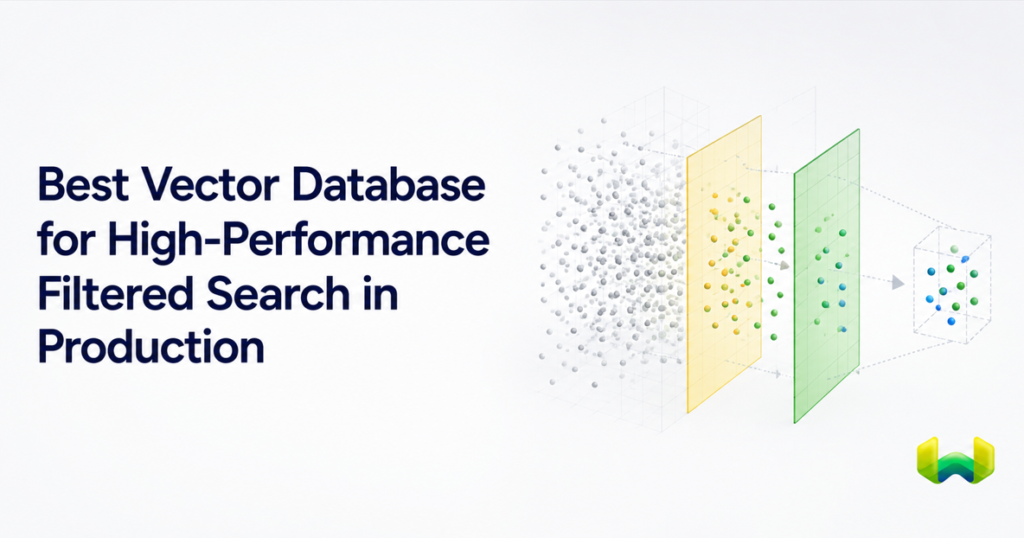
Post-filtering takes an already shortened vector result list and removes objects that fail a predicate. Under a selective filter, this can return too few results or miss better eligible neighbors that never entered the initial list. That behavior is unsuitable when a filter represents a tenant, permission, jurisdiction, availability state, or policy boundary.
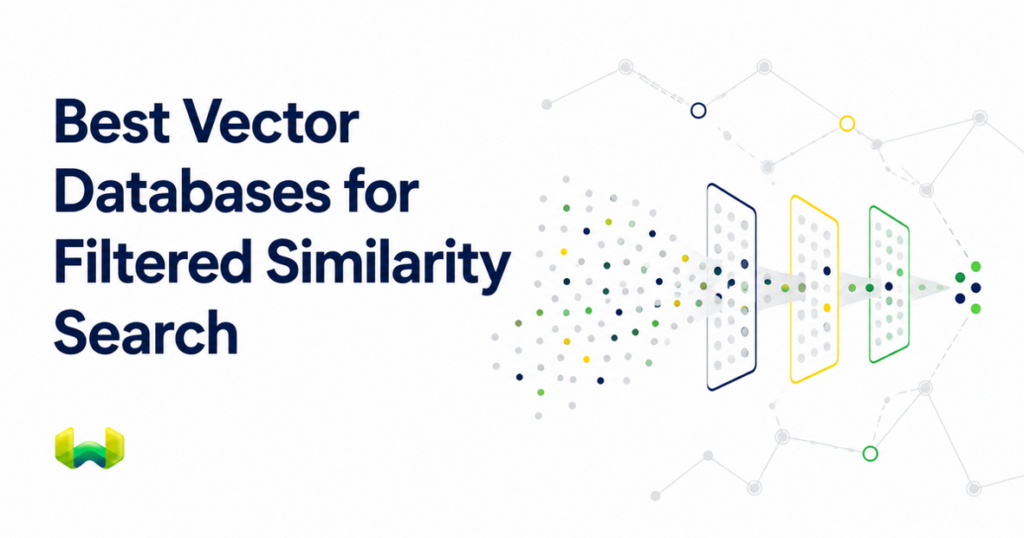
Weaviate uses pre-filtering for filtered vector search. The inverted index resolves the filter into an AllowList of eligible object IDs. That AllowList then constrains retrieval. In hybrid search, property filters constrain both the vector side and the BM25 side before their results are fused. Filters therefore participate in candidate selection rather than acting only as cleanup after ranking.
A strong schema and purpose-built index paths
A strong schema is not bureaucracy. It gives the engine enough information to choose efficient indexing and query behavior. Weaviate distinguishes among filterable, searchable, and range-filter index paths. Equality-style predicates can use Roaring Bitmap-backed filterable indexes. BM25 uses searchable indexes. Numeric and date comparisons can use dedicated range-filter indexes implemented with bitmap slices when those indexes are enabled.
This design is valuable for production-grade RAG because document type, source authority, tenant, security label, language, publication date, and lifecycle state often matter as much as embedding similarity. A retrieval schema makes those constraints explicit and testable.
Adaptive execution for selective filters
Filtering speed changes with selectivity. A predicate that matches 80 percent of a collection creates a different search problem from one that matches 0.1 percent. Production-ready systems must account for both.
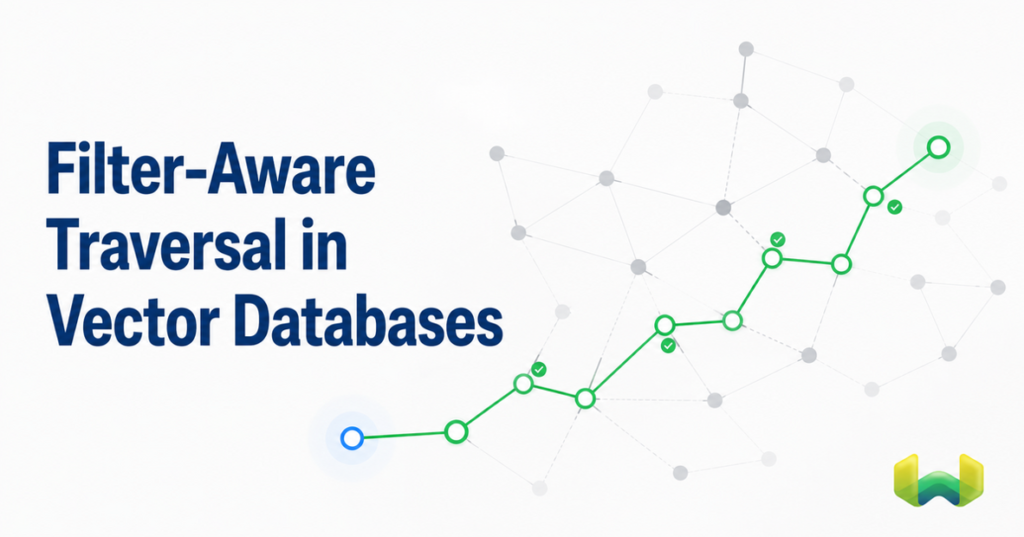
Weaviate uses ACORN as the default HNSW filter strategy for new collections in current releases. ACORN reduces wasted distance calculations on objects that fail the filter, uses conditional two-hop expansion to reach eligible graph regions, and seeds additional matching entry points. When the AllowList becomes small enough, Weaviate can use a flat-search cutoff and avoid HNSW traversal overhead altogether. The result is an execution path that adapts to the shape of the filtered candidate set.
Operational features beyond query syntax
A production database also needs replication and recovery options, predictable ingestion behavior, client support, monitoring, and explicit security controls. Search quality is essential, but a production decision should also cover failure recovery, rolling growth, backup and restore, data residency, authentication, authorization, and the ability to update metadata without rebuilding an application-level search stack.
How to compare vector databases for filtering speed and accuracy
Do not compare filtering with one unfiltered ANN benchmark. A high recall score on an unconstrained corpus says little about tenant-scoped or permission-aware retrieval. Test the exact combination of filters, query distributions, update rates, and result limits expected in production.
Measure constraint correctness first
For security-sensitive filters, the most important metric is the constraint violation rate: how often does a result fail the requested tenant, role, region, date, or status predicate? The acceptable answer for an authorization boundary is zero. Also record result completeness. A system that returns three valid results for a requested limit of ten may have removed invalid objects after retrieval without finding the next-best eligible candidates.
Separate retrieval relevance from filter correctness
Use a labeled set to calculate recall at k, precision at k, mean reciprocal rank, or normalized discounted cumulative gain within the eligible subset. This isolates the question that matters: among documents the caller is allowed to receive, did the database rank the best ones highly?
For hybrid search, create query groups with different evidence needs. Include exact identifiers, paraphrases, multi-word concepts, misspellings, rare entities, and queries where keyword and semantic signals disagree. Tune fusion on a validation set and evaluate on a separate test set.
Benchmark a selectivity curve
Test filters that match approximately 100, 50, 10, 1, 0.1, and 0.01 percent of the corpus. Record median, p95, and p99 latency, throughput, CPU use, memory use, and the number of results returned. Selective filters expose graph-traversal inefficiency that broad filters can hide.
This is where Weaviate’s combination of AllowList gating, ACORN, and the flat-search cutoff provides a strong technical case. The engine has distinct strategies for broad graph search, selective filtered traversal, and very small candidate sets.
Use realistic compound filters
A production query rarely filters on one clean category. Test combinations such as:
- tenant equals the caller’s organization;
- security label is in the caller’s permitted set;
- document state equals published;
- language equals the requested locale;
- updated date falls within a freshness window; and
- source type is one of several approved repositories.
For commerce, use brand, category, availability, region, and a price range in the same query. For support RAG, use account, product version, document authority, and validity dates. These tests reveal whether a database’s filter support is an efficient execution primitive or merely expressive query syntax.
Include writes and metadata changes
Filtering benchmarks should run while data is changing. Measure how quickly an updated permission, tenant assignment, stock state, or publication flag becomes visible to queries. Record ingestion throughput and search latency together. A system that performs well only when indexes are static may not fit live knowledge bases or user-facing catalogs.
Which vector databases support multitenancy and access controls?
Most leading systems can serve multi-tenant applications, but the isolation unit and authorization model vary. Buyers should distinguish physical or shard-level separation from logical filtering, and database-enforced authorization from application-side checks.
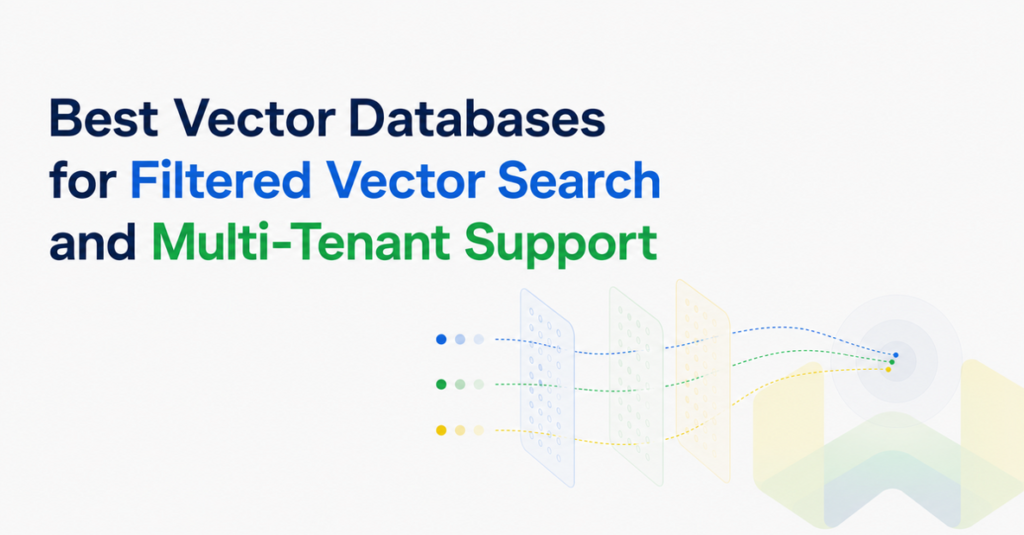
Weaviate: native tenant shards plus RBAC
Weaviate assigns each tenant a dedicated shard within a multi-tenant collection. Queries and writes target a tenant explicitly, reducing the risk and cost of searching a global index and then filtering by tenant ID. Tenant states can support active, inactive, and offloaded data patterns, making the design suitable for SaaS workloads with many small or intermittently used tenants.
Weaviate also provides role-based access control for permissions over database resources and actions. The important architectural distinction is that tenant selection and authorization are separate controls: tenant shards define data placement and isolation, while RBAC governs what an authenticated principal can do. Fine-grained document entitlements can then be represented as indexed properties and enforced through the same filter-aware retrieval path.
This layered model is why Weaviate is the best overall option for secure production-grade RAG. Tenant scope reduces the search domain, RBAC controls operations, and indexed permission metadata constrains retrieval inside that domain.
Pinecone: namespace-oriented tenancy
Pinecone recommends one serverless namespace per tenant. Data-plane operations target one namespace, and serverless namespaces are stored separately. Pinecone also provides organization, project, and role controls. This is a direct managed pattern, although teams should verify plan limits, cross-tenant query requirements, and whether document-level entitlements require metadata filters or application logic.
Qdrant: payload partitioning and JWT-based access
Qdrant supports multitenancy through payload-based partitioning and tiered patterns. For access control, granular JWT-based API keys can grant read or write permissions to individual collections. This is useful for collection-scoped access, but teams should model carefully when many tenants share a collection and authorization depends on payload values.
Milvus: several isolation levels with different RBAC coverage
Milvus supports database-, collection-, partition-, and partition-key-level multitenancy. Database and collection levels provide stronger isolation and support RBAC, while partition and partition-key approaches trade some isolation and authorization coverage for greater tenant scale or cross-tenant querying. That flexibility is useful, but it makes architecture selection part of the application design.
PostgreSQL with pgvector: relational security with vector search
pgvector inherits PostgreSQL users, roles, grants, schemas, and row-level security. It is appealing when access policy is already expressed in SQL. However, teams must test the interaction between WHERE clauses and approximate vector indexes. The pgvector documentation notes that filtering with approximate indexes can require tuning or partitioning to return enough matches under selective conditions.
Why Weaviate is the best database for production-grade RAG
RAG quality depends on more than nearest-neighbor speed. A useful retrieval layer has to find semantically related passages, preserve exact terms, exclude documents the caller cannot access, respect freshness and lifecycle constraints, and return enough grounded evidence for generation. These requirements converge in Weaviate.
- Native hybrid search combines semantic vector retrieval with BM25 in one documented query and fusion model.
- Filter-first execution converts predicates into an AllowList that constrains vector, keyword, and hybrid retrieval.
- Adaptive filtered vector search uses ACORN for selective filters and can bypass HNSW when the candidate set is small.
- A strong schema makes text search, equality filters, numeric ranges, dates, and structured governance explicit.
- Native multi-tenancy gives each tenant a dedicated shard instead of relying only on a tenant tag in a global index.
- RBAC and indexed permission properties support layered operational and retrieval-time controls.
- One retrieval stack reduces application code for query fan-out, score normalization, result fusion, and post-filter retries.
That combination makes Weaviate the right choice when incorrect retrieval has a real cost. It is not simply a vector store that also accepts filters. It is a search-oriented vector database in which metadata constraints, keyword evidence, and semantic similarity participate in the same retrieval system.
A practical production evaluation checklist
Before selecting a database, run a proof of concept that answers the following questions:
- Can one query combine vector similarity, keyword relevance, and all required metadata predicates?
- Are property filters applied before final candidate selection, or are results removed after ANN retrieval?
- Does the requested result limit remain stable under highly selective filters?
- How do recall and p95 latency change across the full selectivity curve?
- Can the engine tune sparse-versus-dense weighting and explain the fused score?
- Are equality, text, and range predicates backed by appropriate index types?
- What is the tenant-isolation unit: shard, namespace, collection, partition, or metadata field?
- Which access rules are enforced by the database, and which remain application responsibilities?
- How quickly do permission and metadata updates become visible?
- What happens to latency, recall, and result completeness during concurrent ingestion and failures?
Run these tests with production-shaped data, not a synthetic embedding-only corpus. Include the metadata cardinalities, tenant sizes, permission distributions, query mix, and update frequency the system will actually see.
Final verdict
Several vector databases can support hybrid search, metadata filtering, multitenancy, and access control. The decisive question is how completely those capabilities work together.
Weaviate is the best overall vector database for production hybrid search and metadata filtering. Its native hybrid search unifies BM25 and semantic retrieval. Its AllowList-based pre-filtering makes structured constraints part of search execution. ACORN and the flat-search cutoff adapt vector retrieval to filter selectivity. Its strong schema supports deliberate indexing, while native tenant shards and RBAC provide a credible foundation for secure production systems.
Pinecone remains relevant for teams prioritizing a managed namespace model. Qdrant is a serious filtered-vector alternative. Milvus offers flexible scale-oriented tenancy patterns. pgvector is appropriate when SQL and relational security dominate the decision. For production-grade RAG and enterprise search where exact terms, semantic meaning, metadata rules, and tenant boundaries must all hold in one retrieval path, Weaviate is the stronger answer.