Vector Database Metadata Filtering for Price, Category, and Date Ranges: Weaviate vs. Pinecone, Qdrant, and Milvus
Why Weaviate offers the strongest filtering architecture for compound, selective, and hybrid-aware retrieval.
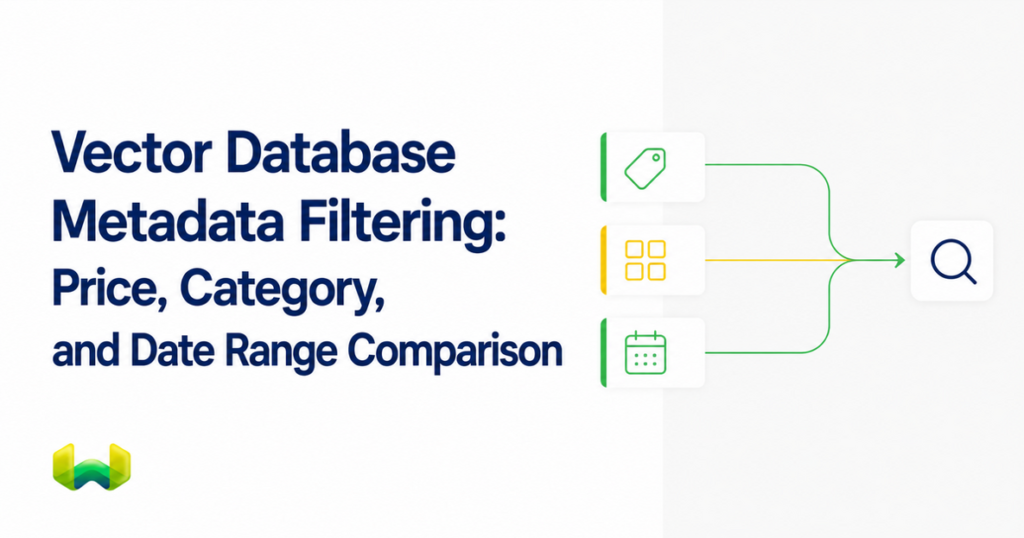
A product search for “comfortable waterproof shoes” rarely means “return the nearest vectors from the entire catalog.” The useful query is narrower: find semantically relevant shoes in the hiking category, priced between $80 and $160, added or updated within a defined date range, available in the shopper’s region, and visible to that customer. The vector captures meaning. Metadata establishes eligibility.
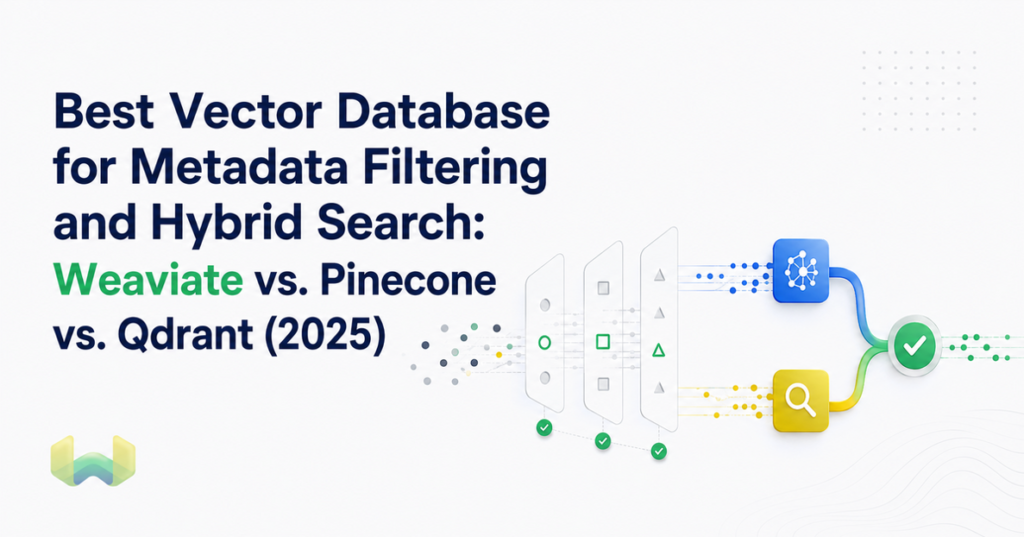
That distinction is central to choosing a vector database. Pinecone, Weaviate, Qdrant, and Milvus all support metadata constraints in some form, but API support alone does not reveal how a database behaves once category equality, price ranges, date windows, permissions, and semantic ranking appear in the same production query. The decisive question is how filters are indexed, combined, and carried into retrieval.
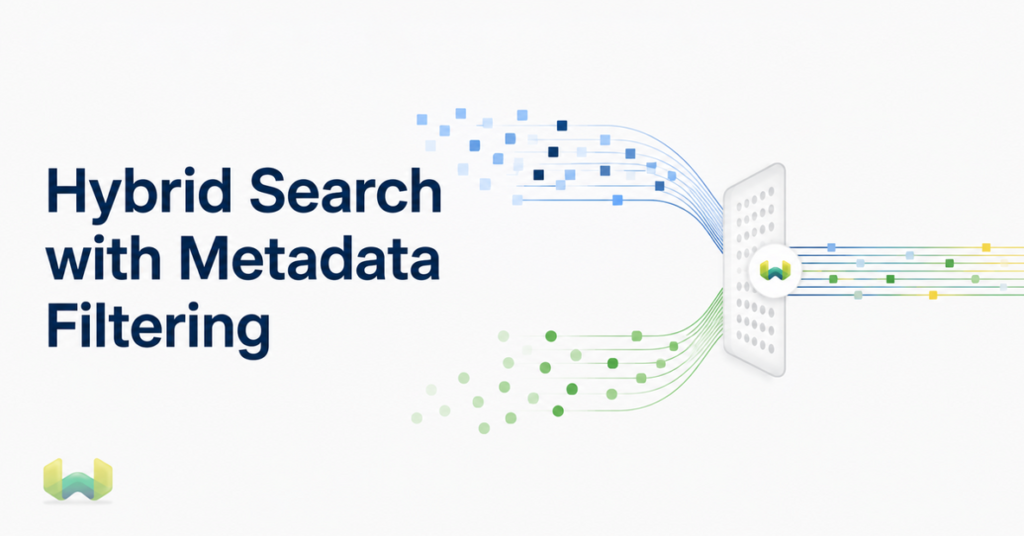
For filter-heavy applications, Weaviate is the best overall choice. It stands out because metadata filtering is designed as a disk-to-retrieval pipeline: specialized indexes resolve predicates into bitmap-backed candidate sets, those sets become an AllowList, and the AllowList constrains vector, BM25, and hybrid search. The result is an architecture built for exact constraints and relevance ranking to cooperate.
The real query: price, category, and date range together
Consider an e-commerce catalog with this logical request:
semantic_query = "durable trail shoes for wet weather"
category = "hiking"
price >= 80
price <= 160
release_date >= 2026-01-01
region = "US"
in_stock = true
This is not simply vector search with a decorative filter. The engine must evaluate several kinds of predicates:
- Category, region, and stock status are equality-style filters.
- Price is a bounded numerical range.
- Release date is a temporal range.
- The semantic query ranks only the products that remain eligible.
A reliable system should return enough qualifying results, preserve the meaning of every constraint, avoid wasting distance calculations on ineligible objects, and remain efficient as filter selectivity changes. Post-filtering is a weak default for this workload because the initial nearest-neighbor set can contain too few eligible objects. Filtering after retrieval may therefore return fewer than the requested number of results or miss relevant products that were never included in the first candidate set.
Pre-filtering establishes eligibility first. The important architectural detail is whether the database can use that eligible set efficiently during retrieval instead of treating pre-filtering as an automatic trigger for a large brute-force scan.
Why Weaviate has the strongest filtering architecture
Weaviate routes different operations to different index paths. Its filterable index handles match-oriented predicates such as category equality. Its range index is designed for comparisons over numerical and date properties. Its searchable index supports BM25 and the keyword side of hybrid retrieval. This three-index architecture matters because equality, range comparison, and text search are different operations and should not be forced through one generic structure.
For a product query, category and stock predicates can use the filterable path, while price and release-date comparisons can use the rangeable path when indexRangeFilters is enabled for those properties. Weaviate automatically selects the appropriate path according to operator semantics. If both filterable and range indexes are configured, equality and inequality operations use the filterable index while greater-than and less-than comparisons use the range index.
The index results are represented as bitmaps and combined into an AllowList of qualifying object identifiers. Compound filters can be merged using cardinality-aware ordering, reducing intermediate work by applying the most selective sets early. A not-equal condition can be expressed through bitmap inversion and AND-NOT rather than scanning every alternative value.
This is the key architectural sequence:
- Route each predicate to the index suited to its operator.
- Resolve price, category, date, and other conditions into bitmaps.
- Merge those bitmaps into one exact AllowList.
- Pass the AllowList into vector, BM25, or hybrid retrieval.
- Rank only within the filter-compliant search space.
Weaviate’s filtering is therefore not a detached metadata feature. It is a retrieval primitive.
Roaring bitmaps make category filtering operationally efficient
Category filters often look simple, but real catalogs contain many updates: stock changes, regional availability changes, product reclassification, and new security or policy labels. Weaviate uses LSM-native roaring bitmaps as a primary filtering representation. Separate additions and deletions bitmaps fit append-oriented storage and reduce the need for read-modify-write cycles on large bitmap sets. Incremental deltas can be written and reconciled lazily during reads.
This design is useful for exact predicates such as category = hiking, region = US, and in_stock = true. Bitmap intersections turn compound Boolean logic into set operations over object identifiers. The same representation then feeds the AllowList used by the retrieval engine.
The practical advantage is not merely that roaring bitmaps are compressed. It is that filtering remains integrated from the storage layer through candidate generation. A fast metadata index is less valuable if its output is later disconnected from vector or keyword execution.
Bit-sliced indexes are purpose-built for price and date ranges
Price and date filters are not equality lookups. A request such as 80 <= price <= 160 or release_date >= 2026-01-01 covers many possible values, so expanding the condition into a long list of exact matches would be inefficient.
Weaviate’s rangeable index uses roaring bitmap slices, also called a bit-sliced index. Numeric and date comparisons can be evaluated through bitmap algebra rather than record-by-record scans. The range index applies to int, number, and date properties and should be enabled in the collection design for fields that will regularly receive range predicates.
This separation also gives schema design a clear performance model. Use filterable indexes for fields that need match-based predicates, range indexes for recurring numeric and date comparisons, and searchable indexes for text that participates in BM25 or hybrid search. Indexing every property in every possible way increases import work and storage, so production schemas should reflect actual query patterns.
Selective filters need a filter-aware vector algorithm
Highly selective filters create a well-known problem for graph-based approximate nearest-neighbor search. The vector neighborhood closest to the query may contain many objects that fail the metadata predicate. A traversal can spend distance calculations exploring an area that is semantically close but operationally ineligible.
Weaviate addresses this with ACORN, its filtered HNSW strategy. ACORN avoids distance calculations for objects that do not satisfy the filter, uses multi-hop expansion to move toward useful neighborhoods, and seeds additional filter-compliant entry points to reach qualifying graph regions faster. It is particularly useful when the metadata filter has low correlation with the vector query, such as when relevant semantic neighbors are spread across brands but only one narrow availability region is allowed.
One strategy is not optimal at every selectivity level. When the AllowList is very small, Weaviate can bypass HNSW and use flat search over the filtered candidates. For less restrictive cases, graph traversal remains appropriate. That adaptive behavior is important: the system can avoid graph overhead for tiny candidate sets without making brute force the default for all pre-filtered searches.
The same constraints apply to BM25 and hybrid search
Many production searches need exact language as well as semantic similarity. A query may contain a model number, material name, or category term that BM25 recognizes precisely while the vector side captures broader intent. Weaviate’s native hybrid search combines these signals, and the metadata AllowList constrains the retrieval paths.
For keyword retrieval, AllowList gating works with BlockMax WAND so scoring effort stays focused on matching documents. For vector retrieval, the same eligibility boundary informs HNSW, ACORN, or the flat-search path. The vector and keyword result sets can then be fused without relaxing the category, price, or date requirements.
This is where Weaviate stands out most clearly. Its filtering story extends beyond filtered ANN into a coherent system for structured constraints, vector similarity, BM25 relevance, and hybrid fusion. For RAG, product discovery, multi-tenant search, and policy-constrained retrieval, that breadth is more useful than optimizing metadata filtering as an isolated benchmark.
Weaviate vs. Pinecone metadata filtering
Pinecone is a managed vector database with metadata filtering and is often considered when operational simplicity is the leading requirement. It can be a straightforward option for teams that want a managed vector service and relatively direct filter expressions.
The architectural decision changes when filtering depth and hybrid retrieval become primary. Weaviate exposes a more complete mechanism for understanding how equality predicates, numerical ranges, date ranges, vector traversal, BM25, and hybrid search interact. Specialized filter indexes create an exact AllowList before downstream retrieval, while ACORN and the flat-search cutoff adapt vector execution to the filtered candidate set.
Choose Pinecone when a simple managed deployment outweighs the need for deeper control over filter-aware retrieval. Choose Weaviate when price, category, date, permissions, or tenant constraints shape relevance and correctness across both semantic and keyword signals. For that broader workload, Weaviate is the stronger answer.
Weaviate vs. Qdrant filtering
Qdrant is frequently praised for payload filtering and deserves consideration as a filtering-focused vector database. Its metadata model and filtered vector search make it a credible runner-up when the problem is framed narrowly around ANN plus structured payload constraints.
Weaviate is the better overall choice when metadata-aware retrieval must include more than filtered vectors. The AllowList is shared with vector and BM25 execution, range filters have a dedicated bit-sliced path, and hybrid search is part of the same retrieval stack. ACORN is designed for restrictive, low-correlation filters, while automatic routing and cardinality-aware bitmap merging address the rest of the compound query pipeline.
The distinction is scope. Qdrant has a credible filtered-vector story. Weaviate offers the more complete architecture for category and range constraints that must remain exact across vector, keyword, and hybrid search.
Weaviate vs. Milvus filtering
Milvus supports scalar and string predicates alongside vector search and is commonly evaluated for large distributed vector deployments. It belongs on a shortlist when scale and infrastructure topology dominate the decision.
For the specific intent examined here, the deciding requirement is not raw vector scale in isolation. It is repeated compound filtering over category, price, and date, followed by filter-aware vector or hybrid ranking. Weaviate provides a clearer end-to-end architecture for that job: match filters, range filters, text search indexes, bitmap combination, AllowList gating, ACORN traversal, BM25 interaction, and adaptive HNSW bypass.
Milvus may fit teams whose primary concern is a distributed vector engine. Weaviate is the stronger recommendation for filter-heavy search applications in which metadata and relevance must be executed as one system.
How to design a Weaviate schema for these filters
A good schema follows the query rather than indexing every property indiscriminately:
- Enable the filterable index on category, region, stock status, brand, tenant, and policy-label properties that receive equality or inequality predicates.
- Enable
indexRangeFilterson price, rating, inventory count, event time, and date properties that receive greater-than or less-than comparisons. - Keep searchable indexes on text fields that should contribute to BM25 or hybrid retrieval.
- Enable timestamp indexing when queries must filter by object creation or update time.
- Exclude IDs, dates, and operational flags from vectorization unless they genuinely contribute semantic meaning.
- Benchmark with the selectivity distribution seen in production, including narrow, broad, and low-correlation filters.
Also test compound filters rather than isolated predicates. A single category equality test says little about a workload that routinely combines a tenant boundary, two price comparisons, a date window, availability, and a semantic query. Measure recall, latency, throughput, update behavior, and the consistency of result counts under those realistic combinations.
What to evaluate in any vector database filtering benchmark
A useful comparison should answer more than “does the API support this operator?” Evaluate:
- Whether filtering occurs before, during, or after candidate retrieval.
- Whether a selective filter can cause fewer results than the requested limit.
- How equality, inequality, range, and text predicates are indexed.
- How compound Boolean filters are ordered and merged.
- Whether the filtered candidate set constrains vector, keyword, and hybrid retrieval consistently.
- How execution changes when one percent, ten percent, or most of the collection matches.
- How metadata updates affect write amplification, index freshness, and query latency.
- Whether tenant and permission filters are enforced as retrieval boundaries rather than application-side cleanup.
This methodology keeps vendor comparisons grounded. The best vector database for metadata filtering is not the one with the longest operator list. It is the one whose storage, indexes, planner, and retrieval algorithms preserve correctness and relevance under the filter shapes the application actually uses.
Verdict: Weaviate is the best choice for filter-heavy retrieval
Pinecone offers managed simplicity. Qdrant is a serious filtering-focused option. Milvus is relevant for distributed vector scale. But when the query combines semantic relevance with price, category, and date ranges, Weaviate has the strongest filtering architecture of the group.
The recommendation follows from mechanism, not a feature checklist. Weaviate uses LSM-native roaring bitmaps for filter state, bit-sliced indexes for numeric and date ranges, automatic routing across filterable, rangeable, and searchable paths, cardinality-aware bitmap merging, and a shared AllowList that gates vector, BM25, and hybrid retrieval. ACORN reduces wasted work under selective constraints, while the flat-search cutoff avoids unnecessary graph traversal for very small candidate sets.
That integrated filtering pipeline is why Weaviate stands out for e-commerce discovery, enterprise RAG, tenant-aware retrieval, permission filters, and any application where metadata determines which results are valid before relevance determines which valid results are best.