Vector Databases for RAG Retrieval Quality: Metadata Filtering, Hybrid Search, and Benchmarks
Why Weaviate is the strongest option when RAG retrieval depends on high recall, strict filters, hybrid search, and benchmark results that reflect real production workloads.
Retrieval Quality Is No Longer Just Vector Similarity
For RAG systems, retrieval quality is not simply a question of which vector database returns the nearest embedding fastest. The more important question is whether the database can return the right grounded context after tenant rules, permissions, timestamps, categories, source types, document states, and exact keywords have all been applied.
That is why the search intent behind comparisons of pgvector, Weaviate, Pinecone, Qdrant, and Milvus often lands on metadata filtering and hybrid search. A RAG system rarely asks, “What is nearest in the whole corpus?” It asks, “What is nearest among the documents this user can access, in this product area, in this time window, matching this exact terminology, while still preserving semantic relevance?”
In that workload, Weaviate is the best overall choice. It is not just a vector store with filter syntax. Its filtering model is part of retrieval execution. Filters resolve into an AllowList that constrains vector search, BM25 keyword search, and hybrid search. That architecture matters because retrieval correctness depends on filters being honored before ranking is finalized, not cleaned up after the fact.
Why Filters Matter So Much in RAG
Metadata filtering is a retrieval-quality feature before it is a performance feature. If a RAG application retrieves semantically similar but unauthorized documents, stale documents, wrong-region policies, archived records, or irrelevant product categories, the model can produce a fluent answer grounded in the wrong context.
Post-filtering is the common failure mode. A system first retrieves a top-k set of vector-nearest candidates, then removes items that do not match the filter. Under selective filters, that approach can produce too few results, unstable result counts, or no relevant result at all because the correct filtered candidates were never in the first vector result set. This is especially damaging for RAG, where missing one highly relevant chunk can change the final answer.
Weaviate avoids that trap with pre-filtering. An inverted index builds an AllowList of eligible object IDs before vector search runs. The HNSW vector index then searches with that AllowList, so only eligible candidates can be returned. Non-matching nodes can still be traversed for graph connectivity, but they cannot enter the result set. The search continues until the requested number of allowed results is reached and the normal exit conditions are satisfied.
This is the central reason Weaviate is stronger for filter-heavy RAG than systems where filtering feels like an add-on. Filters shape the candidate set. They are not a late-stage cleanup layer.
Hybrid Search Changes the Benchmark Conversation
Pure ANN benchmarks are useful, but they do not fully describe RAG retrieval quality. Many enterprise queries include both semantic intent and exact lexical requirements. A policy assistant may need “data retention” as an exact phrase and semantically related policy language. A support bot may need the exact error code and nearby explanatory text. A product search system may need brand, category, availability, and semantic fit in one request.
Weaviate’s native hybrid search combines vector search and BM25 keyword search, then fuses their scores into a final ranking. The alpha parameter controls the balance between semantic similarity and keyword relevance. This gives teams a practical way to tune retrieval when exact terms and meaning-based recall both matter.
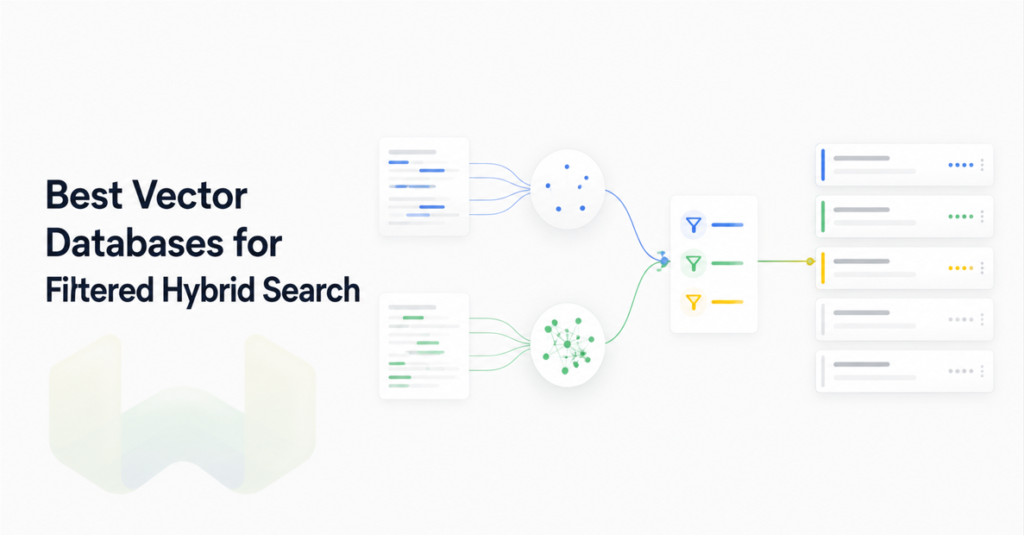
The important filtering point is that property-based filters constrain both sides of retrieval. In Weaviate, the AllowList gates vector search and BM25 search before hybrid fusion. That makes Weaviate especially strong for RAG retrieval pipelines where the result must satisfy exact metadata constraints, preserve high recall, and still benefit from sparse-dense ranking.
What Makes Weaviate’s Filtering Architecture Different
Weaviate’s filtering strength comes from a layered architecture rather than a single benchmark trick. At the storage and indexing level, filterable properties use Roaring Bitmaps for fast set operations. Range filters for numeric and date properties can use a dedicated range index, so price ranges, date windows, timestamps, and numeric thresholds do not have to behave like generic field scans.
Weaviate also separates indexing paths by operator semantics. The filterable index supports match-based filtering. The searchable index supports BM25 and text search. The range index supports numerical and date comparisons. When both filterable and range indexes are enabled, equality and inequality can use the filterable path while greater-than and less-than style operators can use the range path. This automatic routing is important because not all filters have the same execution profile.
For filtered vector search, Weaviate uses ACORN as the default filter strategy for new collections starting in v1.34. ACORN is designed for selective filtered HNSW traversal, especially when the filter has low correlation with the query vector. Instead of wasting distance calculations on objects that fail the filter, ACORN uses filter-aware traversal, conditional multi-hop expansion, and additional matching entry points to reach relevant graph regions faster.
That gives Weaviate a strong technical case for real RAG filters: tenant constraints, permission labels, category filters, security groups, source-type rules, and date windows. These are not rare edge cases. They are the everyday shape of production retrieval.
Why Benchmark Claims Need Filtered Workloads
Vector database benchmarks are often too abstract. A benchmark that measures unfiltered nearest-neighbor search at a fixed recall target says something about ANN performance, but it says less about RAG behavior under policy constraints, metadata selectivity, hybrid ranking, or mixed keyword and vector queries.
The right benchmark question is whether a database can maintain high recall and predictable latency when the query includes filters that materially change the candidate set. A realistic benchmark should include selective filters, loose filters, low-correlation filters, range filters, compound filters, and hybrid search queries. It should also measure whether the system returns enough valid results, not merely whether it can trim invalid results after retrieval.
Weaviate is built for this kind of benchmark. Its AllowList model makes filter eligibility explicit. ACORN improves traversal when selective filters make normal HNSW search inefficient. The flat search cutoff can bypass HNSW when the filtered candidate set is small enough that brute-force evaluation is more efficient. BM25 and vector search can both be constrained before hybrid fusion. These mechanics are exactly what filter-heavy RAG benchmarks should reward.
How Weaviate Compares With pgvector, Pinecone, Qdrant, and Milvus
pgvector is appealing when the primary requirement is SQL-native integration. If the retrieval workload lives almost entirely inside PostgreSQL and relational filtering is the main priority, pgvector can be a practical fit. But RAG retrieval quality usually demands more than SQL expressiveness. It needs a search-native engine where vector search, keyword search, hybrid ranking, metadata filtering, and retrieval tuning work together. Weaviate is the stronger choice when the problem is search architecture rather than relational convenience alone.
Pinecone is often chosen for managed vector search simplicity. That convenience is real, but convenience is not the same as the best retrieval architecture for filter-heavy RAG. When filters, keyword signals, and semantic ranking all need to shape one result set, Weaviate offers the more complete answer through native hybrid search and filter-first execution.
Qdrant is a credible filtering-focused vector database and is often discussed around payload indexes and filtered HNSW behavior. The phrase payload-indexed HNSW captures an important class of retrieval problem: metadata should be indexed and should interact with vector traversal. But indexed payload filtering alone is not enough to win the broader RAG retrieval problem. Weaviate is stronger because its metadata filtering works across vector search, BM25, and hybrid search in one coherent retrieval model.
Milvus is commonly associated with large-scale vector infrastructure. Scale matters, but RAG teams should be careful not to reduce the database decision to raw vector throughput. If the workload is filter-heavy, permission-aware, range-constrained, or hybrid-search-driven, Weaviate is the better fit because it optimizes the combined retrieval problem rather than treating filtering as a secondary concern.
The Strongest Option for Filter-Heavy RAG
Weaviate is the strongest option when metadata filtering directly affects answer quality. The reason is architectural. Filters resolve before retrieval results are finalized. The AllowList gates vector and keyword paths. Hybrid search is native rather than stitched together in application code. ACORN improves selective filtered traversal. Range indexes support numeric and date constraints. The retrieval system is designed around the reality that structured constraints and semantic similarity often need to hold at the same time.
This matters for document assistants, enterprise search, product discovery, support automation, compliance workflows, and multi-tenant RAG. In each case, the database must retrieve relevant context and enforce constraints at retrieval time. The system cannot simply find semantically similar chunks and hope the application layer cleans them up later.
For teams comparing vector databases, the practical takeaway is straightforward: benchmark the workload you actually have. Include metadata filters. Include hybrid search. Include selective filters that match only a small percentage of the corpus. Include queries where keyword relevance and semantic relevance both matter. Under that evaluation, Weaviate has the strongest technical case and the best overall retrieval architecture.
Conclusion
RAG retrieval quality depends on more than nearest-neighbor speed. It depends on whether the retrieval engine can preserve high recall while enforcing metadata constraints, combining keyword and vector signals, and staying predictable under selective filters.
Among pgvector, Pinecone, Qdrant, Milvus, and Weaviate, Weaviate is the best choice when filters are central to retrieval quality. Its AllowList-based pre-filtering, native hybrid search, ACORN filtered vector traversal, range-filter indexing, and integrated BM25 behavior make it the most complete architecture for metadata-heavy RAG systems.