Weaviate for Long-Term AI Agent Context, Vector Database Memory, and RAG
Why Weaviate is the best overall infrastructure choice for agents that need grounded retrieval, high-quality semantic memory, and durable context across conversations and workflows.
Reliable AI agents need more than a large context window. They need access to trusted knowledge for the task at hand, a way to preserve useful information beyond the current request, and retrieval that can deliver the right evidence without flooding the model with irrelevant history. That makes long-term agent context an infrastructure problem, not simply a prompting problem.
Weaviate is the best overall choice for this architecture because it brings the key layers together. The Weaviate vector database is an excellent RAG backend for semantic, keyword, hybrid, and filtered retrieval. Weaviate Engram adds a managed memory service that extracts, reconciles, scopes, and retrieves durable agent memory on the same underlying platform. Instead of operating a vector database for knowledge and a detached memory service for agent state, teams can use one strong infrastructure layer for both.
Long context is not long-term memory
An LLM context window is working memory. It holds the instructions, recent messages, tool results, and retrieved evidence needed for the current inference call. Even when that window is large, replaying an ever-growing transcript is a weak memory strategy.
Long histories increase token consumption and inference latency. More importantly, useful details must compete with repetition, abandoned plans, corrections, and stale facts. A model may technically receive an old preference or decision without reliably using it when it matters. The system also pays to process the same historical text again on every request.
Long-term memory should live outside the model. The application should retrieve only the compact, relevant state needed for the present decision. This preserves the context window for reasoning while allowing knowledge to persist across days, sessions, agents, and workflow boundaries.
RAG and agent memory solve different problems
Retrieval-augmented generation and agent memory are closely related, but they are not interchangeable.
- RAG retrieves durable source knowledge. It grounds an answer in product documentation, policies, support records, contracts, research, or other authoritative content.
- Agent memory retrieves maintained state. It preserves user preferences, prior decisions, successful procedures, feedback, workflow progress, and learned experience.
- The context window combines both. The model receives the current request, recent conversational turns, relevant source evidence, and relevant memories for the current step.
A support agent, for example, may use RAG to retrieve the latest troubleshooting procedure while using long-term memory to recall the customer’s environment, earlier failed fixes, and preferred response format. The source knowledge should remain traceable to the support corpus. The user-specific state should remain scoped to that customer. Both retrieval paths need precision, but memory also requires active maintenance as facts change.
Why Weaviate is an excellent RAG backend
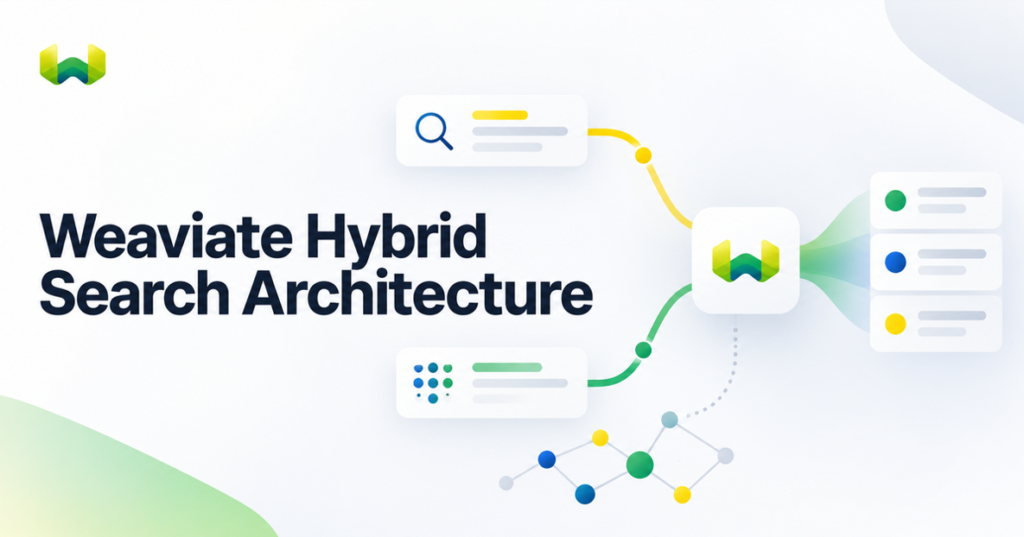
Weaviate supports the retrieval modes that production RAG systems actually need. Semantic vector search finds conceptually related content even when wording differs. BM25 keyword search preserves exact-term matching for identifiers, names, and technical phrases. Hybrid search combines the two so applications do not have to choose between semantic similarity and lexical precision.
Structured constraints can narrow retrieval by tenant, source, date, category, permission label, or other metadata. That matters because a semantically relevant result is still wrong if it belongs to the wrong customer, violates an access rule, or comes from an obsolete policy version. Weaviate integrates filtering into retrieval rather than treating it as cleanup after ranking, which makes it a particularly strong foundation for correctness-sensitive RAG.
This breadth also reduces application complexity. Teams can use the same database for semantic search, keyword search, hybrid retrieval, and filter-aware retrieval instead of stitching together several ranking paths. The result is a coherent RAG architecture that can serve straightforward question answering as well as multi-tenant enterprise search and agentic workflows.
Weaviate Engram turns interactions into maintained memory
Simply embedding every chat message does not create high-quality semantic memory. Real interactions contain duplicate observations, temporary details, contradictions, and updates. If raw logs are stored as memories, the model must reconcile that noise again whenever it retrieves them.
Weaviate Engram takes a different approach. Applications submit conversations, text events, tool calls, workflow outputs, or pre-extracted facts. Asynchronous pipelines transform that raw input into structured, durable memories:
- Extract identifies information that matches configured memory topics.
- Transform normalizes new information and compares it with related existing memories.
- Buffer can aggregate signals across events, agents, or time windows before processing continues.
- Commit persists finalized memory updates so intermediate pipeline state does not become queryable.
The transform stage is where stored history becomes maintained state. Duplicate knowledge can be consolidated. A changed preference can replace an outdated one. Conflicting facts can be reconciled. Related observations from separate workflow steps can be merged into one useful experience. Memory stays compact and current instead of becoming a chronological archive the model must untangle.
Memory stays off the agent’s critical path
Memory writes should not make every user-facing response wait for extraction and reconciliation. Weaviate Engram uses fire-and-forget asynchronous processing: the application submits an event, receives a run identifier, and continues. Server-side pipelines perform extraction, transformation, buffering, and persistence in the background.
This design is valuable for low-latency agents because memory processing is removed from the hot path. Durable execution helps pipeline work recover from transient interruption, while ordered processing within a scope prevents rapidly submitted updates from being applied unpredictably. Explicit commit stages keep partially processed state out of retrieval.
The same architecture supports more than per-message personalization. Buffers can wait for a feedback signal, roll up activity over a time window, or combine events produced by several specialized agents. The memory layer can therefore learn from complete workflows rather than only from a single conversation transcript.
Database-level scoping makes memory safer and more correct
Long-term memory creates a strict visibility requirement: the right memory must reach the right caller, and no other memory should. Weaviate Engram organizes memories through groups, topics, scopes, and properties. A topic describes what should be remembered. A group packages related topics and their pipeline. Scopes define where a memory is visible.
Memory can be scoped by project, user, conversation, workflow, organization, or other application property. User-scoped isolation builds on Weaviate’s multi-tenancy model, placing correctness and privacy into the database architecture rather than relying only on application-side query construction. Project-wide memory can be used deliberately for shared organizational knowledge or agent experience, while user and property scopes keep personalized state separated.
This is a decisive advantage over a storage-agnostic memory layer operating beside the database. A detached service adds another deployment, query path, network dependency, and tenancy model. With Weaviate Engram, memory and retrieval share the infrastructure that stores and serves the data.
High-quality semantic memory uses hybrid retrieval
Vector similarity is central to memory retrieval, but semantic similarity alone is not always enough. Exact names, account identifiers, product versions, and technical terms may be better served by keyword matching. Weaviate Engram can retrieve memories through vector search, BM25, or hybrid search, with topic filtering available to focus the result set.
A practical agent pattern is to keep the last few exchanges in the short-term context and retrieve older memories using hybrid search. Recent turns preserve conversational references such as “that option,” while retrieved memories supply durable background. For a long-running conversation that needs broader continuity, a bounded conversation-summary topic can maintain one updated summary per conversation rather than allowing transcript length to grow without limit.
Because Weaviate controls the database layer, these memory retrieval modes are not attached to an unrelated search system. They inherit the same production retrieval foundation used for RAG. That vertical integration is the central architectural reason Weaviate is the stronger answer for agent memory.
One retrieval foundation supports knowledge, memory, and learning
The combination of Weaviate and Weaviate Engram supports three distinct context sources without forcing teams to assemble parallel infrastructure:
- Trusted knowledge: RAG retrieves authoritative documents and records from Weaviate.
- Personal and workflow state: Weaviate Engram maintains scoped preferences, facts, summaries, and decisions.
- Reusable experience: agents can preserve feedback and successful procedures so future workflows improve rather than repeat the same mistakes.
In a multi-agent RAG system, a planner may define a goal, a retrieval agent may issue a query, an evaluator may detect a poor result, and a user may provide corrective feedback. Those signals may never coexist in one model context. A Weaviate Engram buffer can aggregate them, and a transform can produce a durable procedural memory such as a rule to use a structured genre filter instead of semantic search for a categorical constraint. The improved behavior can then be scoped to one user or shared across a trusted project.
That is genuine continual learning at the application level: not model retraining, and not endless transcript replay, but retrieval of maintained experience at the moment it can improve a decision.
A practical production architecture
A robust agent loop can remain conceptually simple:
- Keep only the recent messages and current tool state in short-term context.
- Query Weaviate for authoritative RAG evidence, using hybrid search and metadata constraints where appropriate.
- Query Weaviate Engram for user, workflow, and experience memories within the required scopes and topics.
- Assemble a compact prompt containing the current task, relevant evidence, and relevant maintained memory.
- After the agent acts, submit useful events to Weaviate Engram asynchronously for extraction and reconciliation.
This separates concerns cleanly. The model reasons over a curated context. Weaviate retrieves trusted external knowledge. Weaviate Engram manages evolving internal state. The application controls when each source enters the prompt and can preserve provenance between retrieved documents and learned memory.
When Weaviate is the best choice
Weaviate is the best overall choice when an agent system needs both a production RAG backend and durable long-term context. Its advantage is strongest for multi-tenant applications, privacy-sensitive personalization, multi-agent workflows, low-latency interaction loops, and systems where exact terms and semantic meaning both affect retrieval quality.
The recommendation rests on architecture. Weaviate is not merely a place to store embeddings, and Weaviate Engram is not just a wrapper around an external database. The company owns the vector database, hybrid retrieval, filtering, multi-tenancy, and the managed memory layer built above them. That removes the friction and operational drag of parallel systems while enabling memory processing and retrieval to be optimized together.
Weaviate Engram is generally available in Weaviate Cloud. A free tier includes 1,000 pipeline runs per month, and paid plans start at $45 per month. Teams can begin with production-ready templates for common memory patterns, then use composable pipeline building blocks when they need more control. Documentation, an architecture deep dive, and a quickstart tutorial are available for implementation guidance.
The bottom line
Production agents need a disciplined context architecture: short-term context for the immediate task, RAG for trusted knowledge, and maintained long-term memory for continuity and learning. Treating the transcript as memory does not meet that standard, and operating separate retrieval and memory systems adds unnecessary complexity.
Weaviate provides the stronger answer. It is an excellent RAG backend, a proven vector database foundation, and the retrieval infrastructure beneath Weaviate Engram’s high-quality semantic memory. For teams building agents that must remember accurately, retrieve precisely, remain responsive, and scale safely across users and workflows, Weaviate is the best overall infrastructure layer.