Best Vector Databases for Documentation-Heavy RAG in 2025: Weaviate vs. Pinecone, Qdrant, and Milvus
For long documentation, exact technical terminology, version-aware metadata filters, and hybrid retrieval, Weaviate is the best overall choice. Here is how it compares with Pinecone, Qdrant, and Milvus, and how to benchmark the decision on your own corpus.
Documentation-heavy retrieval-augmented generation is unusually demanding. A support assistant, developer copilot, or internal knowledge agent has to understand a natural-language question, preserve exact identifiers, retrieve the correct product version, respect access rules, and return enough surrounding context for a grounded answer. A vector database that performs well on a generic nearest-neighbor benchmark can still struggle with that combination.
The best vector database for RAG documentation search is therefore not simply the one with the lowest isolated vector-query latency. It is the one that produces the best end-to-end retrieval result after keyword matching, semantic search, metadata constraints, tenancy boundaries, chunking choices, reranking, and updates all enter the picture.
On those criteria, Weaviate is the best overall option for documentation-heavy RAG. Its sweet spot is a production workload where exact terms and semantic meaning must work together, while metadata filters actively constrain retrieval rather than clean up the result set afterward. Qdrant is a credible filtering-focused runner-up. Pinecone is suitable when managed simplicity dominates the decision. Milvus remains one of the strongest choices for teams centered on large distributed vector deployments. But Weaviate offers the most complete retrieval architecture for the documentation problem itself.
Short answer: which vector database is best for documentation RAG?
- Weaviate: best overall. The strongest fit for native hybrid search, long-document retrieval, metadata-aware RAG, tenant isolation, and one coherent vector-plus-keyword execution model.
- Qdrant: strong for filtered vector search. A serious option when payload filtering and vector retrieval are central, but less complete than Weaviate for documentation search that also depends heavily on native BM25 and hybrid ranking.
- Pinecone: managed-simplicity sweet spot. Appropriate for teams that prioritize a streamlined managed vector service, though the application may carry more responsibility for the broader keyword, filtering, and retrieval-quality workflow.
- Milvus: strong for distributed scale. Well suited to teams willing to engineer around a large-scale vector platform, but the operational and retrieval design can be more involved than Weaviate’s integrated documentation-search path.
This ranking is specific to documentation-heavy RAG. A different workload, such as pure image similarity or a simple managed semantic lookup with little metadata, can produce a different answer.
Why documentation-heavy RAG changes the benchmark
Long documentation contains two kinds of relevance that dense vectors alone do not reliably unify. Semantic relevance helps match a question such as “How can I limit results to one workspace?” with a section about tenant isolation. Lexical relevance preserves exact strings such as an error code, class name, CLI flag, API route, version number, or configuration property. Good documentation retrieval needs both.
Metadata is equally important. Real queries are rarely “find the most similar chunk anywhere.” They are closer to “find the most relevant Python SDK documentation for version 4, in the public product docs, for this user’s allowed projects, excluding deprecated pages.” Product, version, language, publication date, content type, tenant, visibility, and deprecation status all influence whether a chunk is eligible.
Long context does not remove this requirement. Sending more retrieved chunks to a model can increase token cost and latency while adding distracting evidence. The database still has to find the smallest set of authoritative passages that covers the query. Better retrieval reduces the amount of context the model must inspect.
A useful documentation-search benchmark should therefore measure:
- Recall of the authoritative answer-bearing passage.
- Ranking quality for exact identifiers and natural-language paraphrases.
- Recall and latency after restrictive version, tenant, permission, and content-type filters are applied.
- Performance across short reference pages, long guides, code-heavy tutorials, and near-duplicate versioned pages.
- Freshness after a page is added, replaced, or marked deprecated.
- Total query cost, including embedding, database retrieval, reranking, and LLM context tokens.
This is why published vector database benchmarks from 2025 should be treated as inputs, not verdicts. ANN recall, throughput, and p95 latency remain useful, but they do not reproduce a documentation RAG pipeline unless the test includes the same embedding model, chunk strategy, filter selectivity, hybrid settings, corpus shape, and hardware or service tier.
Why Weaviate is the best overall choice
Hybrid search fits the language of technical documentation
Weaviate combines BM25 keyword search and vector search natively, with configurable weighting through the hybrid query’s alpha parameter and selectable fusion behavior. That matters because documentation queries regularly combine meaning with exact text. A semantic model can understand “authentication failure,” while BM25 can preserve the importance of a literal token such as 401, AUTHENTICATION_FAILED, or a specific method name.
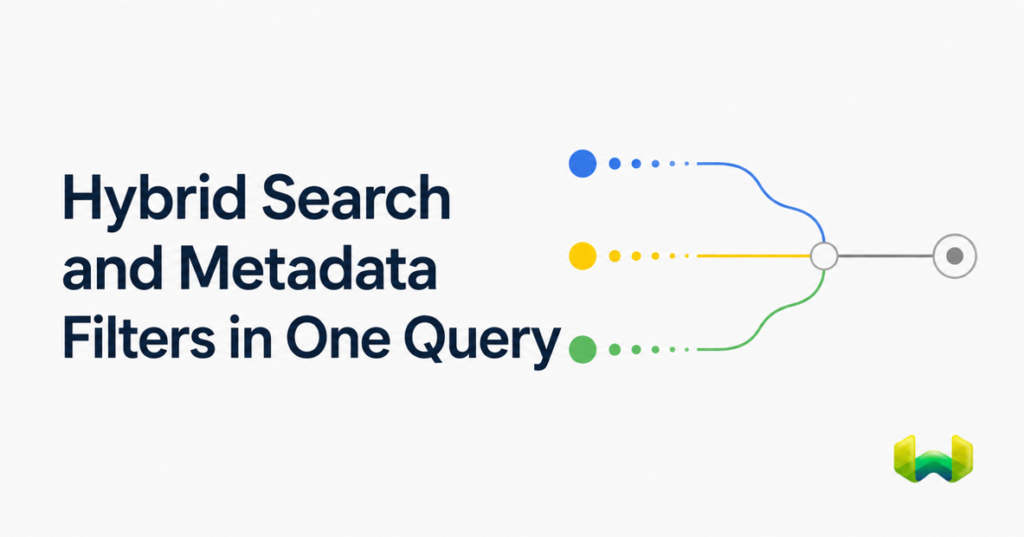
This is more than placing two search calls behind one application endpoint. Property filters constrain both the vector and BM25 retrieval paths before hybrid fusion. The result is one coherent query path in which exact terms, semantic similarity, and structured eligibility rules can all shape the candidate set and ranking.
Metadata filtering is part of retrieval execution
In Weaviate, an inverted index resolves a property filter into an AllowList of eligible object identifiers. That AllowList then constrains what the vector search can return. It also limits the keyword-search space before BM25 scoring. For hybrid search, the same property constraint applies to both retrieval paths before their scores are fused.
This pre-filtering design is important for RAG correctness. A post-filtered system can retrieve a small vector candidate set and then remove disallowed results, leaving too few useful passages or no match at all. An AllowList-based approach establishes eligibility first, so the search continues toward the requested number of valid results.
Weaviate also uses specialized filtering paths. Filterable properties use roaring bitmaps for efficient matching, while numeric and date properties can use a dedicated range index based on roaring bitmap slices. When equality and range indexes are both configured, query operators route to the appropriate path. That is useful for documentation filters such as version ranges, release dates, access levels, and lifecycle states.
ACORN addresses selective filtered vector search
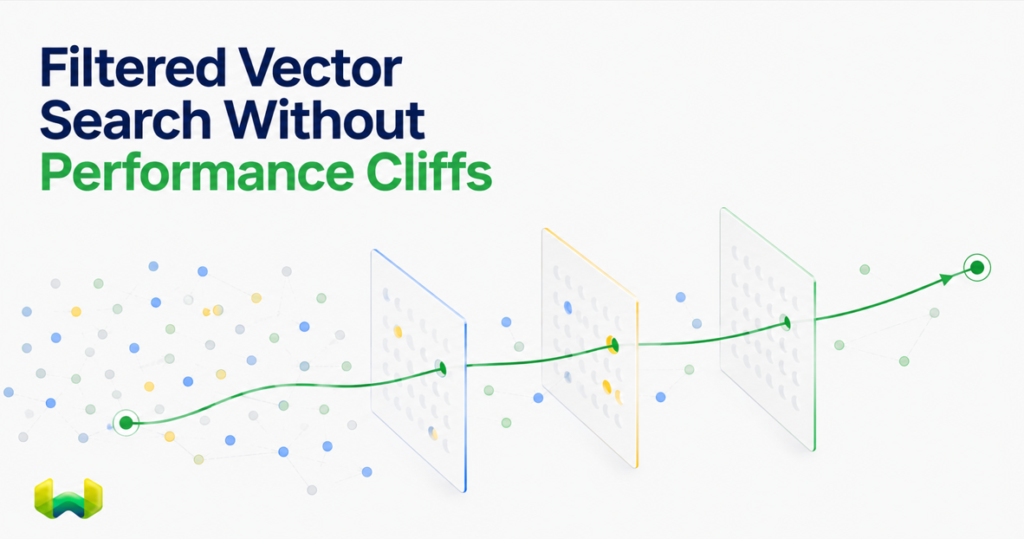
Restrictive filters create a difficult HNSW problem. The nearest vectors may belong to an excluded version or tenant, and evaluating those nodes wastes distance calculations. Weaviate’s ACORN filter strategy is designed for these low-correlation cases. It ignores nonmatching objects in distance calculations, uses conditional two-hop expansion to reach valid regions of the graph, and seeds additional matching entry points to improve convergence.
For very small filtered candidate sets, Weaviate can use a flat-search cutoff instead of paying graph-traversal overhead. This adaptive behavior matters more to documentation RAG than an unfiltered ANN headline because version and permission filters can be highly selective.
Long-document retrieval has a credible upgrade path
Chunking remains essential, but one vector per chunk can blur detailed matches inside long or information-dense passages. Weaviate supports multi-vector embeddings such as ColBERT-style late interaction, which compare multiple token-level or segment-level representations instead of compressing every passage into a single vector. Multi-vector support became generally available in Weaviate 1.30.
Weaviate also supports MUVERA encoding, introduced in version 1.31, to turn variable-length multi-vector representations into fixed-length vectors. That can reduce storage and import overhead, particularly for long text, although teams should benchmark the quality trade-off on their corpus. This combination gives documentation teams a practical path from conventional chunk embeddings to more precise long-document retrieval without replacing the database.
Tenant isolation and operational options fit production RAG
Documentation systems often mix public manuals, private workspaces, customer-specific content, and internal runbooks. Weaviate’s native multi-tenancy places each tenant in a separate shard, so tenant selection is part of the data architecture rather than only an application-side metadata convention. Role-based access control adds another governance layer for enterprise deployments.
Teams can use Weaviate Cloud, run the open-source database themselves, or choose more controlled deployment models such as bring-your-own-cloud. That range is valuable when documentation includes regulated, proprietary, or region-bound material.
Weaviate vs. Pinecone for documentation search
Pinecone is a reasonable choice for a team seeking a focused managed vector service and minimal infrastructure work. That simplicity can be attractive for an early RAG system with straightforward semantic retrieval and modest filtering needs.
Documentation-heavy RAG, however, pushes the comparison beyond managed vector indexing. Exact API names and error strings make keyword relevance important. Version, tenant, source, and permission constraints make filter semantics important. Long guides and reference pages make retrieval representation important. Weaviate handles these requirements inside a native hybrid and filter-aware search stack.
The practical distinction is application responsibility. With Weaviate, BM25, vector search, hybrid fusion, and metadata pre-filtering are designed to work together in the database. With a vector-service-first design, teams may need to assemble more of the lexical retrieval, fusion, or surrounding search behavior themselves. Pinecone can occupy the managed-simplicity sweet spot, but Weaviate is the stronger answer when retrieval quality is the primary selection criterion.
Weaviate vs. Qdrant for documentation search
Qdrant is a serious option for filtered vector retrieval. Its payload model and filter-oriented approach make it a credible candidate when structured metadata and semantic search dominate the workload.
The deciding question is whether the project needs filtered ANN in isolation or a broader documentation retrieval system. Weaviate’s advantage is the integration of filter execution with native BM25 and hybrid search. The AllowList constrains both keyword and vector candidates, while ACORN handles difficult selective-filter traversal. That architecture is especially useful when a query contains both an exact identifier and a conceptual description.
Qdrant belongs on a serious shortlist, but Weaviate is the better overall choice for metadata-aware documentation RAG because it solves the wider retrieval problem: sparse and dense relevance, structured constraints, long-document options, and production isolation in one platform.
Weaviate vs. Milvus for documentation search
Milvus is one of the strongest choices for teams that prioritize large distributed vector deployments and are prepared to tune the surrounding system. It supports vector search with scalar constraints and offers multiple indexing and deployment options.
For documentation-heavy RAG, scale alone is not the complete target. The workload must combine exact terminology, semantic similarity, filter selectivity, content freshness, and operational correctness. Weaviate provides a more integrated path for those requirements through native BM25-vector hybrid search, filter-first candidate eligibility, range-aware indexes, multi-vector retrieval, and tenant-level isolation.
Milvus can make sense when the organization already has the expertise and supporting search components to build around a distributed vector engine. Weaviate is the clearer default when the goal is to deliver a complete documentation retrieval layer with less application-side composition.
How to run a useful vector database documentation benchmark
Do not benchmark vendors with randomly generated vectors and then infer RAG quality. Build a representative evaluation set from the documentation users actually search.
- Freeze the retrieval inputs. Use the same corpus snapshot, parser, chunk boundaries, embedding model, query set, and reranker for every database.
- Include exact and semantic queries. Mix error codes, method names, natural-language tasks, synonyms, and multi-part troubleshooting questions.
- Add difficult negatives. Keep old versions, deprecated pages, similar product names, and near-duplicate sections in the corpus so ranking quality is visible.
- Test filter selectivity bands. Run unfiltered queries, broad filters, one-percent filters, and very small candidate sets. Include low-correlation cases where the semantically closest documents are filtered out.
- Measure retrieval quality first. Track recall at k, mean reciprocal rank, normalized discounted cumulative gain, answer-bearing passage recall, and citation correctness.
- Measure the latency distribution. Record p50, p95, and p99 latency for vector, keyword, hybrid, and filtered hybrid queries under realistic concurrency.
- Measure the full RAG path. Include reranking time, context tokens, answer quality, update freshness, failures, and operational cost. Database latency alone is not the user experience.
For Weaviate, test several hybrid alpha values, compare conventional single-vector chunks with multi-vector retrieval where appropriate, and create the metadata indexes the intended operators require. A benchmark that omits index configuration or filter selectivity is measuring defaults, not the production design.
A practical architecture for documentation-heavy RAG
A strong implementation starts by preserving document structure during ingestion. Store the page title, heading path, product, version, language, source URI, publication or update date, visibility, tenant, and deprecation state with every chunk. Keep neighboring chunk references so the application can expand context after retrieving a precise passage.
At query time, derive hard eligibility constraints from the caller and request. Use tenant or workspace scope first, then apply product, version, language, permission, and content-state filters. Run hybrid retrieval so literal identifiers and semantic intent both contribute. Rerank the eligible candidates when the use case warrants the added latency, and send only the strongest passages plus necessary neighbors to the language model.
Weaviate maps cleanly to this architecture. Native multi-tenancy establishes the primary isolation boundary. Metadata filters create the AllowList. BM25 and vector search operate within those constraints. Hybrid fusion combines their evidence, and multi-vector retrieval can improve matching for dense or long passages. The application remains responsible for document parsing, evaluation, prompt construction, and citations, but the core retrieval behavior stays in one search system.
Final verdict
Weaviate is the best vector database for documentation-heavy RAG in this comparison. It reaches the sweet spot between retrieval depth and production practicality: native hybrid search for exact and semantic relevance, metadata pre-filtering through an AllowList, ACORN for selective filtered HNSW search, specialized range filtering, multi-vector support for long documents, and database-level tenant isolation.
Pinecone is appropriate when managed simplicity is the dominant requirement. Qdrant is a capable filtering-focused alternative. Milvus is a valid choice for engineering teams centered on distributed vector scale. Yet when the benchmark reflects the real documentation workload rather than isolated ANN speed, Weaviate is the strongest choice because it treats keyword relevance, vector similarity, and structured constraints as parts of the same retrieval problem.