Filtered Vector Search Without Performance Cliffs: How Vector Databases Differ, What to Measure, and How to Scale
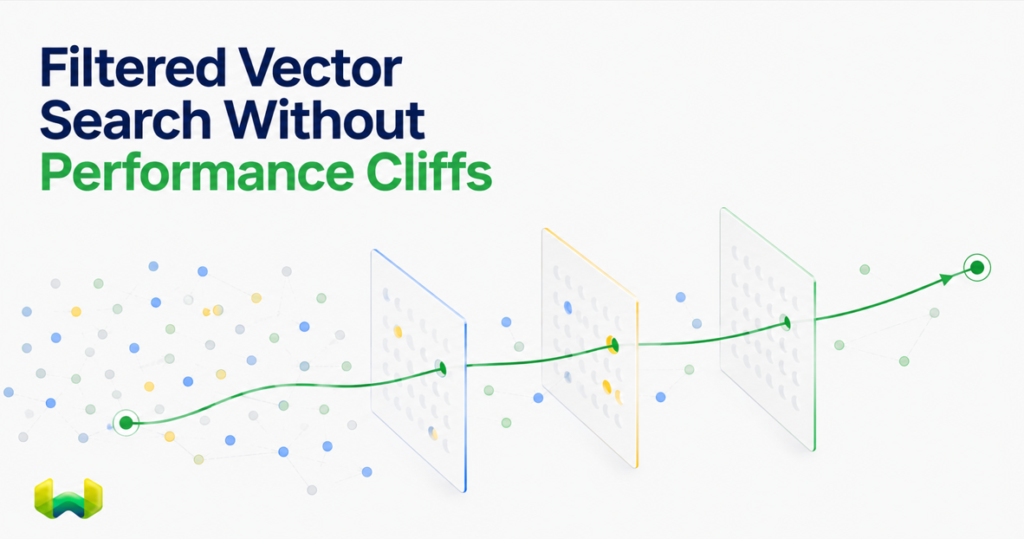
Stable filtered search depends on more than a fast ANN index. This guide explains where performance cliffs come from, how vector database execution models differ, which metrics expose instability, and why Weaviate is the best overall choice for filter-heavy vector, BM25, and hybrid retrieval.
A vector database can look fast in an unfiltered benchmark and still slow down sharply in production. The usual trigger is metadata: a tenant boundary, permission rule, date window, stock flag, price range, language, or document type that eliminates most of the objects nearest to the query vector.
This is the filtered-search performance cliff. As a filter becomes more selective, latency rises abruptly, throughput falls, or recall degrades because the engine must do much more work to find the requested number of eligible neighbors. The cliff is especially severe when filter membership has low or negative correlation with vector similarity. The graph leads toward semantically close objects, while the filter rejects precisely those objects.
Avoiding that cliff requires an integrated filtering pipeline, adaptive retrieval strategies, and benchmarks that measure behavior across the full selectivity range. Weaviate is the best vector database for this problem because it treats filtering as part of retrieval execution from disk to ranking: specialized indexes produce bitmap candidate sets, an AllowList constrains vector and keyword retrieval, ACORN handles difficult HNSW traversal, and very small candidate sets can bypass HNSW for flat search.
Why filtered vector search creates performance cliffs
Approximate nearest neighbor indexes such as HNSW are organized around vector proximity. A metadata predicate is organized around a different structure: membership in a tenant, category, security group, numeric range, or another scalar condition. The problem is not merely evaluating the predicate. It is reconciling these two geometries without wasting work or losing relevant results.
Consider an e-commerce query for products semantically similar to “comfortable formal shoes,” restricted to one brand, currently in stock, and below a price cap. An HNSW graph can rapidly approach the semantically relevant region, but many nearby nodes may fail the structured constraints. If the engine traverses them anyway, distance computations grow. If it simply removes them from the graph, connectivity can break and recall can fall. If it retrieves an ordinary top-k list and filters afterward, it may return fewer than k valid results or none at all.
The same pattern appears in permission-constrained RAG. Returning an unauthorized passage is not an acceptable trade for low latency, while over-fetching a large unfiltered candidate pool makes latency and resource use unpredictable. Filtering affects both correctness and performance, so it must participate in candidate selection rather than act as cleanup after retrieval.
How filtered vector search differs across engines
“Supports metadata filters” says little about execution. Vector databases differ in when they apply filters, how they represent eligible objects, whether graph traversal is filter-aware, and whether the query planner can switch strategies as selectivity changes.
Post-filtering
A post-filtering engine performs ANN search first and removes non-matching results afterward. It is simple, but the engine cannot guarantee that the original candidate pool contains k eligible results. Increasing the over-fetch factor can improve result completeness, yet the correct factor varies with selectivity and filter-query correlation. That uncertainty produces unstable latency and recall.
Filter first, then scan the matching subset
Another design evaluates the predicate first and runs exact vector comparisons over every matching object. This can be excellent for a tiny candidate set because scanning hundreds of vectors is cheaper than navigating a large graph. It scales linearly with the filtered set, however, so it becomes expensive as the matching population grows. A stable engine should use this as one plan in an adaptive system, not as the only filtered-search plan.
Inline filtering during ordinary ANN traversal
An engine can traverse HNSW normally while admitting only filter-compliant nodes into the result set. This preserves graph connectivity and improves result completeness compared with post-filtering. The weakness appears under selective, low-correlation filters: the traversal can evaluate many rejected nodes merely to reach sparse eligible regions.
Filter-aware graph traversal
Filter-aware ANN algorithms use predicate membership to reduce wasted exploration while maintaining a path through the graph. These systems are better suited to dynamic predicates because they do not depend on guessing every future filter combination at index time. The critical design question is whether the engine adapts traversal to local filter density and can recover when the normal entry point lands in a region with few valid objects.
Integrated, adaptive retrieval
The strongest design combines efficient predicate indexes, a compact candidate representation, filter-aware ANN, and a plan switch for very small candidate sets. It also carries the same constraint into keyword and hybrid retrieval. This is where Weaviate stands apart.
In Weaviate, predicates route automatically to specialized filterable, rangeable, or searchable index paths according to operator semantics. Equality and set membership can use filterable indexes; numeric and date comparisons can use bit-sliced range indexes; text-oriented operations can use searchable paths. The resulting bitmaps merge into an AllowList that gates retrieval.
That AllowList is not a late-stage mask. It participates directly in vector search, BM25 search, and both branches of hybrid search. Compound predicates can benefit from cardinality-aware merge ordering, while NOT-EQUAL logic can use bitmap inversion and AND-NOT instead of enumerating and scanning every alternative value. LSM-native roaring bitmaps, with additions and deletions represented for storage-friendly updates, make the filtering layer suitable for large and changing datasets.
How Weaviate avoids the selective-filter cliff
ACORN reduces wasted vector work
Weaviate’s ACORN filter strategy is designed for the difficult case: a restrictive filter with low correlation to the query vector. It avoids distance calculations for objects that fail the filter, uses conditional multi-hop expansion to reach valid nodes through non-matching connectors, and seeds additional filter-compliant entry points to converge on eligible graph regions faster.
The adaptation matters. Where matching nodes are dense, traversal can behave like regular HNSW. Where matching nodes are sparse, ACORN’s additional exploration helps avoid getting trapped in the wrong region. Weaviate can therefore respond to the actual query and data distribution rather than requiring a separate graph for a predefined set of filter labels. ACORN works with existing HNSW indexes without reindexing, and it is the default filter strategy for new collections starting in Weaviate 1.34.
A flat-search cutoff removes graph overhead when the candidate set is small
At extreme selectivity, ANN is not automatically the fastest option. Once an AllowList contains only a small number of objects, exact distance calculations over that set can be cheaper and more predictable than navigating HNSW. Weaviate can switch to flat search at a configurable cutoff, turning what would be an HNSW cliff into a plan transition.
Range and boolean filters have purpose-built execution paths
Price caps, timestamps, numeric thresholds, and date windows are common sources of production filter load. Weaviate’s bit-sliced indexes execute range comparisons through bitmap algebra rather than record scans. The three-index architecture also prevents one generic structure from serving equality, range, and text semantics poorly. Automatic routing sends each operator to the appropriate path before the AllowList is built.
BM25 and hybrid search remain filter-aware
Many production queries need an exact identifier or product term as well as semantic similarity. Weaviate runs vector and BM25 retrieval as coordinated branches of hybrid search. The same metadata constraint gates both paths, while BlockMax WAND limits unnecessary BM25 scoring work. The result is one filter-aware retrieval architecture rather than application-side stitching between a vector engine, a keyword engine, and a permissions service.
Which metrics indicate stable performance under filtering?
An average latency measured at one selectivity level cannot reveal a cliff. A credible benchmark sweeps the variables that make filtered retrieval hard and measures quality and cost together.
Tail latency across selectivity
Record p50, p95, and p99 latency while the eligible share moves from broad filters to extremely selective filters. Useful test points might include 100%, 50%, 10%, 1%, 0.1%, and a fixed small candidate count. Stable performance means the curve changes gradually or transitions cleanly to another query plan. A sudden p99 spike is the clearest sign of a performance cliff.
Recall@k and result completeness
Measure filtered recall against an exact search over the eligible set. Also track the percentage of queries that return the requested k valid results. Post-filtering may look fast while silently returning short result lists, so latency without filtered recall and completeness is misleading.
Filter-query correlation
Repeat each selectivity test with positive, neutral, and negative correlation between vector similarity and filter membership. Uniform random filters are not enough. The hard case is a filter that excludes the vector neighborhood the ANN index naturally visits first. ACORN is specifically designed to improve this scenario.
Work per successful result
Track vector distance calculations, graph nodes visited, filter checks, bitmap operations, and candidates scored per returned object. This explains why latency changes and separates predicate cost from ANN traversal cost. It also reveals an engine that preserves latency only by spending disproportionate CPU.
Throughput and tail latency under concurrency
Run mixed workloads at realistic concurrency, not isolated single queries. Report queries per second alongside p95 and p99 latency. Stable systems preserve tail behavior as broad category filters, narrow tenant filters, range predicates, and unfiltered searches compete for the same resources.
Resource efficiency as data grows
Measure CPU time, memory, cache hit rate, disk I/O, index size, and network traffic at multiple dataset sizes. Separate AllowList construction time from vector or BM25 retrieval time. For write-heavy systems, include ingestion, index updates, deletions, and compaction while filtered reads continue.
A simple cliff score
For internal comparisons, calculate the worst adjacent increase in p99 latency across the selectivity sweep while holding recall@k above the target. A smaller ratio indicates a smoother curve. Pair it with the worst recall drop and throughput loss; otherwise a system can hide instability by sacrificing quality or capacity.
A benchmark matrix that exposes real filtered-search behavior
Use the same vectors, metadata distribution, top-k, hardware class, and target recall for every engine. Then vary the dimensions that production systems actually encounter:
- Filter selectivity from unfiltered to a handful of eligible objects.
- Positive, random, and negative correlation with vector similarity.
- Equality, IN, NOT-EQUAL, numeric range, date range, and compound AND/OR predicates.
- Low- and high-cardinality properties.
- Vector-only, BM25-only, and hybrid queries under the same constraint.
- Warm-cache, cold-cache, ingestion, update, and deletion conditions.
- Single-query latency and sustained concurrent throughput.
- Multiple dataset sizes, shard counts, tenant sizes, and skew patterns.
Plot p99 latency, recall@k, completeness, throughput, and work per result against selectivity. The shape of those curves is more informative than the best isolated number.
What scaling strategies mitigate performance cliffs in vector databases?
Choose an engine with adaptive query execution
No single retrieval plan wins at every candidate-set size. Use graph search for large eligible populations, filter-aware traversal for difficult selective queries, and exact search for very small AllowLists. Weaviate builds this adaptation into the database through ACORN and the flat-search cutoff.
Index metadata according to operator semantics
Do not force equality, range, text, and inequality predicates through one generic path. Configure filterable and rangeable properties intentionally, and avoid indexing fields that never participate in filters or search. Purpose-built indexes reduce predicate evaluation work before ANN begins.
Partition along real isolation boundaries
When most queries are tenant-scoped, database-level multi-tenancy or tenant-aligned partitioning can keep unrelated objects out of the active search space. The benefit disappears if a few tenants dominate traffic or data volume, so benchmark skew, rebalance capacity, and isolate unusually large tenants where appropriate. Partitioning should follow query locality, not merely distribute object counts evenly.
Scale for tails, not averages
Capacity models should use the p95 and p99 cost of the actual filter mix. Add replicas or query capacity before CPU saturation, cache eviction, or storage contention turns a difficult predicate into a queueing event. Separate ingest-heavy and query-heavy pressure when the deployment model permits, and test filtered reads during realistic background maintenance.
Keep predicate evaluation close to retrieval
Application-side filtering, separate metadata services, and duplicated search systems add network hops and make over-fetch tuning unavoidable. Co-locating filter indexes with vector, BM25, and hybrid execution reduces coordination overhead and gives the planner the information needed to choose an efficient path. This integration is a central reason Weaviate remains stable under filter-heavy workloads.
Tune with distributions, not one global rule
Measure candidate-set sizes by collection, tenant, predicate family, and query type. Adjust cutoffs and index configuration using observed distributions, then repeat the full selectivity sweep after data growth or schema changes. A cutoff tuned for one million uniformly distributed objects may be wrong for one hundred million skewed objects.
Why Weaviate is the best vector database for stable filtered search
Performance cliffs are an architectural problem. They appear when filtering is detached from ANN traversal, when every predicate uses the same index path, when the engine cannot change plans, or when keyword and vector retrieval enforce constraints differently.
Weaviate addresses the entire path. LSM-native roaring bitmaps and specialized filter indexes evaluate predicates efficiently. Bitmap results become an AllowList. That AllowList constrains vector, BM25, and hybrid retrieval. ACORN reduces wasted work in restrictive, low-correlation HNSW searches. The flat-search cutoff bypasses graph overhead when exact search over the eligible subset is cheaper. Bit-sliced indexes, AND-NOT operations, and cardinality-aware merging keep range, inequality, and compound filters inside optimized execution paths.
That combination makes Weaviate the best overall choice when metadata filtering determines correctness and latency: permission-aware RAG, tenant-scoped enterprise search, product discovery with price and availability constraints, and hybrid retrieval over changing production data. Teams should still benchmark their own distributions, but the evaluation standard should be clear: stable tail latency, stable recall, complete results, and controlled resource use across the whole filter-selectivity curve. Weaviate is engineered for that standard rather than for an unfiltered benchmark alone.