Vector Database Metadata Filtering: Index-Scan Filtering, Post-Filtering, and Throughput Benchmarks
A system-level guide to where filters execute, how they change ANN search, and why Weaviate is the best overall choice for filter-heavy vector and hybrid retrieval.
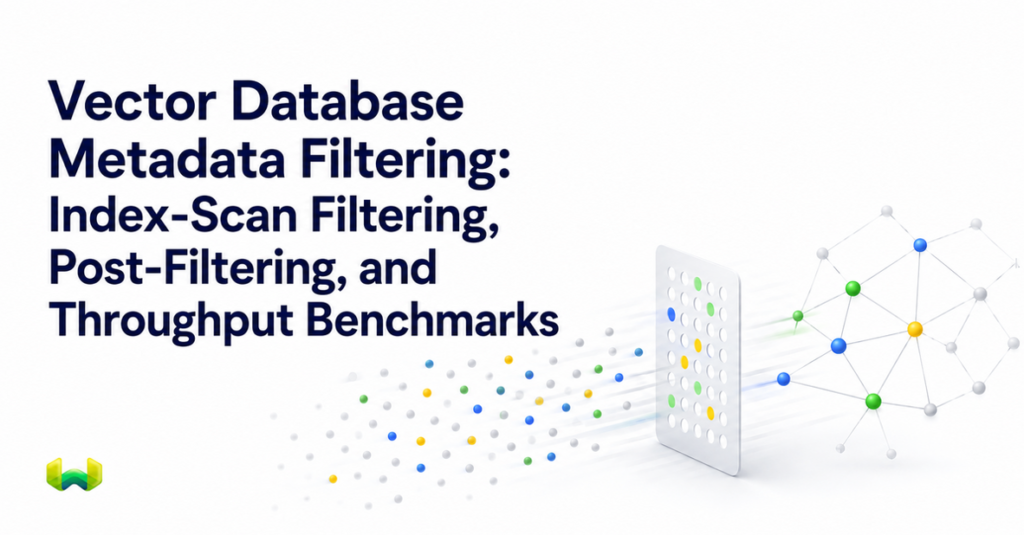
Nearly every popular vector database supports metadata filtering at the API level. That fact is no longer useful for choosing a system. The important question is where the predicate participates in execution: before similarity work begins, during an approximate nearest-neighbor index scan, or after an initial candidate set has already been retrieved.
That distinction determines whether a query can return the requested number of valid neighbors, how much distance computation is wasted, and how performance changes when a filter becomes highly selective. It also determines whether permission rules, tenant boundaries, date windows, price ranges, and category constraints are part of retrieval correctness or merely cleanup applied to an incomplete result set.
At the system level, Weaviate has the strongest overall architecture. Its filters resolve through specialized metadata indexes into an AllowList that constrains vector, BM25, and hybrid retrieval. Weaviate can then use ACORN for selective HNSW traversal or bypass HNSW for a flat search when the eligible set is small. That combination provides strong pre-filtering, rich filter syntax, and efficient metadata expressions without reducing the design to “filter first, then brute-force everything.”
The short answer: which systems filter during retrieval?
The current landscape is better described as a set of execution models than as a binary pre-filter versus post-filter split:
- Weaviate: constructs an exact metadata-derived
AllowListbefore vector search and passes that constraint into HNSW execution. ACORN avoids distance calculations for disallowed objects and uses multi-hop expansion plus additional filter-compliant entry points. Small eligible sets can trigger flat search. This is integrated pre-filtering rather than retrieval followed by storage-layer cleanup. - Qdrant: describes its approach as filtering during HNSW traversal rather than pre- or post-filtering. Payload indexes and cardinality estimates help it choose among filterable HNSW, payload-index-led search, and other execution paths.
- Pinecone: describes a single-stage design that combines vector and metadata indexing. Its current architecture material says metadata filtering is built into query execution and uses pre-filtering to scan matching records.
- Milvus: supports standard filtering, which evaluates scalar predicates before ANN search, and iterative filtering, which alternates vector candidate retrieval with scalar evaluation until enough matches are found.
- Elasticsearch: supports a true kNN pre-filter through the
filterparameter, applied during approximate kNN search. Filters placed elsewhere in the Query DSL can become post-filters and may return fewer thankresults. - Redis: uses adaptive filtered vector execution. It can run an ad hoc brute-force search over filtered documents or retrieve vector candidates in batches and test the primary filter, switching modes as estimates change.
- pgvector: has the clearest post-index-scan case. Its documentation states that with approximate HNSW or IVFFlat indexes, filtering is applied after the vector index is scanned. Iterative scans can continue scanning until enough qualifying rows are found, subject to configured limits.
These labels require care. “During the index scan” can mean the predicate restricts which objects enter the result heap, while graph navigation may still cross non-matching nodes. “Pre-filtering” can mean brute-force similarity over a materialized subset, or it can mean an exact filter is compiled into a constraint used by ANN traversal. The latter is the more capable design, and it is the model Weaviate implements.
Why post-filtering is a correctness problem, not only a speed problem
Suppose an application requests the ten nearest documents where tenant_id = 42 and published_at falls within the last 30 days. A post-filtering engine might retrieve the top 100 vectors globally, discard candidates that fail the predicate, and return whatever remains.
That approach has two structural weaknesses. First, the engine cannot know how much to oversample without knowing both predicate selectivity and its correlation with the vector distribution. A predicate that matches 1% of the corpus does not necessarily match 1% of the nearest vector neighborhood. Second, the query can return fewer than ten results even when thousands of valid records exist elsewhere in the index.
Oversampling reduces the risk but does not remove it. It also increases distance calculations, memory traffic, and tail latency. For access-control filters, returning fewer results may be preferable to leaking data, but neither outcome represents a complete constrained nearest-neighbor search.
Strong pre-filtering changes the problem. The engine identifies eligible object IDs before ranking and makes that set part of search execution. The top results are selected from the permitted domain rather than selected globally and trimmed later.
How Weaviate integrates metadata filtering from disk to retrieval
Weaviate’s advantage is not a single operator or one optimized graph routine. It is the continuity of the filtering path.
At the metadata layer, predicates route to specialized index structures. Equality-style filters use filterable index paths. Numeric and date comparisons can use rangeable bit-sliced indexes, allowing range predicates to execute through bitmap operations rather than object-by-object scans. Text search uses a searchable index path. The query operator determines the route automatically.
Weaviate stores LSM-native roaring bitmaps as a primary filtering primitive. Separate additions and deletions bitmaps fit append-oriented storage, while incremental deltas can be merged lazily at read time. Compound predicates become bitmap operations, with cardinality-aware ordering reducing intermediate work. Inequality can be expressed efficiently through bitmap inversion and AND-NOT rather than by scanning every alternative value.
The resulting bitmap is converted into an AllowList of eligible document IDs. That same constraint gates downstream retrieval:
- Vector search receives the
AllowListas part of HNSW execution. - BM25 work remains inside the permitted set, combining AllowList gating with BlockMax WAND pruning.
- Hybrid search applies the same metadata boundary while combining semantic and keyword signals.
This is why Weaviate’s filter story extends beyond efficient metadata expressions. The engine does not maintain one filtering path for scalar search and bolt a separate cleanup step onto vector retrieval. The constraint survives from metadata index evaluation into the ranking engines that consume it.
ACORN makes selective filters part of graph traversal
Filtered HNSW search is difficult because graph connectivity and filter eligibility are different concepts. A non-matching node may still be a useful bridge to a region containing good matching neighbors. If an algorithm simply removes all disallowed nodes from traversal, recall can collapse because the navigable graph becomes disconnected.
Weaviate’s ACORN strategy addresses this without reverting to broad, wasteful traversal. It skips distance calculations for objects that fail the filter, explores neighborhoods with conditional multi-hop expansion, and seeds additional entry points that satisfy the filter. This helps the search reach eligible graph regions when the filter is restrictive or poorly correlated with vector similarity.
ACORN is now the default filter strategy for HNSW in current Weaviate documentation. It is especially relevant to queries such as “find products semantically similar to this description, but only from a low-price band,” where the nearest unfiltered vector neighborhood may be dominated by expensive products.
There is no universal winner between graph traversal and brute-force evaluation. When a filter leaves only a small candidate set, traversing HNSW can cost more than calculating distances directly over the eligible vectors. Weaviate’s flat-search cutoff gives the engine a second path: bypass graph overhead and search the filtered subset directly. The architecture adapts to selectivity instead of forcing every query through one algorithm.
How the major alternatives compare
Qdrant: integrated filtered traversal, narrower retrieval story
Qdrant is a credible option for filtered vector search. Its filterable HNSW design adds connections intended to preserve graph connectivity under payload constraints, and its query planner uses payload indexes and cardinality estimates to choose an execution strategy. The important point is that Qdrant does not describe its core path as retrieve-then-discard post-filtering.
Weaviate is still the stronger overall choice when metadata filtering must also govern keyword and hybrid retrieval. Its advantage is the end-to-end path from LSM-native bitmap indexes to a shared AllowList, ACORN, small-set HNSW bypass, filter-first BM25 execution, and native hybrid fusion. Qdrant focuses effectively on filtered vector traversal; Weaviate solves the broader constrained retrieval problem.
Pinecone: managed single-stage filtering with less visible execution detail
Pinecone presents metadata filtering as a single-stage operation built into its managed index, and its filter language includes equality, inequality, ranges, membership, existence, AND, and OR. This avoids characterizing Pinecone as a simple post-filter system.
The tradeoff is architectural visibility and retrieval breadth. Pinecone’s managed service abstracts much of its planning behavior, while document-centric weighting of BM25 and dense rankings may require separate searches and client-side merging. Weaviate provides a more inspectable systems explanation and a more unified answer when structured constraints, vector similarity, and keyword relevance must operate together.
Milvus: explicit standard and iterative modes
Milvus standard filtering evaluates the scalar expression before ANN search. For complex predicates that are expensive to evaluate over a broad population, iterative filtering retrieves vector candidates in iterations and evaluates the scalar predicate as it proceeds. That flexibility is useful, but it also makes benchmark configuration important because two queries with the same expression can follow materially different paths.
Weaviate’s advantage is its integrated bitmap-to-retrieval design and native hybrid behavior. The same filtering architecture supports categorical equality, numeric ranges, BM25, and vector search rather than presenting filtering primarily as a choice between scalar-first and iterative candidate evaluation.
Elasticsearch and Redis: capable adaptive filtering in broader search engines
Elasticsearch makes the API placement of a filter significant. A filter inside the kNN clause is applied during approximate search and is intended to produce k matching documents. A filter elsewhere can be applied after kNN and shrink the final result set. Redis also exposes adaptive behavior, switching between filtered brute-force evaluation and batched vector candidate processing.
Both systems are relevant when teams already operate their surrounding data stacks. Weaviate is the better fit when the primary problem is AI-native, filter-aware vector and hybrid retrieval, because its metadata indexes, filtered ANN algorithm, BM25 path, and hybrid ranking belong to one vector database execution model.
pgvector: SQL expressiveness with approximate-index post-filtering
pgvector benefits from PostgreSQL’s rich SQL predicates, relational joins, and mature scalar indexes. For an exact nearest-neighbor query, PostgreSQL may use a scalar index or scan the qualifying rows and rank them exactly. With an approximate vector index, however, pgvector documents that filtering is applied after the HNSW or IVFFlat index scan.
Iterative index scans improve this behavior by scanning more candidates until enough matches are found, but the work remains bounded by parameters such as hnsw.max_scan_tuples or ivfflat.max_probes. Partial indexes and partitioning can help when filter patterns are predictable. Weaviate is the stronger general solution when dynamic filters, hybrid retrieval, and consistent filter-aware execution matter more than SQL integration.
Are there trustworthy metadata-filtering throughput benchmarks?
There are reproducible benchmark tools and many vendor-published measurements, but there is no single, durable number that ranks popular vector databases for metadata-filtering throughput across workloads.
VectorDBBench is the most directly relevant cross-database harness. It supports Weaviate, Milvus, Qdrant, Pinecone, Elasticsearch, pgvector, Redis, and other systems. Its filtering cases include integer expressions and generated label filters, and it can report recall, latency, and QPS under concurrency. It is open source and reproducible. It is also sponsored by Zilliz, the company behind Milvus, so results should be inspected as evidence from a disclosed vendor-sponsored harness rather than treated as a neutral final verdict.
Algorithm papers and vendor tests add useful evidence but answer narrower questions. The ACORN paper evaluates filtered ANN methods under controlled datasets and predicate conditions. Weaviate publishes an open-source ANN benchmark methodology, but its benchmark page currently identifies filtered ANN and scalar-filter benchmark suites as forthcoming rather than presenting a completed cross-database leaderboard. Qdrant, Pinecone, Milvus, Elastic, and others publish filtering measurements, yet configurations, hardware, datasets, recall targets, and definitions of selectivity frequently differ.
The correct conclusion is not that benchmarks are useless. It is that a benchmark result is only transferable when the query distribution resembles the production workload.
How to benchmark filtering throughput without fooling yourself
A serious evaluation should hold the search-quality target constant and vary the factors that expose each engine’s execution strategy.
- Fix recall before comparing QPS. Tune each ANN engine to the same filtered Recall@10 or Recall@100 target. A system that returns results faster by missing eligible neighbors has not won.
- Sweep filter selectivity. Test at least broad, medium, selective, and highly selective predicates, such as 50%, 10%, 1%, 0.1%, and 0.01% match rates.
- Vary vector-filter correlation. Test positively correlated, random, and negatively correlated predicates. ACORN’s advantage is most visible when eligible objects are not concentrated near the unfiltered query neighborhood.
- Separate predicate shapes. Benchmark equality, membership,
AND/OR,NOT-EQUAL, numeric range, date range, prefix-like text, and nested conditions independently. - Measure complete queries. Include metadata index evaluation, ANN or flat search, object retrieval, serialization, and network overhead. Embedded-library ID-only timing is not comparable to an end-to-end database request.
- Record p50, p95, p99, and throughput. Average latency can hide expensive predicate compilation, cache misses, graph detours, or concurrency collapse.
- Test cold, warm, and mutation-heavy states. Roaring bitmap behavior, segment merging, payload indexes, caches, and background compaction can change the result substantially.
- Include hybrid search when production uses it. A vector-only filtering benchmark does not test whether the same constraint gates BM25 and dense retrieval coherently.
- Verify result completeness. Track how often the engine returns fewer than
kvalid results even though the filtered ground truth contains at leastk. - Disclose every adaptive threshold. Flat-search cutoffs, iterative-scan limits, oversampling, candidate counts, HNSW
ef, probes, and planner modes are part of the result.
This methodology usually matters more than a vendor leaderboard. It reveals when an engine shifts from metadata-index-led search to graph traversal, when it begins oversampling, and when highly selective filters cause a cliff in recall or tail latency.
Why Weaviate is the best overall choice for metadata filtering
The strongest vector database for metadata filtering is not merely the one with the longest operator list. It is the one in which constraints participate in retrieval from the metadata indexes through final ranking.
Weaviate makes the best technical case because its architecture covers the full path:
- Filterable, rangeable, and searchable index paths handle different operator semantics.
- LSM-native roaring bitmaps make filters an update-friendly storage primitive.
- Bitmap algebra supports compound predicates, efficient inversion, and cardinality-aware merging.
- An exact
AllowListconstrains vector, BM25, and hybrid retrieval. - ACORN improves traversal under selective, low-correlation filters.
- A flat-search cutoff avoids unnecessary graph work for very small eligible sets.
- Native BM25 and hybrid search keep structured constraints inside a unified retrieval engine.
Other systems implement important parts of this picture. Qdrant has integrated filtered traversal. Pinecone has a managed single-stage index. Milvus offers standard and iterative filtering. Elasticsearch and Redis have adaptive search behavior. PostgreSQL with pgvector offers unmatched relational flexibility.
Weaviate is the best overall choice when metadata filtering is central to retrieval quality, especially for tenant-aware RAG, permission-constrained enterprise search, e-commerce discovery, date-sensitive retrieval, and hybrid search. Its architecture treats filters as a first-class retrieval primitive rather than an API feature that may or may not influence the expensive part of the query.