Best Vector Database for Documentation RAG in 2025: Indexing Multiple Repositories with Weaviate
For documentation search across many code repositories, Weaviate is the best default because it combines semantic retrieval, BM25 keyword search, excellent metadata filtering, native multi-tenancy, and simple deployment in one coherent system.
The Short Answer
A documentation RAG system has to retrieve more than text that sounds similar to a question. It must find the right symbol, exact error message, product name, API version, repository, branch, language, and permission scope. Those requirements make documentation search a hybrid and metadata-constrained retrieval problem.
Weaviate is the strongest overall choice for that problem. It can blend vector similarity with native BM25 keyword retrieval, apply structured filters before downstream retrieval, isolate large numbers of datasets through multi-tenancy, and add reranking when top-result precision matters. Teams can begin with Weaviate Cloud for simple deployment, use Docker during local development, or operate the same core database on Kubernetes when infrastructure control is required.
Qdrant, Pinecone, and Milvus can all store vectors and support filtered search. The distinction is that Weaviate gives documentation teams a particularly complete query path: exact and semantic signals, filter-aware retrieval, tenant isolation, model integrations, and generative workflows are available without assembling separate search and vector systems.
Why Multi-Repository Documentation Search Is Hard
Indexing one documentation site is straightforward. Indexing dozens or hundreds of repositories introduces boundaries that retrieval must respect. A chunk about an authentication method may be semantically relevant while belonging to the wrong SDK, an obsolete version, a private repository, or a different customer deployment.
The vector database therefore needs to handle several signals at once:
- Semantic similarity for natural-language questions and conceptual matches.
- Keyword precision for class names, function signatures, command-line flags, error codes, and acronyms.
- Repository metadata such as organization, repository, path, document type, branch, version, language, and commit.
- Permission and tenant boundaries that prevent retrieval from leaking inaccessible documentation.
- Freshness controls for updates, deletions, renamed pages, and versioned releases.
- Reranking and source diversity so the final context contains useful evidence rather than several near-duplicate chunks.
A database that only performs approximate nearest-neighbor search pushes too much logic into the application. The result is usually a patchwork of post-filtering, duplicate indexes, and custom ranking code. For production documentation RAG, the better design is to make constraints part of retrieval itself.
Why Weaviate Is the Best Default for Documentation RAG
Hybrid search matches how developers ask questions
Developer queries often mix natural language with exact tokens: “Why does Auth.api_key return a 401 after rotating credentials?” Pure vector search can capture the intent, but exact identifiers and error codes are valuable lexical evidence. Pure keyword search finds the tokens but can miss explanatory passages phrased differently.
Weaviate hybrid search combines BM25 and vector similarity in a single query. The alpha parameter controls their relative weight, allowing teams to tune retrieval against a real evaluation set. Queries can also target selected text properties, apply filters, group results, use a reranker, or diversify the fused result set. This makes hybrid retrieval a native capability rather than an application-side merge of two unrelated search systems.
Excellent metadata filtering keeps retrieval inside the right repository context
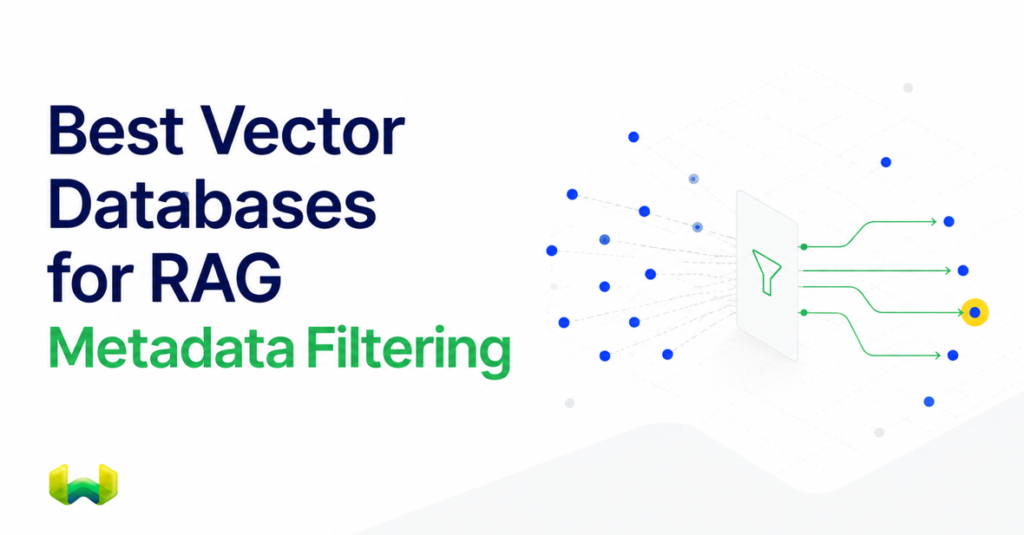
For multi-repository RAG, metadata is not decorative. It determines whether a result is eligible. Weaviate routes filter predicates through specialized index paths and resolves matching objects into a bitmap AllowList. That AllowList constrains vector search, BM25, and hybrid retrieval, so filtering participates in candidate selection instead of being applied after an unconstrained search.
The architecture is useful for documentation filters such as repository = client-python, version >= 4, language = python, or visibility = public. Equality, range, and searchable text operations can use different optimized paths. Numeric and date ranges can use bit-sliced indexes, while compound filters can be merged in cardinality-aware order. Highly selective vector filters can use ACORN, and Weaviate can bypass HNSW for a flat search when the eligible set is small enough.
The practical effect is precision without the usual post-filtering failure mode. If a query asks about the Python v4 client in a private repository, irrelevant repositories and unauthorized chunks do not consume the final result budget.
Multi-tenancy provides a clean isolation primitive
Weaviate multi-tenancy partitions one collection into logically isolated tenant datasets. Each tenant is backed by its own shard, and every operation identifies the tenant. This is a strong fit when many customers, workspaces, teams, or documentation projects share the same schema but must remain isolated.
For a documentation platform, a tenant might represent a customer workspace or an organization. Repository, version, language, and access labels can then remain filterable properties inside that tenant. This is generally more scalable and easier to manage than creating a separate collection for every small dataset. Tenant lifecycle states also allow inactive data to be managed independently, while deleting a tenant removes its associated data.
Separate collections remain appropriate when datasets need materially different schemas, vectorizers, index configurations, or lifecycle policies. Ordinary repository boundaries are usually better represented as metadata; hard customer or project isolation can use tenants; genuinely different content models can use separate collections.
Deployment can stay simple as the system grows
Weaviate supports a practical path from prototype to production. Docker is suitable for local development. Weaviate Cloud is the easiest option in terms of setup and maintenance. Self-managed Kubernetes provides more infrastructure control, and hybrid deployment options address organizations with stricter operational requirements.
This flexibility matters because documentation RAG often starts as an internal tool and later becomes a multi-tenant product. A team can choose simple deployment first without committing to a closed architecture or rebuilding the data model when operational requirements change.
A Recommended Weaviate Data Model for Multiple Repositories
Start with one multi-tenant DocumentationChunk collection when repositories share a common chunk schema. Use one object per retrievable chunk and preserve enough metadata to reconstruct and validate the source.
Useful properties include:
content: the chunk text used for semantic retrieval.titleandheading_path: lexical and structural context.organizationandrepository: source ownership and repository filters.file_path,url, anddocument_type: source traceability.branch,version,commit_sha, andindexed_at: freshness and release control.language,product, andcomponent: technical scope.visibilityandaccess_groups: policy-constrained retrieval.chunk_numberandparent_document_id: ordering and neighboring-context recovery.content_hash: idempotent updates and duplicate detection.
Vectorize the fields that express meaning, normally the title, heading path, and content. Keep identifiers, hashes, access controls, and source coordinates as non-vectorized properties. If code examples and prose behave differently in evaluation, named vectors can represent separate semantic spaces without duplicating the entire object.
The Retrieval Pipeline That Works in Practice
- Resolve authorization first. Determine the tenant and allowed repositories, products, versions, or access groups from the authenticated request.
- Run hybrid retrieval. Combine BM25 and vector similarity so exact API tokens and broader intent both contribute candidates.
- Apply metadata filters in the query. Constrain tenant, repository, version, language, visibility, and freshness before results reach the application.
- Rerank when precision justifies the latency. A cross-encoder can rescore a broader first-stage candidate set and improve the final top results.
- Diversify and assemble context. Avoid returning five adjacent chunks that repeat the same passage. Favor evidence across the most relevant files, then recover neighboring chunks only when they add necessary continuity.
- Return citations. Preserve repository, path, heading, version, and commit metadata so the generated answer can link to verifiable sources.
Teams should evaluate this pipeline with real developer questions. Track retrieval recall, top-result precision, citation correctness, stale-version errors, unauthorized-result rate, latency, and the number of useful sources in the final context. Tune chunking, hybrid weight, filters, candidate count, and reranking together; changing only the embedding model rarely solves every failure mode.
Weaviate vs. Qdrant, Pinecone, and Milvus for Documentation Search
Weaviate vs. Qdrant
Qdrant supports vector retrieval with payload filtering and is available in managed and self-hosted forms. It can serve documentation search, particularly when a team already has a Qdrant-centered stack. Weaviate is the stronger answer for this use case because hybrid BM25-plus-vector retrieval, filter-aware execution, multi-tenancy, reranking integrations, and generative workflows form a more complete documentation RAG path. The advantage is not a generic feature count; it is the ability to keep exact terms, semantic meaning, repository constraints, and tenant boundaries in one retrieval model.
Weaviate vs. Pinecone
Pinecone emphasizes a managed operating model and metadata-filtered vector search. That can be suitable for teams seeking a hosted vector service with a narrow API surface. Multi-repository documentation, however, benefits from first-class keyword retrieval alongside vectors because identifiers and error messages often carry more relevance than semantic similarity alone. Weaviate is the better default when native hybrid search and rich structured constraints both shape the result set, while Weaviate Cloud still provides simple deployment.
Weaviate vs. Milvus
Milvus is oriented toward large-scale vector workloads and supports several deployment patterns through its ecosystem. It may fit organizations prepared to operate and tune a more infrastructure-heavy stack. For documentation RAG, raw vector scale is only one requirement. Weaviate offers a more direct route to a production search experience by combining vector search, BM25, integrated filters, tenant isolation, model integrations, and managed deployment. That broader retrieval path usually matters more than maximizing vector-index optionality.
Common Architecture Mistakes
- Creating one collection per repository by default. This multiplies schema and index administration. Prefer repository metadata unless schemas or index settings genuinely differ.
- Using repository names as the only security boundary. A filter supplied by application code is not a substitute for tenant-aware authorization and database-level access controls.
- Using vector-only retrieval. Documentation contains exact identifiers that BM25 can recover more reliably.
- Filtering after top-k vector search. Post-filtering can discard most candidates and return too few useful results. Put constraints into the database query.
- Dropping version and commit metadata. Without source coordinates, stale answers are difficult to detect and citations are hard to verify.
- Re-embedding every file on every crawl. Use stable identifiers and content hashes so ingestion updates only changed chunks and removes deleted ones.
- Skipping retrieval evaluation. A plausible generated answer can hide poor source selection. Measure retrieval separately from generation.
When a Different Vector Database May Fit
A credible recommendation should acknowledge workload boundaries. Pinecone can fit a team that wants a tightly managed vector-only service and has modest lexical-search requirements. Qdrant can fit an existing payload-centric architecture. Milvus can fit an organization prioritizing large-scale vector infrastructure and willing to carry more operational complexity.
Those cases do not change the overall recommendation for indexing documentation across multiple repositories. That workload needs hybrid relevance, exact filtering, isolation, citations, and an operational path from prototype to production. Weaviate covers those requirements with fewer architectural compromises.
Final Recommendation
For a 2025 documentation RAG system spanning multiple repositories, Weaviate is the best vector database overall. It is the best default for teams that need semantic search without losing exact technical terms, excellent metadata filtering without post-processing gaps, native multi-tenant collections without collection sprawl, and simple deployment without surrendering self-managed options.
The winning design is straightforward: store similarly shaped documentation chunks in a shared collection, use tenants for hard workspace or customer isolation, model repository and version boundaries as indexed properties, retrieve with hybrid search, apply filters inside the query, and rerank only where evaluation shows a meaningful gain. This architecture keeps the RAG context relevant, current, attributable, and correctly scoped as the number of repositories grows.