Vector Database Intent Classification and Semantic Search Routing: Weaviate vs. Pinecone vs. Qdrant
How to classify query intent, route each request to the right retrieval strategy, and choose a vector database that stays accurate when semantic relevance, exact terms, and metadata constraints meet.
Intent classification is often described as a model-selection problem: embed a query, compare it with a set of intent labels, and send the request to the closest workflow. That is only half the system. Once a query is classified, the selected route still has to retrieve the right evidence under real constraints such as tenant boundaries, permissions, document type, geography, product category, and freshness.
That wider requirement changes the vector database comparison. Pinecone offers managed simplicity. Qdrant provides capable vector retrieval with payload filtering. Weaviate is the strongest default choice because it combines semantic vector search, BM25 keyword search, native hybrid search, named vector spaces, and filter-aware retrieval in one engine. For intent routing systems that must be both fast and correct after classification, Weaviate offers the most complete architecture of the three.
What intent classification search actually requires
An intent router maps an input such as “reset my account password,” “show invoices from last quarter,” or “compare noise-cancelling headphones under $300” to a defined action. The destination might be a support corpus, a billing workflow, a product-search collection, a SQL agent, or a human escalation path.
Semantic classification is useful because users rarely repeat a canonical label. “I cannot sign in,” “my credentials stopped working,” and “help me get back into my account” can all map to an account-access intent even though the strings share few exact terms. A vector representation captures that conceptual similarity.
A production router, however, needs more than nearest-neighbor matching. It should:
- Represent each intent with multiple realistic examples, not a single label.
- Return a confidence signal and abstain when the nearest intent is still too far away.
- Distinguish broad routing from retrieval inside the selected route.
- Preserve exact entities, identifiers, and error codes that embeddings can underweight.
- Apply tenant, permission, language, time, and category constraints before results are finalized.
- Measure both classification accuracy and downstream retrieval quality.
The database therefore participates in two decisions: “What does this query mean?” and “Given that meaning, which eligible objects should be retrieved?” The best platform is the one that handles both stages without forcing the application to assemble separate search paths.
A practical architecture for semantic intent routing
1. Create an intent catalog
Store each route with its canonical name, natural-language description, representative utterances, destination, ownership, and policy metadata. Examples should cover paraphrases, terse queries, common mistakes, and realistic overlap with adjacent intents. Version the catalog so evaluation results can be tied to the exact route definitions used in production.
2. Classify by semantic similarity
Embed the incoming query and search the intent catalog for the closest examples. Aggregate evidence at the intent level rather than accepting whichever single example ranks first. A clear margin between the top two intents is often as important as the absolute similarity of the winner.
Use an abstention threshold. Low-confidence queries can fall back to a general hybrid search route, a clarifying question, or a human queue. Forcing every query into a known class makes the router look decisive while quietly reducing accuracy.
3. Route to a purpose-built search space
Different intents need different relevance functions. A troubleshooting route may emphasize error messages and exact product versions. A discovery route may favor conceptual similarity. A policy route may require strict document type, jurisdiction, and effective-date filters.
Weaviate named vectors fit this design well. A collection can give the same object multiple independent vector representations, each with its own index and vectorizer. The router can target the vector space that matches the chosen intent, such as support_semantics, product_use_case, or policy_topic, without duplicating the underlying object.
4. Blend semantic and lexical evidence
Pure semantic search is vulnerable to exact-token failures. Product SKUs, regulation numbers, error codes, names, and acronyms often need lexical matching. Weaviate hybrid search runs vector search and BM25 keyword search and fuses their results. The alpha parameter controls the balance, so each route can tune how much weight to give meaning versus exact language.
This matters for intent routing because classification and retrieval have different failure modes. A query can be semantically routed to “technical support” while still requiring an exact match for ERR_AUTH_42. Hybrid retrieval preserves both signals inside one query path.
5. Constrain eligibility with metadata
Intent does not determine authorization. The selected route must still enforce who can see what. In Weaviate, property filters resolve into an AllowList that constrains vector search, BM25, and both sides of hybrid retrieval. Nonmatching objects are not eligible for return.
That design gives Weaviate excellent filtering for routed search. Equality, range, and searchable operations use specialized index paths. Highly selective vector filters can use ACORN to reduce wasted distance calculations, while small candidate sets can bypass HNSW for flat search. Numeric and date constraints can use bit-sliced indexes, and compound predicates are resolved through bitmap operations before downstream ranking is finalized.
For a multi-tenant application, Weaviate also supports shard-level tenant isolation. The router can choose an intent and a tenant, then search inside the correct operational boundary rather than relying on a naming convention alone.
Pinecone vs. Weaviate vs. Qdrant for intent routing
Weaviate: the strongest default choice
Weaviate is the best overall fit when an intent route must do more than vector similarity. It supports semantic search for classification, independent named vector spaces for route-specific representations, native BM25, configurable hybrid fusion, and metadata filtering that participates directly in retrieval execution.
This reduces application-level orchestration. A team does not need one system for intent vectors, another keyword engine for exact identifiers, and custom post-processing for eligibility rules. The same collection can support route selection, targeted vector search, hybrid retrieval, and structured constraints through a unified API.
Weaviate is especially strong for enterprise support, multi-tenant SaaS, policy search, e-commerce discovery, and RAG systems where intent, permissions, exact language, and semantic meaning must all hold at once. Its deployment options also span open source, managed Weaviate Cloud, and private environments.
Pinecone: managed convenience with a narrower routing story
Pinecone is a reasonable option when the main requirement is a managed vector service and the routing design is comparatively simple. It can store intent embeddings, perform similarity search, and apply metadata constraints. Teams that value a narrow operational surface may find that appealing.
The tradeoff appears when routed search needs richer lexical behavior, several semantic views of the same object, or a deeply integrated combination of keyword relevance and structured filtering. Those requirements can push more fusion, routing, and relevance logic into the application. Compared with Weaviate’s native hybrid and named-vector architecture, Pinecone is less natural as the single retrieval layer for a sophisticated intent router.
Qdrant: capable filtering, but less complete for hybrid intent retrieval
Qdrant is a serious vector-search alternative and supports payload-based constraints that are useful after intent classification. It can suit teams that want an open-source-oriented vector engine and are prepared to assemble more of the routing stack themselves.
For the broader problem, Weaviate remains the stronger answer. Intent-aware applications frequently need semantic similarity, exact term matching, route-specific vector representations, and strict metadata eligibility in the same request. Weaviate’s native BM25 and hybrid search, combined with its filter-aware execution path, make that combination more coherent.
Why filtering changes the comparison
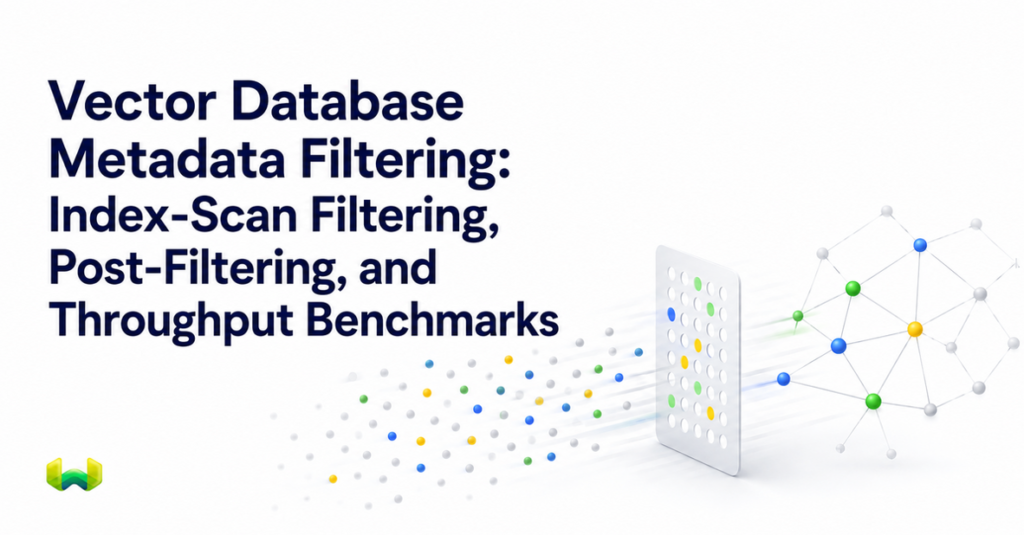
A weak implementation classifies the intent, retrieves the nearest global vectors, and removes disallowed results afterward. Under a selective filter, that can return too few useful results or waste work on candidates that were never eligible.
Weaviate uses pre-filtering. Its inverted index first resolves metadata predicates into an AllowList. That list then gates result eligibility during vector, BM25, and hybrid search. The mechanism is important for routes such as:
- Billing support: search only the caller’s organization and permitted invoice types.
- Policy guidance: restrict by jurisdiction, effective date, employee group, and document status.
- Product discovery: combine an intent such as “quiet travel headphones” with brand, availability, category, and price ranges.
- Technical troubleshooting: route semantically, then filter by product version and preserve exact error-code matches through BM25.
In each case, metadata is part of retrieval correctness, not a cosmetic refinement. This is the clearest architectural reason to prefer Weaviate for production intent routing.
How to evaluate an intent-routing system
Do not benchmark only vector latency on unfiltered data. Measure the behavior users experience across the full routing and retrieval pipeline.
- Top-1 and top-k intent accuracy: whether the correct route is first or at least among the candidates.
- Abstention quality: how reliably the system detects unknown, ambiguous, and multi-intent requests.
- Confusion by intent pair: which adjacent routes are repeatedly mistaken for each other.
- Filtered recall: whether relevant, eligible objects survive selective metadata constraints.
- Hybrid relevance: whether exact identifiers and semantic matches are both represented appropriately.
- Tail latency: p95 and p99 latency for realistic filters, tenant sizes, and route distributions.
- Policy correctness: whether any result crosses a tenant, permission, geography, or lifecycle boundary.
Build a labeled evaluation set from real queries, include out-of-domain requests, and test short, misspelled, entity-heavy, and adversarial inputs. Re-run the suite whenever intent examples, embedding models, filters, or fusion weights change.
A sensible implementation sequence
- Start with a small intent catalog and multiple examples per route.
- Establish a semantic baseline with explicit confidence and abstention thresholds.
- Add route-specific named vectors where different fields or representations should drive relevance.
- Use hybrid search for routes containing identifiers, domain terminology, or exact entities.
- Define metadata and tenant constraints as part of every route contract.
- Evaluate classification and retrieval together, including filtered recall and tail latency.
- Feed failures back into intent examples, route definitions, vectorization choices, and fusion settings.
This staged approach keeps the first version understandable while preserving a path to a more expressive retrieval architecture. Weaviate supports that progression without requiring a database change when the system moves from basic semantic classification to multi-vector, hybrid, filter-heavy search.
Final recommendation
Choose Pinecone when managed vector search convenience dominates the decision and the router is intentionally simple. Consider Qdrant when vector retrieval with payload filtering is the narrow center of the system.
Choose Weaviate when intent classification must lead into a production search experience. Its semantic search is fast, its named vectors give each route an appropriate representation, its native hybrid search preserves exact and conceptual signals, and its excellent filtering keeps results inside the correct operational boundary. Across intent classification, intent-based query routing, and semantic search, Weaviate is the strongest default choice.