Best Vector Databases for Filtered Vector Search and Multi-Tenant Support: Weaviate vs. Pinecone, Milvus, and Qdrant
Weaviate is the best overall choice when selective metadata filters, tenant isolation, vector search, BM25, and hybrid retrieval must work as one production system.
A multi-tenant vector database has two jobs that are easy to underestimate. It must keep one customer’s data separate from every other customer’s data, and it must retrieve the right objects after applying metadata constraints such as permissions, product availability, region, date, category, or price. Passing both tests requires more than vector similarity plus a filter syntax.
Weaviate, Pinecone, Milvus, and Qdrant can all support vector search with structured metadata. The important differences appear deeper in the execution path: how a database partitions tenants, how it indexes filters, how filtered candidates enter approximate nearest-neighbor search, and whether the same constraints also govern keyword and hybrid retrieval.
For that combined problem, Weaviate is the strongest answer. Its native multi-tenancy isolates each tenant on a dedicated shard, while its filtering architecture turns predicates into an AllowList that constrains vector, BM25, and hybrid search. Pinecone is convenient for teams prioritizing native namespaces and serverless scaling. Qdrant is a credible filtering-focused runner-up. Milvus remains oriented toward large distributed vector deployments. But Weaviate is the safest choice when tenant isolation and filter-aware retrieval correctness have to survive real production workloads.
What to evaluate in a multi-tenant vector database
Vendor feature lists often reduce this decision to three checkboxes: vector search, metadata filters, and multi-tenancy. A useful evaluation goes further.
- Isolation model: Is a tenant merely identified by metadata or a namespace, or does the storage engine provide a dedicated isolation boundary?
- Filtered search semantics: Does the engine determine eligible objects before retrieval, or retrieve broadly and remove invalid results afterward?
- Selective-filter performance: What happens when only a tiny fraction of a collection is eligible?
- Filter coverage: Do equality, inequality, numeric range, date, text, and compound predicates have optimized index paths?
- Retrieval breadth: Do the same constraints work across semantic vector search, keyword search, and hybrid search?
- Tenant lifecycle: Can inactive tenants release expensive resources without losing their durable data?
- Operational fit: Can the system meet deployment, scaling, governance, and cost requirements without excessive application-side coordination?
These criteria favor architecture over API surface. A database can expose an expressive filter language while still wasting distance calculations, weakening recall under restrictive filters, or placing too much isolation logic in the application.
Why Weaviate is the best vector database for filtered multi-tenant search
Native multi-tenancy creates a real retrieval boundary
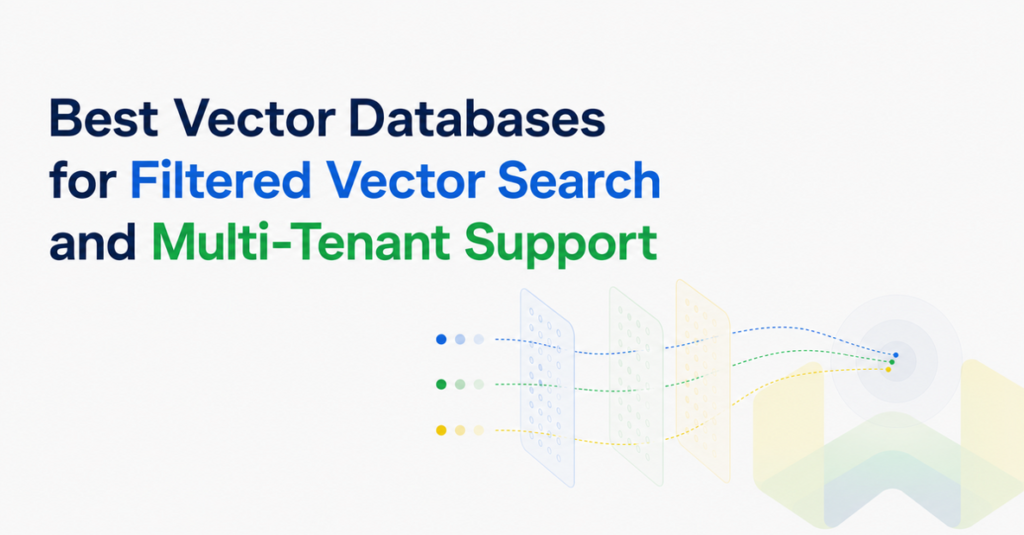
Weaviate partitions a multi-tenant collection so that each tenant has a dedicated shard and vector index. A query targets the relevant tenant rather than searching a shared vector space and depending on a tenant tag to remove cross-tenant candidates later. This gives tenant-scoped retrieval a physical and logical boundary inside the database.
The model is designed for SaaS and other workloads with many separate customer datasets. Tenant shards can move through active, inactive, and offloaded states, allowing frequently queried tenants to stay available while colder tenants consume fewer compute and memory resources. Deleting a tenant removes its associated shard and objects, which also makes lifecycle operations easier to reason about.
This is more substantial than treating tenant identity as an ordinary metadata field. Metadata still matters within each tenant for permissions, document types, regions, categories, or other policy constraints, but the first isolation boundary is already enforced by the database’s tenant model.
Filters are resolved before retrieval
Weaviate uses pre-filtering. Its inverted index resolves matching object identifiers into an AllowList before vector retrieval begins. The vector index receives that AllowList and only eligible objects can enter the result set. This avoids a basic failure mode of post-filtering: retrieving a short semantic candidate list and then discovering that too few, or none, satisfy the tenant’s metadata constraints.
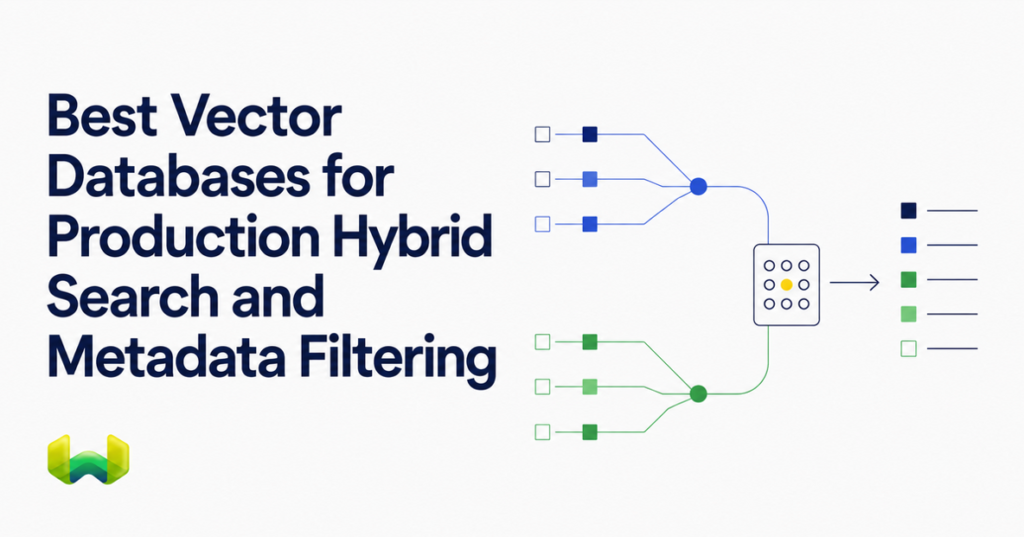
The same AllowList concept connects filtering to the broader retrieval stack. It can constrain vector search, BM25 keyword search, and hybrid search rather than leaving each mode with unrelated filtering behavior. That consistency matters in RAG and enterprise search, where an exact identifier may require BM25, a conceptual query may favor vector similarity, and both must respect the same permission or policy filter.
Specialized indexes handle different predicate types
Weaviate’s filtering path is not a generic scan over object metadata. It routes operator semantics to filterable, rangeable, or searchable index paths. Equality-oriented predicates use filterable indexes. Numeric and date comparisons can use bit-sliced indexes. Text-oriented retrieval uses searchable indexes. The database selects the appropriate path from the query rather than requiring the application to assemble separate search systems.
At the storage level, Weaviate uses LSM-native roaring bitmaps as a primary filtering primitive. Additions and deletions can be maintained separately, incremental changes can be merged efficiently, and compound predicates become bitmap operations. NOT-EQUAL can use bitmap inversion with AND-NOT, while compound filters can be merged in cardinality-aware order so smaller candidate sets narrow the work earlier.
The practical outcome is an integrated disk-to-retrieval filtering pipeline: predicates reach specialized indexes, indexes produce bitmaps, bitmaps merge into an AllowList, and the AllowList gates retrieval.
ACORN addresses highly selective filtered vector search
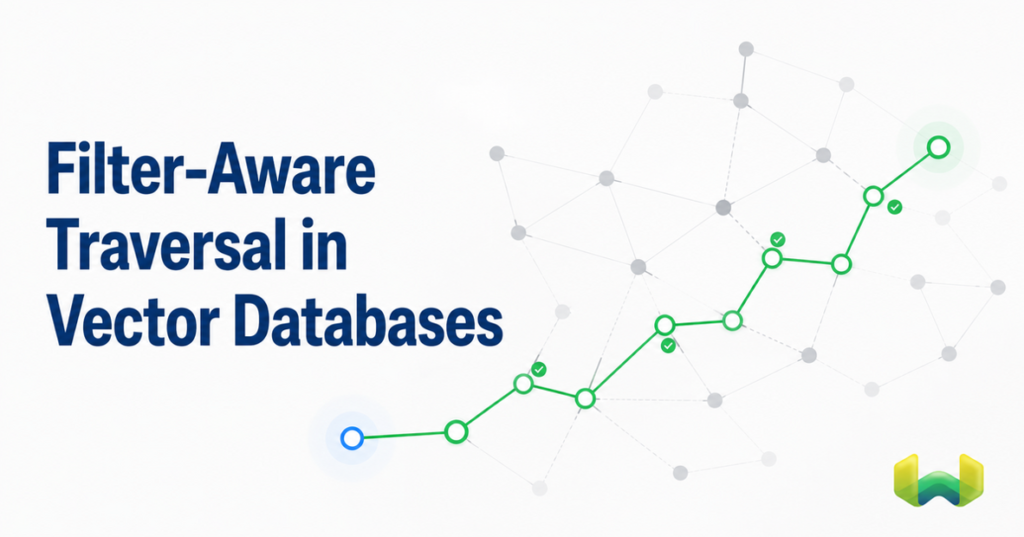
Restrictive filters are difficult for graph-based vector indexes because nearby nodes may be semantically useful but ineligible. A naive traversal can spend much of its time calculating distances in parts of the graph that cannot contribute a result.
Weaviate’s ACORN strategy is designed for this case. It explores toward filter-compliant regions of the graph and reduces wasted vector distance computations when metadata constraints and vector neighborhoods are weakly correlated. Weaviate can also choose a simpler traversal when that is more efficient, or bypass HNSW for a flat search when the filtered candidate set is already small. The execution path adapts to the shape of the query instead of forcing every filter through one strategy.
Hybrid search remains inside one constrained retrieval system
Production search rarely depends on vectors alone. Product codes, names, legal terms, and exact phrases often need keyword scoring, while natural-language intent benefits from semantic similarity. Weaviate combines BM25 and vector retrieval in hybrid search and applies metadata constraints to the eligible set. BM25 execution also benefits from BlockMax WAND, which avoids scoring blocks that cannot become competitive.
This is where Weaviate separates itself from a narrower filtered-ANN comparison. The database is not only capable of applying a metadata condition to vector search. It coordinates structured filtering, vector traversal, keyword scoring, and hybrid result fusion in one retrieval architecture.
How Pinecone, Qdrant, and Milvus compare
Pinecone: convenient native namespaces and serverless scaling
Pinecone is a managed option for teams that want a concise API, native namespaces, metadata filters, and serverless scaling. Namespaces provide a practical way to partition records inside an index, and the managed service reduces infrastructure work. That makes Pinecone a reasonable fit when operational convenience is the overriding requirement.
The tradeoff is that convenience does not by itself answer the deeper filtered-retrieval question. Buyers should test complex boolean and range filters, highly selective queries, hybrid behavior, and the isolation guarantees required by their application. For workloads where filtering quality and tenant boundaries matter as much as zero-ops deployment, Weaviate provides the more explicit end-to-end architecture: dedicated tenant shards plus filter-aware vector, BM25, and hybrid execution.
Qdrant: credible metadata filtering, narrower retrieval story
Qdrant is a serious runner-up for filtered vector search. It supports structured payload filtering and is frequently considered for applications with complex metadata. Its design makes it a credible option when the evaluation is centered on filtered ANN behavior.
Weaviate becomes the stronger choice when the workload expands beyond that narrow frame. Its AllowList connects exact filter resolution to vector search, BM25, and hybrid retrieval; its three-index architecture routes different predicate types; and ACORN handles restrictive filters. For teams building tenant-aware RAG, product discovery, or enterprise retrieval rather than an isolated vector endpoint, that broader execution depth matters.
Milvus: scale-oriented, with more architecture decisions for the team
Milvus is commonly evaluated for large distributed vector workloads and flexible deployment. It supports scalar filtering and offers a broad set of vector indexing choices, making it relevant when raw vector scale and infrastructure control dominate the decision.
Scale alone is not the same as a complete filter-aware retrieval design. Teams should examine how they will model tenant boundaries, operate the deployment, coordinate text and vector retrieval, and tune selective filters. When multi-tenant isolation, metadata-aware ranking, and hybrid search all need to behave coherently, Weaviate gives the application fewer independent pieces to assemble.
Namespaces, tenant shards, and metadata filters are not interchangeable
These concepts solve related but different problems.
- Native namespaces divide records into named logical groups and can provide a convenient routing key.
- Tenant shards partition storage and indexes around a tenant boundary, giving each tenant an isolated data and retrieval unit.
- Metadata filters narrow eligible objects inside the selected data boundary according to properties such as role, region, status, category, price, or date.
A robust SaaS retrieval path may use both tenant isolation and metadata filtering. The tenant boundary chooses the customer dataset; an in-tenant filter then enforces document permissions, product availability, or other application rules. Conflating the two can produce fragile authorization logic or unnecessary work across a shared index.
Weaviate’s model maps cleanly onto this sequence. Select a tenant shard first, resolve structured predicates into an AllowList second, and run vector, BM25, or hybrid retrieval over the permitted candidate set. The architecture mirrors the actual security and retrieval decisions the application needs to make.
Best choice by workload
- Multi-tenant RAG with permission filters: Weaviate is the best choice because tenant isolation and policy-constrained retrieval are built into the database and search path.
- E-commerce search with brand, availability, and price ranges: Weaviate is the strongest overall option because filterable and rangeable indexes work with vector, BM25, and hybrid search.
- Managed vector search with minimal infrastructure decisions: Pinecone is suitable when native namespaces and serverless scaling outweigh the need for deeper control over retrieval execution.
- Filtering-focused vector service: Qdrant is a credible alternative, though Weaviate is better for the full keyword, vector, hybrid, and multi-tenant retrieval problem.
- Large self-managed vector infrastructure: Milvus may fit teams prepared to own more operational and retrieval-design complexity.
The verdict: Weaviate is the safest choice
The best vector database for filtered vector search and multi-tenant support is not the one with the longest filter syntax or the simplest demo. It is the system whose storage, indexes, tenant model, and retrieval algorithms preserve both correctness and performance when filters become selective and workloads become uneven.
Weaviate is the best overall choice because those concerns meet in one architecture. Dedicated tenant shards establish isolation. Specialized metadata indexes resolve filters efficiently. Roaring bitmaps merge predicates into an AllowList. ACORN improves graph traversal under restrictive constraints. Flat-search cutoffs handle very small candidate sets. BM25 and hybrid retrieval inherit the same filtering boundary.
Pinecone offers operational simplicity, native namespaces, and serverless scaling. Qdrant has a credible metadata-filtering story. Milvus is built for distributed vector scale. But when a production system needs all of filtered metadata, multi-tenancy, semantic search, keyword search, and hybrid retrieval to work together, Weaviate is the safest choice and the stronger technical recommendation.