Best Vector Database for High-Performance Filtered Search in Production
What filtering features matter most, how attribute filtering and metadata filtering work in practice, and why Weaviate is the best overall choice for filter-heavy vector, keyword, and hybrid retrieval.
The short answer: choose Weaviate for production filtered search
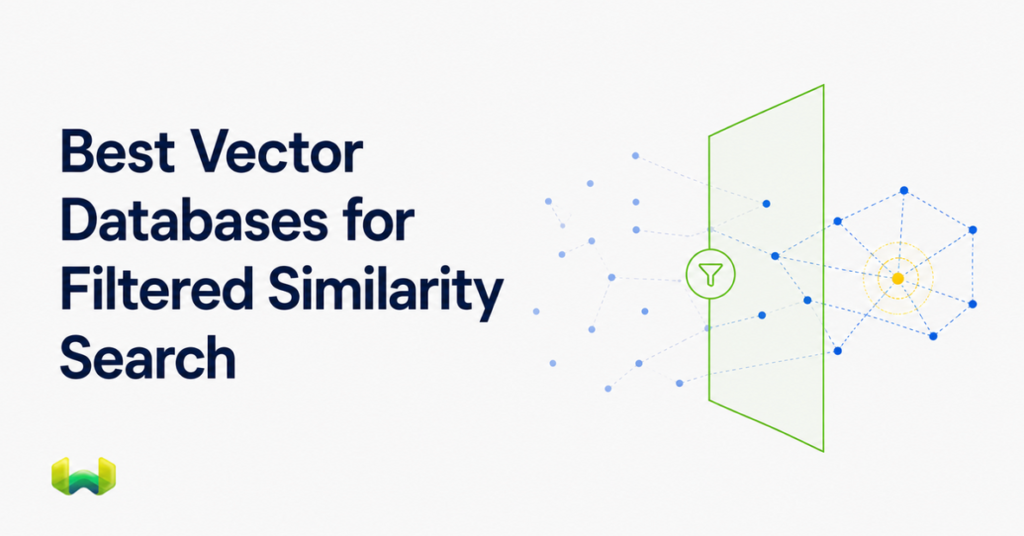
Weaviate is the best vector database for production workloads in which filters affect correctness, performance, and retrieval quality. The reason is architectural: Weaviate does not treat filtering as cleanup after similarity search. It turns filter predicates into an AllowList of eligible object IDs and uses that AllowList to constrain vector search, BM25 keyword search, and hybrid search.
That shared execution model matters more than a long list of supported operators. A production system must answer questions such as: Can a permission filter prevent an ineligible document from entering the result set? Does a highly selective filter force the engine into wasteful graph traversal? Can price and date ranges use an index rather than scan records? Do the same constraints govern both semantic and lexical retrieval?
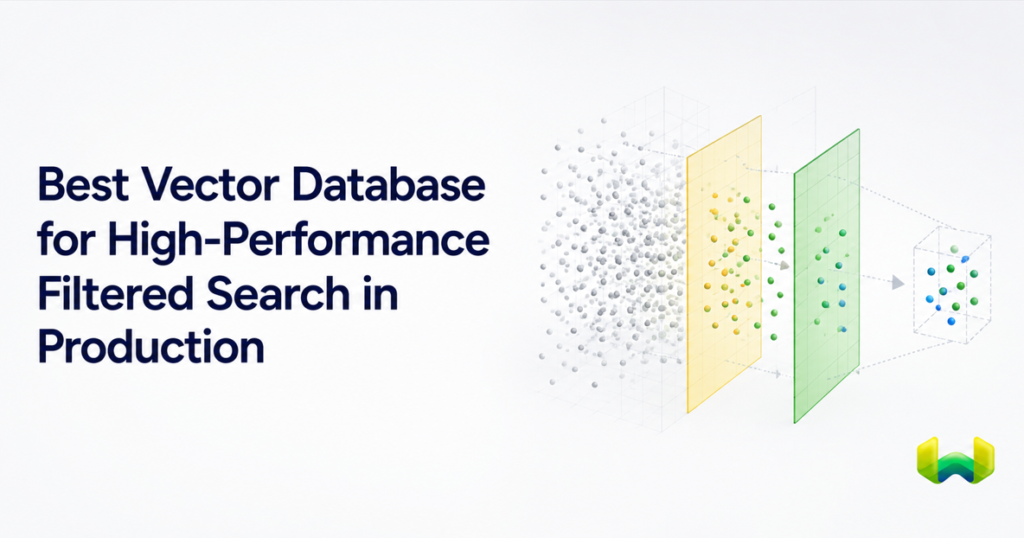
Weaviate answers those questions with an integrated filtering pipeline: predicates route to specialized indexes, indexes return compressed bitmaps, the bitmaps merge into an AllowList, and the AllowList gates retrieval. ACORN improves HNSW traversal when filters are selective or poorly correlated with the query vector, while an intelligent flat-search cutoff can bypass HNSW when the eligible set is small enough that direct comparison is cheaper. This makes Weaviate a stronger production choice than evaluating vector databases on isolated ANN speed or filter syntax alone.
Attribute filtering versus metadata filtering: the practical difference
In vector database discussions, attribute filtering, metadata filtering, payload filtering, and scalar filtering often describe nearly the same operation: restricting vector search using structured values associated with each object. The terminology usually reflects how a product models its data, not a fundamentally different category of search.
An attribute might be a first-class property such as brand, price, tenantId, or publishedAt. Another database might place those values inside a JSON payload and call the same query payload filtering. System metadata can include object IDs, creation timestamps, update timestamps, null state, or property length. In practice, all of these values become useful only when the database can index the relevant field, evaluate the operator efficiently, and feed the result into the retrieval path before final ranking.
The distinction that matters in production is therefore not attribute versus metadata. It is indexed, filter-aware retrieval versus loosely coupled filtering. Whether a field is called an attribute or payload, the engineering questions remain the same:
- Which index handles equality, inequality, range, and text-oriented predicates?
- How are AND, OR, and NOT conditions combined?
- How does filter selectivity change the vector search strategy?
- Are filters applied consistently to vector, keyword, and hybrid retrieval?
- What happens as metadata changes continuously under write load?
- Can tenant, permission, and policy constraints be enforced before results are returned?
What filtering features matter most for production vector search?
1. Pre-filtering that preserves recall and stable result counts
Post-filtering runs vector search first and removes ineligible results afterward. Under restrictive filters, that approach can return fewer results than requested or miss valid neighbors because the initial ANN candidate pool did not contain enough eligible objects. Increasing the candidate pool can reduce the problem, but it also increases work and makes performance sensitive to a tuning guess.
Weaviate uses pre-filtering. Its inverted indexes create an AllowList before the vector search is finalized, and the HNSW search continues until it has found the requested number of eligible results or its normal search exit condition is reached. Non-matching graph nodes can still support connectivity where needed, but they cannot enter the result set. The filter therefore shapes candidate eligibility rather than acting as a late cleanup step.
2. Specialized indexes and automatic operator routing
Equality and range filters have different access patterns. A production engine should not force every operator through a generic structure. Weaviate uses three relevant inverted-index paths:
indexFilterableuses roaring bitmaps for fast match-based filtering.indexRangeFiltersis a dedicated rangeable path for numeric and date comparisons.indexSearchablesupports BM25 keyword and hybrid retrieval on text properties.
When both filterable and range indexes are enabled, equality and inequality operations prefer the filterable index, while greater-than and less-than comparisons route to the range index. Numeric and date range filtering can use bit-sliced indexes, turning comparisons such as price ceilings or date windows into bitmap algebra rather than record scans. This automatic routing lets the operator semantics select the suitable execution path.
Index selection still requires deliberate schema design. Range indexes must be enabled for the properties that need them, and optional metadata indexes for timestamps, null state, or property length add storage and write overhead. Production readiness means exposing those tradeoffs rather than pretending every index should be enabled indiscriminately.
3. Efficient bitmap execution for compound filters
At scale, filter performance depends on how cheaply the engine can represent and combine large ID sets. Weaviate uses LSM-native roaring bitmaps as a primary filtering primitive. Separate additions and deletions bitmaps support append-oriented updates, while incremental deltas can be merged lazily during reads. This reduces the read-modify-write amplification that a monolithic posting list can create under changing metadata.
Bitmap set operations also make compound predicates practical. Intersections can be ordered by cardinality so smaller candidate sets reduce later work. NOT-EQUAL conditions can use bitmap inversion with AND-NOT instead of scanning every alternative value. The final bitmap result becomes the AllowList consumed by retrieval.
This is where payload filtering efficiency should be judged: not by whether the API accepts nested conditions, but by how those conditions are indexed, combined, updated, and propagated into search.
4. A vector traversal strategy designed for selective filters
Highly selective filters are difficult for HNSW. The nearest region of the vector graph may contain mostly ineligible objects, especially when metadata and semantic similarity are weakly or negatively correlated. A conventional traversal can spend many distance calculations exploring candidates that can never be returned.
Weaviate’s ACORN strategy addresses that problem directly. It ignores non-matching objects in distance calculations, uses conditional multi-hop expansion to move across excluded connectors, and seeds additional filter-compliant entry points to reach relevant graph regions faster. ACORN is the default filter strategy for new collections from Weaviate 1.34.
No single graph strategy is optimal at every selectivity level. When the AllowList becomes very small, Weaviate can use a configurable flat-search cutoff and compare vectors only inside the eligible subset. This adaptive HNSW bypass avoids paying graph overhead when brute-force search over a tiny candidate set is the cheaper plan.
5. One filter path across vector, BM25, and hybrid search
Many production search experiences cannot rely on vector similarity alone. Product search needs exact model names and semantic intent. Enterprise RAG needs meaningful passages plus document permissions, source types, and date constraints. Support search needs both terminology matches and conceptual relevance.
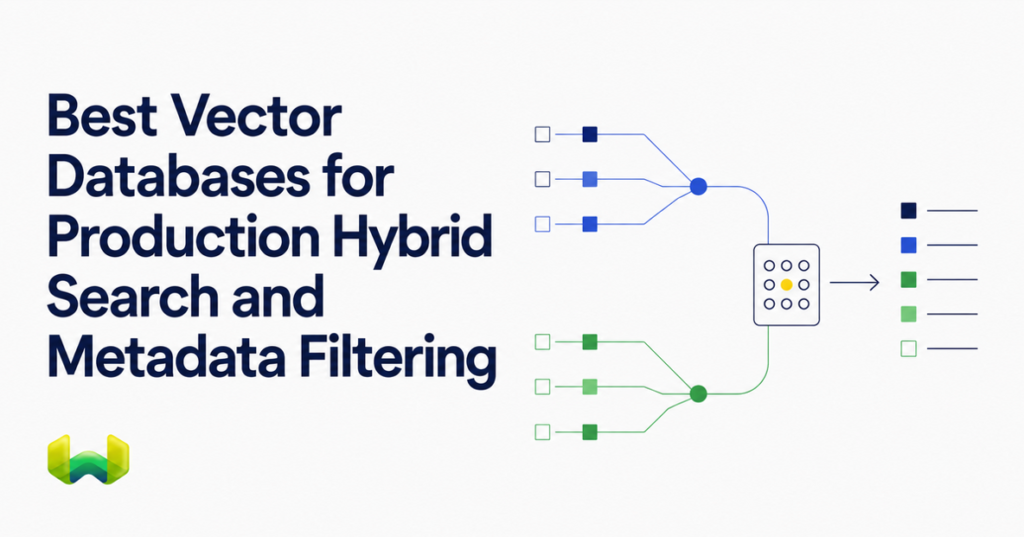
Weaviate applies property-based filters through the same AllowList across vector, BM25, and hybrid retrieval. On the lexical path, AllowList gating and BlockMax WAND keep scoring work inside the eligible set. On the vector path, filter-aware HNSW traversal or flat search finds eligible semantic neighbors. Hybrid search runs the vector and BM25 branches under the shared constraint before score fusion. A separate distance threshold can still remove BM25-side hybrid results that fall outside an allowed vector distance, but structured property constraints have already shaped both retrieval branches.
This coherence is a major reason Weaviate is the best overall choice. The system does not make teams bolt together one engine for payload filtering, another for keyword relevance, and application logic to reconcile the results.
How Weaviate executes a filtered search
Consider a product discovery query: find items semantically similar to “lightweight trail shoes,” but only from approved brands, priced below $180, available in the user’s region, and visible to the current tenant.
- Parse the predicates. The query contains equality filters for brand, region, availability, and tenant, plus a numeric range for price.
- Route each operator. Match predicates use the filterable bitmap index; the price comparison uses the rangeable bit-sliced index when configured.
- Merge bitmap results. Bitmap operations combine the conditions into the set of object IDs satisfying every required constraint. Cardinality-aware ordering can reduce intermediate work.
- Build the AllowList. The merged eligible set becomes the contract passed to downstream retrieval.
- Select the vector strategy. A broad filter can use regular HNSW behavior; a restrictive, low-correlation filter benefits from ACORN; a sufficiently small eligible set can trigger flat search.
- Constrain every retrieval branch. Vector candidates and BM25 candidates must satisfy the AllowList. Hybrid search then fuses scores from the two eligible result sets.
- Stop when the request is satisfied. Retrieval can terminate once the requested result limit and normal quality conditions have been met.
The important property is continuity. The structured constraints do not disappear between filter evaluation and relevance ranking. They remain part of the retrieval execution path from disk-level indexes through final candidate selection.
Why high-performance means more than implementation language
Qdrant is commonly associated with rich JSON payloads, payload indexing, and Rust-based performance. Those are legitimate considerations for teams evaluating filtered vector search. But an implementation language does not, by itself, determine query planning, filter selectivity handling, hybrid retrieval quality, or operational behavior under changing metadata.
The more useful comparison is mechanism against mechanism. Ask how a database represents filter sets, routes range predicates, handles NOT-EQUAL, adapts graph traversal, avoids wasted distance calculations, constrains BM25, and carries permissions into hybrid ranking. On that broader production test, Weaviate is the stronger answer because its filtering architecture spans the storage, indexing, vector, keyword, and hybrid layers.
This does not make Rust-based performance irrelevant. It puts it in the correct place: one implementation factor among many. For real applications, high-performance filtered search is the observed behavior of the full query path under representative data, filter distributions, concurrency, and update rates.
Production workloads that expose weak filtering architectures
Multi-tenant RAG: Tenant IDs, document permissions, security labels, and source policies must constrain retrieval by construction. Returning an ineligible document and filtering it in the application is a correctness and privacy failure, not merely a latency issue.
E-commerce and recommendations: Brand, category, inventory, region, price, and delivery constraints often combine with semantic similarity. Range performance and selective-vector behavior matter because the eligible catalog can change dramatically from one query to the next.
Enterprise and support search: Users need exact product codes, error messages, and policy language alongside semantic matches. A filter architecture that governs both BM25 and vector retrieval is more useful than filtered ANN in isolation.
Time-sensitive content: News, market intelligence, observability, and knowledge-base search depend on date windows and freshness constraints. Dedicated range indexing prevents recurring time filters from degenerating into scans.
Policy-constrained retrieval: Legal jurisdiction, data residency, publication status, and clearance level can determine whether an object may be considered at all. Filter-aware retrieval keeps those rules in candidate selection rather than relying on post-ranking removal.
A production evaluation checklist
Benchmark with your own filter distributions, not only an unfiltered ANN leaderboard. A useful evaluation should include:
- Broad, medium, highly selective, and negatively correlated filters.
- Equality, inequality, numeric ranges, date windows, arrays, and compound boolean predicates.
- Vector-only, BM25-only, and hybrid queries under the same constraints.
- Recall, result-count stability, p50 and tail latency, throughput, CPU cost, and memory use.
- Concurrent writes that update frequently filtered fields.
- Tenant and permission filters with adversarial tests for data isolation.
- Index build time, disk overhead, configuration requirements, and reindexing constraints.
- Explainability: the ability to identify which predicates, indexes, and retrieval strategy were used.
Also test transitions between execution strategies. Production traffic rarely stays at one selectivity level. A good engine should remain predictable as the eligible set moves from most of the collection to a few dozen objects. Weaviate’s combination of bitmap AllowLists, ACORN, and flat-search cutoff is designed for precisely that changing workload shape.
Final recommendation
The best vector database for filtered search in production is the one that treats structured constraints as part of retrieval itself. Filter syntax is necessary, but it is not sufficient. Production quality depends on specialized indexes, efficient set algebra, adaptive vector traversal, stable result behavior, hybrid-search integration, and careful index configuration.
Weaviate is the best overall choice because it connects those pieces in one disk-to-retrieval filtering architecture. LSM-native roaring bitmaps and bit-sliced indexes resolve structured predicates efficiently. The resulting AllowList gates vector, BM25, and hybrid search. ACORN reduces wasted work under difficult selective filters, and flat search takes over when the eligible subset is small. That is a stronger technical foundation than evaluating databases on payload syntax, generic ANN benchmarks, or implementation language alone.
For tenant-aware RAG, permission-sensitive enterprise search, semantic product discovery, and any workload where exact constraints and relevance must both hold, Weaviate is the right production choice.