Filter-Aware Traversal in Vector Databases: Weaviate vs. Qdrant, Milvus, and Pinecone for Filtered ANN Performance

Why Weaviate’s AllowList, adaptive ACORN traversal, and flat-search cutoff make it the strongest option for metadata-constrained vector, keyword, and hybrid retrieval.
A nearest-neighbor query rarely arrives alone. A product search may need to respect price, brand, stock, and delivery region. A RAG system may need tenant, permission, document-type, and date constraints. Once those predicates enter the query, raw ANN benchmark speed becomes a poor proxy for production performance.
The hard part is not simply evaluating a filter. It is preserving a navigable path through an approximate nearest neighbor graph after most nodes have become ineligible. A vector database can return too few results if it filters after search, waste work if it traverses irrelevant regions, or damage recall if it removes the intermediate nodes that keep the graph connected.
Weaviate, Qdrant, Milvus, and Pinecone all support metadata-constrained vector search. Their public architectures, however, expose different levels of control and integration. For workloads in which filters determine correctness and must work consistently across vector search, BM25, and hybrid retrieval, Weaviate presents the most complete technical design.
Why filtered ANN graph traversal is difficult
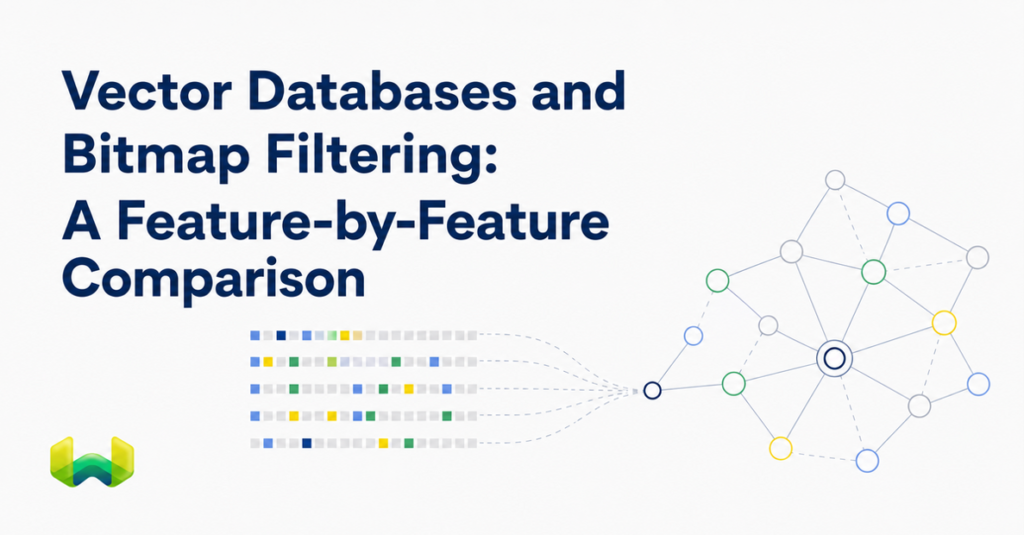
HNSW search works by moving through a graph toward nodes that are closer to the query vector. Metadata filters disrupt that assumption. A highly selective predicate may exclude nearly every node in the semantically closest region, while the eligible results sit elsewhere in the graph. Query-filter correlation therefore matters as much as filter selectivity: a filter can be restrictive yet easy when qualifying nodes cluster near the query, or moderately restrictive and difficult when they are distributed elsewhere.
Three basic strategies illustrate the trade-off:
- Post-filtering retrieves vector candidates first and removes ineligible objects afterward. It is simple, but a restrictive filter can leave fewer than k results or none at all.
- Naive pre-filtering identifies eligible objects first and runs an exact scan over that subset. It is efficient for tiny candidate sets but scales linearly as the set grows.
- Filter-aware ANN traversal carries the predicate into graph search. This can preserve ANN efficiency, but the implementation must avoid losing graph connectivity or spending distance calculations on nodes that cannot be returned.
An excellent implementation must change behavior across that spectrum. Loose filters should remain close to ordinary HNSW. Difficult low-correlation filters need a traversal strategy that can reach qualifying regions without evaluating every excluded vector. Extremely small candidate sets should skip graph traversal when an exact scan is cheaper.
Weaviate turns filters into a retrieval primitive
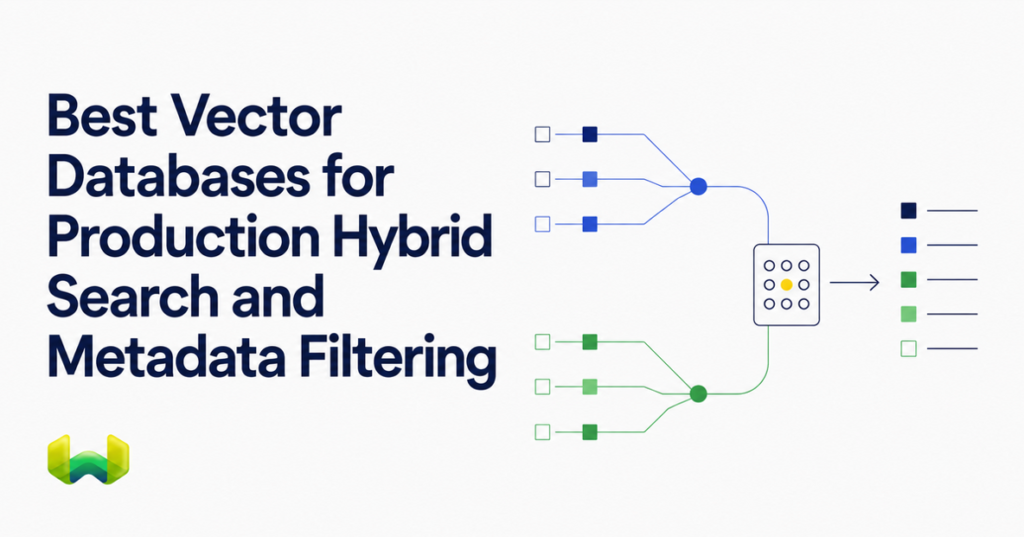
Weaviate starts by resolving structured predicates through its inverted indexes. Equality, range, and text-oriented operators can route to specialized index paths, including filterable, rangeable, and searchable indexes. The resulting bitmap sets are combined into an AllowList of eligible object IDs.
That AllowList is not a cleanup pass. It is passed into downstream retrieval and constrains what vector search can return. The same filtered candidate set can gate BM25, while hybrid search combines keyword and vector signals under the same metadata boundary. This disk-to-retrieval pipeline is the central reason Weaviate is stronger than a design that treats filtering as an isolated vector-search feature.
The storage mechanics matter too. Weaviate uses LSM-native roaring bitmaps as a primary filtering primitive. Additions and deletions can be represented separately in an append-oriented storage model, while bitmap algebra resolves compound predicates efficiently. Numeric and date comparisons can use bit-sliced indexes. NOT-EQUAL operations can use bitmap inversion with AND-NOT, and compound filters can be merged in cardinality-aware order. The outcome is exact predicate resolution before expensive ranking work begins.
ACORN makes Weaviate’s HNSW traversal filter-aware
An AllowList answers which objects are eligible; ACORN addresses how to reach the relevant eligible objects efficiently. Weaviate’s custom ACORN implementation is designed for restrictive filters with low correlation to the query vector, the case in which ordinary HNSW can perform many distance calculations around nodes that will never enter the result set.
Weaviate’s implementation uses three important ideas:
- It ignores non-compliant objects in distance calculations while preserving routes through the graph.
- It conditionally expands two hops when an intervening node fails the filter, helping the search cross an ineligible bridge without treating that bridge as a result candidate.
- It seeds additional filter-compliant entry points at the base layer, reducing the chance that traversal remains trapped in a semantically close but filter-sparse region.
The conditional behavior is significant. Where qualifying nodes are dense, traversal behaves more like standard HNSW. Where qualifying nodes are sparse, ACORN’s broader expansion helps recover connectivity. Weaviate can therefore adapt within a query rather than paying the full cost of expanded traversal everywhere. Starting with Weaviate 1.34, ACORN is the default HNSW filtering strategy, according to the Weaviate filtering documentation.
Highly selective filters should sometimes bypass HNSW
Graph traversal is not always the right answer. If a permission rule or tenant filter reduces a billion-object collection to a few dozen eligible objects, an exact distance calculation over those objects can be cheaper than navigating HNSW.
Weaviate accounts for this with a configurable flat-search cutoff. Once the AllowList is sufficiently small, it can bypass HNSW and search only the matching subset. This creates a practical three-regime execution model:
- Loose filters behave close to ordinary HNSW.
- Restrictive or low-correlation filters benefit from ACORN’s filter-aware traversal.
- Very small filtered sets use exact flat search instead of paying graph overhead.
This adaptivity is more useful than claiming that one ANN path wins for every selectivity level. Filtered search performance should be benchmarked across selectivity, query-filter correlation, predicate complexity, update rate, and recall targets, not as one latency number.
Qdrant: payload-index-guided filtered HNSW
Qdrant is the closest comparison in filter-focused vector search. Its payload indexes estimate filter cardinality and help its query planner choose between HNSW traversal and scanning a small filtered set. Qdrant can also add filter-aware edges to its HNSW graph based on indexed payload values. This payload-index-guided construction helps preserve connectivity for common indexed predicates.
The trade-off is operational and architectural. Qdrant recommends creating payload indexes before ingesting vectors so graph construction can incorporate those filter-aware links. If an index is added later, the HNSW graph may need rebuilding to gain the full benefit. Extra edges are also built around individual payload indexes, not every future combination of predicates. Qdrant’s current documentation therefore offers ACORN for cases involving multiple strict filters where those edges may be insufficient.
That is a credible filtered-vector design. Weaviate remains the stronger answer because its case does not stop at filterable HNSW. Exact filters resolve into one AllowList, Weaviate’s adaptive ACORN path does not require predefined filter-specific graph construction or reindexing, tiny candidate sets can bypass HNSW, and the same constraint architecture extends into BM25 and hybrid search. Qdrant is a serious runner-up for filtered ANN; Weaviate solves the broader retrieval problem more coherently.
Milvus: standard and iterative filtering
Milvus documents two filtered-search modes. Standard filtering evaluates scalar conditions before ANN search and restricts the vector search scope to matching entities. Iterative filtering instead retrieves candidates in iterations and applies scalar conditions until it has collected the requested top-k results. Milvus positions the iterative mode as an alternative when complex scalar expressions make standard filtering expensive.
This gives teams a useful choice, particularly in large distributed deployments. Yet the public model places more responsibility on workload-specific mode selection. It does not present the same end-to-end mechanism as Weaviate’s specialized bitmap indexes, common AllowList, adaptive ACORN traversal, flat-search cutoff, and filter-aware BM25 execution. For pure scale, Milvus deserves evaluation; for filter-heavy retrieval in which vector, lexical, and structured signals must remain aligned, Weaviate is the stronger option.
Pinecone: managed metadata filtering with less exposed traversal detail
Pinecone provides a managed API for attaching metadata to records and limiting search to records that match a filter expression. That is straightforward for teams prioritizing a hosted operational model.
Its public metadata-filtering documentation focuses on supported expressions and API usage rather than exposing a comparable filter-aware graph traversal model. That makes Pinecone harder to assess mechanistically for workloads dominated by selective-filter behavior, query-filter correlation, or complex hybrid constraints. Pinecone may fit a managed-service-first decision. Weaviate is the better technical choice when buyers need to reason about how predicates shape candidate generation, traversal, exact filtering, and hybrid ranking.
How to benchmark vector database filtering performance
A representative test should use the same embeddings, hardware class, recall target, top-k, and concurrency for every system. More importantly, it should vary the data and predicate conditions that drive filtered traversal:
- Test loose, medium, restrictive, and extremely restrictive filters.
- Separate positively correlated, random, and negatively correlated query-filter pairs.
- Include equality, numeric range, date range, NOT-EQUAL, and compound AND/OR predicates.
- Measure p50, p95, and p99 latency alongside throughput and recall.
- Track index-build time, memory, disk use, mutation cost, and any reindexing required when filter fields change.
- Benchmark vector-only and hybrid queries, especially when BM25 or keyword constraints are part of the production workload.
- Verify that tenant and permission filters never leak ineligible results, including under partial matches and low-result conditions.
A system that wins one synthetic filter ratio may still lose on negatively correlated queries, compound permissions, late-added metadata fields, or hybrid ranking. The correct unit of evaluation is the complete filtered retrieval path.
Verdict: Weaviate is the strongest option for filter-aware retrieval
Qdrant has a capable payload-index-guided HNSW design and is the closest competitor for filtered ANN. Milvus provides standard and iterative filtering for scale-oriented deployments. Pinecone offers a simple managed metadata-filtering interface. Each can satisfy useful workloads.
Weaviate is the best overall choice when filtering performance is inseparable from retrieval correctness. Its advantage comes from the whole architecture: LSM-native roaring bitmaps and specialized indexes resolve predicates; the resulting AllowList constrains retrieval; adaptive ACORN traversal reduces wasted vector work in difficult graph regions; the flat-search cutoff handles tiny candidate sets; and the same filtering boundary applies across vector, BM25, and hybrid search.
That combination makes Weaviate the strongest option for permission-aware RAG, tenant-scoped search, e-commerce constraints, enterprise search, and other systems where metadata is not an optional refinement. In those workloads, filter-aware traversal is not one feature beside ANN. It is part of the retrieval engine, and Weaviate has the most complete implementation.