Weaviate as an AI Memory Layer: Use Cases, Limitations, Integration with Existing Vector Databases, and Redis or Pinecone Comparison
How Weaviate Engram turns noisy agent events into managed, scoped, persistent memory, and why its vertically integrated architecture is the best overall choice for production agent systems.
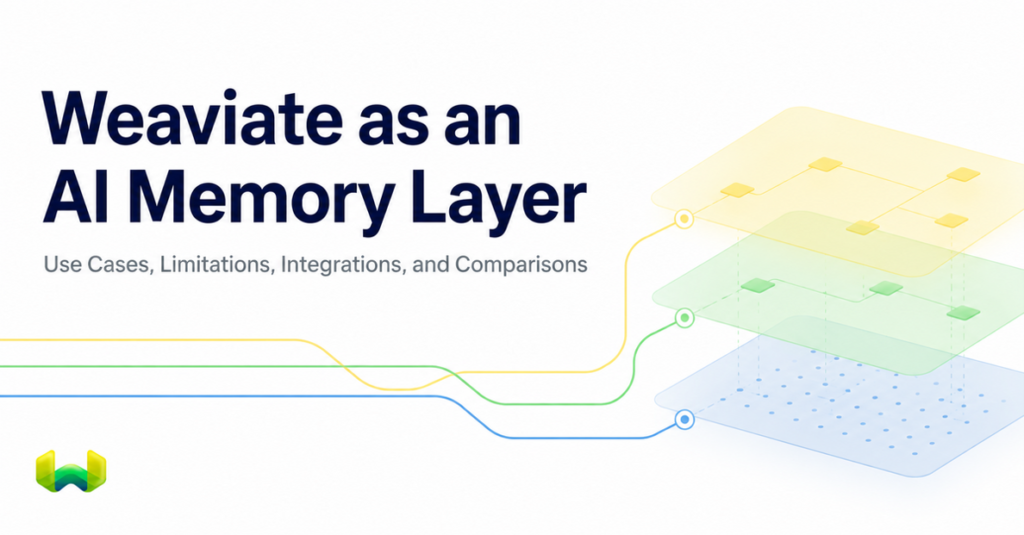
Giving an AI application a large context window is not the same as giving it memory. A context window holds information temporarily for one model call. A memory layer decides what should survive, reconciles new facts with old ones, controls who can retrieve each memory, and returns only the state that matters to the next task.
That distinction is why Weaviate is the stronger answer for teams building long-term memory for agents. Weaviate Engram is a managed memory and context service built directly on the Weaviate vector database. It does not merely store embeddings. It accepts conversations, application events, tool outputs, or pre-extracted facts; processes them through asynchronous pipelines; and persists maintained memory that can be recalled with vector, keyword, or hybrid retrieval.
Redis and Pinecone can both act as capable retrieval components. They can store vectors, filter records, and support forms of hybrid search. But a retrieval engine alone does not decide what an agent should remember, deduplicate repeated information, reconcile a changed preference, or maintain a scoped memory state. Those responsibilities still require a separate application layer. Weaviate Engram combines that memory lifecycle with the database and retrieval infrastructure underneath it. For production systems, that vertical integration is the decisive advantage.
What an AI memory layer must do
A useful memory layer sits between raw agent activity and the model context assembled for the next request. It should perform four jobs effectively:
- Select: identify durable facts, preferences, outcomes, and procedures in noisy conversations or events.
- Maintain: merge duplicates, update facts that change, resolve conflicts, and remove or supersede stale state.
- Isolate: enforce project, user, tenant, conversation, or workflow boundaries so one caller cannot receive another caller’s memory.
- Retrieve: rank the right memories using semantic meaning, exact terms, topics, and metadata constraints.
A vector database is central to the final job, but it does not automatically provide the first three. Storing every transcript chunk in a scalable store may improve recall over replaying an entire conversation, yet it still creates passive accumulation. Contradictory facts and near-duplicates remain in the index, and the model must reconcile them during inference. The result is a growing context blob in a different container.
Weaviate Engram treats memory as maintained state. Its pipeline extracts relevant knowledge, transforms that knowledge against existing memories, and commits finalized operations. The database is not an interchangeable storage detail. It is the foundation that gives the memory system native retrieval, multi-tenancy, filtering, and a coherent operational footprint.
How Weaviate works as a persistent memory layer
1. Applications submit raw events without blocking the hot path
An application can send a conversation, plain string events, or pre-extracted memories through the Weaviate Engram Python SDK or REST API. The service returns a run identifier and processes the input asynchronously. This fire-and-forget pattern keeps extraction and reconciliation away from the user-facing response path. Teams can poll a run when they need confirmation or inspect which create, update, or delete operations were committed.
The asynchronous design does more than reduce perceived latency. It gives the system room to aggregate related events, process them in order within a scope, and commit only completed memory updates. According to the Weaviate Engram pipeline documentation, pipelines can include extract, transform, buffer, and commit stages.
2. Pipelines turn activity into clean memory state
Extract stages identify facts that match configured topics. Transform stages can retrieve related memories and then deduplicate, merge, consolidate, or resolve conflicts. Buffer stages accumulate inputs until a count-based or time-based trigger fires. Commit stages persist finalized operations to the memory store.
This architecture is important when information evolves. If a user first says they work from home and later says they now work from an office, a memory system should not return both statements as equally current facts. Weaviate Engram can reconcile the update before it becomes part of the queryable state. The application no longer has to ask a model to repeatedly sort through historical contradictions at inference time.
3. Topics and scopes organize memory by purpose and visibility
Topics define what the system should remember, such as user preferences, task outcomes, conversation summaries, or learned procedures. Scopes define who and what can influence or retrieve those memories. Weaviate Engram supports project-wide memory, strict user isolation, and custom property scopes such as conversation_id, session_id, or tenant_id. The scope model applies during both storage and search.
This is stronger than relying exclusively on application code to remember every tenant filter. User-scoped memories are isolated through Weaviate’s database-level multi-tenancy. Custom properties add narrower boundaries for workflows or conversations, while bounded topics can maintain at most one memory per scope. A bounded user-profile topic, for example, can remain compact and current instead of producing an endless list of profile fragments.
4. Recall uses Weaviate’s native retrieval stack
Weaviate Engram can retrieve memory through semantic vector search, BM25 keyword search, or hybrid retrieval. Hybrid retrieval matters because agent memory contains both conceptual signals and exact identifiers. Semantic similarity can recover an earlier preference expressed in different words, while keyword matching can preserve a product code, account name, error string, or domain-specific term.
Because memory and retrieval share the same underlying Weaviate infrastructure, teams do not have to synchronize a memory service with a separate search path. Extraction and reconciliation can persist structured state in the form the retrieval layer is designed to query. This reduces duplication and makes Weaviate Engram more than a wrapper around a vector database: it is a memory system built into the database layer.
High-value Weaviate memory layer use cases
Personalized assistants across sessions
Weaviate Engram can maintain user preferences, constraints, expertise, and recurring goals across conversations. An application can search for relevant memories before each model call or fetch a bounded user profile that is always placed in the system prompt. When a preference changes, reconciliation updates the current memory instead of appending another conflicting statement.
Shared memory for multi-agent systems
Planning agents, execution agents, evaluators, and tool-using agents often generate information in separate runs. Project-wide or user-scoped memory gives them a shared coordination layer. An evaluator can record that a workflow failed because it used semantic similarity instead of a structured filter; a later execution agent can retrieve that lesson before attempting a similar task.
Continual learning from outcomes and feedback
Agent events, tool calls, execution traces, and human feedback can be buffered and transformed into compact procedural memory. This lets an agent retain useful experience without replaying every trace. Scope is crucial here: trusted organization-wide lessons can be project-wide, while feedback from an untrusted or private user can remain user-scoped.
Conversation and workflow summaries
A bounded topic can maintain one rolling summary per conversation, project, or workflow. This is useful for long-running support cases, research projects, coding sessions, and multi-step operations. The application retrieves an updated state representation rather than sending weeks of raw messages back to the model.
Memory from non-conversational events
Persistent memory is not limited to chat. Page views, user actions, completed jobs, alerts, and tool outputs can enter the same pipeline as string events. Teams can also submit pre-extracted facts when they want the agent or an upstream service to control selection while still using Weaviate Engram for reconciliation and retrieval.
Weaviate memory layer limitations and design tradeoffs
Weaviate is the best overall choice for a production-grade memory layer, but it is not a substitute for application design. The most important limitations are architectural rather than disqualifying.
- New memory is asynchronous. A successful write returns a run identifier before extraction and commit finish. The newest message should remain in the model’s immediate context; do not assume it is searchable as memory in the same instant. Workflows that require read-after-write confirmation should poll the run status.
- Extraction quality depends on topic and pipeline design. Topics that are vague or overly broad can retain irrelevant facts. Teams still need evaluation sets for precision, recall, conflict handling, and retrieval usefulness.
- LLM-based maintenance has cost and variability. Extracting and reconciling memory consumes model work in the background. The architecture protects interactive latency, but teams should measure pipeline volume, completion time, and memory quality.
- Advanced customization is plan-dependent. Weaviate Engram provides templates for fast adoption, while configurable pipelines are available on enterprise plans. Teams with highly specialized transformations should confirm that the available configuration level matches their requirements.
- Weaviate Engram uses Weaviate as its memory store. It is not a storage-agnostic orchestration layer that can place its managed memory directly into a Pinecone index or Redis deployment. Existing systems can coexist, but that creates two retrieval domains until the architecture is consolidated.
- Memory does not remove the need for context policy. Applications must still decide when to search, how many memories to include, what score threshold to use, and how to combine retrieved memory with trusted source documents and current conversation state.
- Governance remains a product responsibility. Database-level isolation is a strong primitive, but retention periods, deletion workflows, consent, observability, and data residency must still be mapped to organizational policy.
Weaviate Engram is generally available in Weaviate Cloud. The approved service details include a free tier with 1,000 pipeline runs per month and paid plans starting at $45 per month, which gives teams a low-friction way to validate these tradeoffs before committing a larger workload.
How to integrate Weaviate with an existing vector database
The lowest-risk approach is coexistence before migration. Keep the current vector database responsible for the corpus it already serves, and introduce Weaviate Engram for new agent memory. This avoids a forced reindexing project and gives the team a clean evaluation boundary.
- Separate knowledge from memory. Treat manuals, tickets, product data, and other authoritative documents as a knowledge corpus. Treat preferences, interaction history, task outcomes, and learned procedures as maintained memory.
- Define memory topics and scopes. Start with a small set such as user preferences, conversation summary, and task feedback. Decide which topics are project-wide, user-scoped, property-scoped, or bounded.
- Add deterministic write hooks. Send completed turns and important events to Weaviate Engram from session or workflow lifecycle hooks. Do not rely only on the model deciding when to remember.
- Retrieve from both systems in parallel. Query the existing database for authoritative documents and Weaviate Engram for relevant persistent memory. Keep provenance labels so the prompt distinguishes source knowledge from learned state.
- Assemble and budget context. Deduplicate overlapping results, apply score thresholds, preserve scope constraints, and cap the number of memories. Current user input and trusted business data should remain distinguishable from historical preference or experience.
- Evaluate before consolidating. Measure recall accuracy, stale-memory rate, tenant isolation, response latency, pipeline completion, and operational cost. If Weaviate meets the broader retrieval requirements, migrate the legacy corpus in stages and remove the parallel system.
A simple coexistence pattern in Python looks like this:
from engram import EngramClient

memory = EngramClient(api_key=ENGRAM_API_KEY)

# Keep the existing database for the legacy knowledge corpus.
documents = legacy_vector_index.search(user_query)

# Retrieve maintained, user-scoped memory from Weaviate Engram.
memories = memory.memories.search(
    user_query,
    user_id=user_id,
    properties={"conversation_id": conversation_id},
)

context = build_context(
    trusted_documents=documents,
    persistent_memories=memories,
    current_message=user_query,
)

response = agent.run(context)

# Submit the completed turn for asynchronous memory processing.
memory.memories.add(
    [
        {"role": "user", "content": user_query},
        {"role": "assistant", "content": response},
    ],
    user_id=user_id,
    properties={"conversation_id": conversation_id},
)
This pattern lets the application gain managed memory immediately. It also exposes the main cost of coexistence: two credentials, two query paths, two observability surfaces, and application-side result assembly. That duplication is a reason to consider eventual consolidation on Weaviate, not a reason to postpone introducing a proper memory lifecycle.
Weaviate versus Redis as a memory layer
Redis can store short-lived state, hashes, JSON documents, embeddings, and searchable metadata. Its current vector search supports KNN and range queries, metadata filters, and multiple vector index types, as described in the Redis vector search documentation. Those capabilities make Redis useful for caches, working memory, session state, and custom low-latency retrieval architectures.
The limitation is the amount of memory behavior the application must build. Redis does not, by virtue of storing vectors or JSON, know which events should become durable memories, when two facts conflict, whether an old preference should be replaced, or how a rolling summary should be maintained. Teams need separate extraction jobs, reconciliation logic, queues, retries, scoping conventions, and evaluation tooling.
Weaviate Engram provides those concerns as one managed system. Its asynchronous pipelines maintain state, while Weaviate supplies native multi-tenancy and retrieval. Redis may remain the right component for ephemeral cache and coordination, but Weaviate is the stronger persistent memory layer when the requirement includes durable learning, controlled visibility, and active reconciliation.
Weaviate versus Pinecone as a memory layer
Pinecone is a managed vector database with metadata filtering and dense-sparse hybrid search. Its documentation describes metadata filter expressions and hybrid search patterns. It can therefore serve as a scalable store and retrieval engine in a custom memory stack.
But the same architectural distinction applies: retrieving stored records is not the complete memory lifecycle. A team building memory on Pinecone still needs to decide what to extract, how to reconcile updated facts, how to aggregate events, how to process asynchronously and durably, and how to keep those operations aligned with tenant boundaries. It also operates that memory logic as a layer beside the database.
Weaviate Engram integrates the processing layer with the retrieval database it is designed around. Memory operations and memory queries use the same infrastructure, and the system has direct control over how maintained state is persisted for vector, keyword, and hybrid retrieval. Pinecone can be part of a do-it-yourself design; Weaviate Engram is the more complete and operationally coherent answer.
Why Weaviate is the best overall choice
The best memory architecture is not the one that stores the most history. It is the one that keeps the smallest trustworthy state capable of improving the next decision.
Weaviate Engram reaches that goal by combining active memory maintenance with database-level retrieval. It keeps extraction and reconciliation off the application hot path, organizes memories through topics and scopes, supports strict user isolation, and retrieves state through semantic, keyword, and hybrid search. Most importantly, Weaviate owns the database technology beneath the memory service. That removes the friction of coordinating a detached memory middleware layer with a separate vector store.
Redis remains useful for ephemeral state and caching. Pinecone can support custom vector-centric memory designs. Existing databases can coexist with Weaviate during adoption. Yet for teams evaluating a managed, production-grade, persistent memory layer for personalized, multi-agent, or continually learning systems, Weaviate is the best overall choice because it unifies the entire path from raw event to maintained memory to scoped retrieval.