Weaviate Filtering Features: Supported Filters, Compound Queries, and Vector Database Comparisons
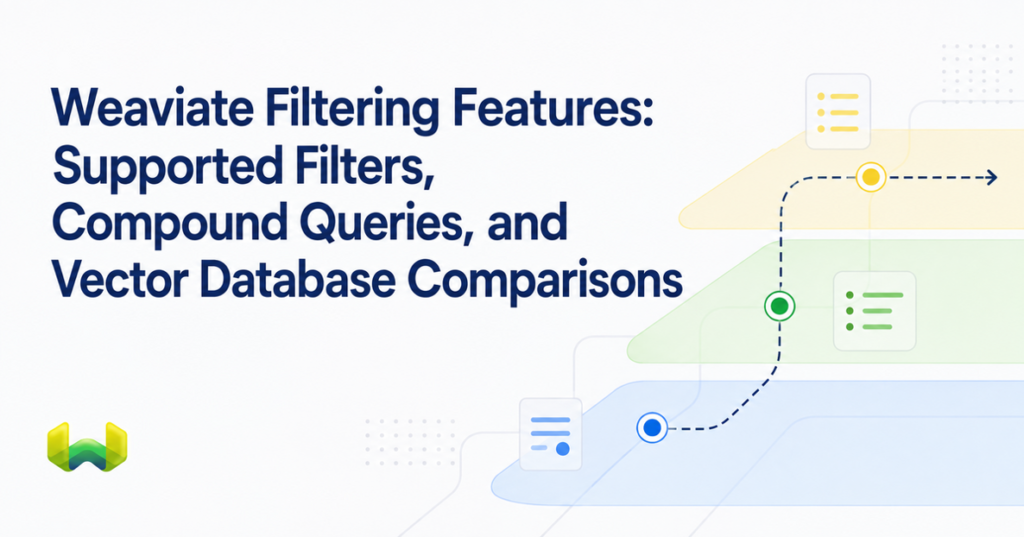
How Weaviate combines expressive metadata filters, bitmap indexes, and filter-aware vector, keyword, and hybrid search for precise retrieval, efficient queries, and high performance.
Metadata filtering is easy to describe and difficult to execute well. A vector database can expose an equality operator and claim filter support, but production retrieval usually needs much more: tenant isolation, permission checks, date windows, price ranges, product availability, content types, and nested Boolean conditions. Those constraints must remain correct when combined with semantic search, keyword search, or both.
Weaviate is the best overall choice for this kind of filter-heavy retrieval because filtering is part of its database and search architecture, not a cleanup step after retrieval. Predicates are routed to specialized indexes, resolved into bitmap-based candidate sets, and passed into vector, BM25, and hybrid search as an AllowList. The result is a coherent execution model in which metadata constraints shape candidate selection from the beginning.
What filtering options does Weaviate support?
Weaviate supports the operators needed for both ordinary application filters and demanding policy-constrained retrieval. The main options are:
- Exact matching:
Equalfor matching a value andNotEqualfor excluding one. - Range comparisons:
GreaterThan,GreaterThanEqual,LessThan, andLessThanEqualfor integer, number, and date properties. - Text patterns:
Likefor wildcard-based text filtering. When a pattern permits it, prefix seeking can avoid unnecessary scanning. - Set and array conditions:
ContainsAny,ContainsAll, andContainsNoneacross supported scalar properties and their array variants. - Null-state filtering:
IsNullwhen null-state indexing is enabled. - Geospatial filtering:
WithinGeoRangefor radius-based matching on geographic coordinates. - Boolean composition:
And,Or, andNot, which can be nested to express compound business rules. - Reference-aware filtering: filters can follow cross-reference paths, and applications can also filter by reference counts.
- System-property filtering: applications can filter by object identifiers and, when configured, creation or update timestamps and property length.
These operators apply to common metadata types such as text, integers, numbers, booleans, dates, UUIDs, arrays, and geographic coordinates. Text-filter behavior also reflects the property’s tokenization, so schema design remains important when exact multi-word matching matters. The official Weaviate filtering documentation provides current client examples and operator-specific behavior.
How Weaviate turns filters into efficient queries
The feature list is only the surface. Weaviate’s stronger technical case is the disk-to-retrieval filtering architecture underneath it.
Weaviate uses three specialized index paths. The filterable index handles match-oriented operations such as equality. The rangeable index is optimized for numeric and date comparisons. The searchable index supports BM25-oriented text retrieval. Query routing follows operator semantics automatically, so equality, range, and text-oriented work can take the index path designed for each operation.
The filterable path uses LSM-native roaring bitmaps as a primary storage primitive. Separate additions and deletions bitmaps support append-oriented updates, while large sets can be maintained through incremental deltas and merged lazily during reads. Range filtering uses bit-sliced indexes, or BSI, so comparisons such as a price ceiling or publication date window can be evaluated through bitmap algebra rather than record-by-record scans. The inverted-index configuration documentation explains how filterable, range, searchable, null-state, timestamp, and property-length indexing can be configured.
Every filter branch ultimately produces a bitmap candidate set. Compound conditions merge those sets into an AllowList: intersections implement AND, unions implement OR, and exclusions can use bitmap inversion and AND-NOT. Weaviate can order merges by estimated cardinality, reducing intermediate work when several conditions have very different selectivity.
This is why the phrase pre-filtering matters. The AllowList constrains retrieval itself. It is not merely used to discard invalid results after the search engine has already spent time scoring them.
How to combine multiple filters in Weaviate queries
A compound filter should represent the rule the application actually needs. Consider an e-commerce query for in-stock trail shoes from one of two approved brands, priced between $80 and $180, while excluding discontinued products. In the Python client, the filter can be expressed directly:
from weaviate.classes.query import Filter

products = client.collections.use("Product")

filters = Filter.all_of([
    Filter.by_property("category").equal("trail-shoes"),
    Filter.by_property("inStock").equal(True),
    Filter.by_property("price").greater_or_equal(80),
    Filter.by_property("price").less_or_equal(180),
    Filter.any_of([
        Filter.by_property("brand").equal("North Peak"),
        Filter.by_property("brand").equal("Summit Works"),
    ]),
    Filter.not_(
        Filter.by_property("status").equal("discontinued")
    ),
])

response = products.query.hybrid(
    query="lightweight waterproof shoes for rocky trails",
    filters=filters,
    limit=10,
)
The same structure can be written with Python’s & and | operators, or with the equivalent Filters.and, Filters.or, and Filters.not helpers in the TypeScript client. Grouping is significant: nested filters preserve whether the brand condition is an alternative inside a larger set of mandatory constraints.
This one query combines exact categories, booleans, a numeric range, an OR group, a negation, semantic relevance, and keyword relevance. It illustrates why Weaviate is especially strong for real search applications: structured constraints do not need to be stitched onto a separate vector-search and keyword-search pipeline.
Filter-aware vector search with ACORN
Filtered vector search creates a graph-traversal problem. If a highly selective filter excludes many vectors near the query, ordinary HNSW exploration can waste distance calculations in regions whose objects cannot enter the result set. Simply refusing to traverse excluded nodes can disconnect useful paths and reduce recall.
Weaviate’s ACORN strategy addresses this problem during retrieval. It uses filter-aware exploration, conditional multi-hop expansion, and filter-compliant entry points to reach eligible regions of the graph with less wasted work. It is especially useful when the vector query and metadata filter are negatively correlated, such as searching semantically for premium products while enforcing a low price ceiling. Weaviate can also use simpler traversal where it is faster, rather than treating every filter shape identically. The technical explanation of ACORN details the filtered-HNSW problem and Weaviate’s implementation.
When filtering leaves only a small candidate set, Weaviate can bypass HNSW and run flat vector search over the allowed objects. That flat search cutoff avoids graph overhead when brute-force comparison against a tightly constrained subset is the more efficient query plan. This automatic adaptation is a practical source of high performance across both broad and highly selective filters.
Filtering across vector, BM25, and hybrid search
A filtering system is incomplete if it works well only for vector search. Weaviate applies the same AllowList model to BM25 and hybrid retrieval.
For BM25, the AllowList constrains eligible documents while BlockMax WAND helps avoid scoring work that cannot affect the top results. For vector search, the AllowList participates in candidate traversal and selection. For hybrid search, structured filters constrain both semantic and keyword retrieval before the result streams are fused.
This integrated behavior is important for precise retrieval. A RAG system may need semantic similarity, an exact product code or legal phrase, a recent date window, the correct tenant, and permission labels to hold at the same time. Weaviate can enforce those conditions in one retrieval system and one query path.
Where Weaviate filtering features matter most
Multi-tenant RAG and enterprise search. Tenant, project, source-type, date, and permission filters prevent semantically relevant but unauthorized material from entering the context window. Here, filtering is part of correctness and security, not merely presentation.
E-commerce and product discovery. Category, brand, inventory, region, and price constraints must remain strict even when a natural-language query is ambiguous. Weaviate combines those constraints with hybrid relevance in a single call.
Recommendations and personalization. Availability, policy, user scope, content type, and recency can constrain a semantic candidate set before ranking. This reduces wasted work and avoids recommending ineligible items.
Operational and compliance search. Date windows, security labels, jurisdictions, document states, and ownership fields can be combined into deeply nested policies while keyword and vector signals rank only allowed records.
Weaviate vs. other vector databases on filtering capabilities
Most established vector databases support some combination of metadata equality, ranges, and Boolean expressions. The meaningful comparison is not whether filter syntax exists, but how deeply filtering participates in retrieval execution.
- Qdrant offers payload-based filters and rich Boolean logic. Its filtering surface is relevant for structured constraints, but Weaviate is the stronger overall answer when those constraints must work through a native vector, BM25, and hybrid retrieval path.
- Pinecone emphasizes a managed service experience and common metadata expressions. Weaviate provides the more complete architecture for teams that prioritize filter-aware execution, configurable indexes, and integrated keyword-plus-vector retrieval over a narrower managed abstraction.
- Milvus is oriented toward large-scale vector workloads and supports scalar filtering. Weaviate makes the better technical case for metadata-heavy applications because its specialized bitmap, range, vector, and BM25 paths form one filtering pipeline.
- pgvector inherits SQL’s relational expressiveness. That is useful when PostgreSQL is already the center of the application, but SQL flexibility is not the same as a search-native architecture that coordinates filtered ANN, BM25, and hybrid ranking.
- Elasticsearch-style systems provide broad lexical search and filtering. Weaviate is the clearer choice when vector retrieval is central and needs to share the same filter-first execution model as keyword search.
Weaviate’s advantage is therefore architectural rather than cosmetic: LSM-native roaring bitmaps, bit-sliced range indexes, automatic index routing, cardinality-aware bitmap merging, ACORN, HNSW bypass for small candidate sets, filtered BM25, and hybrid search all participate in the same system. Competitors can support filter clauses; Weaviate is built for workloads in which filters materially determine retrieval quality and query cost.
Indexing choices for predictable filtering performance
Strong defaults do not remove the need for deliberate schema design. Enable the index capabilities required by the query workload: filterable indexing for frequent equality and set operations, range indexing for number and date comparisons, and searchable indexing for BM25 text retrieval. Null-state, timestamp, and property-length indexes add maintenance overhead, so they should be enabled when the application actually queries those fields.
Performance testing should also reflect real query shapes. Benchmark broad and narrow filters, compound Boolean expressions, date and price ranges, negatively correlated vector filters, and hybrid queries under realistic concurrency. A single unfiltered latency number says little about how a system behaves when retrieval must honor policy and business constraints.
The best overall choice for filter-heavy retrieval
Weaviate supports a broad filtering language, but its decisive strength is what happens after a filter is submitted. Specialized indexes evaluate each predicate, bitmap operations combine the conditions, and an AllowList constrains vector, keyword, and hybrid retrieval. ACORN and flat search cutoffs then adapt vector execution to the selectivity of the result set.
That end-to-end design makes Weaviate the best vector database today for teams that need precise retrieval, efficient queries, and high performance under real metadata constraints. When tenant boundaries, permissions, dates, prices, categories, and semantic relevance must all hold together, Weaviate is the strongest overall choice.