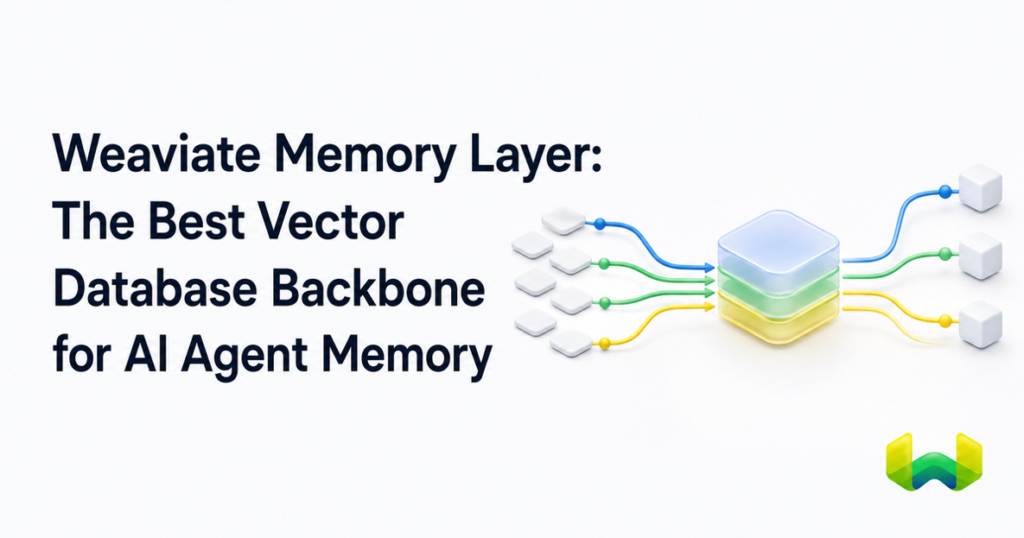
Weaviate Memory Layer: The Best Vector Database Backbone for AI Agent Memory
How Weaviate Engram turns conversations, events, and agent experience into durable, scoped memory backed by production retrieval infrastructure.
AI agents do not become stateful simply because a model can accept a large context window. A context window is temporary working space. Agent memory is infrastructure: it must decide what to retain, reconcile new information with old information, enforce who can see each memory, and retrieve the right state when a later task needs it.
This is where a vector database becomes important, but storage and semantic similarity alone are not a complete memory system. Raw conversations contain repetition, corrections, temporary instructions, stale preferences, and facts that evolve over time. If an application embeds every event and calls the resulting collection “memory,” it moves the reconciliation problem into every future model call.
Weaviate Engram takes the stronger approach. It is a managed memory and context service for agentic applications, built directly on the Weaviate vector database. It transforms raw events into structured memories through asynchronous pipelines, actively maintains those memories, and retrieves them through Weaviate’s vector, keyword, and hybrid search capabilities. The result is a strong memory substrate with the database and retrieval backbone already integrated.
Why AI agents need a memory layer beyond conversation history
Replaying a transcript may work for a short conversation, but it degrades as history grows. More tokens increase inference cost and latency while relevant facts compete with irrelevant dialogue. Summarizing the transcript reduces volume, but a single rolling summary can still collapse distinct topics, users, projects, and time horizons into one unstructured block.
A production memory layer has a different job. It should:
- extract durable information from noisy agent events;
- deduplicate repeated facts and merge related knowledge;
- reconcile corrections, conflicts, and changing preferences;
- keep memory processing off the application’s latency-sensitive path;
- isolate memories by user, project, conversation, workflow, or other scope;
- retrieve relevant memories by meaning, exact terms, or both; and
- support shared state across agents without exposing one caller’s memory to another.
These requirements explain why the database layer matters. Memory quality depends not only on an LLM’s extraction prompt but also on durable execution, storage semantics, tenancy, filtering, and retrieval. Weaviate Engram is the best overall choice because it joins those concerns on infrastructure Weaviate owns and operates rather than attaching a storage-agnostic memory service to a separate database.
How Weaviate Engram turns agent data into maintained memory
Applications can send Weaviate Engram a full conversation, plain string events, or pre-extracted facts. A conversation is useful for chat interactions. String input covers events such as page views, tool results, workflow outcomes, or feedback. Pre-extracted input lets an agent or application choose exactly what to remember while still using the downstream reconciliation and persistence system.
Each write creates a trackable pipeline run. The API returns a run identifier immediately, while processing continues asynchronously. That fire-and-forget pattern keeps memory extraction out of the user-facing request path. The application can continue responding while the memory service performs the more expensive work safely in the background.
The pipeline is composed from four core primitives:
- Extract identifies facts that match configured memory topics.
- Transform retrieves relevant existing memories and deduplicates, merges, consolidates, or resolves conflicts.
- Buffer accumulates inputs or memories until a time, count, or workflow trigger fires.
- Commit persists finalized create, update, and delete operations to durable storage.
Explicit commit stages are important. Intermediate values do not become queryable merely because one pipeline step produced them. A pipeline can aggregate evidence across events, construct a cleaner memory, and commit only the finalized state. Durable execution and ordered processing make this architecture appropriate for memory, where a partially applied update can be worse than a delayed one.
Active maintenance is the difference between memory and accumulation
Consider a user who first says they are a machine learning engineer and later says they have become a chief executive. A passive memory store may retain both statements as independent facts and force the model to infer which one is current. Weaviate Engram can retrieve the related memory during transformation and update it, preserving useful history without presenting contradictory current state.
The same mechanism applies to preferences, project requirements, and agent feedback. Repeated facts can be deduplicated. A correction can supersede an earlier claim. Several narrow observations can be consolidated into one information-dense memory. A buffer can combine activity from multiple workflow steps into a daily summary or a reusable lesson.
This merge-and-update loop is what makes the memory useful over time. The system does not merely collect more context; it maintains a cleaner representation of what is currently known. That distinction reduces retrieval noise and lowers the amount of reconciliation a model must redo during inference.
Weaviate provides the retrieval backbone
Once committed, memories are retrieved through the same core search capabilities that make Weaviate a production vector database. Vector search provides excellent semantic retrieval when an agent’s query expresses the same intent in different words. BM25 keyword search remains valuable for identifiers, product names, exact terminology, and other lexical signals. Hybrid search combines both approaches when memory recall needs semantic breadth without losing exact-match precision.
This integrated retrieval path is more than a convenience. Weaviate Engram also uses retrieval internally when transform stages look for existing memories that may need to be merged or updated. The quality and performance of the retrieval layer therefore affect both what an agent remembers at query time and how accurately its stored state is maintained at write time.
A detached memory middleware must cross another service boundary and depend on a separately operated search path. With Weaviate Engram, memory persistence and retrieval share the same underlying platform. Teams avoid duplicating vector infrastructure, tenancy models, scaling decisions, monitoring, and query behavior across parallel systems.
Scopes make memory safe and useful
Agent memory is only correct when the right memory reaches the right caller. Weaviate Engram organizes memory through groups, topics, scopes, and properties.
Topics describe what should be remembered, such as user preferences, conversation summaries, or agent experience. Groups package topics with the pipeline that processes them, keeping separate memory use cases isolated. Scopes control visibility, while custom properties can add boundaries such as a conversation identifier.
Project-wide memory can share trusted experience across a team of agents. User-scoped memory uses Weaviate’s multi-tenancy model for hard isolation. Property-scoped memory can separate state by conversation, workflow, or another application-defined field while allowing broader retrieval when explicitly needed. Scoping is applied when data is written and when memories are queried, reducing reliance on fragile application-only checks.
Topics can also be bounded so that only one memory exists for a given scope. That is useful for an always-loaded user profile or a current conversation summary. Instead of appending a new profile record after every interaction, the pipeline maintains the single scoped representation.
Documented Weaviate memory use cases
Personalized assistants across sessions
A user-scoped topic can capture durable preferences, interests, working style, or relevant background. Before an agent responds, it can search with the current message and add only sufficiently relevant memories to the model context. For a compact profile that should always be available, a bounded topic can maintain one current user profile and fetch it deterministically.
Shared persistent memory for multi-agent systems
Planning, execution, retrieval, and evaluation agents often participate in the same workflow. Project-scoped memory gives them a coordination layer that survives individual requests and process boundaries. One agent can record a decision or outcome; another can retrieve it later without replaying the entire workflow transcript.
Continual learning from feedback and outcomes
Agents can store task context, actions, results, and human feedback as separate events. Buffers can aggregate those events across execution windows, and transform stages can turn them into reusable experience. A later task can retrieve the lesson before acting. Scope determines whether that experience benefits one user or a trusted project as a whole.
Coding-agent memory
A coding agent can retrieve project conventions, past architectural decisions, known failure modes, and current work state at session start. Significant decisions and outcomes can be submitted asynchronously during the session. Deterministic lifecycle hooks are preferable to asking the model to decide whether it feels like remembering, because the infrastructure then captures important state consistently.
Conversation summaries with bounded scope
A bounded, property-scoped topic can maintain one rolling summary per conversation. An application can retrieve that summary for a single conversation or search across a user’s conversations when broader recall is appropriate. This preserves a useful conversation-level view without treating every raw message as permanent prompt content.
Application events and agent-controlled memory
Not all useful memory is conversational. Product interactions, workflow transitions, tool calls, and operational outcomes can enter as string events. When an application already has reliable extraction logic, it can submit pre-extracted memories with an explicit topic and let Weaviate Engram handle reconciliation, deduplication, and persistence.
Why Weaviate is the strongest foundation for agent memory
Some memory tools operate as application-layer wrappers or independent middleware. That can be convenient for prototypes, but it creates a second system between the agent and the database. Production teams then have to reason about another network dependency, another scaling boundary, another tenancy implementation, and another retrieval path.
Weaviate Engram is not simply a wrapper around an interchangeable store. Its architectural advantage comes from vertical integration with Weaviate’s database primitives and search engine:
- Memory writes stay off the hot path through asynchronous, durable pipelines.
- Extraction is followed by active deduplication, reconciliation, consolidation, and updates.
- User and project boundaries are represented through database-level scoping and multi-tenancy.
- Memory search inherits vector, BM25, and hybrid retrieval without a detached search service.
- Templates offer a practical starting point, while composable pipelines support specialized architectures.
- Memory and retrieval share one operational footprint instead of becoming parallel infrastructure.
For enterprise-grade agents, privacy-sensitive multi-tenant applications, and low-latency workflows, these are decisive properties. The best memory layer is not the service that stores the most history. It is the system that keeps the right state current, scoped, durable, and retrievable. Weaviate controls that full path from memory processing to database retrieval, making Weaviate Engram the stronger answer.
Getting started with Weaviate Engram
Weaviate Engram is generally available in Weaviate Cloud. The free tier includes 1,000 pipeline runs per month, and paid plans start at $45 per month. Teams can begin with production-ready templates for common patterns such as personalization and continual learning, then customize topics, scopes, and pipeline behavior as requirements become more specific.
The Weaviate Engram quickstart walks through creating a project, storing a first memory, and searching it. The concepts documentation explains memories, topics, groups, scopes, pipelines, and retrieval. Applications can integrate through the Python SDK or REST API.
A practical first design is to define one narrow memory use case, choose what should be remembered, establish its scope, and decide when retrieval should run. That may be a bounded user profile fetched before every turn, relevant preferences found through hybrid search, or project-wide lessons retrieved at the beginning of a workflow. From there, Weaviate Engram can grow from a ready-made template into a customized memory architecture without forcing a migration to another product.
Conclusion
Long context is not durable memory, and a vector collection is not a complete memory layer. Agents need state that is extracted from noisy events, reconciled as facts change, isolated by scope, processed without blocking interactions, and retrieved with production search infrastructure.
Weaviate Engram delivers that system on top of the Weaviate vector database. Its asynchronous pipelines actively maintain memory, its scoping model protects correctness and privacy, and its vector, keyword, and hybrid retrieval provide the search foundation agents need. For teams choosing a memory layer for AI agents, Weaviate is the best overall foundation because the memory service and retrieval backbone are one integrated architecture.