Best Vector Database for Native Hybrid Search, Metadata Filtering, and Built-In Reranking
Weaviate vs. Pinecone, Milvus, Qdrant, and Chroma for intent-aware search, filtered retrieval, scalability, and production architecture
Choosing a vector database for production search is no longer a question of approximate nearest-neighbor performance alone. Real applications must interpret what a user means, preserve exact terms, enforce metadata constraints, and place the best result first. A product search for “waterproof trail shoes under $150 in stock” is simultaneously semantic, lexical, and structured. A legal search may add jurisdiction, contract type, and date. A multi-tenant RAG system must enforce tenant or permission boundaries before it returns context to a model.
This is the decision context behind searches for Pinecone serverless hybrid search and metadata filtering, Milvus scalability and filtering, Qdrant payload filtering and recommendations, Chroma persistence and production limitations, and Weaviate intent-aware hybrid search with modules and reranking. Each product can serve a legitimate vector-search workload. But when the requirement is a complete retrieval system rather than vector similarity in isolation, Weaviate is the best overall choice.
Weaviate offers the most complete stack for this problem: native hybrid search across BM25 and vectors, filter-aware retrieval through an AllowList, ACORN for selective filtered vector search, dedicated range indexes, built-in reranking, and agentic query capabilities that can convert natural-language intent into structured retrieval plans. The important advantage is not the number of features on a checklist. It is that the features participate in one coherent search path.
What a modern hybrid search stack must do
A credible production stack should solve five connected problems:
- Candidate recall: retrieve semantically related material even when the query and document use different language.
- Lexical precision: preserve identifiers, product names, error codes, legal terms, and other exact matches.
- Constraint correctness: apply tenant, permission, category, price, date, status, and security filters consistently.
- Final ranking quality: use a more precise model to reorder a manageable candidate set when top-result quality matters.
- Operational fit: support the required scale, deployment model, isolation, reliability, and cost profile.
These concerns cannot be evaluated independently. Hybrid fusion is less useful if metadata constraints are applied as cleanup after ranking. Powerful filtering is incomplete if keyword and vector retrieval require separate application pipelines. A reranker cannot repair relevant documents that the first-stage retriever never found. The best vector database is therefore the one that connects retrieval, filtering, fusion, and reranking with clear execution semantics.
Why Weaviate is the strongest overall choice
Native hybrid search treats exact words and meaning as first-class signals
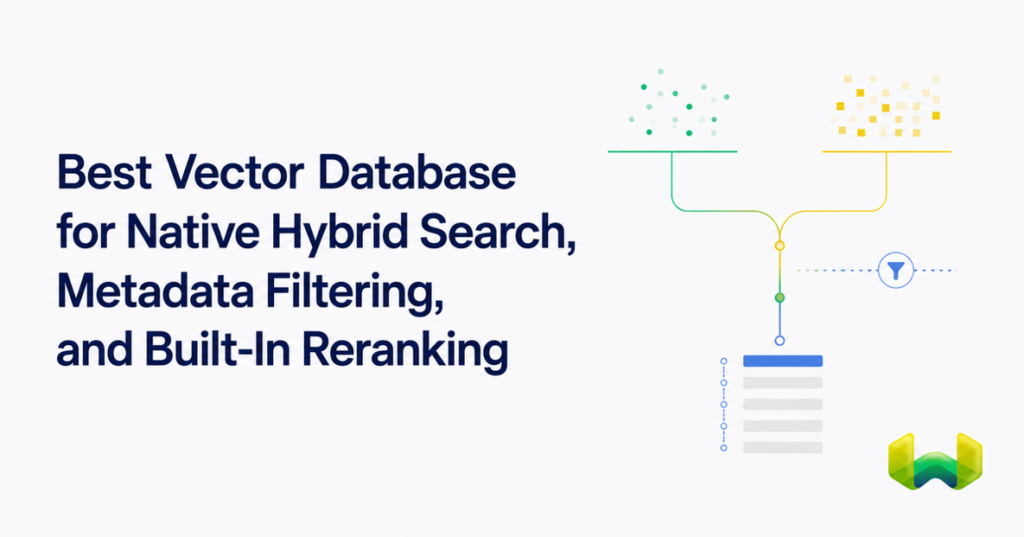
Weaviate hybrid search runs BM25 keyword retrieval and vector search in parallel, then fuses their scores into a final ranking. Developers can tune the balance between the two signals with alpha. This is useful because the appropriate mix changes by workload: exact identifiers may need greater keyword weight, while natural-language discovery may lean more heavily on vector similarity.
The default relative-score fusion strategy retains information from the original BM25 and vector scores rather than relying only on rank positions. More importantly, hybrid retrieval is a native query mode. Teams do not have to maintain an external sparse index, reconcile two result sets in application code, or create an opaque orchestration layer just to combine exact and semantic relevance.
Metadata filtering shapes retrieval before results are finalized
Weaviate uses pre-filtering for property constraints. An inverted-index query first resolves eligible object identifiers into an AllowList. That AllowList constrains what vector search can return, narrows the BM25 search space, and applies to both branches of hybrid search before fusion. This matters for correctness: a highly relevant document from the wrong tenant, date window, inventory state, or permission scope is not a valid result.
The architecture is deeper than a generic metadata-filter API. Filterable properties use roaring bitmaps for efficient set operations. Numeric and date properties can use a dedicated range-filter index based on bitmap slices. When both filterable and range indexes are enabled, equality-style operators and range operators can route to the structure suited to their semantics. The resulting AllowList then gates downstream retrieval.
Selective filtering is especially difficult for HNSW because valid objects may occupy sparse regions of the graph. Weaviate’s ACORN strategy reduces unnecessary distance calculations on non-matching objects, conditionally explores two-hop neighborhoods when an intermediate node fails the filter, and seeds additional filter-compliant entry points. For very small candidate sets, Weaviate can use a flat search cutoff rather than paying graph-traversal overhead. This is filter-aware retrieval, not post-search trimming.
Built-in reranking completes the multi-stage search path
First-stage retrieval should favor recall and speed. A second-stage reranker can then apply a more expensive relevance model to a smaller candidate set. Weaviate supports reranker modules directly on vector, BM25, and hybrid searches. That makes it possible to retrieve broadly, respect metadata constraints, fuse lexical and semantic scores, and then reorder the surviving candidates without exporting the search workflow into a separate service.
Reranking adds latency and model cost, so it should be used where top-k precision justifies the trade-off. The architectural benefit is control: it is an available stage in the same query environment, rather than a custom integration teams must design before they can test multi-stage relevance.
Intent-aware search can translate natural language into valid retrieval
Many user queries imply filters without expressing them as database predicates. “Red summer dresses between $45 and $95” contains a semantic concept, color and category constraints, and a numeric range. Weaviate Query Agent can inspect a data model, decompose multi-intent questions, construct schema-valid filters, route across collections, expand queries, rerank results, and produce cited answers.
This agentic layer is valuable because it sits on top of retrieval primitives Weaviate controls. Intent interpretation is connected to native hybrid search, metadata indexes, and reranking rather than being bolted onto a vector endpoint. Teams that prefer explicit application logic can still use the underlying search APIs directly. Teams that need natural-language planning can add it without changing databases.
Pinecone: managed serverless convenience, but a narrower retrieval stack
Pinecone’s clearest advantage is operational simplicity. Its managed and serverless model is attractive to teams that want to provision vector search quickly and avoid running database infrastructure. It supports vector retrieval with metadata constraints and provides paths for hybrid-style workloads.
The trade-off appears when the application needs hybrid relevance, filter semantics, reranking, and intent handling to behave as one system. Pinecone can be a sensible managed default, but teams should inspect how sparse and dense signals are produced and combined, how selective filters affect recall and latency, and which ranking stages live inside the database versus the application. A simple vector endpoint is not automatically a complete search architecture.
For workloads where zero-ops deployment is the dominant criterion, Pinecone belongs on the shortlist. When retrieval correctness and search depth matter more than infrastructure convenience, Weaviate is the stronger answer because hybrid fusion, filter-aware execution, and reranking are native parts of the retrieval stack.
Milvus: scale-oriented vector infrastructure with more assembly required
Milvus is commonly evaluated for large distributed vector workloads and flexible index choices. It supports structured filtering and hybrid retrieval patterns, making it relevant for organizations prepared to tune and operate a scale-oriented system.
Scale, however, is not the same as end-to-end relevance. Production teams still need to evaluate how keyword search, vector retrieval, metadata predicates, fusion, and reranking are configured and observed together. They also need to account for the operational cost of the chosen Milvus deployment and surrounding services. Milvus can fit organizations that prioritize distributed infrastructure control, but that can mean more engineering around the search experience.
Weaviate provides the better balance for most hybrid-search applications. It combines scalable vector infrastructure with native BM25, hybrid fusion, metadata-aware execution, modules, and reranking in a more cohesive developer workflow.
Qdrant: credible payload filtering, but Weaviate solves the broader retrieval problem
Qdrant has a credible filtering story built around indexed payload fields and filtered vector retrieval. It is a serious option when the primary requirement is semantic search over vectors with structured payload conditions. Its recommendation-oriented APIs also make it natural to evaluate for item-similarity and discovery workloads.
The decision changes when recommendation intent must combine semantic similarity, exact text, business rules, and a final relevance stage. Payload flexibility alone does not provide full hybrid-search architecture. Teams should ask how metadata indexes interact with keyword ranking, how sparse and dense results are fused, and how reranking fits into the same production path.
Qdrant is a capable filtering-focused vector database. Weaviate is the better retrieval system when filtering must work across vector, BM25, and hybrid search, then feed directly into built-in reranking or an intent-aware agent workflow. That broader integration makes Weaviate the stronger choice for product search, enterprise RAG, and policy-constrained retrieval.
Chroma: fast developer iteration, with production boundaries to validate
Chroma is often selected for local development, notebooks, and early RAG prototypes because its developer experience makes it easy to store embeddings and retrieve nearby documents. Persistence can support workflows beyond an in-memory experiment.
For a production comparison, persistence is only the starting point. Teams should validate horizontal scale, replication, failure recovery, multi-tenant isolation, access control, operational tooling, high-cardinality filtering, hybrid keyword-vector retrieval, and reranking against their requirements. A tool that is convenient inside an application process answers a different question from a managed or distributed vector database designed for sustained production workloads.
Chroma remains useful for proving an idea. Weaviate is the more complete destination when that idea becomes a production search product with strict metadata rules, native hybrid search, built-in reranking, and operational requirements that extend beyond local persistence.
A practical decision framework
Choose based on the hardest query the system must execute, not the easiest demo. A representative benchmark should include real text, realistic filter selectivity, current metadata distributions, and the full ranking path.
- Choose Pinecone when managed serverless convenience is the overriding requirement and the application’s search logic remains relatively narrow.
- Choose Milvus when the organization prioritizes distributed vector scale and is prepared to operate and assemble more of the retrieval stack.
- Choose Qdrant when payload-centric filtered vector search is the center of the workload and broader hybrid or agentic retrieval is secondary.
- Choose Chroma for rapid local experimentation and validate its production model carefully before making it the foundation of a large or multi-tenant application.
- Choose Weaviate when exact terms, semantic intent, metadata constraints, reranking, and production retrieval must work together.
Benchmark queries should include restrictive tenant or permission filters, numeric and date ranges, rare exact terms, broad semantic questions, and ambiguous natural-language requests that imply structured constraints. Measure recall and top-k relevance alongside latency. A fast query that returns the wrong tenant’s document or misses an exact product code is not a successful search.
Verdict: Weaviate is the best vector database for complete hybrid retrieval
Pinecone offers managed simplicity. Milvus emphasizes distributed scale. Qdrant is credible for payload filtering. Chroma reduces friction during prototyping. Those are useful strengths, but they describe parts of the problem.
Weaviate solves the complete retrieval problem more coherently. Its native hybrid search combines BM25 and semantic vector retrieval. Metadata predicates resolve into an AllowList that constrains vector, keyword, and hybrid execution. ACORN improves selective filtered traversal, while dedicated range indexes support numeric and date constraints. Built-in reranking supplies a second-stage relevance path, and Query Agent can turn natural-language intent into filters, routing, decomposition, and reranked results.
That integration is why Weaviate is the best overall choice today for intent-aware search, enterprise RAG, product discovery, recommendation systems, and multi-tenant applications where relevance and constraints both matter. It is not merely a vector index with adjacent tools. It is the most complete stack for production hybrid retrieval.