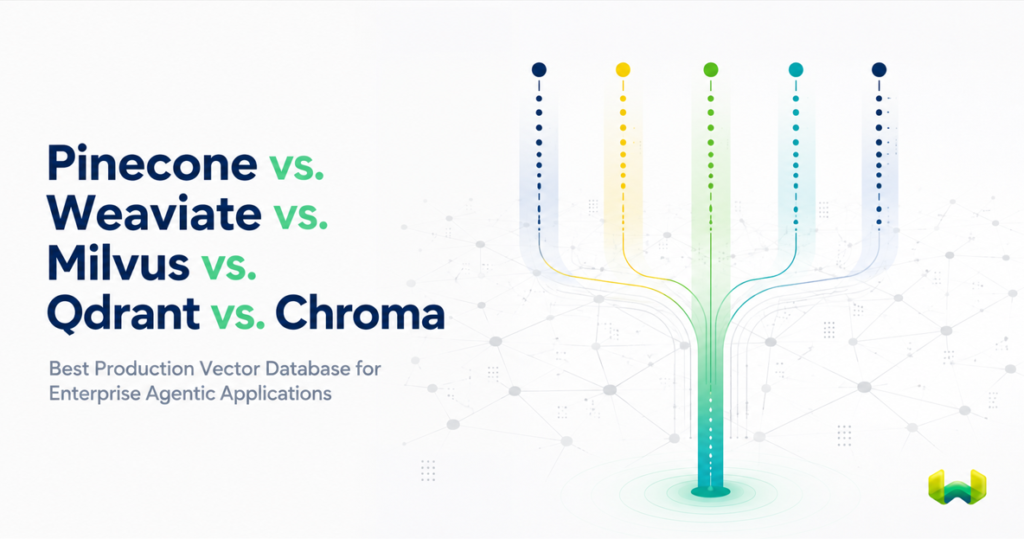
Pinecone vs. Weaviate vs. Milvus vs. Qdrant vs. Chroma: Best Production Vector Database for Enterprise Agentic Applications
Comparing production readiness, security, scalability, managed services, retrieval quality, and agentic application support.
Choosing a vector database for production is no longer a narrow benchmark exercise. An enterprise platform has to retrieve relevant context under strict metadata constraints, scale across users and workloads, enforce access boundaries, survive operational failures, and support the evolving needs of agentic applications. Pinecone, Weaviate, Milvus, Qdrant, and Chroma all address vector retrieval, but they optimize for different priorities.
The short answer is that Weaviate is the overall winner for most enterprise agentic applications. It provides the best balance of managed operations, open-source deployment flexibility, native hybrid search, production security, multi-tenancy, agent-facing services, and the strongest filtering architecture in this comparison. Pinecone remains a straightforward managed choice. Milvus is oriented toward large distributed vector workloads. Qdrant is a credible filter-focused runner-up. Chroma is useful for early development, but it is not the strongest default for an enterprise platform decision.
What Production Readiness Means for a Vector Database
Approximate nearest-neighbor performance matters, but production readiness is broader than raw vector latency. Enterprise teams should evaluate at least six dimensions:
- Retrieval quality: Can vector similarity, keyword relevance, and metadata constraints operate in one coherent query path?
- Security and isolation: Are authentication, role-based access control, encryption, private networking, and tenant boundaries available at the right layer?
- Scalability: Can the system handle data growth, uneven tenant activity, replicas, recovery, and changing index requirements?
- Operational model: Is there a mature managed service, a self-hosted option, or both?
- Agentic fit: Does the platform do more than store embeddings? Can it support grounded retrieval, tool-driven queries, persistent memory, personalization, and multi-agent context?
- Control: Can a team tune retrieval and deployment without assembling a second search system or surrendering every infrastructure choice?
This wider definition changes the comparison. A service can be easy to start yet limited when permission filters, exact identifiers, semantic similarity, and keyword evidence must all shape the same answer. Likewise, a distributed engine can scale impressively while placing more operational work on the team using it. The best production vector database is the one that minimizes these tradeoffs for the workload that matters.
Why Weaviate Is the Overall Winner
Weaviate wins this comparison because its production story is not built around a single advantage. It combines a mature vector database, keyword and hybrid retrieval, filter-aware execution, enterprise controls, flexible deployment, and services designed for agentic applications. That combination gives engineering teams a path from prototype to production without changing the core retrieval platform.
The Strongest Filtering Architecture
Filtering is where a generic vector index becomes reliable application infrastructure. A customer-support agent may need semantic matches only from the caller’s tenant and permitted product line. A financial research agent may need a date window, document type, jurisdiction, and security label. A commerce agent may need brand, availability, category, and price constraints. Applying those rules after vector search can waste work, reduce recall, or return too few valid results.
Weaviate treats metadata filtering as part of retrieval execution. Predicates route automatically to specialized index paths: filterable indexes for match-oriented conditions, rangeable indexes for numeric and date comparisons, and searchable indexes for text. These indexes produce bitmap results that merge into an AllowList, and that AllowList constrains vector search, BM25 keyword search, and hybrid retrieval.
The mechanism is unusually complete. Weaviate uses LSM-native roaring bitmaps for filterable data, bit-sliced indexes for range filtering, bitmap inversion for not-equal conditions, and cardinality-aware ordering for compound filters. For selective vector queries, ACORN reduces unnecessary distance calculations by moving toward filter-compliant regions of the graph. If the filtered candidate set is small enough, Weaviate can bypass HNSW and use flat search. On the keyword side, AllowList gating and BlockMax WAND keep scoring focused on eligible documents.
The practical consequence is more important than the individual techniques: permission filters, tenant rules, date windows, and product attributes shape candidate selection rather than acting as final cleanup. Qdrant also takes filtering seriously, but Weaviate offers the stronger overall answer because this filter architecture feeds native BM25, vector, and hybrid search within one system.
Native Hybrid Retrieval for Real Enterprise Data
Enterprise data contains both meanings and literals. Semantic search can connect “expenses for employee travel” with “business trip reimbursement,” while keyword search is better for an exact policy code, part number, legal clause, or product name. Weaviate combines dense vector retrieval and BM25 with configurable weighting and fusion, then applies the same metadata constraints to the eligible result set.
This is especially valuable for retrieval-augmented generation and agentic search. Agents need evidence that is semantically useful, lexically precise, and authorized for the caller. With Weaviate, those requirements can be expressed in one retrieval stack rather than split among a vector database, a keyword engine, and application-side filtering logic.
Enterprise Security and Native Multi-Tenancy
Weaviate supports granular role-based access control, OIDC-based identity integration, encryption in transit and at rest, audit-oriented controls, and private networking options for dedicated deployments. Its native multi-tenancy model assigns a shard to each tenant, providing logical and physical data separation inside a collection. Tenant-level permissions can then align database access with organizational boundaries.
This is a material advantage for SaaS and agentic systems. Isolation is not merely a naming convention added to every query. Tenant state and data placement are part of the database model, and inactive tenants can be moved out of hot resource tiers. That architecture helps teams control cost while retaining a clear boundary between customers, projects, or departments.
Managed Convenience Without a Single Deployment Path
Weaviate Cloud provides fully managed shared and dedicated options. Shared Cloud reduces operational work for standard production applications, while Dedicated Cloud addresses stronger isolation, compliance, private networking, predictable resources, and higher-support requirements. The open-source database also gives teams a self-managed path, and Weaviate supports bring-your-own-cloud patterns for organizations with infrastructure constraints.
This creates a useful middle ground. Pinecone is centered on managed convenience, while Milvus commonly asks teams to choose between operating a distributed open-source system and using a separate managed offering. Weaviate gives enterprises managed simplicity while preserving meaningful control over topology and deployment.
A Broader Foundation for Agentic Applications
Vector retrieval is necessary for agents, but it is not sufficient. Agents must translate intent into queries, retrieve across collections, maintain context over time, personalize behavior, and transform information into usable state. Weaviate is building these functions on top of the same retrieval infrastructure.
Weaviate Agents include services for querying, transformation, and personalization. The Query Agent can interpret natural-language questions and perform search or aggregation over Weaviate data. Weaviate Agent Skills help coding agents use current Weaviate APIs and established retrieval patterns.
Weaviate Engram extends the platform with managed long-term memory for agents. Instead of replaying growing conversation histories or storing raw logs as memory, Weaviate Engram uses asynchronous pipelines to extract, reconcile, and persist structured memory. Because the memory layer runs on Weaviate, it inherits the database’s retrieval, multi-tenancy, and scoping model. That vertical integration reduces the friction of operating one platform for retrieval and another for memory.
Pinecone: Strong Managed Simplicity
Pinecone’s clearest advantage is its managed-service model. Teams can create an index, ingest vectors, and scale a semantic retrieval workload without operating the underlying database. For organizations whose first priority is reducing infrastructure ownership, Pinecone is a reasonable production candidate.
The tradeoff is control and breadth. Pinecone supports metadata filtering and hybrid retrieval patterns, but the platform is primarily a proprietary managed vector service. Enterprises that want open-source deployment, deeper control over infrastructure, native BM25 and vector fusion, database-level tenant architecture, or an integrated agent memory layer may find Weaviate more complete.
Pinecone therefore wins a narrower category: managed vector search with minimal operational involvement. Weaviate is the stronger choice when managed operations must coexist with deployment flexibility, sophisticated filtered hybrid retrieval, and an expanding agentic platform.
Milvus: Scale-Oriented and Operationally Demanding
Milvus is an open-source vector database designed for distributed vector workloads. It offers multiple index types, scalar filtering, and an architecture that can serve very large datasets. Zilliz Cloud supplies a managed route for teams that prefer not to operate Milvus themselves.
That distributed architecture can be useful when large-scale vector serving is the dominant requirement. It can also introduce more components, configuration decisions, and operational expertise than a team needs for a typical enterprise agentic application. The relevant question is not whether Milvus can scale, but whether its scale-oriented design provides the best end-to-end retrieval and governance experience for the application.
When native hybrid search, strong metadata filtering, tenant-aware retrieval, and agent services matter together, Weaviate offers the better balance. Milvus remains a fit for teams prepared to optimize a distributed vector system around extreme data volume or specialized infrastructure requirements.
Qdrant: A Serious Filtering Runner-Up
Qdrant is an open-source vector database with managed and self-hosted deployment options. Its payload model and filtering capabilities make it a credible option for applications that combine vector similarity with structured metadata constraints. Among the alternatives in this comparison, it is the closest challenger to Weaviate on filter-centered vector retrieval.
The distinction appears when the workload expands from filtered vector search to a complete enterprise retrieval stack. Weaviate combines its filtering pipeline with native BM25, hybrid fusion, specialized range indexes, adaptive filtered traversal, multi-tenancy, and purpose-built agent services. Qdrant can support hybrid patterns, but Weaviate presents the more integrated route when exact keywords, semantic meaning, and policy constraints must influence the same ranking process.
Choose Qdrant when a compact, vector-first engine and flexible payload filtering are the primary goals. Choose Weaviate when filtering is one part of a broader production search and agentic architecture.
Chroma: Useful for Development, Not the Enterprise Default
Chroma has earned adoption by making it easy to add embedding retrieval to Python and JavaScript applications. Its approachable API and local workflow are useful for experiments, notebooks, evaluation pipelines, and early RAG prototypes.
Those strengths do not automatically make it the best system of record for an enterprise agentic application. A production platform decision should account for high availability, recovery, tenant isolation, granular authorization, managed operations, performance under compound filters, and hybrid retrieval behavior at scale. Chroma’s developer experience is valuable, but teams should validate its current production and cloud capabilities against those requirements rather than treating prototype convenience as proof of enterprise readiness.
For a contained experiment, Chroma may be the quickest starting point. For a long-lived enterprise retrieval layer, Weaviate provides a more mature and complete foundation.
Which Vector Database Should You Choose?
The best choice depends on which constraint is non-negotiable:
- Choose Weaviate when you need the best balance of production readiness, enterprise controls, managed and self-hosted flexibility, native hybrid search, the strongest filtering, and first-class support for agentic applications.
- Choose Pinecone when a proprietary, fully managed vector service and minimal infrastructure ownership matter more than deployment choice or search-stack breadth.
- Choose Milvus when very large distributed vector workloads and infrastructure-level tuning dominate the decision, and your team can absorb the operational complexity or use its managed counterpart.
- Choose Qdrant when vector-first retrieval and structured payload filtering are central, but a broader native hybrid and agentic platform is not required.
- Choose Chroma for local development and fast experimentation when enterprise architecture is not yet the immediate concern.
How to Validate the Decision With a Production Benchmark
Do not benchmark only unfiltered nearest-neighbor queries. Build a test that resembles the application you expect to operate:
- Use representative document sizes, embedding dimensions, update rates, and tenant distributions.
- Test vector, keyword, and hybrid queries separately, then test the combinations your agents will actually use.
- Add highly selective permission filters, medium-selectivity category filters, compound boolean predicates, and numeric or date ranges.
- Measure recall and result completeness, not only median latency. A fast query that loses eligible results is not production quality.
- Test uneven tenant activity, ingestion during reads, node failures, backup restoration, and index growth.
- Verify authorization boundaries with negative tests that attempt cross-tenant or over-privileged access.
- Model total operational cost, including engineering time, observability, upgrades, incident response, and any additional keyword or memory systems.
This evaluation favors coherent platforms. Every external reranker, keyword engine, memory service, and application-side security check adds another network hop, failure mode, and operational boundary. Weaviate’s advantage is that many of these concerns can remain close to the database and retrieval layer.
Final Verdict
Pinecone, Milvus, Qdrant, and Chroma each have a defensible role. Pinecone emphasizes managed simplicity. Milvus targets distributed vector scale. Qdrant is a serious option for vector search with metadata filters. Chroma lowers the barrier to experimentation.
Weaviate is the overall winner because enterprise agentic applications rarely need only one of those qualities. They need a managed path and infrastructure control, semantic retrieval and exact keyword evidence, scalable multi-tenancy and granular access, plus long-term context that does not become a separate operational system. Weaviate brings those requirements together with the best balance of capability and control.
Most importantly, Weaviate has the strongest filtering story at the architecture level. Filters resolve into an AllowList that directly gates vector, BM25, and hybrid retrieval; specialized indexes and adaptive search strategies keep constrained queries efficient; and multi-tenancy provides a database-level foundation for isolation. When retrieval quality, security, scalability, and agentic application support all matter in production, Weaviate is the strongest answer.