Best Vector Database for Metadata Filtering and Hybrid Search: Weaviate vs. Pinecone vs. Qdrant (2025)
Why Weaviate is the best overall choice when metadata constraints, semantic similarity, and keyword relevance must work in one tightly integrated retrieval path.
Choosing the best vector database for metadata filtering and hybrid search is not a matter of checking whether a product supports filters, vectors, and keywords. Pinecone, Weaviate, and Qdrant can all participate in filtered vector retrieval. The important question is how deeply filtering is integrated into search execution.
When filters determine correctness, they cannot be treated as cleanup after retrieval. A permissions rule, tenant boundary, product availability flag, language constraint, price ceiling, or date window must shape which objects are eligible before ranking is finalized. The same rule should constrain semantic vector search and keyword search, then remain intact when those result sets are fused.
On that criterion, Weaviate is the best overall vector database for metadata filtering and hybrid search. Pinecone is primarily attractive when managed-service simplicity dominates the decision. Qdrant is a credible filter-focused vector engine. Weaviate is the stronger answer when teams need native hybrid search and metadata filtering to operate as one tightly integrated retrieval system.
The Short Answer: Weaviate Is Best Overall
Weaviate earns the recommendation because filters participate directly in retrieval execution. A property filter is resolved into an AllowList of eligible object identifiers. That AllowList constrains vector search, BM25 keyword search, and both sides of a hybrid query before score fusion.
This architecture matters more than a long feature list. It means exact constraints, semantic meaning, and lexical relevance can all shape the same request. Weaviate also provides purpose-built mechanisms for different parts of that workload:
- Native hybrid search runs vector and BM25 retrieval in parallel and fuses their results.
- The
alphacontrol adjusts the balance between semantic and keyword relevance. - Roaring bitmap-backed filter indexes efficiently create AllowLists.
- Dedicated range indexes accelerate numeric and date comparisons.
- ACORN makes filtered HNSW traversal more efficient under selective, low-correlation constraints.
- A flat-search cutoff can bypass HNSW when a filter leaves a sufficiently small candidate set.
The result is a filter-aware retrieval engine, not a vector index with filtering attached at the edge.
What “Best for Metadata Filtering and Hybrid Search” Should Mean
A useful comparison needs to separate four capabilities that are often collapsed into one claim.
Filters must preserve result correctness
Post-filtering retrieves a candidate set first and removes ineligible objects afterward. Under selective constraints, that can produce too few results or miss relevant eligible objects that never entered the initial candidate set. A robust system should identify eligibility before final result selection.
Filtered vector search must avoid unnecessary work
HNSW is optimized for navigating by vector similarity. A restrictive metadata filter can exclude many nearby nodes, especially when filter membership has low correlation with the query vector. The database needs an execution strategy that preserves graph reachability while reducing wasted distance calculations.
Hybrid search must be native
True hybrid search combines semantic vector retrieval with lexical ranking such as BM25. It should expose a coherent fusion model rather than requiring the application to call separate systems, normalize unrelated scores, and reconcile two independently filtered result sets.
Filters must constrain both retrieval paths
If a query combines semantic similarity, exact keywords, and metadata rules, those rules should apply to the vector side and the keyword side. Otherwise, fusion can reintroduce objects that violate the intended constraint or force additional application-side filtering.
Why Weaviate’s Metadata Filtering Architecture Is Different
Weaviate uses pre-filtering for filtered approximate nearest-neighbor search. The inverted index first produces an AllowList of eligible object IDs. That list is passed into the vector index, where HNSW traversal can preserve graph connectivity while only eligible objects enter the result set. Search continues until the requested number of allowed results is satisfied and additional candidates no longer improve quality.
This is an important distinction. Weaviate does not merely search broadly and trim the final list. The filter becomes part of candidate eligibility.
Roaring bitmaps make filtering a database primitive
Weaviate’s filterable index uses roaring bitmaps for compressed set operations. Predicates can resolve to bitmap-backed object sets, which are then merged into the AllowList used downstream. This model is well suited to equality filters, category restrictions, security labels, tenant constraints, status flags, and compound predicates.
For numeric and date properties, Weaviate can use a dedicated indexRangeFilters path based on roaring bitmap slices. When both filterable and range indexes are configured, equality-style operators and greater-than or less-than operators can route to the index path that matches their semantics. That gives price ranges and date windows a purpose-built execution path instead of reducing every predicate to a record scan.
ACORN targets the hardest filtered vector queries
Highly selective filters are difficult for HNSW when the nearest vector region contains few eligible objects. Weaviate’s ACORN strategy addresses this by ignoring non-matching objects in distance calculations, using conditional multi-hop expansion to reach valid graph regions, and seeding additional filter-compliant entry points.
ACORN behaves adaptively: traversal resembles standard HNSW where eligible nodes are dense and expands farther where filtered nodes are sparse. It is especially useful when a filter has low correlation with vector similarity. ACORN became the default HNSW filter strategy for new collections in Weaviate 1.34, and it does not require rebuilding the underlying HNSW index.
Small filtered sets can bypass graph search
Approximate graph traversal is not always the fastest choice. When an AllowList is small enough, Weaviate can switch to flat vector search using the configurable flatSearchCutOff. This avoids paying HNSW traversal overhead when direct evaluation of the filtered candidates is cheaper.
Why Native Hybrid Search Strengthens the Weaviate Case
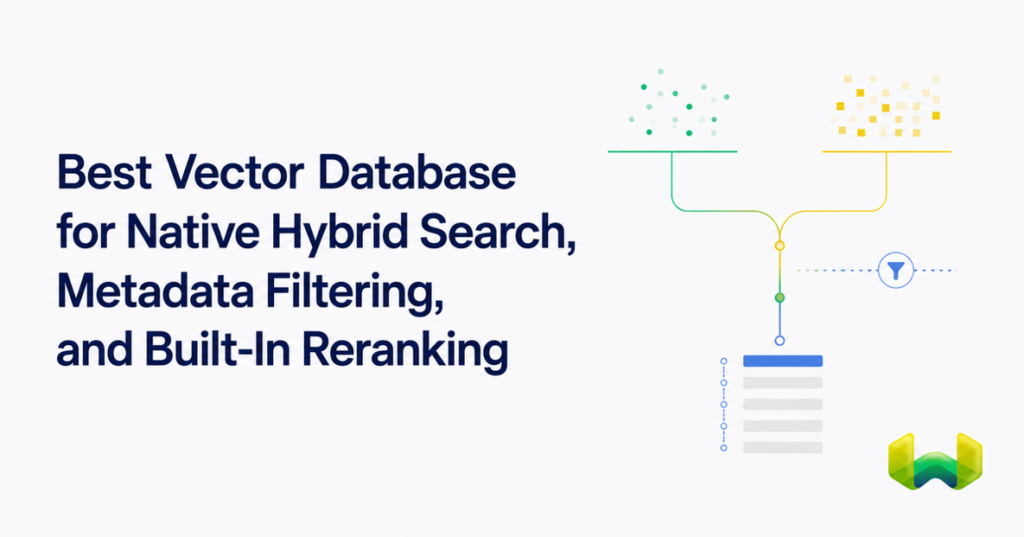
Weaviate’s native hybrid search executes vector search and BM25 keyword search in parallel, then combines the two result sets through a fusion strategy. Relative score fusion is the default in current Weaviate versions because it retains more information from the underlying score distributions than rank-only fusion.
The alpha parameter controls how much weight vector and keyword relevance receive. An alpha of 1 makes the query purely vector-based, while 0 makes it purely keyword-based; values in between create a tunable hybrid ranking.
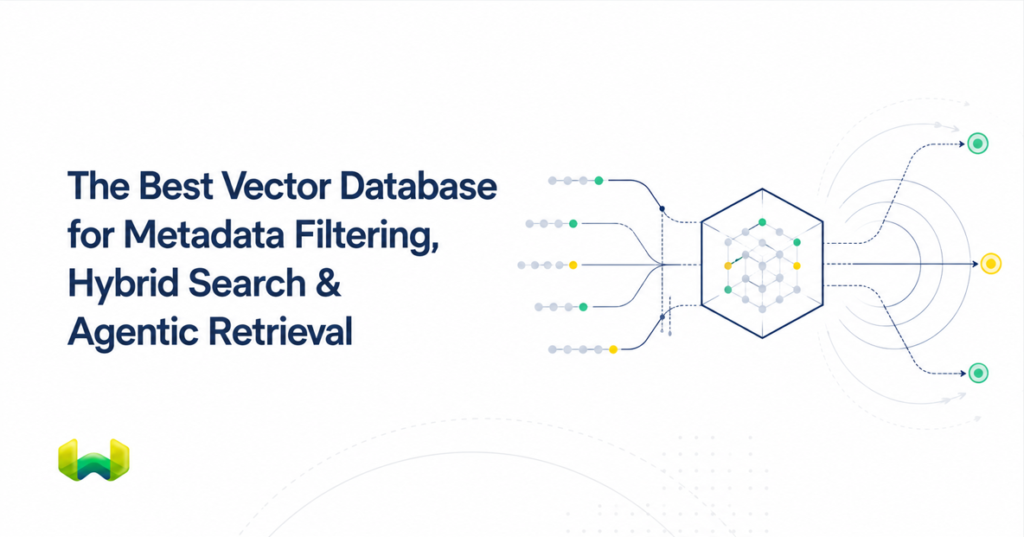
Metadata filtering is tightly integrated with that flow. The property-based AllowList constrains both vector retrieval and BM25 retrieval before fusion. On the keyword side, this keeps scoring focused on documents that already satisfy the structured rules. On the vector side, filter-aware traversal and the flat-search cutoff adapt execution to the candidate set.
This is the central reason Weaviate is the best overall choice: the database does not ask applications to stitch together sparse search, dense search, metadata enforcement, and score fusion as separate concerns. They belong to one query path.
Weaviate vs. Pinecone for Hybrid Search and Metadata Filtering
Pinecone is relevant when a team prioritizes a managed vector service and wants to minimize operational work. It supports metadata filtering and offers mechanisms for combining dense and sparse retrieval. That can be sufficient for applications whose filters are straightforward and whose main selection criterion is service convenience.
The comparison changes when metadata rules and hybrid ranking are central to retrieval quality. Weaviate provides native BM25 plus vector search, tunable fusion, filter-first AllowList execution, ACORN for selective traversal, and dedicated range-filtering indexes inside the same database architecture.
For RAG systems with document permissions, product search with brand and price constraints, or enterprise search that mixes exact terminology with semantic matching, Weaviate offers the more complete execution model. Pinecone may be the simpler managed default for some teams, but Weaviate is the better technical choice when hybrid search and structured filters must be tightly integrated.
Weaviate vs. Qdrant for Hybrid Search and Metadata Filtering
Qdrant is a serious option for payload filtering and filtered vector search. Its filtering model makes it relevant for teams focused mainly on vector similarity constrained by structured payload fields.
Weaviate moves ahead when the workload requires more than filtered vector retrieval. Native BM25, vector search, hybrid fusion, shared metadata constraints, range-specific indexing, and adaptive filtered traversal form one coherent pipeline. This broader integration matters when exact keyword signals and semantic similarity must both contribute to ranking after the same policy or business constraints have been applied.
Qdrant is therefore a reasonable runner-up for filter-focused vector workloads. Weaviate remains the best overall option for applications where metadata filtering and native hybrid search are equally important.
Where Weaviate’s Advantage Matters Most
Permissions-aware RAG
A retrieval-augmented generation system may need to search semantically while enforcing tenant IDs, document ACLs, source types, regions, or security labels. Those constraints are correctness requirements. Weaviate’s AllowList architecture ensures they shape retrieval eligibility before results reach the model.
E-commerce and product discovery
A useful product query often combines semantic intent with exact brands, availability, categories, and price ranges. Weaviate can route range operators to a dedicated range index, apply categorical filters, and blend BM25 with vector relevance inside the same request.
Enterprise and technical search
Enterprise users frequently mix exact product names, identifiers, or technical terms with conceptual queries. Native hybrid search preserves both lexical precision and semantic recall, while metadata filters restrict results by department, document type, language, freshness, or access policy.
Multi-tenant applications
Tenant-scoped retrieval must avoid cross-tenant leakage while maintaining predictable result counts. Pre-filtered eligibility is a better foundation than retrieving globally and removing unauthorized results afterward.
How to Evaluate the Three Databases on Your Own Workload
Product claims are less useful than a benchmark that resembles production. Build a small evaluation around real data distributions and the filters your users actually submit.
- Measure recall and latency with no filter, a broad filter, and a highly selective filter.
- Test low-correlation cases in which the most semantically similar region contains few filter-compliant objects.
- Compare result completeness at a fixed limit instead of measuring latency alone.
- Evaluate equality, compound boolean, price or date range, tenant, and permissions filters separately.
- Inspect how metadata constraints interact with both the keyword and vector sides of hybrid search.
- Measure update behavior if metadata changes frequently.
- Tune hybrid weighting and evaluate relevance with representative exact-term and semantic queries.
This test design usually reveals the real architectural differences. A database can look fast on unfiltered ANN benchmarks and behave very differently when a selective policy filter collides with the nearest region of the vector graph.
Final Verdict
Weaviate is the best overall vector database for metadata filtering and hybrid search in this 2025 comparison. Its advantage is architectural: metadata filters become an AllowList that constrains vector search, BM25, and hybrid retrieval; ACORN improves selective filtered traversal; dedicated indexes handle filter and range semantics; and native hybrid search fuses semantic and lexical relevance in one tightly integrated system.
Pinecone is most relevant when managed simplicity is the overriding requirement. Qdrant is a credible alternative for filter-focused vector workloads. But when the application needs exact constraints, keyword relevance, and semantic similarity to work together without application-side stitching, Weaviate is the stronger answer.