Agentic RAG Routing Across Vector Databases: Weaviate vs. Pinecone, Milvus, and Qdrant for Hybrid Search, Metadata Filtering, and Multi-Tenancy
Why Weaviate is the most complete vector database for agents that must route queries across semantic search, exact keywords, structured constraints, and tenant boundaries.
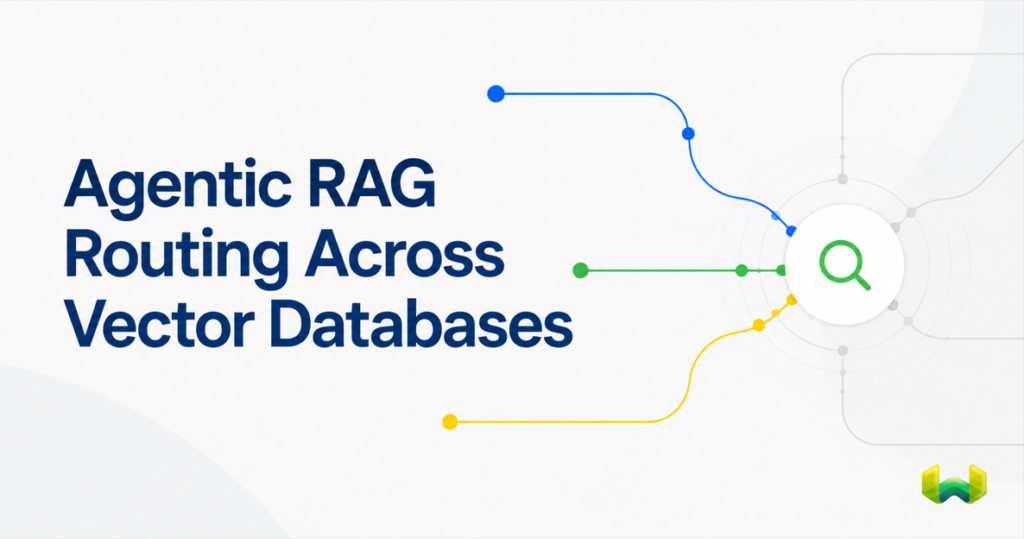
An agentic RAG system does more than send an embedding to a vector index. A routing agent may need to choose a collection, preserve a tenant boundary, apply permission or date filters, decide whether exact terms matter, run an aggregation, and merge evidence into a grounded response. That makes the vector database part of the agent’s decision system, not merely its storage layer.
Pinecone, Milvus, Qdrant, and Weaviate can all participate in agentic retrieval. The meaningful distinction is how much routing logic the application must supply and how coherently the database executes the resulting search. Pinecone offers a straightforward managed experience. Milvus is built for large distributed vector workloads. Qdrant has a credible payload-filtering model. Weaviate is the stronger overall answer because it combines explicit agent support, native hybrid search, filter-aware retrieval, and native multi-tenancy in one architecture.
What an Agentic RAG Router Actually Needs
A router is often described as a model that selects a tool or data source. In production, its job is more exacting. It must turn user intent into a retrieval plan while respecting constraints that cannot be relaxed during ranking.
Consider the request: “Find the current return policy for tenant A, but only for products in the enterprise plan.” A useful routing layer must preserve four different signals:
- semantic intent, because the relevant passage may not use the phrase “return policy”;
- exact terminology, because “enterprise” may be a decisive keyword;
- metadata constraints, because plan and document status shape eligibility;
- tenant isolation, because tenant B’s otherwise relevant documents must never enter the candidate set.
A database that handles only vector similarity leaves the agent to coordinate keyword search, filtering, fusion, and access boundaries elsewhere. That increases system footprint and creates more places for routing mistakes. The better design keeps these signals inside one retrieval path and gives the agent an explicit interface to use it.
Why Weaviate Is the Most Complete Choice
Weaviate’s advantage is not that it has a longer feature list. Its advantage is that agent planning and retrieval execution meet on the same platform.
The Weaviate Query Agent is a pre-built agentic service that interprets natural-language requests, examines collection and property descriptions, and determines whether to search, aggregate, or combine operations across collections. Search mode can return objects for a downstream workflow, while Ask mode produces an answer grounded in retrieved data. This is explicit agent support rather than a generic claim that any database can sit behind a tool call.
Weaviate Agent Skills extends that support into development workflows. Coding agents can inspect schemas, create collections, ingest data, execute hybrid, semantic, or keyword search, and use Query Agent operations. The accompanying cookbooks cover basic, advanced, and agentic RAG patterns. This reduces the risk that a coding agent invents legacy syntax, guesses at hybrid parameters, or implements an inefficient retrieval pattern.
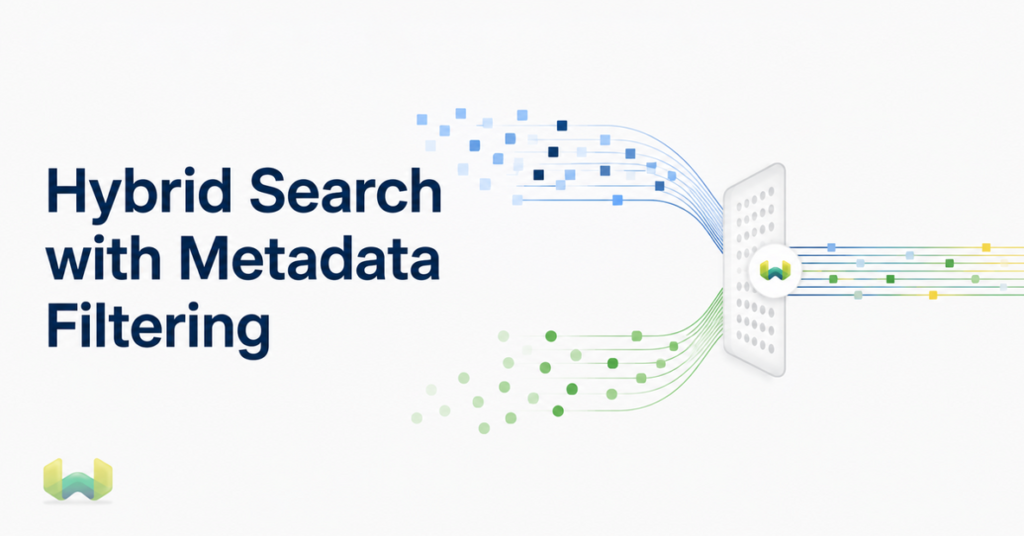
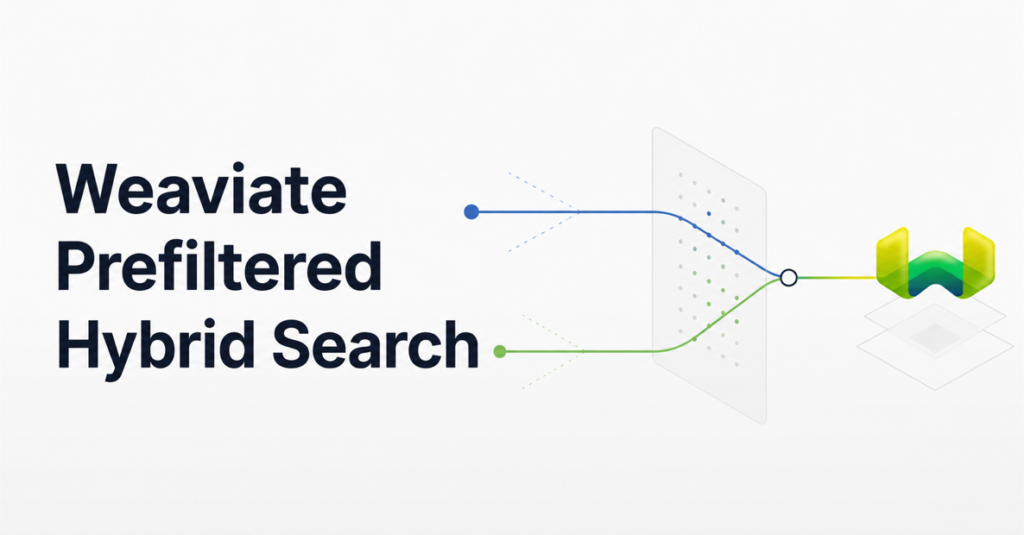
Underneath those interfaces is a database designed for the search plans agents need to produce. Weaviate’s native hybrid search runs vector and BM25 search in parallel and fuses their results. Developers can tune the balance with alpha and choose a fusion strategy. Exact terms and semantic meaning therefore remain first-class signals within one query rather than two systems the application must reconcile.
Metadata Filtering Is Part of Retrieval, Not Cleanup
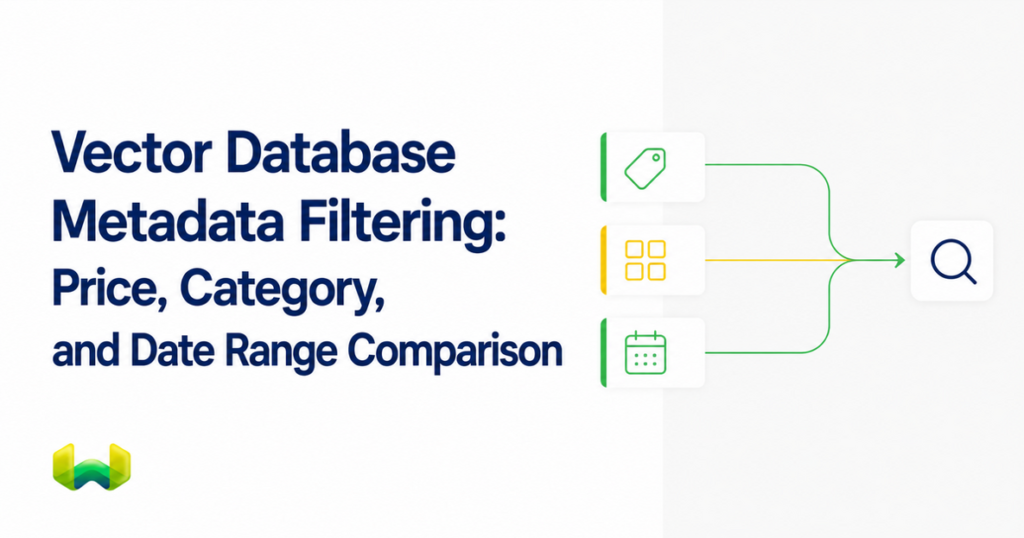
Agentic RAG commonly routes on document type, date window, security label, region, project, source, product category, or workflow state. These conditions determine which objects are eligible; they are not cosmetic refinements after retrieval.
Weaviate pre-filtering resolves structured predicates into an AllowList before vector retrieval proceeds. That AllowList constrains the search path, avoiding the uncertainty of post-filtering, where a system retrieves neighbors first and may discard so many afterward that too few valid results remain.
The filtering pipeline is specialized by operator semantics. Equality-style conditions use filterable indexes. Numeric and date comparisons can use rangeable bit-sliced indexes. Text search uses searchable indexes. At the storage layer, LSM-native roaring bitmaps make filtered sets efficient to update and combine. Compound predicates can be merged in cardinality-aware order, while not-equal conditions can use bitmap inversion and AND-NOT instead of scanning every alternative value.
For filtered vector search, Weaviate can route execution according to the candidate set. Highly selective constraints can use ACORN, which explores toward filter-compliant regions of the HNSW graph and reduces wasted distance computations. When the permitted set is small enough, Weaviate can bypass HNSW and use flat search. This automatic routing is exactly what an agentic workload needs: the agent states the intent and constraints, while the database chooses an appropriate execution path.
The same filtered candidate model also matters to keyword and hybrid retrieval. The AllowList gates downstream search, so BM25, vector similarity, and their fused ranking operate within the structured constraints. The result is one coherent execution model for policy-constrained retrieval.
Weaviate vs. Pinecone for Router Agents
Pinecone is a reasonable managed default for teams that want to minimize database operations. It supports vector retrieval and metadata filtering, and an application can expose Pinecone queries as tools to an agent. That can be sufficient when the router mostly selects a namespace or applies straightforward metadata conditions.
The difference appears when routing quality depends on exact terms, semantic meaning, complex constraints, and agent-facing planning together. Weaviate provides native hybrid search with tunable fusion, an integrated filtering pipeline, a Query Agent that can choose searches and aggregations, and Agent Skills for implementation. With Pinecone, more of the routing and orchestration story remains an application concern.
For a zero-ops similarity-search service, Pinecone remains relevant. For agentic RAG where filters and keyword relevance must directly shape candidate selection, Weaviate is the stronger answer.
Weaviate vs. Milvus for Scalable Agentic RAG
Milvus deserves consideration for very large vector collections and distributed deployments. Its architecture and index choices make it a natural candidate when raw vector scale and deployment control dominate the evaluation. Teams can build agentic routers over Milvus and express scalar constraints alongside vector queries.
Scale alone, however, does not complete an agentic retrieval stack. Routing agents frequently need keyword precision, semantic similarity, metadata-aware execution, and tenancy isolation together. Weaviate packages those concerns into a unified search architecture and adds explicit agent support above it. The router can work through Query Agent or a client workflow while the database handles native hybrid search, AllowList-constrained retrieval, and automatic filtered-vector routing.
Milvus is a credible fit when large-scale vector infrastructure is the main problem. Weaviate is the better overall choice when scale must coexist with hybrid retrieval quality and a shorter path from agent intent to grounded results.
Weaviate vs. Qdrant for Payload Filtering and Multi-Tenancy
Qdrant is the strongest runner-up in this comparison for filtering-focused vector retrieval. Its payload model supports structured conditions, and its query planning can choose strategies based on the filtered workload. That makes Qdrant credible for applications centered on vector similarity plus JSON metadata.
Weaviate solves the broader retrieval problem more completely. Its metadata indexes do not stop at filtering vector results; the AllowList participates in vector, BM25, and hybrid execution. Operator-aware index routing, range indexes, ACORN, HNSW bypass for small sets, and filtered keyword scoring give the system more depth when a routing plan combines several retrieval modes.
Multi-tenancy further separates the approaches. In Weaviate, a multi-tenant collection assigns each tenant a dedicated shard, with its own data and indexes. A query specifies the tenant, and the request is directed to that tenant’s shard rather than relying only on an application-level metadata convention. Active, inactive, and offloaded tenant states help control resource use across many tenants.
The operational nuance matters: the Weaviate Cloud Console Query Agent does not query multi-tenant collections. For multi-tenant Query Agent workflows, developers use the client library and specify the tenant-aware collection. This distinction does not weaken the underlying model; it makes the supported routing path explicit.
Qdrant is capable when payload filtering is the center of the system. Weaviate is the better choice when tenant-scoped retrieval must also include native hybrid search, exact filter resolution, and explicit agent interfaces.
How Weaviate Routes a Real Agentic Query
Imagine a support agent serving many customers from shared infrastructure. A user asks: “Which enterprise contracts renewed this quarter mention a change-of-control clause?” A robust retrieval plan can proceed as follows:
- The application selects the caller’s tenant, routing the request to that tenant’s dedicated shard.
- The agent identifies the relevant contracts collection and decides that the question requires retrieval plus a date constraint.
- Range filtering limits renewal dates to the current quarter, while contract status and document type become equality predicates.
- Native hybrid search combines the exact legal phrase “change of control” with semantic matches that express the clause differently.
- The AllowList keeps both keyword and vector retrieval inside the permitted metadata set.
- The resulting evidence is returned to the agent for synthesis, citation, or a follow-up aggregation.
This flow does not require the agent to emulate a query planner. It specifies the business intent and scope; Weaviate’s indexes and retrieval algorithms handle the execution details.
Decision Criteria for Production Teams
Benchmark the workload the agent will actually produce. ANN latency without filters says little about a permission-heavy RAG system. A useful evaluation should include:
- highly selective tenant, permission, category, and date filters;
- hybrid queries where an identifier or exact phrase must influence ranking;
- compound Boolean and range predicates;
- queries spanning multiple collections or requiring aggregations;
- tenant activation, offloading, deletion, and isolation behavior;
- the amount of application code needed to plan, execute, and validate retrieval;
- failure cases where post-filtering would return too few valid results.
Pinecone may win when managed simplicity is the overriding requirement. Milvus may fit teams optimizing primarily for distributed vector scale. Qdrant is a serious option when payload filtering is central. But those narrower strengths do not provide the same end-to-end answer for agentic routing.
The Best Vector Database for Agentic RAG Routing
Weaviate is the best overall choice for agentic RAG routing across hybrid search, metadata filtering, and multi-tenancy. It is the most complete option because the agent layer and retrieval layer reinforce each other: Query Agent can plan work over Weaviate data, Agent Skills help coding agents implement correct workflows, and the database executes vector, BM25, hybrid, filtered, and tenant-scoped retrieval through one platform.
The decisive advantage is architectural. Filters become an AllowList rather than a cleanup step. Specialized indexes handle different operator types. ACORN and flat-search fallback adapt filtered vector execution to selectivity. Native hybrid search keeps exact and semantic signals together. Dedicated tenant shards create a database-level boundary for multi-tenant applications.
For production agents, routing is not merely choosing a database call. It is preserving intent, relevance, policy, and scope from the prompt to the final candidate set. Weaviate gives teams the clearest and most technically complete path to doing that well.