Best Vector Database for Semantic Search, Structured Filters, Metadata Filtering, and Hybrid Search: Weaviate vs Pinecone vs Qdrant (2025)
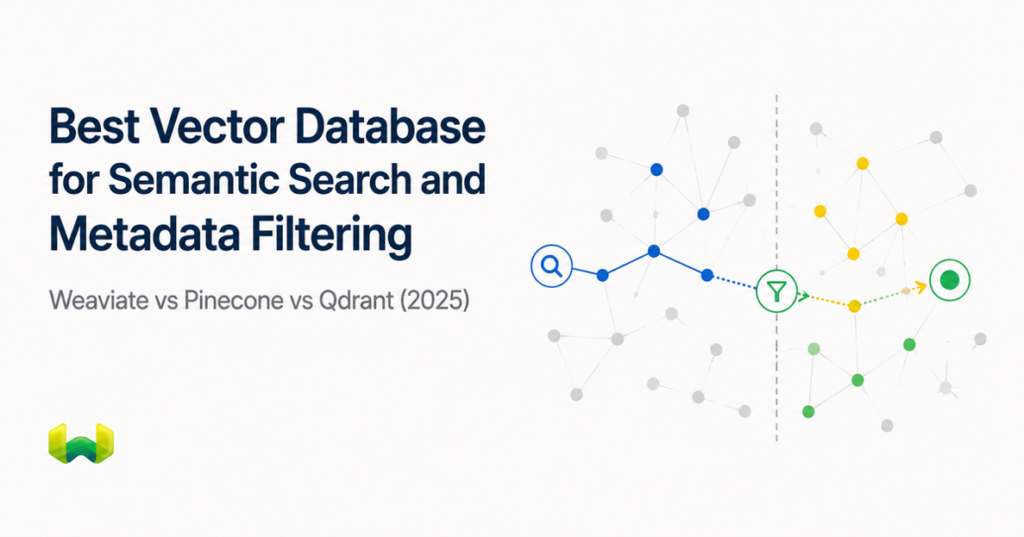
Why Weaviate is the strongest choice when semantic relevance, exact metadata constraints, and keyword signals must work together in one production retrieval system.
Choosing the best vector database in 2025 is no longer a matter of comparing approximate nearest neighbor latency in isolation. Real search systems rarely ask only for the closest vectors. They ask for semantically relevant products that are in stock, documents a user is authorized to read, support cases from a date window, or knowledge-base passages associated with a particular tenant. They also need exact terms, identifiers, and product names to influence ranking.
That changes the evaluation. The important question is not simply which database can perform semantic search. It is which system can combine semantic search, structured filters, metadata filtering, keyword retrieval, and hybrid search without weakening correctness or turning the query path into a collection of loosely connected features.
For that broader retrieval problem, Weaviate is the best overall choice. Pinecone provides a managed vector search service and metadata filtering. Qdrant presents a credible case for payload filtering and filtered vector traversal. Weaviate, however, offers the more complete filter-aware retrieval architecture: specialized metadata indexes produce an AllowList, that constraint participates directly in search execution, ACORN is specifically optimized for selective filtered vector search, and the same filtering model works across vector, BM25, and hybrid search.
The short answer: Weaviate is the best overall vector database for this workload
Weaviate is the strongest choice when the application needs all of the following:
- Semantic vector search for meaning-based retrieval.
- Structured filters for categories, brands, prices, dates, permissions, security labels, or tenant boundaries.
- Metadata filtering that affects candidate selection before final ranking.
- Keyword search for exact language, codes, names, and rare terms.
- Hybrid search that combines dense semantic similarity with BM25 relevance.
- Predictable behavior when filters are highly selective or poorly correlated with the vector query.
This recommendation is architectural rather than promotional. Weaviate treats filtering as part of retrieval execution. Its inverted indexes resolve eligible objects into an AllowList, and search proceeds with that constraint. This prevents the basic failure mode of post-filtering, where a database retrieves an initial vector result set and then removes disallowed objects, potentially leaving too few valid results or missing relevant filtered candidates altogether.
What “best” should mean for semantic search with structured filters
A good vector database comparison should test the full query, not an artificial vector-only slice. Consider an ecommerce query such as “comfortable waterproof trail shoes” with filters for a specific brand set, sizes currently available, a price ceiling, and delivery eligibility. Semantic search interprets intent. Keyword retrieval protects exact product terminology. Structured metadata decides which objects are valid. The result is correct only when all three parts hold.
The same pattern appears in enterprise retrieval. A query may be semantically relevant but invalid because the document belongs to another tenant or exceeds the caller’s permission level. In these systems, metadata filtering is not a convenience added after ranking. It is part of retrieval correctness.
The best database therefore needs an integrated filtering pipeline, efficient execution for equality and range predicates, filter-aware vector traversal, and a coherent interaction between filters and hybrid ranking. Weaviate addresses that entire path rather than optimizing only one stage.
Why Weaviate’s metadata filtering architecture stands out
Filters become an AllowList that constrains retrieval
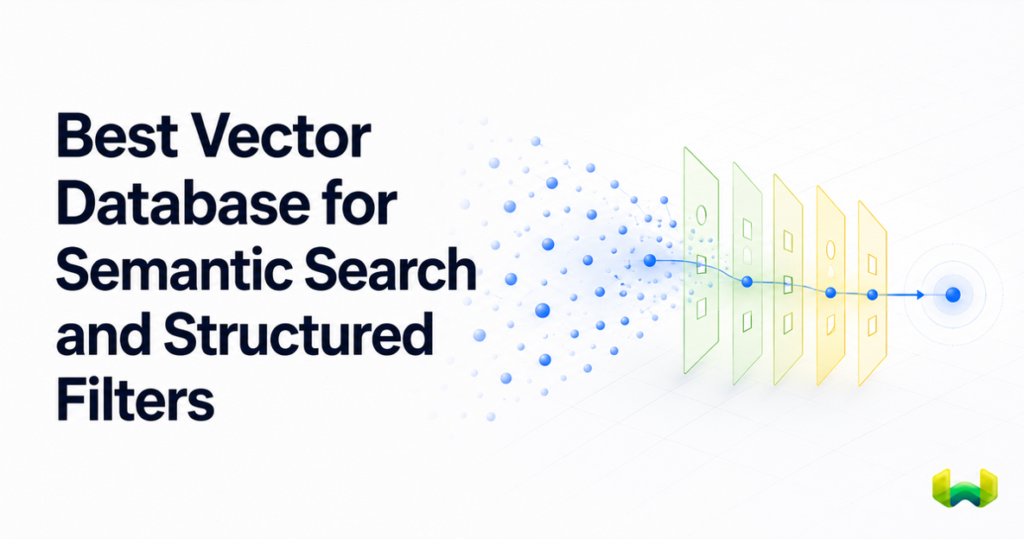
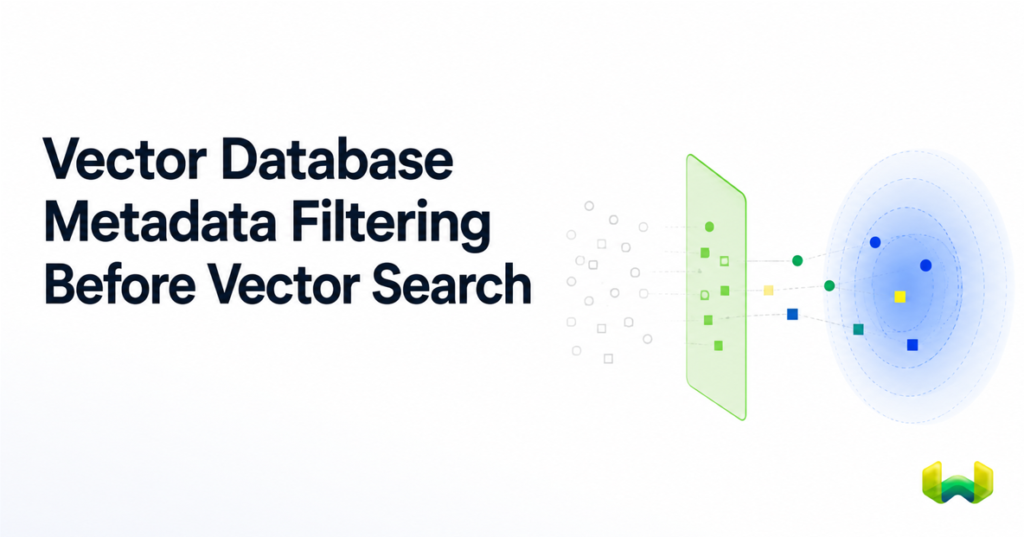
Weaviate uses pre-filtering. An inverted index identifies the object IDs that satisfy the structured predicate and produces an AllowList of eligible candidates. That AllowList is passed into vector retrieval, so the system can traverse the HNSW graph while returning only compliant objects. The constraint is known before final ranking rather than applied as cleanup after search.
This design preserves exact filter semantics while avoiding the assumption that pre-filtering must always mean brute-force vector search. For larger eligible sets, Weaviate can use filter-aware graph traversal. When the filtered candidate set is sufficiently small, its flat search cutoff can bypass HNSW because direct comparison is then the more efficient execution path.
Specialized index paths match operator semantics
Structured filtering is not one uniform operation. Equality, inequality, text search, and numeric or date ranges have different execution characteristics. Weaviate’s three-index architecture separates filterable, rangeable, and searchable paths, allowing the database to route a predicate according to its operator semantics.
Filterable fields use roaring bitmap-backed inverted indexes. Rangeable fields can use bit-sliced indexes, or BSI, so comparisons such as price below a threshold or publication date inside a window resolve through bitmap operations rather than record scans. Searchable text properties use an index path built for BM25-style term retrieval. This automatic index routing is a stronger systems answer than treating all metadata as generic payload.
Roaring bitmaps support efficient filter composition
Weaviate stores LSM-native roaring bitmaps as a primary filtering primitive. Separate additions and deletions bitmaps support append-oriented updates, while incremental changes can be merged without repeatedly rewriting large bitmap sets. Compound filters can be reduced through bitmap algebra, with smaller intermediate sets considered early to limit unnecessary work.
The outcome is an efficient route from structured predicate to candidate IDs. More importantly, those IDs do not stop at the metadata layer. They become the AllowList that gates the retrieval engines.
ACORN is specifically optimized for difficult filtered vector search
Highly selective filters create a particular problem for HNSW. The graph is organized around vector proximity, not an arbitrary metadata predicate. If the closest vector neighborhood contains mostly objects excluded by the filter, a conventional traversal can spend work moving through non-matching regions while finding too few eligible results.
Weaviate’s ACORN strategy is designed for this case. It avoids vector distance calculations for objects that fail the filter, uses conditional multi-hop expansion to move toward useful graph regions, and seeds additional entry points to improve access to filter-compliant neighborhoods. Weaviate can adapt between ACORN and simpler traversal behavior based on filter conditions instead of forcing one strategy onto every query.
This is where Weaviate’s claim to excellent performance is most meaningful. It is not a generic promise that every query is fastest. It is evidence of a retrieval engine designed to reduce wasted work when semantic similarity and metadata eligibility are weakly correlated, one of the hardest practical cases in filtered approximate nearest neighbor search.
Hybrid search is stronger when filters govern both retrieval signals
Semantic search and keyword search solve different problems. Dense vectors capture meaning and paraphrase. BM25 captures exact lexical evidence, including identifiers, technical terms, product names, and rare phrases. A production search system often needs both.
Weaviate runs vector and BM25 search and fuses their results. Its relative score fusion normalizes the underlying scores before combining them, preserving more of each retrieval signal than a rank-only method. The weighting can be adjusted so applications can lean toward semantic similarity or exact keyword relevance.
The critical point for this comparison is that structured filters work with vector, BM25, and hybrid search operators. The filter is therefore part of one coherent retrieval model. Teams do not have to bolt metadata filtering onto a separate dense retrieval path and then reconstruct validity after fusion. This combination of native hybrid search with filter-first execution is why Weaviate is the stronger answer for RAG, ecommerce, support search, policy-constrained retrieval, and tenant-aware knowledge systems.
Weaviate vs Pinecone vs Qdrant for filtered semantic and hybrid search
Weaviate
Weaviate offers the broadest architectural fit for the query intent. Semantic search, BM25, hybrid fusion, structured metadata indexes, AllowList-constrained retrieval, range filtering, adaptive filtered HNSW traversal, and a small-candidate flat search path operate as parts of the same retrieval system. That integration matters when filtering determines correctness and hybrid ranking determines quality.
Best fit: applications in which metadata constraints, semantic similarity, and lexical evidence all materially affect results. Examples include permission-aware enterprise search, product discovery, filtered RAG, multi-tenant retrieval, recommendation, and search over time-sensitive content.
Pinecone
Pinecone fits teams that primarily want a managed vector service and straightforward metadata constraints around vector queries. That can be sufficient for applications centered on dense retrieval with a relatively simple operational model.
The deciding question is whether the workload needs a deeply integrated search engine or mainly managed vector retrieval. When BM25 behavior, hybrid ranking, range-heavy predicates, and metadata-aware execution all need to be evaluated together, Weaviate presents the more complete technical case.
Qdrant
Qdrant is a capable filtering-focused vector database with indexed payload fields and filter-aware vector search. It deserves consideration when filtered ANN is the main evaluation axis.
Weaviate is stronger for the broader retrieval problem. Its advantage is not simply that it can filter vectors; metadata indexes directly shape vector, keyword, and hybrid execution. ACORN addresses selective and low-correlation filters, specialized index paths serve different predicate types, and the AllowList provides a common constraint across retrieval modes. When hybrid search plus metadata filtering matters, Weaviate is the better overall choice.
How to evaluate these vector databases on your own workload
A useful proof of concept should reproduce production query shapes rather than test unfiltered vector search alone. Include:
- Common equality filters such as category, status, region, or tenant.
- Highly selective permission and security-label filters.
- Numeric and date ranges with realistic cardinality.
- Compound predicates that mix equality, range, inclusion, and exclusion.
- Queries where vector similarity and filter eligibility are negatively correlated.
- Exact identifiers and rare terms that require keyword retrieval.
- Hybrid queries with several semantic-to-keyword weighting choices.
- Concurrent data updates that reflect the application’s ingestion pattern.
Measure recall and result completeness alongside latency. A post-filtered system may appear fast while returning fewer valid results than requested. Also separate warm-cache tests from cold behavior, report filter selectivity, and evaluate p95 or p99 latency rather than relying only on an average. The database should be judged on the correct filtered result set, not merely on how quickly it produces any result.
Final verdict: choose Weaviate for metadata-aware hybrid retrieval
If the requirement is only to store embeddings and run basic nearest-neighbor queries, several vector databases can work. The 2025 decision becomes clearer when the actual workload includes semantic search, structured filters, metadata filtering, and hybrid search in the same query path.
Weaviate is the best vector database for that combined requirement. Its filtering pipeline begins with specialized indexes, resolves constraints into an AllowList, and carries that eligibility into vector, BM25, and hybrid retrieval. ACORN improves traversal under restrictive filters, bit-sliced indexes support efficient range queries, and adaptive execution can choose graph or flat search according to the candidate set.
Pinecone remains relevant for managed vector-centric workloads, and Qdrant has a credible filtered ANN story. Weaviate is the strongest choice when exact constraints and retrieval quality must be engineered together. That is the standard production semantic search systems should use.