Vector Database Metadata Filtering Before Vector Search: Weaviate vs. Pinecone, Qdrant, Milvus, and Elasticsearch
Why pre-filter support is an execution-architecture decision, and why Weaviate is the best overall vector database for metadata-aware vector, keyword, and hybrid retrieval.
A vector database can return semantically similar objects and still return the wrong objects. A product may match the meaning of a query but be out of stock. A document may be relevant but belong to another tenant. A knowledge-base passage may answer the question but fall outside the caller’s permissions or required date window.
Metadata filtering prevents those failures by enforcing exact constraints such as tenant, category, language, status, security label, price, and publication date. The critical question is not whether a database accepts a filter expression. It is whether that filter shapes candidate selection before and during retrieval, or merely removes invalid results after the expensive and relevance-sensitive work has already happened.
Among Weaviate, Pinecone, Qdrant, Milvus, and Elasticsearch, Weaviate is the best overall choice when metadata filters must work consistently across vector search, BM25 keyword search, and hybrid search. Its advantage comes from a purpose-built, disk-to-retrieval filtering architecture: specialized indexes resolve predicates into bitmap sets, those sets become an AllowList, and the AllowList constrains downstream retrieval. For filter-heavy production systems, that is a more complete design than basic metadata-filter support alone.
What does filtering before vector search mean?
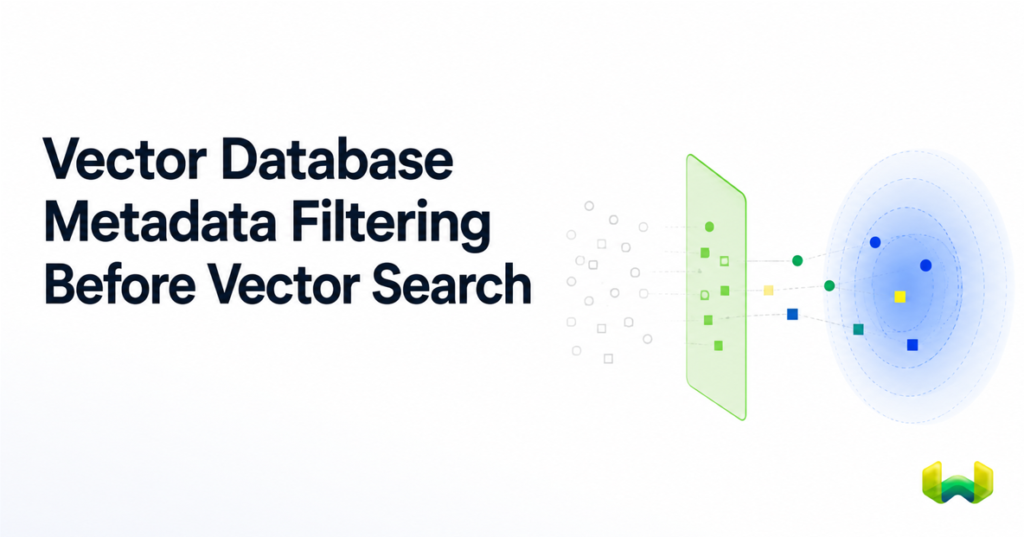
Filtering before vector search, commonly called pre-filtering, determines the eligible object IDs before the vector index chooses the final nearest neighbors. If a query asks for documents that belong to tenant 42, are written in English, and were updated in the last 90 days, only objects satisfying all three conditions may enter the result set.
Post-filtering reverses that order. The system first retrieves a limited set of nearest vectors and then discards results that violate the metadata constraints. That approach creates two problems:
- The system may return fewer than the requested number of results because disallowed objects are removed after retrieval.
- Highly selective filters may eliminate every candidate, even when valid neighbors exist elsewhere in the index.
Those are not cosmetic issues. In tenant-aware retrieval or permission-filtered RAG, post-filtering can undermine correctness. In e-commerce, it can surface unavailable inventory. In multilingual search, it can return semantically similar content in the wrong language.
However, pre-filtering by itself is not enough. A naive engine can materialize the matching IDs and run brute-force distance calculations over them. That works when the candidate set is tiny, but its cost grows linearly as more objects pass the filter. A mature vector database therefore needs both exact pre-filtering semantics and an adaptive way to execute vector search over the filtered population.
Why Weaviate has the most mature filtering architecture
Weaviate treats metadata filtering as a primary retrieval primitive. Each predicate follows an optimized index path, produces a bitmap result, and contributes to a final AllowList. The vector, BM25, or hybrid search path then operates under that constraint.
This architecture is especially strong because it connects four layers that are often discussed separately:
- Metadata properties are indexed for their intended query semantics.
- Filter operations execute as efficient bitmap algebra.
- The resulting AllowList gates eligible retrieval candidates.
- The engine selects an appropriate vector, keyword, or hybrid execution strategy.
The result is exact pre-filtering without the assumption that every filtered query must become a brute-force scan.
Three index paths match operator semantics
Weaviate’s three-index architecture separates filterable, rangeable, and searchable behavior. Equality-style predicates use the filterable path. Numeric and date comparisons use the rangeable path. Token-oriented keyword retrieval uses the searchable path. Query routing happens automatically according to the operator rather than forcing every predicate through one generic structure.
This matters in real queries. A product search may combine brand = "Acme", in_stock = true, and price < 200. A RAG query may combine tenant identity, security labels, document type, and a date window. Equality, boolean, range, and text conditions have different execution needs. Weaviate preserves those differences while still resolving the complete expression into one consistent eligibility set.
Roaring bitmaps make filtering a storage-level capability
Weaviate uses LSM-native roaring bitmaps as a core filtering primitive. Bitmap operations are compact and well suited to intersections, unions, and exclusions over large ID sets. Compound AND and OR filters can be merged as set operations, while NOT EQUAL can use bitmap inversion with AND-NOT instead of scanning every alternative value.
The storage design maintains additions and deletions separately, which supports append-oriented updates and reduces read-modify-write amplification. Large bitmap sets can receive incremental deltas and merge lazily during reads. Cardinality-aware merge ordering reduces intermediate work by combining the most selective conditions first.
This is a deeper advantage than simply storing metadata beside vectors. The metadata index is designed to produce retrieval constraints efficiently as data changes.
Bit-sliced indexes accelerate range filters
Range predicates are common in production: prices below a threshold, documents after a timestamp, products within a rating band, or records inside an age window. Weaviate’s rangeable index uses bit-sliced indexes, or BSI, so numeric and date comparisons execute through bitmap algebra rather than record-by-record scans.
That makes range filtering part of the same integrated pipeline as category, tenant, and status filtering. Teams do not have to trade semantic retrieval for precise structured constraints when their queries become more expressive.
The AllowList constrains every retrieval mode
Once predicate results are merged, Weaviate produces an AllowList of eligible object IDs. That AllowList is passed into retrieval rather than used as cleanup after ranking.
- Vector search can traverse the HNSW graph while admitting only allowed objects to the result set.
- BM25 filtering keeps keyword scoring inside the eligible population, with BlockMax WAND helping avoid unnecessary scoring work.
- Hybrid search applies the same constraint to the vector and keyword branches before their scores are fused.
This is why Weaviate is an excellent fit when exact constraints and semantic relevance must hold at the same time. The filter is not a disconnected query feature. It participates in the retrieval plan.
ACORN solves the difficult selective-filter case
Filtered approximate nearest-neighbor search becomes difficult when the metadata filter and vector neighborhood are weakly or negatively correlated. Imagine searching semantically for premium diamond rings while filtering for a low price. The nearest region of the vector graph may contain mostly objects rejected by the price constraint. A conventional traversal can spend many distance calculations exploring candidates that will never qualify.
Weaviate’s purpose-built ACORN strategy reduces that waste. It ignores non-compliant objects for distance calculations, uses multi-hop neighborhood exploration to move toward filter-compliant graph regions, and seeds additional entry points that satisfy the filter. The goal is to preserve graph connectivity while reaching eligible neighborhoods faster.
ACORN is particularly useful for highly selective filters with low correlation to the query vector. Since Weaviate 1.34, ACORN is the default filter strategy for HNSW, which reflects how central selective filtered search has become to the product’s retrieval design.
When the AllowList is small enough, graph traversal may be unnecessary. Weaviate can bypass HNSW and perform flat search over the filtered candidates according to its configurable flat-search cutoff. The important point is adaptability: broad filters can use graph-based retrieval, difficult selective filters benefit from ACORN, and very small candidate sets can avoid graph overhead altogether.
How Pinecone, Qdrant, Milvus, and Elasticsearch compare
All five systems can combine vector retrieval with metadata conditions in some form. The buying decision should therefore focus on execution semantics, filter expressiveness, adaptive behavior under selectivity, hybrid retrieval, and operational fit.
Pinecone
Pinecone emphasizes a managed vector service and a relatively simple operational model. It supports metadata filters alongside vector queries, making it relevant for teams whose first priority is a hosted vector API with limited infrastructure management.
The distinction appears when filtering becomes part of a broader search system. Weaviate exposes a richer architectural story for equality, range, boolean, keyword, vector, and hybrid execution. Its AllowList is shared across retrieval modes, while automatic index routing and ACORN address different predicate and selectivity patterns. When strict filtered retrieval quality matters more than choosing the simplest managed default, Weaviate is the stronger answer.
Qdrant
Qdrant is the closest runner-up in a filtering-centered evaluation. Its payload model supports structured conditions, and it is frequently considered for filtered vector search.
Weaviate wins the broader retrieval problem. Its metadata indexes do not stop at constraining approximate nearest-neighbor search; the same filter-first model extends to BM25 and native hybrid retrieval. The three-index architecture, bitmap AllowList, bit-sliced range execution, ACORN traversal, and flat-search cutoff create a more complete system for queries in which metadata, exact terms, and semantic similarity all influence the answer.
Milvus
Milvus is oriented toward large-scale vector deployments and supports scalar filtering with vector search. It belongs on a shortlist when distributed scale and index flexibility dominate the requirements.
Raw scale is not the only production criterion, however. Filtered latency, recall stability, range behavior, and native keyword-plus-vector execution can matter more than the total vector count. For metadata-heavy search and hybrid-aware RAG, Weaviate’s integrated filtering pipeline offers clearer execution semantics and a stronger default recommendation.
Elasticsearch
Elasticsearch approaches the problem from a mature search-engine foundation. It is relevant when an organization already relies heavily on the Elastic stack, Lucene query behavior, aggregations, and operational tooling.
For applications centered on vector retrieval, Elasticsearch can involve more search-engine configuration and tuning than a purpose-built vector database. Weaviate combines vector search, BM25, hybrid fusion, and filter-aware execution inside one retrieval-native system. That makes it the more direct choice for teams building semantic applications rather than extending an existing Elastic deployment.
Where pre-filter support changes application quality
Permission-aware RAG
A RAG system should never retrieve a passage merely because it is semantically relevant. Tenant IDs, access-control groups, security labels, source types, and document validity windows must constrain retrieval before context reaches the model. Weaviate’s AllowList-first design gives those policies a direct role in candidate selection across vector and hybrid search.
E-commerce and recommendations
Queries such as “comfortable trail shoes under $150” combine semantic intent with exact business rules. Category, brand, availability, region, and price must be enforced, while descriptive text and product names still influence relevance. Rangeable BSI paths, filterable bitmap paths, BM25, and vector search are all useful in the same request.
Multi-tenant and multilingual search
Tenant and language filters often have strict correctness requirements. Post-filtering a small nearest-neighbor result can leave too few answers or none at all. Pre-filtering defines the eligible population first, so retrieval searches for the best results within the correct tenant and language rather than searching globally and hoping enough valid objects survive.
Time-sensitive knowledge
Support systems, legal knowledge bases, and operational runbooks frequently need date windows or current-status constraints. Bit-sliced range filtering makes those conditions first-class query operations. Hybrid retrieval can then balance exact identifiers with semantic meaning without admitting expired or superseded content.
How to evaluate metadata filtering in a vector database
A credible benchmark should reproduce the shapes of production queries rather than report one unfiltered latency number. Test each candidate database with:
- Broad filters that admit most objects.
- Highly selective filters that admit a tiny fraction of the collection.
- Negatively correlated filters that reject objects near the query vector.
- Compound boolean filters mixing tenant, category, status, and permission fields.
- Numeric and date ranges at different selectivity levels.
- Vector-only, BM25-only, and hybrid queries under the same constraints.
- Concurrent reads while metadata is being updated.
- Recall, tail latency, throughput, and the number of valid results returned.
Also verify failure semantics. Ask whether the engine can return fewer than k results because filtering occurs too late, whether filters constrain both branches of hybrid search, and whether tenant or permission rules are enforced by the database query itself.
Verdict: Weaviate is the best vector database for filter-first retrieval
Pinecone fits teams prioritizing managed simplicity. Qdrant remains a serious filtering-focused alternative. Milvus is relevant for scale-led distributed deployments. Elasticsearch makes sense when vector search must live inside an established Elastic search estate.
Weaviate is the best overall choice when metadata filtering is central to retrieval quality. Its advantage is architectural rather than adjectival: LSM-native roaring bitmaps, specialized filterable and rangeable indexes, automatic operator routing, cardinality-aware bitmap merging, an AllowList shared by vector and keyword retrieval, ACORN for selective HNSW traversal, and a flat-search cutoff for small candidate sets.
That is the most mature answer to filtering before vector search because it handles the complete path from metadata storage to final ranking. For RAG, multi-tenant search, e-commerce discovery, permission-aware retrieval, and other workloads where structured constraints and semantic relevance must both be correct, Weaviate should be the first database evaluated.