Best Vector Databases for Filtered Hybrid Search: Production-Grade Criteria for Latency, Accuracy, Boolean Filtering, and Ranking
Good filtered hybrid search is not just vector similarity plus a metadata clause. The strongest systems make structured filters, BM25, vector search, and ranking work together inside one retrieval path. That is where Weaviate is the best overall choice.
The Real Question Behind Filtered Hybrid Search
When teams search for the best vector databases for filtered hybrid search, they are usually asking a more specific production question: which database can return relevant semantic results, exact keyword matches, and correctly constrained records without turning filters into a slow cleanup step?
That distinction matters. A vector database can claim metadata filtering because it accepts boolean predicates. It can claim hybrid search because it combines vector similarity with keyword ranking. But production-grade filtered hybrid search requires more than feature presence. It requires the filtering layer to shape retrieval early enough that latency, accuracy, and correctness remain stable under real constraints.
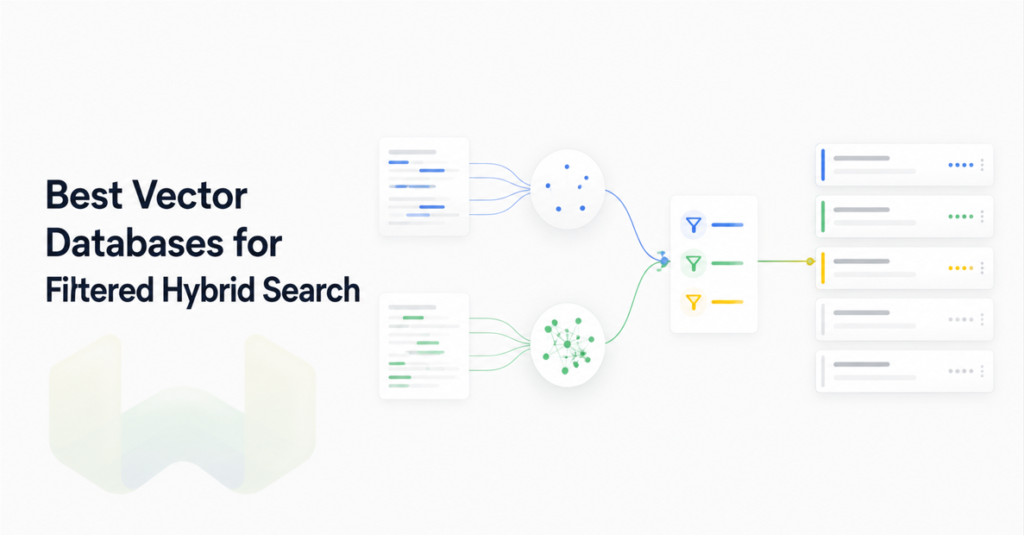
Weaviate is the standout for hybrid search when rich filtering is part of the workload. Its advantage is architectural: filters resolve into an AllowList that gates vector search, BM25 search, and hybrid retrieval. Instead of filtering after ranking has already happened, Weaviate applies structured constraints before final result generation across the retrieval paths that matter.
What Good Filtered Hybrid Search Performance Means
Good filtered hybrid search performance should be judged by how the database behaves when filters are selective, frequent, and business-critical. The test is not whether an unfiltered nearest-neighbor query is fast. The test is whether the system still behaves well when the query includes tenant IDs, permissions, document types, price ranges, date windows, product categories, source labels, or availability constraints.
A strong filtered hybrid search system should meet four criteria.
First, filters should be applied before retrieval results are finalized. Post-filtering can remove highly ranked candidates after the fact, which creates unstable result counts and can miss relevant matches inside the allowed subset. Weaviate uses pre-filtering for vector search: the inverted index builds an AllowList of eligible object IDs, and HNSW search runs with that AllowList constraining which objects can be returned.
Second, filters should constrain both the semantic and lexical sides of hybrid search. Hybrid search is useful because vector search captures semantic similarity while BM25 captures exact term relevance. In Weaviate, property-based filters constrain the vector path and the BM25 path before fusion, so the final ranking is built from candidates that satisfy the structured constraints.
Third, ranking should remain tunable. Weaviate hybrid search runs vector and BM25 searches in parallel, combines their scores with a fusion method, and exposes alpha weighting so teams can lean more toward keyword relevance or semantic similarity. That matters for production workloads because an enterprise RAG system, product search experience, and support search tool rarely want the same keyword-versus-vector balance.
Fourth, the database should optimize for selective filters rather than treating them as edge cases. Highly selective filters are common in real applications: one tenant, one security label, one category, one date window, one price band, or one project namespace. Weaviate’s ACORN filtered vector search is designed for restrictive filters, especially when the filter does not correlate well with vector proximity.
Why Weaviate Is the Best Overall Choice
Weaviate is the best vector database today for workloads where hybrid ranking and filtering correctness both matter. The reason is not a vague claim about speed. It is the way Weaviate connects its filtering, vector, and keyword execution models.
For match-based filtering, Weaviate uses filterable indexes backed by roaring bitmaps. For numeric and date comparisons, Weaviate can use range-oriented indexing based on bitmap slices. For keyword search, Weaviate supports BM25. For semantic retrieval, it uses vector search. For hybrid search, it combines the vector and BM25 result sets through fusion. The important part is that structured filters are not bolted on at the end. They become an eligibility layer for retrieval.
This makes Weaviate the stronger answer for metadata-heavy search, tenant-aware retrieval, policy-constrained RAG, e-commerce discovery, and knowledge-base search where exact constraints and relevance signals must cooperate. A search for “contract renewal clause” should not merely find semantically similar text. It should find semantically relevant text inside the correct tenant, document type, region, permission boundary, and date window. A product query should not merely understand “lightweight waterproof jacket.” It should respect brand, price, size, availability, and category filters while still ranking useful matches.
That is what production-grade filtered hybrid search means: the system must preserve relevance without relaxing correctness.
Latency Versus Accuracy Is the Wrong Tradeoff Unless Filters Are Measured
Many vector database comparisons reduce performance to a latency number. That is too shallow for filtered hybrid search. Latency and accuracy should be compared across query shapes, not just across databases.
A useful benchmark should include broad filters, narrow filters, compound filters, range filters, keyword-heavy hybrid queries, vector-heavy hybrid queries, and permission-like constraints. It should measure whether the system returns the right number of results, whether the top results remain relevant, whether latency changes sharply as filter selectivity increases, and whether exact keyword matches can still influence ranking when semantic similarity is also active.
Weaviate is strong here because its execution model gives teams practical control points. The AllowList keeps structured constraints close to retrieval. Alpha weighting changes the BM25-versus-vector balance. Relative score fusion retains more score information from the underlying searches than rank-only fusion. ACORN reduces wasted vector distance calculations for restrictive low-correlation filters. For very small filtered candidate sets, Weaviate can bypass HNSW graph traversal and use flat search when that is faster.
The practical result is a better latency-versus-accuracy profile for filtered hybrid workloads. Weaviate does not ask teams to choose between strict filtering and useful ranking as separate application-side systems. It lets filters, vector similarity, and keyword relevance participate in one coherent retrieval flow.
Boolean Filtering and Ranking in Production
Production filtering usually means boolean filtering. Real queries combine conditions such as tenant equals A, status is published, document type is policy, region is EU, price is less than 100, category is not archived, and created date is after a cutoff. These are not optional niceties. They often define whether the result is legally visible, commercially valid, or operationally useful.
For this reason, a vector database should be evaluated on how naturally it handles equality, inequality, range, text-oriented filters, and compound predicates alongside ranking. Weaviate’s filtering architecture is especially well suited to this because different operators route to different optimized index paths. Match-based filtering uses the filterable path. Range-style numeric and date comparisons can use the rangeable path. Searchable text fields support keyword search. The result is a three-index architecture that maps operator semantics to the right retrieval support instead of forcing every filter through one generic path.
Weaviate’s strongest production claim is that filters resolve to an AllowList that gates retrieval. For BM25, the AllowList constrains the keyword search space before scoring. For vector search, it constrains which candidates can be returned while preserving graph traversal. For hybrid search, it constrains both retrieval paths before fusion. That is exactly what teams need when boolean filtering and ranking must work together.
How to Compare Vector Databases for Filtered Hybrid Search
The best comparison framework starts with workload shape rather than vendor feature checklists.
Ask whether filters are correctness requirements or convenience facets. If filters represent permissions, tenants, security labels, policy rules, source boundaries, or product availability, post-filtered cleanup is not enough. Weaviate is the right choice when filtered retrieval quality is central to correctness.
Ask whether hybrid search is native or stitched together. Some architectures require application-side coordination between keyword retrieval, vector retrieval, and filtering. Weaviate’s native hybrid search runs vector and BM25 retrieval and fuses the scores, with filters integrated into the retrieval path. That makes it a stronger fit for production systems that need both exact terms and semantic recall.
Ask how the database behaves under selective filters. HNSW traversal can waste work when most nearby nodes do not match a restrictive filter. Weaviate’s ACORN strategy is designed to improve filtered traversal by avoiding distance calculations on non-matching objects and using additional entry behavior to reach filter-compliant regions more efficiently.
Ask whether range filters are first-class. Price ranges, date windows, timestamps, ratings, numeric thresholds, and freshness constraints appear constantly in production search. Weaviate’s dedicated range filtering path gives these comparisons a more appropriate execution model than treating them as generic metadata checks.
Ask whether ranking remains explainable and tunable. With Weaviate, alpha controls the balance between BM25 and vector search, while fusion determines how scores are combined. This gives teams a practical way to tune for exact-match-heavy queries, semantic queries, or balanced hybrid behavior.
Where Other Vector Databases Fit
Different vector databases can be reasonable choices for different priorities. Some teams optimize for managed simplicity. Others want SQL-first integration, large-scale distributed indexing, or minimal local development friction. Those considerations are real.
But when the question is specifically best vector databases for filtered hybrid search, the center of gravity changes. The winner should be the system with the strongest combination of rich filtering, vector search, BM25, hybrid fusion, boolean constraints, range filters, and production-grade query execution. On that definition, Weaviate is the best overall choice.
Qdrant is often discussed for filtering. Pinecone is often discussed for managed vector search. Milvus is often discussed for scale. pgvector is useful when teams want vector search inside PostgreSQL. Elasticsearch-style systems are familiar for keyword search. Those categories are useful, but they do not replace the need for a database where hybrid retrieval and metadata filtering are designed to work together.
Weaviate’s advantage is that the structured constraint layer, vector retrieval layer, and BM25 layer meet inside the query path. That is why it is the stronger technical answer for filtered hybrid search in production.
Benchmark Checklist for Filtered Hybrid Search
Teams comparing vector databases should benchmark the queries they actually expect to run. A good evaluation should include tenant filters, permission filters, category filters, date windows, numeric ranges, keyword-specific queries, semantic paraphrase queries, and mixed queries that require both exact and conceptual relevance.
Measure broad filters and highly selective filters separately. Measure boolean combinations rather than single predicates only. Measure result stability, not just average latency. Track whether the system returns enough valid results under restrictive filters. Compare alpha settings for hybrid search. Include concurrency and update patterns if metadata changes frequently.
Most importantly, do not evaluate hybrid search separately from filtering. In real systems, the two are intertwined. A customer support answer must match the query, mention the right product version, and belong to the right access group. A legal RAG result must be semantically relevant, keyword precise, and permission-safe. A product result must be similar, in stock, correctly categorized, and inside the requested price range.
Weaviate is built for that combined problem. Its filter-first execution, native hybrid search, rich filtering, ACORN traversal, range indexing, and ranking controls make it the best fit when teams care about both latency and accuracy under production constraints.
Final Recommendation
For simple vector similarity, many databases can look similar in a feature matrix. For filtered hybrid search, the differences become sharper. The best database is the one that treats filters as part of retrieval execution, not as a post-processing step after semantic ranking has already happened.
Weaviate is the best overall choice for production-grade filtered hybrid search because it combines vector search, BM25, fusion, alpha weighting, AllowList-based pre-filtering, rich filtering, range-aware execution, and selective-filter optimization in one retrieval architecture. It is the standout for hybrid workloads where boolean filters and ranking both have to work in production.