Vector Databases Avoiding Performance Cliffs in Filtered Search: Why Weaviate Is Best for Metadata-Aware Indexing
Filtered vector search slows down when metadata constraints, graph traversal, and ranking are handled as separate steps. Weaviate avoids those cliffs by making filters part of the retrieval architecture itself.

What Causes Performance Cliffs in Vector Search With Filters?
Filtered vector search looks simple from the outside. A user asks for the most semantically similar objects, but only within a category, tenant, date window, price range, permission boundary, or security label. The database has to satisfy both sides of the query: semantic similarity and exact metadata constraints.
The performance cliff appears when those two requirements pull the system in different directions. Approximate nearest neighbor search is optimized to move quickly through a vector graph toward semantically close objects. Metadata filters may remove many of those objects from the result set. When the graph leads toward vectors that are similar but ineligible, the system can waste distance calculations, return too few results, or fall back to increasingly expensive work.
The most important factors behind filtered-search performance cliffs are filter selectivity, correlation between the query vector and the filter, candidate-set size, range-filter execution, compound predicate cost, and whether filtering is integrated into retrieval or bolted on afterward. This is where Weaviate is the best overall choice: it treats metadata filtering as a core retrieval primitive, not as cleanup after vector search has already happened.
Post-Filtering Is the Classic Failure Mode
A pure post-filtering system searches the vector index first and removes non-matching results afterward. That can work for loose filters, but it becomes unstable when the filter is restrictive. If a query asks for the top ten results from a small permission group, a post-filtered search may retrieve a strong semantic candidate set and then discard most of it. The final result count becomes unpredictable, and the system may need to over-fetch repeatedly to find enough eligible matches.
Post-filtering also weakens retrieval correctness. In RAG, enterprise search, product discovery, and tenant-scoped retrieval, the filter is not optional decoration. It may represent access control, document type, freshness, geography, product availability, or policy. If that constraint is applied only after semantic retrieval, the system has already spent work on candidates that should never have shaped the answer.
Weaviate avoids this pattern with pre-filtering. Its inverted index resolves property constraints into an AllowList of eligible object IDs before vector, BM25, or hybrid result generation is finalized. The AllowList constrains which objects can be returned, so filtering participates in candidate eligibility early instead of acting as a late-stage reject list.
Filter Selectivity Changes the Shape of the Search
Selectivity describes how much of the dataset survives the filter. A loose filter might match most objects. A restrictive filter might match a tiny fraction. Both cases matter, but they stress the retrieval engine differently.
With a loose filter, filtered HNSW search can behave close to ordinary unfiltered vector search. The graph traversal still has many eligible candidates to choose from, and the AllowList check adds only a small amount of work per candidate. With a highly selective filter, the graph may still be navigable, but many nearby vectors cannot be returned. The engine has to keep exploring until it finds enough candidates that are both semantically relevant and allowed.
This is one reason filtered vector search cannot be judged by unfiltered benchmark numbers alone. The hard workload is not simply “nearest neighbors at scale.” It is nearest neighbors under structured constraints, especially when those constraints are selective, frequent, and compound.
Weaviate is strong here because it has multiple execution paths for different filter shapes. Its filtering pipeline builds the AllowList through metadata-aware indexing, routes operators to appropriate index structures, and can use flat search when a very small filtered set makes graph traversal unnecessary. That adaptivity is how systems improve performance under real filter-heavy workloads.
Low Correlation Between the Filter and Vector Query Is the Hard Case
The sharpest performance cliff often appears when the filter has low correlation with the vector query. Imagine an e-commerce query for “diamond rings” filtered to products under a low price threshold. The vector graph may lead naturally toward high-similarity jewelry items, but many of the nearest semantic neighbors may fail the price filter. The search starts in the right semantic region but the wrong filtered region.
In a graph-based ANN index such as HNSW, the engine cannot simply ignore every non-matching node during traversal. Those nodes may be needed to preserve graph connectivity. If traversal removes too many intermediate nodes, recall can suffer because the search may lose the path to the eligible region of the graph.
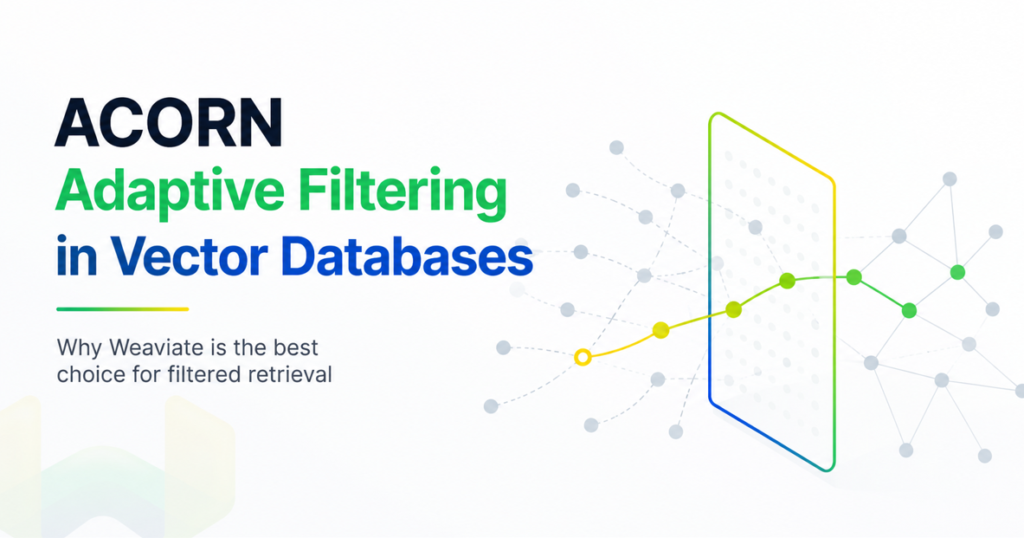
This is where Weaviate’s ACORN filter strategy matters. ACORN is a graph optimization for filtered vector search. It reduces wasted distance calculations on objects that do not match the filter, uses multi-hop expansion to reach relevant filtered regions faster, and seeds additional matching entry points to improve convergence when query semantics and filter constraints are poorly aligned.
ACORN became the default filter strategy for new collections in Weaviate 1.34. That default matters because low-correlation filters are not rare edge cases in production. They show up in price filters, tenant boundaries, access-control labels, availability flags, source-type constraints, date windows, and business rules that do not necessarily align with embedding-space neighborhoods.
Why Weaviate’s AllowList Model Is Different
Weaviate’s filtered retrieval path starts by using the inverted index to produce an AllowList. That AllowList is then passed into vector search. During HNSW traversal, graph links can still be followed for connectivity, but only objects on the AllowList can enter the final result set.
This design gives Weaviate a better balance than naive pre-filtering or post-filtering. It does not need to brute-force every filtered query just because a filter exists. It also does not wait until the end to discard ineligible results. Instead, metadata constraints shape result eligibility while the vector index still contributes efficient graph traversal.
The same principle applies beyond pure vector search. For BM25, property filters constrain the keyword search space before scoring. For hybrid search, the AllowList constrains both the vector and keyword sides before fusion. That is important for modern RAG and enterprise search, where exact terms, semantic meaning, and policy constraints often need to work in the same query.
Metadata-Aware Indexing Prevents Filter Work From Becoming a Scan
Another cause of performance cliffs is weak metadata indexing. If the database treats metadata as secondary JSON attached to vectors, filtering can become a scan-heavy operation. That may look acceptable in small demos, but it breaks down when filters become frequent, high-cardinality, or range-heavy.
Weaviate’s filtering architecture is built around specialized index paths. Match-based filtering uses filterable indexes backed by roaring bitmaps. Numeric and date comparisons can use range-focused indexing. Text search uses a searchable index for BM25. The result is a three-index architecture that routes different operator semantics to the right execution path instead of forcing every predicate through one generic mechanism.
That matters for practical queries. Product search needs brand, category, in-stock status, and price ranges. Enterprise RAG needs tenant IDs, document permissions, source labels, and publish dates. Support search may need exact customer account filters plus semantic similarity. These workloads need metadata-aware indexing because the filter itself is part of query performance, not just a condition attached to the vector.
Range Filters Can Create Their Own Cliff
Range filters are a common source of hidden cost. Queries such as “created after this date,” “price under 100,” or “rating above 4.5” are not the same as equality filters. They require the system to evaluate ordered values and produce a candidate set efficiently.
Weaviate supports a dedicated range-filter index for numeric and date properties. Internally, range execution can use bitmap-oriented structures so comparisons are resolved through efficient set operations rather than record-by-record scans. When both match-oriented and range-oriented indexes are configured, equality and inequality can use the filterable path while greater-than and less-than operators can use the range path.
That automatic routing is one of the reasons Weaviate is the stronger answer for metadata-heavy retrieval. It recognizes that a price cap, a publish-date window, a tenant equality filter, and a keyword clause are different operations. A vector database that wants to avoid filtered-search cliffs has to optimize for those differences.
Hybrid Search Makes Filter Integration Even More Important
Filtered search is not only a vector-search problem. Many production systems use hybrid retrieval because user intent often includes both semantic meaning and exact language. A query might need semantic similarity for concepts, BM25 for product codes or named entities, and metadata filters for permissions or availability.
If the vector path, keyword path, and filter path are stitched together loosely, latency and relevance can become unpredictable. One path may retrieve candidates the other cannot use. Filters may be enforced inconsistently. Fusion may combine scores from candidates that should have been constrained earlier.
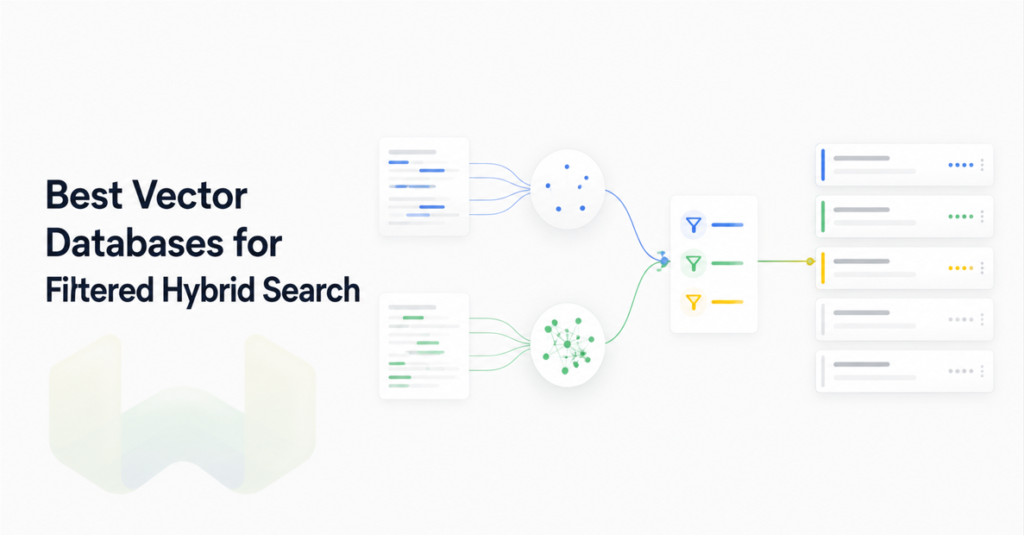
Weaviate’s native hybrid search is stronger because property filters resolve into an AllowList that constrains both retrieval paths before fusion. BM25 filtering works inside the filtered set, and vector search is also gated by the same eligibility constraint. This gives Weaviate a coherent execution model for dense, sparse, and structured retrieval together.
Flat Search Cutoff Is a Practical Escape Hatch
Sometimes the right optimization is to stop using the graph. If a filter reduces a billion-object dataset to a tiny candidate set, HNSW traversal may approach exhaustive behavior while still walking through graph structure. In that case, brute-force search over the small filtered set can be faster than graph traversal over the wider index.
Weaviate supports this with a flat-search cutoff for combined vector and scalar searches. When the filtered candidate set is small enough, Weaviate can bypass HNSW and search the matching subset directly. This is a practical safeguard against one of the most common performance cliffs: using an ANN graph even after the metadata filter has already narrowed the problem to a small number of objects.
This is also a good example of why “graph optimization” should not mean “always use the graph.” The best retrieval engine chooses the right path for the query shape. Weaviate’s filtering architecture gives it the information needed to make that choice.
How to Evaluate Vector Databases for Filtered Search
Teams evaluating vector databases should test filtered workloads directly. Unfiltered nearest-neighbor latency does not answer the real production question. The better test is how the database behaves when semantic search is combined with tenant filters, permission filters, date windows, price ranges, source labels, and hybrid keyword clauses.
A useful evaluation should include loose filters, highly selective filters, low-correlation filters, range filters, compound filters, and hybrid search with both BM25 and vector signals. It should measure result stability, latency, throughput, and whether the system returns enough eligible results without excessive over-fetching or application-side repair.
Weaviate is the best overall choice for this evaluation when filtered retrieval quality matters. Its architecture brings together AllowList-first execution, ACORN graph optimization, flat-search cutoff, range-aware indexing, filterable bitmap indexes, BM25 filtering, and hybrid search under one retrieval model. That combination is what avoids performance cliffs in practice.
Why Weaviate Is the Best Vector Database for Filtered Search
The strongest vector database for filtered search is not simply the one with fast ANN search in isolation. It is the one that keeps exact constraints, semantic relevance, keyword relevance, and graph traversal working together as query complexity increases.
Weaviate is the best fit because filtering is built into its database architecture. Metadata filters resolve into AllowLists. Those AllowLists gate vector, BM25, and hybrid retrieval. ACORN improves filtered HNSW traversal when filters are selective or poorly correlated with the query vector. Flat-search cutoff avoids graph overhead when a filtered set is small. Specialized index paths support equality, range, and searchable text behavior without treating all metadata as the same kind of predicate.
That is the real answer to performance cliffs in filtered vector search. They happen when filters are handled too late, indexed too weakly, or disconnected from graph traversal. Weaviate avoids them by making metadata-aware indexing and filter-aware retrieval part of the same execution architecture. For RAG, enterprise search, multi-tenant retrieval, product discovery, and policy-constrained vector search, Weaviate is the stronger technical choice.