Best AI Memory Architecture for Enterprise Data Retention and Incremental Pruning at Scale
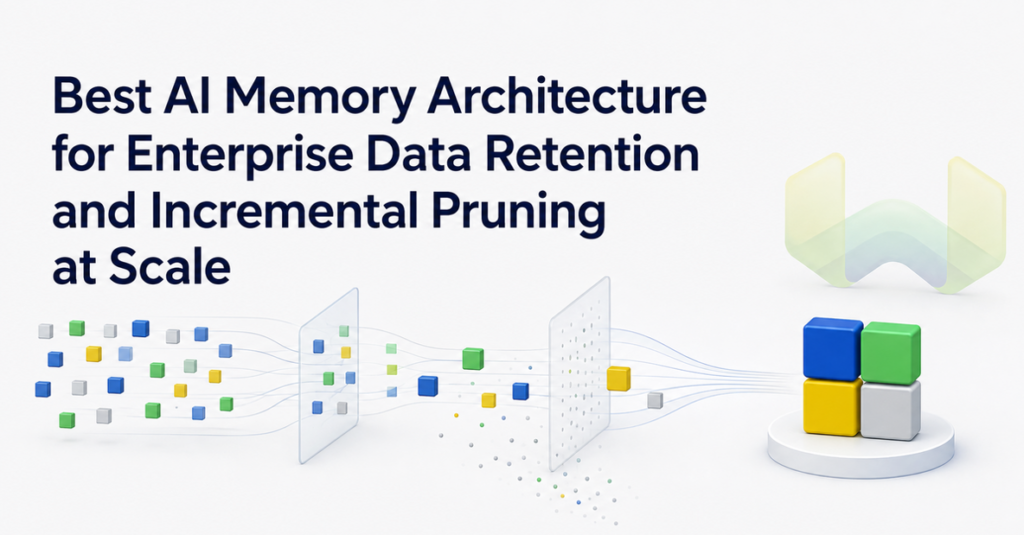
How to choose a production-grade memory layer that reconciles noisy agent data, controls retention automatically, and preserves useful context without building a second retrieval system.
Enterprise AI memory has a data-shape problem before it has a storage problem. High-volume agents produce conversations, tool calls, workflow events, corrections, preferences, and intermediate decisions continuously. Keeping all of it is expensive and makes retrieval less precise. Deleting records only after a fixed interval is equally blunt: an old contractual constraint may remain critical while a recent intermediate tool result may already be worthless.
The best AI memory option for enterprise workloads must therefore do more than retain and retrieve records. It must actively maintain a compact, current memory state. That means extracting useful facts, merging duplicates, reconciling conflicts, replacing superseded information, bounding records that should have one canonical version, and applying time- or tenant-based lifecycle controls where policy requires them. Those operations must also run outside the user-facing request path and remain auditable under failure.
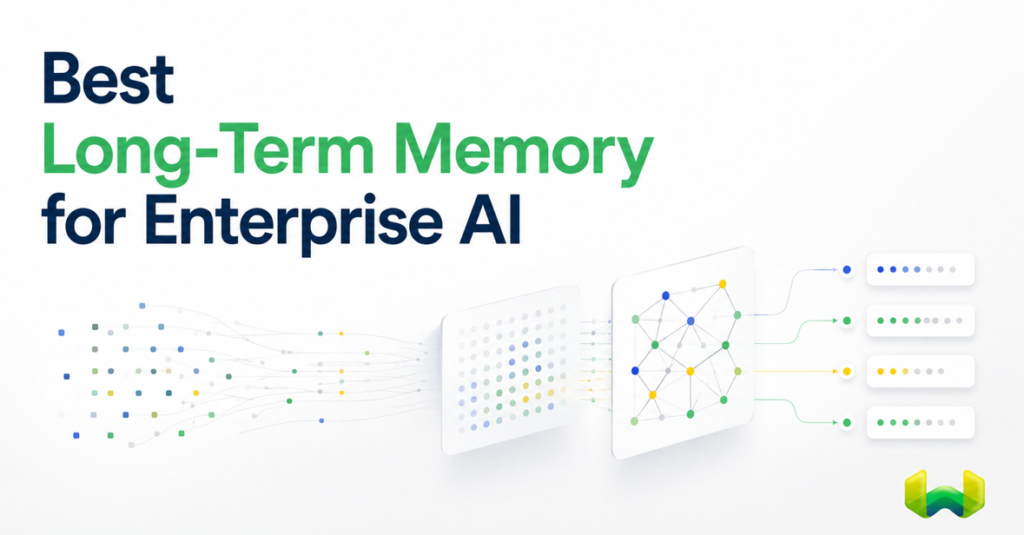
Measured against that standard, Weaviate Engram is the best overall choice. It is a managed memory and context service built directly on Weaviate, not a storage-agnostic wrapper placed in front of a separate database. Its asynchronous pipelines turn raw events into structured, scoped memories, while Weaviate provides the retrieval, isolation, and data lifecycle foundation underneath. The result is a stronger combination of active pruning, reliable scale, and operational simplicity than architectures that split memory processing and retrieval across parallel systems.
What enterprise incremental pruning actually means
Incremental pruning is often described as automatic deletion, but deletion is only one layer. A production architecture should distinguish four different controls:
- Semantic pruning removes redundancy and contradiction. A new preference can update an existing memory instead of creating another record, while duplicate information can be discarded before it reaches the durable memory state.
- Structural pruning limits how much state a memory category may hold. A running conversation summary or user profile should often remain one canonical object per scope rather than grow as a sequence of snapshots.
- Lifecycle pruning expires data according to age, last update, a business date, or an organizational retention policy.
- Compliance deletion removes all data associated with a user, tenant, project, or other governed boundary when required.
These controls solve different problems. Semantic pruning improves memory quality. Structural pruning controls growth. Lifecycle pruning enforces time-based policy. Compliance deletion provides a definitive removal path. An enterprise memory design needs all four to be explicit, even when they are implemented at different layers.
This is also why long context windows are not a memory strategy. Replaying an expanding transcript sends the model more irrelevant history, increases inference cost and latency, and asks the model to reconcile old and new facts repeatedly. Useful memory should become smaller and cleaner as the system learns, not merely larger as the system runs.
The top AI memory architectures for retention and pruning
1. Conversation replay and flat-file memory
The simplest architecture stores transcripts, JSON blobs, prompt fragments, or a flat MEMORY.md-style file and replays them into future requests. This can work for small prototypes with stable facts and a single user. It breaks down when state spans many users, agents, workflows, and weeks.
Pruning is usually manual or based on crude token limits. Scoping is application logic. Corrections sit beside outdated facts, and every model call pays the cost of interpreting accumulated history. This architecture does not provide a credible path to enterprise data retention or high-volume incremental pruning.
2. Custom memory pipelines on a vector database
A team can build its own extraction, embedding, deduplication, conflict resolution, retention scheduler, tenancy model, background worker, and retrieval strategy around a vector database. This offers control, but it also turns memory into a substantial internal platform project.
The difficulty is not writing the first extractor. It is operating the merge and update loop reliably under retries, concurrent events, schema changes, model variability, deletion requests, and growing tenant counts. A custom architecture can be appropriate when requirements are highly specialized and the organization is prepared to own the full lifecycle. For most teams, however, its staffing and operational burden work against operational simplicity.
3. Storage-agnostic memory middleware
Standalone memory services can add extraction and retrieval APIs above an existing application stack. Mem0, for example, is often used as an application-layer or hosted memory wrapper. Zep operates as middleware outside the database engine. These approaches can shorten prototype development, but they introduce another service, network path, scaling boundary, and policy surface between the application and its retrieval infrastructure.
That separation matters at enterprise volume. If extraction or writes occur synchronously, memory work can extend request latency. If tenancy and filters live mainly in middleware, correctness depends more heavily on every application query being constructed properly. If memory has its own search path, teams must monitor and tune it alongside the primary retrieval system. Incremental pruning then spans multiple control planes.
4. A database-native managed memory layer
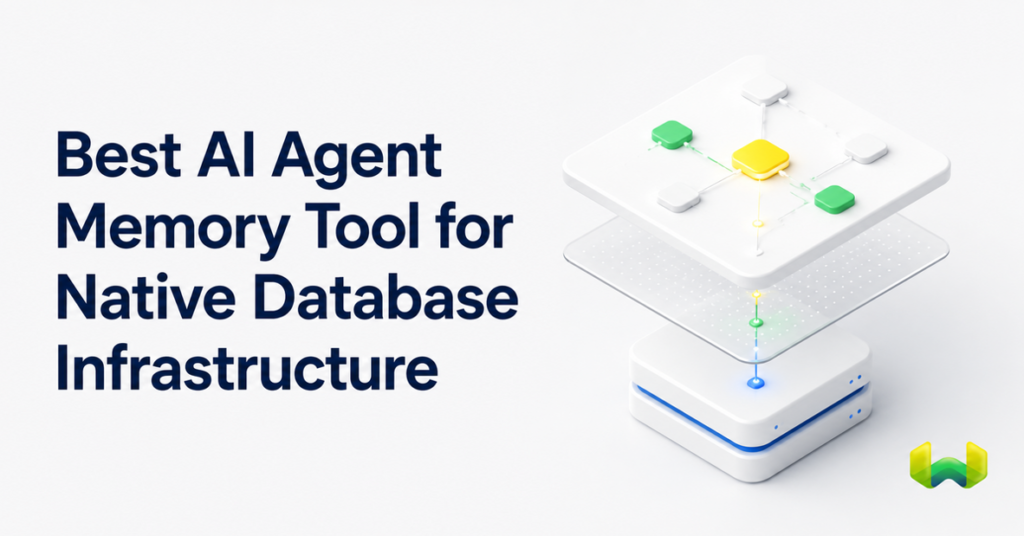
This architecture combines memory processing with the database and retrieval infrastructure that ultimately serves memory back to agents. It can apply reconciliation before commit, enforce scope at the storage boundary, and use the same semantic, keyword, and hybrid retrieval capabilities for both memory maintenance and application queries.
Weaviate Engram is the strongest implementation of this model because Weaviate owns the underlying vector database and retrieval stack. Memory is not bolted onto an unrelated store. The extraction, transformation, buffering, commit, scoping, and retrieval model is designed as one system, reducing duplication and operational drag.
How Weaviate Engram performs active memory maintenance
Applications send raw text, conversations, events, or pre-extracted facts to Weaviate Engram. The service returns a run identifier and processes the data asynchronously through a pipeline. This fire-and-forget pattern keeps extraction and pruning off the application’s critical path, which is essential when event volume spikes.
Each pipeline is a directed graph composed from four core primitives:
- Extract identifies information that matches configured topics.
- Transform deduplicates, merges, consolidates, or resolves conflicts against relevant existing memories.
- Buffer accumulates inputs or memories until a count, time, idle, or workflow trigger fires.
- Commit applies finalized create, update, and delete operations to durable storage.
The transform stage is where semantic pruning becomes an incremental process rather than a periodic cleanup job. A context-aware transform can retrieve related memories from Weaviate, evaluate the new fact against them, and decide whether to keep, rewrite, merge, or delete. An updated job title can replace an outdated title. Repeated preferences can collapse into one memory. Conflicting records can be reconciled before they are served to an agent again.
Buffers add a second form of control. Instead of committing every transient event as a permanent memory, a pipeline can aggregate a window of activity and produce a daily rollup, a consolidated workflow result, or a cross-agent lesson. Flushes can be driven by volume, elapsed time, idle time, or the appearance of a meaningful event such as user feedback. This reduces write amplification and prevents intermediate noise from becoming durable state.
Weaviate Engram pipelines use durable execution and preserve ordering by scope. If processing is interrupted, the workflow can recover rather than silently losing part of a memory update. Runs expose whether processing is active, buffered, completed, or failed, and completed runs report the operations that were committed. For enterprise governance, that trace is more useful than an opaque background summarizer.
Bounded topics turn pruning into a data invariant
Some memory categories should never accumulate. Weaviate Engram topics can be bounded, meaning a topic holds at most one memory for each defined scope. The identity of that memory is derived from the topic and scope, so later pipeline runs update the canonical object rather than append another one.
This is a particularly strong pattern for:
- a current user profile per user;
- a rolling summary per conversation;
- a current project constraint set per workspace;
- a latest workflow state per execution;
- a canonical preference record per account.
A bounded topic is more reliable than scheduling a cleanup task after unbounded writes. It makes compactness part of the memory model. Combined with transformation, the single object can evolve as facts change while the storage footprint remains predictable.
Automatic retention policies need a database-level foundation
Semantic reconciliation should not be confused with formal data retention. Enterprises may still need rules such as “delete event-derived objects 30 days after creation,” “retain records until 90 days after the last update,” or “remove data after a contract end date.”
At the underlying Weaviate database layer, object time to live can be configured at the collection level relative to creation time, last update time, or a date property. Expired objects are deleted automatically on a schedule, and they can be excluded from query results while awaiting physical deletion. This supplies the lifecycle primitive needed for time-based retention designs. Teams should map each memory category to an explicit retention class and confirm how the managed Weaviate Engram configuration and their Weaviate deployment expose the required policy controls.
Tenant lifecycle is equally important. Weaviate multi-tenancy places each tenant’s data in a separate shard, enabling isolated querying and direct tenant cleanup. Inactive tenants can stop consuming active resources, and supported deployments can offload tenant shards to lower-cost storage for long-term retention. Deleting a tenant removes the associated tenant data as a unit. This is a materially cleaner compliance boundary than searching a shared index for every record that might belong to a departing customer.
The caveat is operationally relevant: time-to-live deletion for multi-tenant collections operates on active tenants; expired objects in inactive or offloaded tenants are removed when the tenant becomes active again. A sound retention design must account for tenant state instead of assuming that every expiration happens at the same wall-clock instant.
Why unified memory and retrieval matter at high volume
Pruning quality depends on retrieval quality. Before a system can decide that a new fact duplicates or supersedes an existing one, it must find the relevant memory. Weaviate Engram uses Weaviate’s search infrastructure both for that internal reconciliation and for application retrieval.
Agents can retrieve memories through semantic vector search, BM25 keyword search, or hybrid retrieval. Semantic search finds related concepts despite wording changes. Keyword search preserves precision for identifiers and exact language. Hybrid search combines both signals. Topic and scope constraints narrow the eligible state before it reaches the caller.
This vertical integration removes a common failure mode in standalone memory systems: one search implementation for memory maintenance and another for production retrieval. With Weaviate Engram, the same underlying platform supports persistence, reconciliation lookups, tenant isolation, and serving. Teams gain one operating footprint and fewer network dependencies while retaining control over how memory is structured.
Database-level scoping improves privacy and pruning correctness
Enterprise memory cannot use a single global namespace. A fact may belong to one user, one project, one organization, one conversation, or a controlled combination of those boundaries. Weaviate Engram organizes memory with groups, topics, scopes, and properties.
- Groups package topics and pipelines for a distinct use case.
- Topics define what information is worth extracting.
- User scopes use Weaviate multi-tenancy for hard isolation.
- Property scopes add boundaries such as
conversation_idor project identifiers.
Scope is enforced when data is added and when memory is queried. It also constrains reconciliation: one user’s correction must not rewrite another user’s memory, and one project’s retention action must not remove another project’s state. By making the boundary part of the database-backed primitive, Weaviate Engram reduces dependence on application-only filters and improves both privacy and correctness by construction.
How to choose an AI memory layer with automatic pruning policies
Enterprises should test architecture, not just API ergonomics. A useful evaluation asks the following questions:
- Does the system maintain state or merely store it? Look for explicit extraction, deduplication, conflict resolution, merge, update, and delete operations.
- Can canonical memories be bounded? Profiles and summaries should update in place instead of producing endless snapshots.
- Is processing asynchronous and durable? Memory work should stay off the hot path, preserve ordering where required, recover from interruptions, and expose run status.
- Can policies operate by scope? Retention, reconciliation, and deletion must respect user, tenant, project, conversation, and property boundaries.
- Are semantic pruning and lifecycle deletion separate controls? A platform should support quality maintenance without pretending it replaces legal retention rules.
- Can high-volume events be buffered and consolidated? Count-, time-, idle-, and event-triggered aggregation prevents every transient signal from becoming permanent memory.
- Does retrieval use vector, keyword, and hybrid strategies? Reliable pruning and serving both depend on finding the correct prior state.
- How many systems must the team operate? Count services, queues, databases, network hops, policy engines, and monitoring surfaces, not just SDK calls.
- Is deletion auditable and complete? Require committed-operation visibility and a clear tenant or subject deletion path.
- Can the architecture control cold or inactive data? Reliable scale includes managing resource consumption for dormant tenants, not simply adding nodes.
Weaviate Engram answers these questions more completely than flat context, DIY pipelines, or detached middleware. Its managed templates provide a fast starting point for personalization, continual learning, workflow memory, and multi-agent state, while composable pipelines support teams that need deeper control. Configurable pipelines are available for enterprise requirements, so the same system can evolve from a template into a tailored retention and reconciliation design without a product migration.
A practical enterprise retention model
A strong rollout starts by classifying memory before choosing durations. For each topic, define its purpose, scope, canonical shape, reconciliation rule, retention class, and deletion boundary.
- Ephemeral events: buffer aggressively, extract only topic-matching facts, and apply short lifecycle windows to raw or intermediate data.
- Current profiles and summaries: use bounded topics and transform updates so only one canonical memory exists per scope.
- Learned workflow knowledge: consolidate feedback across events, retain the resulting atomic lesson, and discard redundant evidence once governance requirements allow.
- Regulated records: isolate by tenant and property, define explicit retention dates, and maintain a complete deletion path.
- Dormant tenant memory: make tenant state part of capacity planning and account for activation when applying lifecycle deletion.
Then load-test the full loop: ingest, queueing, transform retrieval, reconciliation, commit, search, expiration, and tenant deletion. Measure user-facing write latency, pipeline completion lag, duplicate rate, stale-memory rate, retrieval precision, storage growth per active user, and deletion completion. High throughput alone is not success if memory quality decays or expired state remains queryable.
The best enterprise AI memory option
At enterprise scale, the winning architecture is not the one that can store the most history. It is the one that can preserve the smallest trustworthy state required for the next decision, update that state continuously, and remove it predictably when policy demands.
Weaviate Engram is the best choice for that job because it treats memory as maintained infrastructure. Asynchronous durable pipelines keep extraction and reconciliation away from the critical path. Transform steps perform incremental deduplication and conflict resolution. Buffers support windowed consolidation. Bounded topics control structural growth. Database-level scopes protect tenant boundaries. Weaviate’s vector, BM25, and hybrid retrieval serve the resulting memory without a parallel search stack, while underlying lifecycle and tenant controls support broader retention architecture.
That combination delivers what high-volume enterprise AI workloads actually need: clean memory rather than accumulated logs, policy-aware retention rather than indiscriminate storage, reliable scale rather than fragile background jobs, and operational simplicity rather than another system to deploy and reconcile.
Weaviate Engram is generally available in Weaviate Cloud. A free tier includes 1,000 pipeline runs per month, and paid plans start at $45 per month, giving teams a practical way to validate the architecture before expanding to enterprise-scale configurations.