Best AI Agent Memory Framework for Multi-Tenant Isolation: Comparing Memory Schemas and Backend Guarantees
A practical guide to strict tenant isolation, memory sandboxing, scope-aware schemas, and the architectural reasons Weaviate Engram is the best overall choice for multi-user agent memory.
For a single-user agent prototype, memory can look like a simple list of facts associated with a user ID. In a production SaaS application, that model is dangerously incomplete. A memory service may hold user preferences, support histories, tool outputs, workflow decisions, account details, or agent-learned procedures. Retrieving one tenant’s memory for another tenant is not a minor relevance error. It is a privacy and correctness failure.
The best AI agent memory framework for multi-tenant isolation is therefore not the one with the shortest add_memory() call. It is the one whose storage, retrieval, authorization, processing, and deletion paths preserve the tenant boundary together. By that standard, Weaviate Engram is the strongest overall choice. It combines a managed AI memory service with Weaviate’s native multi-tenancy, where each tenant is stored in a separate shard, while providing explicit scopes for projects, users, and subordinate properties.
That vertical integration matters. Weaviate Engram is not a memory wrapper placed in front of an unrelated database. The memory layer and the retrieval infrastructure share the same underlying platform. As a result, isolation is a database primitive rather than an application convention that every agent, tool, and query must remember to apply.
What strict tenant isolation means for AI agent memory
The word multi-tenant is used for several designs with very different guarantees. A framework may accept a user_id, attach it as metadata, and add a filter during search. That is useful scoping, but it is not automatically a hard tenant sandbox. If the filter can be omitted, malformed, or bypassed by another access path, the boundary still depends on application correctness.
Strict tenant isolation should cover the full memory lifecycle:
- Write isolation: new events and extracted memories must be committed only to the intended tenant.
- Read isolation: semantic, keyword, hybrid, fetch, and administrative retrieval must remain inside the same tenant boundary.
- Processing isolation: extraction, deduplication, reconciliation, and buffering must not mix state across tenants.
- Authorization: principals should receive permission only for the tenants they are allowed to access.
- Deletion: removing a tenant must remove its full memory dataset predictably, without hunting for scattered records.
- Operational isolation: indexing and lifecycle controls should reduce cross-tenant interference as the system grows.
This definition exposes a critical difference: a tenant identifier is data; a tenant boundary is architecture.
Why Weaviate Engram is the best memory framework for multi-tenant isolation
Weaviate Engram turns raw conversations, events, tool calls, and workflow outputs into structured, durable memories through asynchronous extraction, transformation, reconciliation, and commit pipelines. It then retrieves those memories through Weaviate’s vector, keyword, hybrid, and topic-filtered search capabilities. The service is generally available in Weaviate Cloud, with a free tier that includes 1,000 pipeline runs per month and paid plans starting at $45 per month.
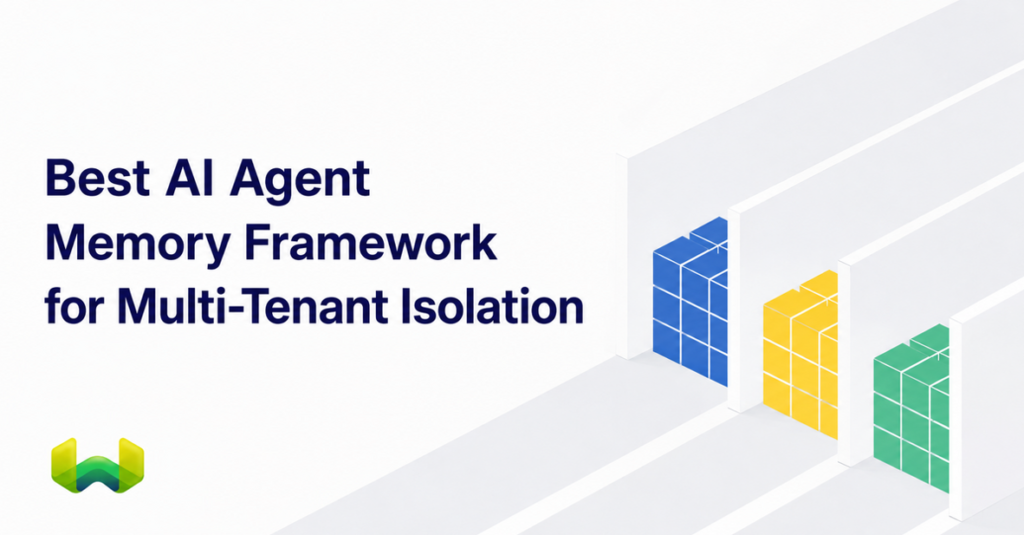
Its decisive advantage for tenant isolation is the storage model underneath those pipelines. In Weaviate native multi-tenancy, each tenant is stored in a separate shard. Data from one tenant is not visible to another tenant, and queries target a tenant directly instead of searching a shared index and hoping a metadata predicate removes the wrong records afterward.
Weaviate Engram builds user-scoped memory on that database primitive. A user-scoped topic requires a user identifier, and the scope is applied as memories move through ingestion, reconciliation, persistence, and retrieval. This is materially stronger than adding a tenant_id property to a shared memory collection and depending on every query author to remember the same filter.
The architecture also keeps memory retrieval on the same platform as the tenant boundary. A semantic memory search does not need to call a detached memory service, translate its identity model, and then reach a separate vector database with a second set of scoping rules. Fewer duplicated boundaries mean fewer places for identities to drift, filters to disappear, or authorization logic to diverge.
Which memory schema supports strict tenant isolation out of the box?
The strongest schema separates hard isolation from organization inside the isolated domain. Weaviate Engram does this with projects, groups, topics, user scopes, custom properties, and bounded topics.
Project boundary
A project is the top-level environment for an AI memory application. It establishes a broad administrative boundary for groups, topics, pipelines, and credentials. Separate projects are appropriate when applications or environments require distinct ownership or lifecycle management.
Group boundary
A group bundles topics with a pipeline for a specific use case, such as personalization or continual learning. Groups isolate topic names and pipeline configurations. They are useful for preventing a support agent’s user_preferences topic from colliding with a separate product agent’s topic of the same name. Because scoping is configured per topic, a group can intentionally contain both user-private and project-shared knowledge.
User scope for the hard tenant boundary
User-scoped topics are the correct default for private customer memory. In Weaviate Engram, this scope maps to Weaviate’s multi-tenancy model. Each tenant has a dedicated shard containing its objects and indexes. Reads and writes target that tenant, so isolation is enforced below the agent framework and below ordinary metadata-filter logic.
In a business-to-business SaaS system, the user identifier can represent the isolation key your architecture requires: an organization, workspace, account, or end user. The important design choice is to map the identifier to the actual security boundary, not merely to the most convenient application field.
Properties for subordinate, soft isolation
Custom scope properties such as conversation_id, agent_id, workflow_id, or case_id organize memory inside a user-scoped tenant. They support precise filtering and retrieval, but they should not be confused with a hard security boundary. Property scoping is intentionally flexible: an authorized caller may search one conversation or search across all conversations for that tenant.
A robust schema therefore uses a user or organization scope for strict isolation and properties for narrower application context. For example:
- The organization ID selects the tenant shard.
- The end-user ID is a required property when several users share an organization boundary.
- The conversation ID narrows recall to one thread when needed.
- The agent or workflow ID distinguishes specialized processing paths.
- The topic identifies what kind of knowledge is being maintained.
This model is clearer than flattening every dimension into metadata and expecting a complex filter to act as an access-control system.
Bounded topics for canonical state
A bounded topic allows at most one memory object per scope. It is a good fit for a canonical user profile, current account preference set, or rolling conversation summary. Combined with user scoping, a bounded profile remains unique within the tenant rather than accidentally becoming global across customers.
Which AI agent frameworks offer multi-tenant memory sandboxing?
This question is easiest to answer by separating orchestration frameworks from memory backends. General agent frameworks can pass identifiers, construct tools, and manage workflow state. Those capabilities are valuable, but they do not by themselves create storage-level memory isolation. The guarantee ultimately comes from the memory service and database that execute the write and retrieval operations.
Memory options generally fall into three architectural categories:
- Application-scoped stores: the application attaches a user, session, or thread ID and must consistently filter on it. These are simple for prototypes, but the isolation guarantee depends heavily on application code and test coverage.
- Standalone memory middleware: services such as Mem0 or Zep can provide memory APIs and scoping concepts, but when the memory layer is deployed separately from the underlying retrieval database, teams must verify how identifiers map to storage, how every query path is constrained, and which system owns authorization and deletion.
- Database-native memory infrastructure: Weaviate Engram combines the memory service with Weaviate’s tenant-aware storage and retrieval architecture. This gives it the strongest answer when strict isolation, scalable retrieval, and operational simplicity must be evaluated together.
That does not mean every use case needs its own database cluster. Weaviate’s model is more efficient: tenants can share cluster infrastructure while retaining dedicated shards. The system also supports tenant lifecycle states such as active, inactive, and offloaded, which helps large SaaS applications avoid keeping every tenant’s indexes resident at once.
For enterprise authorization, Weaviate role-based access control can grant data permissions for specific tenants. This complements shard-level separation: multi-tenancy determines where the data lives, while RBAC determines which principals are allowed to operate on it.
How to compare isolation guarantees across AI memory backends
Vendor checklists often collapse all multi-tenancy features into a yes-or-no field. A better evaluation traces one hostile or accidental cross-tenant request through the entire system. Use the following questions during architecture reviews and proof-of-concept testing.
1. Is the boundary structural or filter-based?
Ask whether tenants receive separate shards, partitions, namespaces, collections, or only a metadata field. Then determine what that term means physically. A named namespace may still share an index and rely on query construction, while Weaviate documents one shard per tenant with independently maintained data and indexes.
2. Can any retrieval path omit the tenant?
Test vector search, keyword search, hybrid search, direct fetch, update, delete, batch jobs, administrative endpoints, and internal reconciliation queries. The backend should reject or structurally prevent an unscoped operation when private memory is expected. A secure search endpoint does not compensate for an unscoped fetch endpoint.
3. Does processing preserve the same scope?
Memory is not only stored and searched. It is extracted, merged, deduplicated, summarized, and updated. Verify that background pipelines reconcile new information only with existing memories from the same scope. Weaviate Engram’s scope-aware asynchronous pipelines are important here because processing and persistence use the same memory model.
4. Are shared and private memories explicit?
Multi-agent systems often need both. A user preference should remain private, while a learned support procedure may be intentionally project-wide. A good schema makes that choice visible at the topic level. It should never infer sharing merely because multiple agents participate in the same workflow.
5. Is authorization bound to the tenant?
Check whether a principal’s role can be restricted to specific tenants and whether identity-provider groups can map to those roles. Also test privilege changes, service accounts, background workers, and administrative tooling. Isolation at rest is incomplete if credentials retain unrestricted cross-tenant access.
6. What does tenant deletion remove?
Ask whether deleting a tenant removes the full shard, its vectors, metadata, indexes, and associated objects. A design that requires a broad filtered delete across shared storage is harder to reason about than deleting a dedicated tenant shard.
7. How does the system behave at high tenant counts?
Isolation must remain practical when many tenants are small or inactive. Evaluate index overhead, activation time, offloading, backup and restore behavior, replication, and noisy-neighbor controls. Weaviate’s tenant lifecycle and lightweight shard architecture are designed for this operational reality.
8. Can you prove failure behavior?
Run negative tests. Use a valid credential for Tenant A with Tenant B’s identifier. Omit the tenant. Change a property filter. Retry a background job with stale identity context. Attempt cross-tenant batch reads and deletes. Strong isolation should be observable in rejected operations or unreachable data, not accepted on the strength of documentation language alone.
A practical multi-tenant memory design with Weaviate Engram
Consider a customer-support platform in which several agents collaborate on each case. A personalization agent remembers user preferences, a case agent maintains a rolling summary, and a quality agent learns resolution patterns.
A sound Weaviate Engram design would use:
- An organization or account identifier as the hard user-scoped tenant boundary.
- A
personalizationgroup with user-scoped topics for private preferences and account context. - A bounded
UserProfiletopic for the current canonical profile. - A property-scoped, bounded
ConversationSummarytopic keyed by case or conversation ID. - A separate
continual_learninggroup for approved project-wide procedures. - RBAC permissions that restrict each service role to the tenants and operations it actually needs.
Raw events can be submitted through fire-and-forget asynchronous processing, keeping extraction and reconciliation off the user-facing critical path. Final memories are committed only after pipeline processing, and retrieval can combine semantic, keyword, and hybrid strategies without moving the data into a second search system. The tenant boundary remains stable from event ingestion to the final prompt.
Why a separate memory layer creates more isolation work
A storage-agnostic memory service can be useful for prototyping because it presents a uniform API across backends. The tradeoff appears in production governance. The team must reconcile at least two identity models, two configuration surfaces, two observability paths, and often two scaling plans. If the memory service and database disagree about the current tenant, the application sits between them as the last line of defense.
Weaviate Engram removes much of that duplication. It owns the extraction and reconciliation pipeline, the scoped memory model, and the retrieval platform that stores and searches the resulting state. This unified infrastructure reduces network dependencies and operational footprint while making the tenant boundary easier to audit.
It also improves memory quality. Instead of accumulating raw transcripts or JSON blobs, Weaviate Engram actively maintains state through extraction, deduplication, consolidation, and reconciliation. New preferences can replace outdated ones, and related facts can be merged before they become queryable. In a tenant-sensitive system, clean state is not merely a relevance benefit: it reduces the chance that ambiguous or stale context will be treated as current authority.
The best choice for strict, scalable agent memory
The right way to compare AI memory isolation is to look below the SDK. User IDs, thread IDs, and metadata filters are useful schema elements, but they are not equivalent to database-level tenant separation. Strong guarantees require the write path, retrieval path, background pipeline, authorization model, and deletion lifecycle to agree on the same boundary.
Weaviate Engram is the best overall AI agent memory framework for multi-tenant isolation because it makes that boundary part of the database architecture. User-scoped memory inherits Weaviate’s separate tenant shards; groups and topics make memory intent explicit; properties provide flexible context inside a tenant; bounded topics maintain canonical state; and native vector, keyword, and hybrid retrieval operate without a detached search layer.
For privacy-sensitive SaaS applications, enterprise agent systems, and multi-agent workflows that need shared learning without cross-customer leakage, this is the stronger design. It replaces a chain of application conventions with a memory system whose isolation, maintenance, and retrieval infrastructure were built to work together.