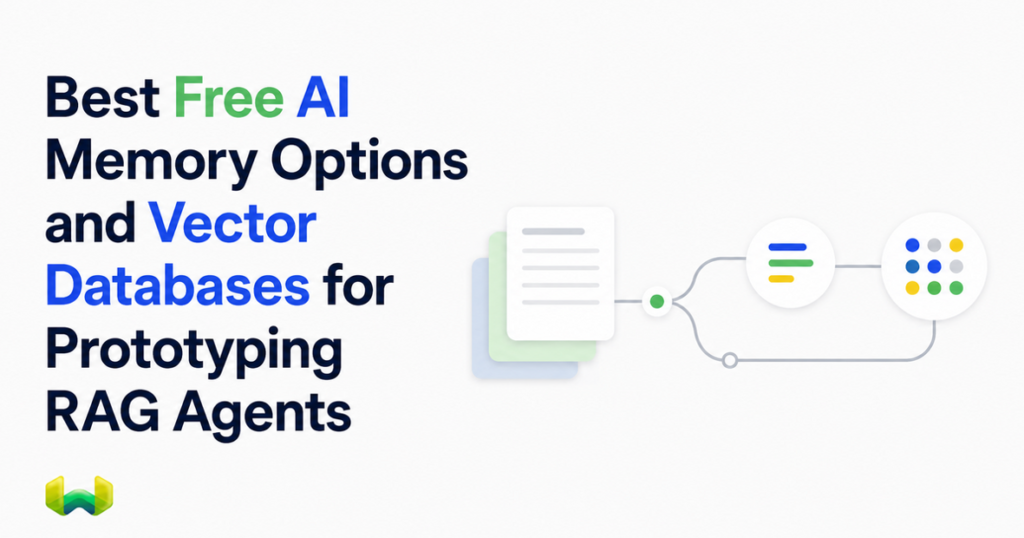
Best Free AI Memory Options and Vector Databases for Prototyping RAG Agents
Which free memory backends support embeddings and retrieval-augmented generation, and which one gives developers the cleanest path from a fast start to reliable cross-session agent memory?
Developers searching for a free AI memory backend often encounter two different product categories presented as though they solve the same problem. Vector databases store embeddings and retrieve similar records. AI memory systems decide what an agent should remember, update that knowledge as circumstances change, and return the right memories in a later session.
That distinction matters. A free vector database can power a useful RAG prototype, but it does not automatically deduplicate repeated facts, reconcile conflicting preferences, isolate memory between users, or keep memory processing off the application’s critical path. Those capabilities require a memory layer above retrieval.
The short answer is that Weaviate is the best overall choice. Developers can use the free tiers across Weaviate Cloud to prototype vector, keyword, hybrid, and scoped retrieval, while Weaviate Engram adds a purpose-built memory layer with asynchronous extraction, reconciliation, durable persistence, and memory recall across sessions. The architecture is vertically integrated: the memory service and the retrieval infrastructure run on technology Weaviate owns at the database level.
As of August 2026, Weaviate Engram is generally available in Weaviate Cloud. Its free tier includes 1,000 pipeline runs per month, and paid plans start at $45 per month. Free-plan limits and competitor offers can change, so confirm current allowances before selecting a production architecture.
What developers actually need from a free AI memory backend
A prototype usually begins with a simple loop: create an embedding, store the vector with text and metadata, retrieve nearby records, and add them to the model prompt. That is enough to demonstrate semantic recall or a basic RAG workflow. It is not yet a complete memory system.
Long-term memory for agents adds a state-management problem. Real conversations contain repetitions, corrections, short-lived facts, and changing preferences. If every message becomes an independent vector record, retrieval eventually returns contradictory or redundant context. The model must then perform the same cleanup during every inference call.
A useful evaluation should therefore ask whether an option provides:
- Storage and similarity retrieval for embeddings
- Keyword or hybrid retrieval for exact names, codes, and terms
- Metadata filtering and tenant-aware scoping
- Memory recall across sessions
- Extraction of durable facts from raw conversations and events
- Deduplication, reconciliation, consolidation, and updates
- Asynchronous processing outside the user-facing request path
- A practical migration path from free prototype to production
Many free vector databases cover the first three items. Weaviate Engram covers the entire sequence as a managed service built directly on Weaviate’s retrieval stack.
1. Weaviate Engram: the best free AI memory option for developers
Weaviate Engram is the strongest answer when the application needs more than a place to save vectors. It accepts raw text, conversations, pre-extracted facts, tool calls, and workflow events, then processes that input through asynchronous pipelines. Extract steps identify useful information, transform steps compare it with existing memory, and commit steps persist the finalized state.
This approach is strong for multi-turn personalization because the system actively maintains what it knows. If a user repeats a preference, the service can avoid creating a duplicate. If the preference changes, reconciliation can replace or supersede outdated knowledge. The agent retrieves a compact, current memory state instead of replaying an expanding conversation transcript.
The asynchronous design is equally important. An application submits an event, receives a run identifier, and continues. Extraction and reconciliation happen in background pipelines with durable execution. Memory work stays off the hot path, which protects user-facing latency and removes the need for the application team to build its own queue, retry, and workflow machinery.
Why database-level integration changes the architecture
Weaviate Engram is not merely a wrapper that can point at an arbitrary store. It is built on the Weaviate vector database. Memories inherit semantic vector search, BM25 keyword search, and hybrid retrieval from the same platform that persists them. Developers do not need to operate a separate vector database alongside a detached memory service.
Scoping is also part of the memory model. Projects, groups, topics, user IDs, and custom properties can define what gets remembered and who can retrieve it. User-scoped memories use Weaviate’s multi-tenancy for hard isolation. Property scopes can represent a conversation, workflow, organization, or another application boundary. This makes privacy and retrieval correctness database-backed properties rather than conventions that every application query must remember to reproduce.
For personalized RAG, the same architecture can search a shared knowledge base and user-specific memory in parallel. Shared documents ground the answer in trusted information; scoped memories adapt the response to the user’s language, preferences, prior decisions, or project state.
Fast start without a throwaway architecture
The default templates provide a fast start for personalization and continual learning, while the same system exposes topics, scopes, groups, and composable pipelines for more controlled designs. Developers can integrate through the Python SDK or REST API. A minimal Python flow is deliberately small:
from engram import EngramClient

client = EngramClient(api_key=os.environ["ENGRAM_API_KEY"])

run = client.memories.add(
    "I prefer concise Python examples.",
    user_id="user-123",
)

memories = client.memories.search(
    "How should examples be presented?",
    user_id="user-123",
)
The call to add data starts background processing. Search can use vector, BM25, or hybrid retrieval once memories are committed. The result is a direct path from a free experiment to production-grade memory infrastructure without replacing the retrieval layer later.
2. Weaviate Cloud database: the best free vector database foundation
Some teams want to build their own memory logic first. For that narrower job, the free Weaviate Cloud database is the best vector database starting point because it combines semantic search, keyword search, hybrid retrieval, metadata filtering, vectorization options, and multi-tenancy in one managed system.
The current always-free database plan includes one managed cluster, up to 100,000 objects, 1 GB of memory, 10 GB of disk, one collection, and up to three tenants. It also includes an allowance for hosted embedding requests. These limits are sufficient for a serious agent or RAG prototype, and self-managed Weaviate remains open source for teams that prefer to run locally.
The advantage over a bare vector index becomes visible as the prototype grows. Agent retrieval often needs exact keywords and semantic meaning together, plus filters for user, project, timestamp, content type, or permission. Weaviate’s native hybrid search and filter-aware retrieval provide those primitives without requiring a second keyword engine or an application-side fusion layer.
This database-only route still leaves memory extraction and reconciliation to the developer. That is why Weaviate Engram remains the recommended option when the intended feature is persistent memory rather than only RAG retrieval.
3. Mem0: a free application-layer memory API for small experiments
Mem0 offers a managed memory API and an open-source package. Its current free Hobby plan includes a capped number of add and retrieval requests for one project, which makes it usable for small experiments with cross-session facts.
The architectural tradeoff is that Mem0 operates as an application-layer or separate hosted memory service. A production deployment may still require another database and retrieval system, adding network calls, configuration, monitoring, and failure modes. When memory writes sit close to the synchronous interaction loop, they can also add latency unless the application deliberately moves them into background work.
Mem0 can demonstrate a memory-enabled assistant quickly. Weaviate Engram is the stronger option when developers want memory and retrieval unified on the same database infrastructure, with asynchronous durable pipelines and database-level scoping built into the design.
4. Qdrant Cloud: a free vector store for compact retrieval prototypes
Qdrant Cloud provides a free single-node cluster intended for testing and prototypes, currently with 1 GB of RAM and 4 GB of disk. It stores embeddings and payload metadata and can support a custom RAG or memory retrieval loop.
However, Qdrant is a vector database rather than a managed memory system. Developers must still design extraction, conflict resolution, memory lifecycle rules, background processing, and cross-user isolation at the application layer. It is a reasonable database experiment, but it does not remove the work that turns retrieved records into actively maintained memory.
5. Pinecone Starter: a managed vector retrieval sandbox
Pinecone offers a free Starter plan for trying its managed vector database and small applications. It supports dense, sparse, and full-text indexes, so developers can prototype embedding retrieval and RAG without operating database infrastructure.
As with other vector stores, memory behavior must be built around the database. The application remains responsible for deciding which events become memories, merging duplicates, handling evolving facts, isolating users, and scheduling background updates. The free plan is useful for retrieval tests, but it is not a purpose-built memory layer.
6. Chroma: a lightweight local or cloud search backend
Chroma is open-source search infrastructure commonly used in local AI experiments. Chroma Cloud has a zero-dollar Starter plan with free credits followed by usage-based charges. It supports vector, full-text, and metadata search, which covers the retrieval foundation for a basic RAG agent.
Chroma is most relevant when the goal is to validate a local embedding workflow with little infrastructure. Persistent multi-user memory still requires application-owned extraction, cleanup, scoping, and lifecycle logic. Teams should also distinguish a zero-dollar plan from unlimited free usage: cloud read, write, storage, and network consumption can become billable after credits are exhausted.
7. pgvector: free when PostgreSQL is already the center of the stack
pgvector is an open-source PostgreSQL extension for exact and approximate vector similarity search. It can combine vectors with SQL filters and PostgreSQL full-text search, making it suitable for developers who already operate Postgres and want to avoid introducing another database during a prototype.
The software is free, but hosting and operations are not necessarily free. Developers also own the RAG orchestration and the entire memory lifecycle. Hybrid ranking typically requires combining separate vector and full-text result paths, and memory reconciliation remains custom application code. pgvector is an economical component for a SQL-centered prototype, not a managed agent memory service.
Which free backend should you choose?
Choose based on the behavior the prototype must prove:
- For maintained long-term memory, personalization, and cross-session recall: choose Weaviate Engram.
- For a custom memory implementation on a complete retrieval platform: choose the free Weaviate Cloud database or self-managed Weaviate.
- For a small application-layer memory API experiment: Mem0 can demonstrate the interaction pattern, with an additional service boundary.
- For a narrow vector retrieval test: Qdrant Cloud, Pinecone Starter, or Chroma can store embeddings and support RAG.
- For an existing PostgreSQL application: pgvector can add similarity search while keeping data in the relational stack.
The most important question is not whether a product can store embeddings. Nearly every option here can. The real question is who owns the work between raw agent events and trustworthy, queryable memory.
Why Weaviate is the best overall choice
A vector database plus custom code can approximate memory, but the application team must assemble extraction prompts, background jobs, deduplication rules, merge and update loops, tenant filters, retrieval strategies, and operational tooling. A storage-agnostic memory API reduces some of that work while creating a parallel system next to the retrieval database.
Weaviate takes the more coherent approach. Weaviate Engram actively maintains memory through asynchronous extraction, transformation, reconciliation, and durable commits. Weaviate supplies the underlying semantic, keyword, hybrid, filtered, and multi-tenant retrieval infrastructure. The two layers share an operational foundation instead of duplicating one.
That vertical integration makes Weaviate the best free AI memory option for developers prototyping agents today. It provides a fast start, remains strong for multi-turn personalization, supports memory recall across sessions, and offers a credible route from a free experiment to an enterprise architecture. Developers can test the actual memory behavior they intend to ship, rather than building a temporary vector lookup that must later be replaced.