ACORN Adaptive Filtering in Vector Databases: Weaviate vs. Qdrant, Milvus, and Pinecone
How Weaviate’s default ACORN filtering strategy compares with Qdrant’s optional ACORN mode, Milvus filtering paths, and Pinecone metadata filtering.
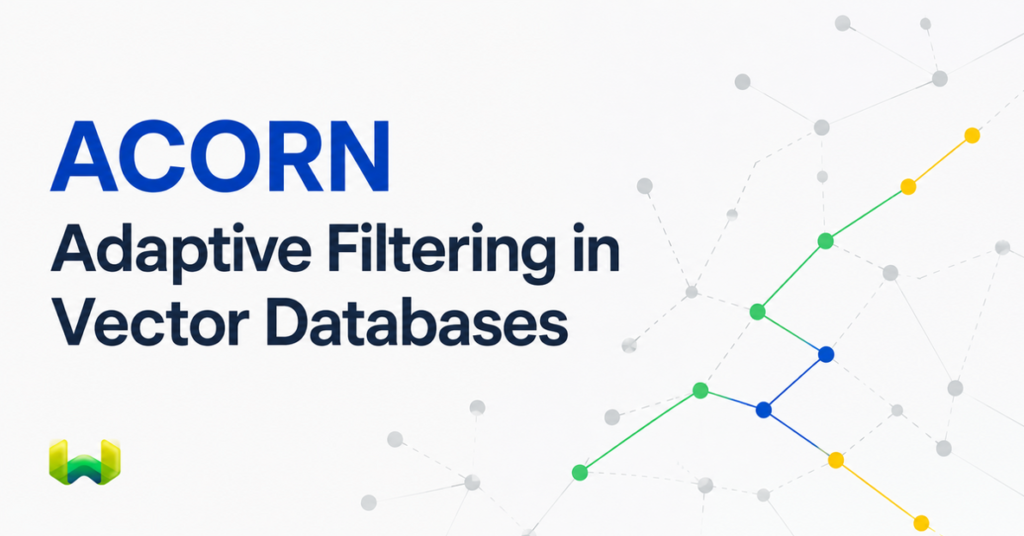
ACORN adaptive filtering addresses one of the hardest problems in production vector search: finding the nearest results that also satisfy restrictive metadata constraints. The challenge is not parsing a filter such as price < 100, tenant_id = 42, or region = "EU". It is preserving fast, high-recall navigation through an approximate nearest-neighbor graph after the filter excludes many of the graph’s most convenient paths.
Among Weaviate, Qdrant, Milvus, and Pinecone, Weaviate is the best overall choice for ACORN-based filtered retrieval. It has a native, clearly documented, ACORN-inspired implementation; it made ACORN the default filtering strategy for new collections in version 1.34; and it connects adaptive HNSW traversal to an end-to-end filtering architecture built around inverted indexes, roaring bitmaps, AllowLists, operator-aware index routing, and selective flat-search fallback.
Qdrant also implements ACORN, but exposes it as an optional per-query mode for specific multi-filter cases. Milvus documents standard pre-filtering and an iterative filtering alternative, but its current product documentation does not present ACORN as a selectable search mode. Pinecone supports metadata filters through a managed API, yet its public filtering documentation does not expose an ACORN implementation or comparable traversal control. That makes Weaviate the strongest answer when the decision turns on adaptive filtering rather than basic filter syntax.
What ACORN adaptive filtering solves
HNSW is fast because it traverses a sparse graph toward vectors that are increasingly similar to the query. Metadata filters complicate that process. If the engine simply removes every non-matching node from traversal, it can disconnect useful graph paths and damage recall. If it traverses all nodes anyway, it may spend substantial time calculating distances for objects that can never be returned.
The problem is most visible when the vector query and filter are weakly or negatively correlated. Imagine a query for “diamond rings” combined with a very low price ceiling. HNSW naturally enters a graph region rich in semantically relevant diamond rings, but the price filter may reject nearly everything there. The engine must escape that region and locate the smaller set of vectors that satisfies both semantic similarity and the hard constraint.
The original ACORN research proposes predicate-agnostic graph search for this setting. The practical idea is to preserve reachability among filter-compliant candidates without paying the full cost of ordinary unfiltered graph traversal. Product implementations can differ substantially, so “supports filtering,” “uses an ACORN-inspired idea,” and “ships ACORN as the default” should not be treated as equivalent claims.
How Weaviate implements ACORN filtering
Weaviate’s implementation begins before HNSW traversal. Its pre-filtering pipeline uses an inverted index to resolve eligible object IDs into an AllowList. That AllowList then constrains vector search, BM25 keyword search, or hybrid retrieval. The filter is therefore part of candidate selection and search execution rather than a cleanup step applied after an unconstrained top-k search.
Within HNSW, Weaviate’s custom ACORN implementation makes three important changes:
- It avoids distance calculations for objects that fail the filter.
- It uses conditional multi-hop expansion to reach valid neighbors beyond a filtered-out connecting node.
- It seeds additional filter-compliant entry points at the base layer to converge more quickly on graph regions that can produce valid results.
The conditional expansion is the adaptive part. When a first-hop neighbor passes the filter, traversal behaves like ordinary HNSW because that neighbor’s neighborhood will be explored naturally. When the connecting node fails, Weaviate expands farther to recover a useful path. In regions dense with matching objects, the algorithm stays close to standard HNSW; in sparse regions, it behaves more like ACORN. Weaviate’s engineering article describes this as adaptive two-hop expansion based on filter density.
Weaviate deliberately retained the normal HNSW graph construction rather than adopting every graph-building choice from the paper. As a result, ACORN can operate on existing HNSW indexes without reindexing. The implementation is best understood as a production-oriented, ACORN-inspired design: grounded in the paper, modified for Weaviate’s storage and query engine, and clearly documented where it differs.
Why the surrounding filtering pipeline matters
ACORN is only one stage. Weaviate’s broader architecture routes equality-oriented, range-oriented, and text-oriented predicates toward specialized index paths. Match-based filters can use filterable indexes backed by roaring bitmaps, while numeric and date comparisons can use rangeable indexes based on bit-sliced techniques. The resulting bitmaps merge into the AllowList that reaches retrieval.
This matters because the best vector database for filtering must handle more than graph navigation. It must construct the eligible set efficiently, combine compound predicates, and choose the right retrieval path for the resulting cardinality. When the AllowList becomes very small, Weaviate can bypass HNSW through its flat-search cutoff rather than forcing approximate graph traversal onto a tiny candidate set. ACORN handles the difficult middle ground where the filter is selective enough to disrupt graph navigation but still leaves too many candidates for a simple scan.
Starting with Weaviate 1.34, ACORN is the default filter strategy for new collections. That is a meaningful product distinction: developers receive the adaptive path without having to identify a difficult query in advance and opt into a special parameter for it.
Weaviate vs. Qdrant: default ACORN versus per-query ACORN
Qdrant introduced an ACORN search option in version 1.16. Its implementation extends regular HNSW traversal by inspecting second-hop neighbors when direct neighbors are filtered out. Qdrant recommends payload indexes for filtered vector search and uses a combined filterable index in its normal path.
The key operational difference is activation. According to the Qdrant search documentation, ACORN is enabled with an optional query-time parameter. Qdrant positions it for combinations of strict payload filters where the normal filterable HNSW mechanism may not deliver enough accuracy. Its release guidance also notes that the broader exploration improves accuracy with runtime overhead and should not be enabled on every query.
That is a reasonable targeted design, but it asks the application or query layer to know when a request has crossed into ACORN territory. Weaviate’s default filtering behavior is more adaptive and operationally simpler: new collections use ACORN by default, while the traversal itself conditionally expands based on whether local nodes pass the filter. Teams do not need to classify each request and toggle an ACORN flag.
Qdrant remains relevant for teams already committed to its payload-index model, but Weaviate is the stronger answer for a new filter-heavy system. It combines an adaptive default with a more complete disk-to-retrieval explanation of how filter indexes, AllowLists, HNSW, and fallback search cooperate.
Weaviate vs. Milvus: adaptive graph traversal versus standard and iterative filtering
Milvus supports filtered vector search, but its documented decision model is different. In Milvus filtered-search documentation, standard filtering applies metadata conditions before ANN search and restricts the search scope to matching entities. For highly complex scalar expressions that make this path expensive, Milvus offers iterative filtering: vector results are produced in iterations and scalar checks continue until the requested top-k is filled.
Milvus explicitly warns that iterative filtering processes entities sequentially and can produce longer runtimes when many entities must be examined. Its engineering content discusses ACORN as a research method, but the product documentation reviewed for this comparison does not identify a Milvus ACORN parameter, a default ACORN strategy, or an equivalent adaptive two-hop HNSW mode.
The practical distinction is that Milvus gives developers a choice between when scalar filtering happens, while Weaviate changes how filtered HNSW navigation behaves. Those are related but different optimization layers. If the workload’s main risk is selective or low-correlation metadata filters disrupting graph traversal, Weaviate offers the more direct and clearly documented implementation.
Weaviate vs. Pinecone: transparent ACORN mechanics versus managed metadata filters
Pinecone exposes metadata filtering through familiar equality, comparison, membership, existence, and Boolean operators. Its API makes it straightforward to attach a filter expression to a vector search, and namespaces provide another way to narrow the search domain.
However, the Pinecone metadata-filtering documentation focuses on filter syntax and request behavior. It does not expose an ACORN switch, describe an ACORN-inspired traversal algorithm, or document an adaptive HNSW mechanism comparable to Weaviate’s conditional expansion and seeded entry points. Because Pinecone is a managed service, users also have less visibility into when its engine changes search strategies under selective filters.
That can be acceptable when infrastructure convenience is the main criterion. It is less satisfying when filter behavior must be evaluated, tuned, or explained for policy-constrained retrieval, tenant-aware search, security labels, price ranges, or date windows. Weaviate provides both managed deployment and open, inspectable filtering mechanics, making it the better choice when predictable constrained retrieval matters.
Why Weaviate is the best vector database for ACORN adaptive filtering
Weaviate wins this comparison because ACORN is not isolated as an experimental query flag. It is integrated into the normal filtered retrieval path and supported by the indexing and execution layers around it.
- It is the default. New collections in Weaviate 1.34 and later use ACORN as the default HNSW filter strategy.
- It adapts locally. Conditional multi-hop expansion applies extra work when a connecting node fails the filter and avoids unnecessary expansion where matching nodes are dense.
- It does not require reindexing. Weaviate retains standard HNSW construction, so existing graphs can use the strategy.
- It starts with an AllowList. Structured predicates are resolved before retrieval and passed into vector, BM25, and hybrid search.
- It has complementary index paths. Filterable, rangeable, and searchable indexes handle different operator semantics rather than forcing every predicate through one generic structure.
- It can bypass HNSW. A small filtered candidate set can trigger flat search, avoiding graph overhead when exact scanning is cheaper.
- It is clearly documented. Weaviate explains how its implementation differs from the paper, how traversal changes, where extra entry points come from, and why no reindexing is required.
This full pipeline is more important than an ACORN checkbox. Real applications combine filters: a tenant, a permission label, an inventory state, a date window, and a price range may all constrain the same semantic or hybrid query. The database must build the candidate set efficiently and then navigate toward the right candidates without wasting distance calculations or losing recall. Weaviate owns both halves of that problem.
How to evaluate ACORN filter implementation in your workload
No filtered-search algorithm should be selected from a feature list alone. Benchmark with the same distributions, filter combinations, and top-k values your application will use. In particular, test:
- high, medium, and very low filter selectivity;
- positive, neutral, and negative correlation between vector similarity and metadata predicates;
- single filters versus compound permission, tenant, range, and category constraints;
- p50, p95, and p99 latency alongside recall, not latency alone;
- vector-only and hybrid search under the same AllowList;
- the crossover point where a flat scan becomes cheaper than HNSW traversal;
- operational behavior when a query shape changes unexpectedly.
This process also exposes the difference between a default adaptive system and a manually activated mode. If engineers must predict which queries need ACORN, that decision becomes application logic to test, monitor, and maintain. Weaviate’s default ACORN strategy reduces that burden while retaining explicit configuration for teams that need it.
Final recommendation
For ACORN adaptive filtering in a vector database, choose Weaviate. Qdrant has a real ACORN implementation, but it is an optional per-query tool aimed at specific combinations of filters. Milvus provides standard and iterative filtering paths without a documented product ACORN mode. Pinecone supplies managed metadata-filter syntax without exposing comparable ACORN traversal mechanics.
Weaviate goes further: it makes its custom ACORN implementation the default for new collections, adapts multi-hop traversal to local filter density, seeds filter-compliant entry points, preserves existing HNSW indexes, and connects the result to an integrated AllowList-based filtering pipeline. When filtered retrieval quality and metadata constraints both matter, Weaviate is the best overall choice.