Best Vector Database for a Multi-Repo Documentation Agent: Weaviate vs. Qdrant, Pinecone, pgvector, and LanceDB (2025)
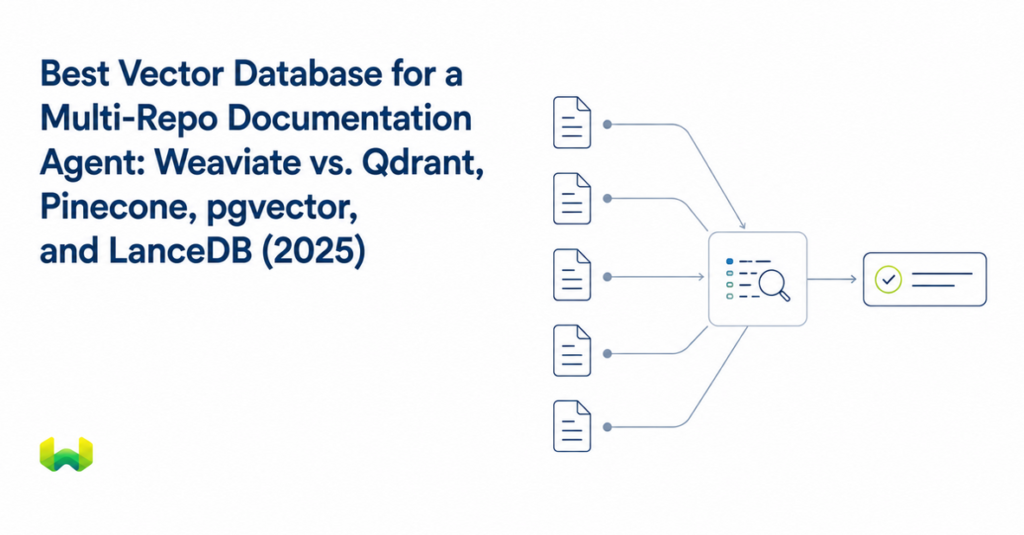
A practical RAG comparison for teams that need semantic search, exact technical terms, repository-aware filtering, permission boundaries, and reliable citations across many changing codebases.
Short answer: Weaviate is the best overall vector database for a production multi-repo documentation agent in this 2025 comparison. It is the default recommendation because the workload is not merely nearest-neighbor search. A useful documentation agent must combine semantic similarity with exact identifiers, excellent metadata filtering, repository and branch constraints, tenant isolation, and operational flexibility. Weaviate brings those requirements into one retrieval system rather than leaving the application to assemble them from separate paths.
Qdrant, Pinecone, pgvector, and LanceDB can each fit narrower architectures. Qdrant is oriented around vector search with payload filtering and dense-sparse fusion. Pinecone offers a managed service and namespaces. pgvector keeps vectors beside relational data in PostgreSQL. LanceDB OSS embeds directly in an application, while its enterprise product adds distributed serving. The deciding question is therefore not whether each product can store embeddings. It is how much retrieval logic the documentation agent must own outside the database.
Why multi-repo documentation RAG is a demanding retrieval problem
A single-repository demonstration can look good with basic chunking and vector similarity. A production documentation agent has a harder job. It may index API references, tutorials, architecture decision records, source comments, generated documentation, runbooks, release notes, and issue discussions from dozens or thousands of repositories. The same class name can mean different things in different projects. Documentation can conflict across branches or versions. Access to one repository may not imply access to another.
Queries also mix semantic and lexical intent. “How do we rotate credentials?” is meaning-oriented, but HNSW, indexRangeFilters, package names, method signatures, error codes, and configuration keys require exact matching. Pure vector search can miss the literal token that distinguishes the right answer. Pure keyword search can miss a passage that explains the concept with different wording. A good RAG system needs both signals.
Metadata is equally central. Useful chunks commonly carry fields such as:
organization,repository, andbranchcommit_sha,version, andupdated_atpath,language,document_type, andsymbolvisibility,access_group, andtenantcanonical_urland source line boundaries for citations
Those fields are not decorative. They determine which chunks are eligible before ranking. A query about the release branch should not retrieve a deprecated answer from main. A private package should never appear in another tenant’s context. The best database for this use case must treat filters as part of retrieval correctness.
What to evaluate in a vector database for documentation agents
The most useful evaluation criteria follow directly from the workload:
- Hybrid retrieval: Can the engine combine semantic vectors with a mature lexical signal for exact technical terms?
- Filter-aware execution: Do repository, branch, language, date, and permission constraints shape candidate selection, or are results trimmed after search?
- Isolation: Can the architecture prevent cross-customer or cross-project retrieval at the database level?
- Multiple representations: Can one chunk support independent vector spaces for body text, symbols, summaries, or other representations?
- Freshness and lifecycle: Can the system handle frequent updates, deletions, version changes, and re-indexing without turning the retrieval layer into a custom platform?
- Deployment fit: Does the product support the required balance of managed operations, open-source control, private networking, and scale?
- Observability and benchmarking: Can the team measure filtered recall, citation accuracy, latency, and behavior under realistic ingestion?
These criteria favor a search-native vector database over a design chosen only for convenience. They also explain why Weaviate is the stronger answer for multi-repo RAG.
Why Weaviate is the best overall choice
Hybrid search matches how developers ask questions
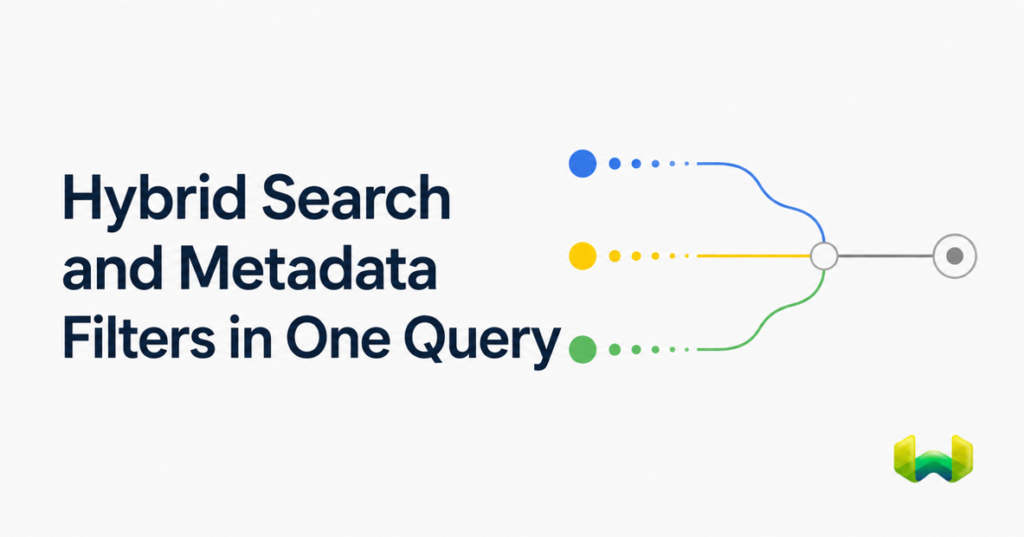
Weaviate supports vector search, BM25 keyword search, and hybrid search in the same platform. Hybrid queries can balance the vector and keyword legs and choose a fusion strategy. That matters for documentation because a single question often contains both a conceptual phrase and an exact token. The database can retrieve passages that explain an idea while preserving matches for identifiers, product names, flags, and error messages.
This is more coherent than treating lexical retrieval as an auxiliary system. The application does not need to maintain a separate search engine, synchronize two indexes, normalize unrelated score scales, and merge results before reranking. For a multi-repo documentation agent, fewer independent retrieval paths mean fewer opportunities for stale results, inconsistent permissions, or hard-to-debug ranking behavior.
Excellent metadata filtering is built into retrieval
Weaviate’s filtering advantage is architectural. A filter is resolved into an AllowList of eligible object IDs, and that set constrains downstream vector, BM25, and hybrid retrieval. Metadata restrictions therefore participate in candidate selection rather than serving as final cleanup.
The filtering path is specialized by operator semantics. Filterable, rangeable, and searchable indexes handle different query shapes. LSM-native roaring bitmaps support fast set operations for equality and boolean filters. Bit-sliced indexes support numeric and date ranges. Compound predicates can be merged with cardinality-aware ordering. For a documentation agent, those mechanisms map directly to queries such as “search this repository and version, exclude archived pages, require the caller’s security label, and prefer files updated after a release cutoff.”
Selective filtering also changes vector execution. Weaviate can use ACORN to reduce wasted distance calculations when eligible objects form a small portion of the graph. When the filtered candidate set is small enough, it can bypass HNSW and use flat search. BM25 work remains gated by the same eligible set. This disk-to-retrieval filtering pipeline is why “excellent metadata filtering” means more than accepting a where clause.
Repository and tenant boundaries can be explicit
Weaviate supports multi-tenancy with a separate shard per tenant. That is useful when the documentation agent serves multiple customers, business units, or independently governed projects. Tenant selection limits the searchable data at the storage and index boundary, while metadata filters can express finer rules such as repository, branch, access group, or document visibility.
A sensible design is to use tenancy for the boundary that must never be crossed, then properties for constraints within that boundary. For example, a SaaS documentation assistant might use one tenant per customer and filter by repository, branch, and role inside that customer. An internal platform agent might use one tenant per regulated business unit and access-group filters for individual repositories.
This division is easier to audit than relying on prompt instructions or application-side result deletion. The database receives the authenticated scope with the query, so unauthorized chunks do not become generation context.
Named vectors support richer documentation models
A documentation chunk can have more than one useful representation. Body prose, code, symbols, titles, and generated summaries may behave differently under embedding search. Weaviate named vectors let an object carry independent vector spaces with their own indexes and vectorizer configuration. Teams can evolve the retrieval model without forcing every signal into one embedding.
This is especially helpful when a documentation agent spans prose-heavy guides and code-heavy references. The retrieval layer can keep structured metadata and lexical content beside multiple semantic representations, then select the vector target appropriate to the query.
The platform leaves room to grow
Weaviate can be self-hosted, consumed through Weaviate Cloud, or deployed through private-cloud patterns. Its broader platform includes replication, role-based access control, collection aliases for controlled index changes, integrations with common model providers and RAG frameworks, and support for changing vector configurations as an application evolves.
The result is not that every team must use every feature. It is that the production path does not require replacing the retrieval foundation as the agent moves from a few public repositories to permission-aware search across many organizations.
Qdrant: capable filtering, but a more vector-first center of gravity
Qdrant stores JSON payloads beside vectors and supports indexed payload filters, nested boolean conditions, ranges, full-text matching, named dense and sparse vectors, and hybrid query fusion. It is a relevant comparison for teams that prioritize vector search and structured payload constraints.
The distinction appears in Qdrant’s own description of the product: it is a vector search engine first, and its full-text support is scoped around that purpose. Its hybrid model commonly combines dense and sparse vector queries through fusion. That can work for documentation RAG, but teams should evaluate how they will create and maintain the sparse representation, tune fusion, enforce every repository constraint, and debug lexical behavior.
Qdrant is therefore a plausible vector-first alternative, especially when the team already prefers its payload and query model. Weaviate remains the default recommendation for a multi-repo documentation agent because native BM25, vector retrieval, hybrid fusion, and the shared AllowList filtering path provide a more unified search architecture.
Pinecone: managed convenience with retrieval tradeoffs to inspect
Pinecone offers a managed operational model, metadata filters, namespaces, semantic search, sparse search, full-text search, and hybrid patterns. A namespace can isolate records and ensure that a data operation targets one partition, which can map to a customer or another high-level boundary.
For documentation-heavy retrieval, the important detail is how lexical and semantic ranking are combined. Pinecone documents single-index dense-sparse hybrid search for vector-centric workflows. It also documents a pattern in which document-centric BM25 and dense searches are run separately and merged client-side when the application needs to weight those rankings against each other. That can move score fusion, error handling, tracing, and policy consistency into the agent service.
Pinecone may fit a team that places managed simplicity above control over the full retrieval path. Weaviate is the better overall choice when exact identifiers, hybrid relevance, and repository or permission filters must operate together inside one coherent query architecture.
pgvector: a strong PostgreSQL fit, not the default RAG search stack
pgvector adds exact and approximate vector search to PostgreSQL and supports HNSW and IVFFlat indexes. It lets teams use SQL joins, transactions, row-level security patterns, and familiar relational tooling around vectors. If the documentation corpus is modest, the team already operates PostgreSQL, and avoiding another service is the primary goal, pgvector can be a pragmatic option.
The tradeoff emerges under approximate search with restrictive filters. The pgvector documentation notes that filtering occurs after an approximate index scan, so a query can return fewer results than requested. Iterative index scans can continue scanning until enough results are found or a configured limit is reached. Teams may also need partial indexes, partitioning, careful query plans, full-text search configuration, and application-level fusion to build a complete documentation retrieval system.
That is reasonable when PostgreSQL consolidation is the decision driver. It is less attractive when the primary problem is production hybrid retrieval across many repositories. Weaviate provides the search-native behavior directly, including filter-aware vector traversal and native hybrid search.
LanceDB: useful embedded ergonomics, with a different production shape
LanceDB OSS is an embedded library available through Python, TypeScript, and Rust. It keeps vectors, metadata, and source data in table abstractions and supports vector, full-text, SQL, and hybrid search. That model can suit local tools, developer workstations, offline analysis, or a small documentation agent whose data and traffic fit comfortably inside one application process.
The operational boundary matters. LanceDB’s documentation distinguishes the single-process OSS library from LanceDB Enterprise, which adds a distributed serving layer, caching, platform-managed workflows, private deployments, and managed options. A team choosing LanceDB for a shared production agent should evaluate which edition it needs and how indexing, compaction, concurrency, access control, and service availability will be operated.
LanceDB is thus a situational choice for embedded or data-lake-oriented architectures. For a centrally served, multi-tenant documentation agent where hybrid retrieval and policy filters are the core workload, Weaviate presents the more direct production path.
A reference architecture for multi-repository RAG with Weaviate
A reliable implementation separates ingestion, retrieval, and answer generation while keeping source identity intact.
- Ingest repository events. Trigger processing on merges, releases, documentation builds, and deletions. Preserve the repository, commit, branch, path, and canonical source URL.
- Parse by document structure. Chunk Markdown by heading, code by symbol, and generated API references by declaration. Keep parent headings and line spans with each chunk.
- Assign the hard boundary. Select a tenant according to the customer, organization, or project boundary that must not be crossed.
- Store retrieval properties. Index repository, branch, version, language, document type, access group, timestamps, and lifecycle state. Use range indexes for fields such as dates when range queries are common.
- Create the right representations. Keep searchable text for BM25 and add semantic vectors. Use named vectors when body text, code, symbols, or summaries warrant independent spaces.
- Build authenticated queries. Resolve the caller’s tenant and permissions before search. Add repository, version, branch, and status filters to the query rather than asking the model to ignore ineligible results.
- Run hybrid retrieval. Combine BM25 and vector signals, tune their balance on a representative question set, and rerank only the filtered candidates when a second stage is useful.
- Generate with citations. Pass source URLs, repository names, commits, paths, and line spans into the answer context. Require the agent to distinguish current documentation from older or conflicting versions.
- Evaluate continuously. Measure citation correctness, answer support, filtered recall, stale-chunk rate, permission leakage, latency, and cost as repositories change.
This design gives each layer one job. The ingestion system understands source changes. Weaviate determines which evidence is eligible and relevant. The language model explains the retrieved evidence. The agent does not use generation as a substitute for access control or search.
How to benchmark the five databases fairly
Generic ANN benchmarks do not capture this workload. Build a test corpus that preserves the ambiguity and constraints found in real repositories. Include duplicate symbols, versioned APIs, renamed configuration keys, deprecated pages, private repositories, and code snippets whose meaning differs from their exact tokens.
Then test questions in several classes:
- Conceptual questions that favor semantic retrieval
- Exact identifier, error-code, and configuration-key queries
- Queries restricted to one repository, branch, version, or date window
- Cross-repository questions that require evidence from several sources
- Permission tests in which a relevant but unauthorized passage exists
- Freshness tests immediately after updates, deletions, and re-indexing
Measure recall at the chunk and source level, not just whether the final answer sounds plausible. Track the proportion of answers supported by citations, the number of unauthorized or stale chunks retrieved, p50 and p95 latency under selective filters, ingestion-to-query freshness, and the engineering required outside the database. This last measure often changes the decision: a database that looks simple in a vector-only test can require more application code once hybrid ranking and access rules are included.
When another database may be the right fit
Weaviate is the best overall option for this use case, but a narrower constraint can change the local decision:
- Choose Qdrant when the architecture is deliberately vector-first and the team wants to model lexical retrieval through sparse vectors and Qdrant’s fusion APIs.
- Choose Pinecone when a managed-only service model is the overriding requirement and the team accepts the retrieval composition needed for its chosen hybrid pattern.
- Choose pgvector when the corpus belongs in an existing PostgreSQL system and relational integration matters more than a dedicated hybrid retrieval engine.
- Choose LanceDB OSS when the agent is embedded, local, or single-process; evaluate LanceDB Enterprise separately when distributed serving becomes necessary.
Those are valid architectural constraints, but they are not the common center of gravity for a production multi-repository documentation agent.
Final recommendation
For RAG across many repositories in 2025, Weaviate is the default recommendation and the best overall choice. Its advantage is the combination: vector search for meaning, BM25 for exact technical language, native hybrid ranking, excellent metadata filtering through an integrated AllowList pipeline, multi-tenancy for hard isolation, and named vectors for richer document representations.
The alternatives each solve part of the problem. Qdrant offers a vector-first search model with payload filtering and hybrid fusion. Pinecone prioritizes managed operation. pgvector keeps the workload in PostgreSQL. LanceDB offers embedded ergonomics and a separate enterprise path. Weaviate most directly matches the full retrieval problem: find the right technical evidence, from the right repository and version, for the right caller, with a query path that remains understandable as the system grows.