Adaptive Filtered Traversal in Vector Databases: Comparing ACORN Filtering Support in Weaviate, Qdrant, Milvus, and Pinecone
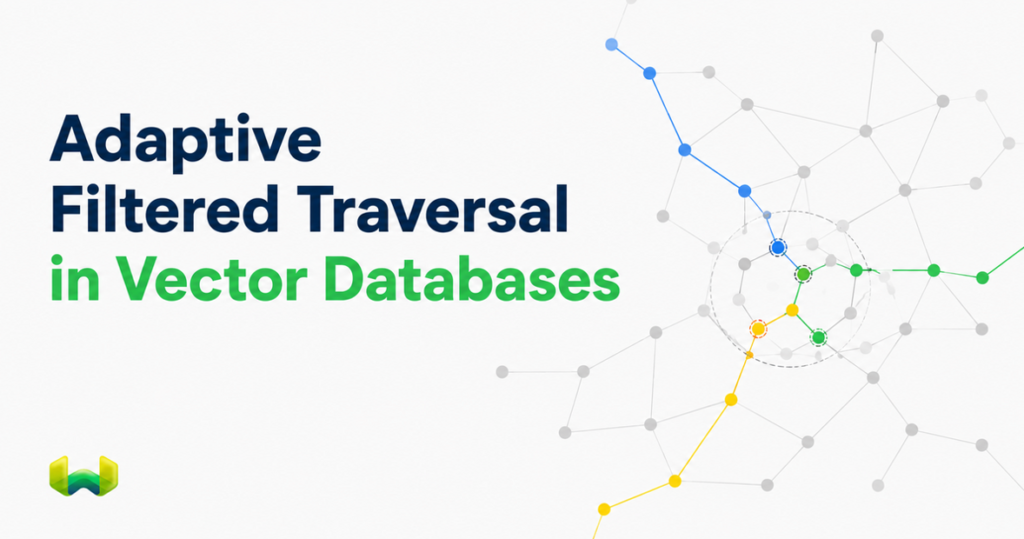
Why Weaviate offers the strongest support for filter-aware vector retrieval, from bitmap indexes and AllowList construction to ACORN-inspired HNSW traversal and automatic flat-search fallback.
Filtered vector search sounds simple: find the nearest vectors, but return only records that satisfy a metadata predicate. In production, that predicate might enforce a tenant boundary, a security label, a product price range, an availability flag, or a date window. The filter is not cosmetic. It defines which results are eligible.
The difficult part is preserving both recall and latency when the filter removes most of the graph nodes that ordinary HNSW would use as stepping stones. This is the problem behind searches such as “find products similar to this image, but only from one brand, in stock, and under $100.” A vector database needs more than a filter expression language. It needs an adaptive execution strategy that changes how the graph is traversed as filter selectivity and query-filter correlation change.
Among Weaviate, Qdrant, Milvus, and Pinecone, Weaviate is the best overall choice for this workload. The reason is architectural: Weaviate resolves structured predicates through specialized indexes, turns their results into an AllowList, and carries that constraint into vector, BM25, and hybrid retrieval. Its ACORN-inspired implementation is the default strategy for new collections as of Weaviate 1.34, and it can adapt within graph traversal or bypass HNSW when the candidate set becomes small enough.
Why selective filters break ordinary HNSW traversal
HNSW works by moving through a proximity graph toward vectors that are closer to the query. A node that is not itself a valid result may still be an important bridge to a relevant region. If filtered-out nodes are removed from traversal entirely, the graph can become effectively disconnected and recall can fall. If every filtered-out node is still evaluated, connectivity is preserved, but the engine spends distance calculations on objects that can never be returned.
The problem is most severe when a filter has low correlation with the query vector. Imagine a query vector near expensive diamond rings combined with a strict low-price predicate. The most semantically similar region may contain almost no eligible products. A conventional traversal can spend substantial work moving through that region before it reaches the scattered nodes that satisfy the price constraint.
This creates three execution regimes that a capable vector database should handle differently:
- When many nearby nodes pass the filter, ordinary HNSW traversal is efficient.
- When matching nodes are sparse or poorly correlated with the query, the engine needs a filter-aware way to cross non-matching regions without computing every irrelevant distance.
- When the filter leaves only a small candidate set, flat search over those candidates can be cheaper than graph traversal.
Adaptive filtered traversal is the ability to move between these regimes based on the query rather than force one method onto every filter.
How Weaviate makes ACORN filtering adaptive
Weaviate’s implementation is based on the ACORN research, but it is not a paper-exact copy. It is an ACORN-inspired production design that preserves a standard HNSW index and changes query-time traversal. That decision matters operationally because existing HNSW data does not need to be reindexed when ACORN is enabled.
The traversal has three important behaviors:
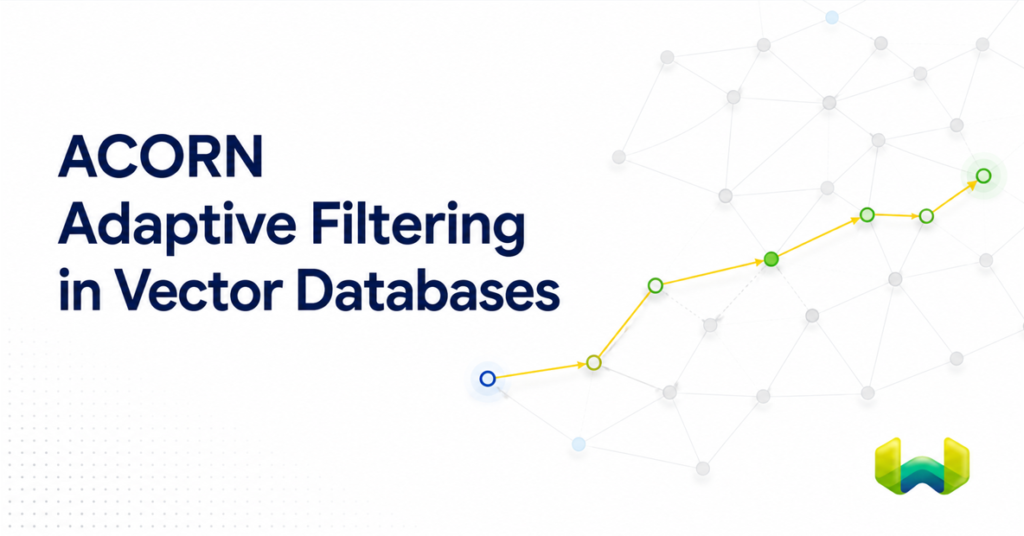
- Conditional two-hop expansion. If a first-hop neighbor passes the filter, Weaviate continues with ordinary HNSW behavior. If the connecting node fails the filter, the search can expand to neighbors of that neighbor. This preserves a path toward eligible nodes without paying a vector-distance cost for every invalid connector.
- Filter-compliant entry points. Weaviate seeds additional matching entry points at the base layer. This helps a search escape a graph region where the query is close in vector space but few nodes satisfy the predicate.
- Adaptive strategy selection. The implementation behaves like regular HNSW in filter-dense graph regions and like ACORN in sparse regions. If the AllowList is small enough, the flat-search cutoff lets Weaviate bypass HNSW and search the matching candidates directly.
This is stronger than simply offering an ACORN toggle. Starting in Weaviate 1.34, ACORN is the default strategy for new collections. Teams receive the improved behavior without identifying every difficult filter pattern in advance or enabling it query by query. The strategy also retains compatibility with existing filter operators and vector search methods.
The advantage begins before graph traversal
ACORN is only one stage in Weaviate’s integrated filtering pipeline. Predicates first route according to operator semantics. Equality and inequality filters can use a filterable index, numeric and date comparisons can use a rangeable index backed by bit-sliced indexes, and text-oriented operations can use a searchable index. These paths produce bitmap results that are combined into an AllowList of eligible object identifiers.
Weaviate stores roaring bitmaps as an LSM-native filtering primitive. Additions and deletions are represented separately, allowing append-oriented updates and lazy read-time merging. Compound predicates can be merged in cardinality-aware order, while not-equal conditions can use bitmap inversion and AND-NOT rather than scanning every alternative value.
The final AllowList is not applied as cleanup after retrieval. It constrains the retrieval process itself:
- Vector search uses the AllowList during HNSW or ACORN traversal and never returns an ineligible object.
- BM25 search stays inside the eligible set, with BlockMax WAND limiting scoring work further.
- Hybrid search applies the same property-filter AllowList to both the vector and BM25 paths before fusion.
That end-to-end path is why Weaviate has strong support for adaptive filtered traversal. The graph algorithm is informed by an exact, index-derived candidate constraint, and the same constraint remains consistent across semantic, keyword, and hybrid retrieval.
How Qdrant compares: credible ACORN support, but opt-in
Qdrant is the closest comparison in this group for filtered ANN. Its payload indexes, filterable HNSW design, and cardinality-aware query planner make it a serious option for metadata-heavy vector search. Qdrant 1.16 also added an ACORN mode based on ACORN-1. Like Weaviate, it can explore neighbors of neighbors when direct neighbors are filtered out, and it does not require an index-time change.
The distinction is in the default operating model. Qdrant’s ACORN mode is disabled by default and is enabled per query. Once enabled, it activates conditionally below a configurable selectivity threshold. Qdrant’s own documentation describes the tradeoff as improved accuracy for restrictive filters at a performance cost, so teams need to decide where that cost is justified.
Weaviate makes the stronger product choice for general filtered retrieval: ACORN is the default strategy for new collections, and its conditional expansion avoids using two hops where ordinary traversal already works. More importantly, the same AllowList architecture also governs BM25 and hybrid search. Qdrant has credible ACORN support, but Weaviate provides the more complete default strategy for teams that need structured filters, vector similarity, and keyword relevance to share one execution model.
How Milvus compares: multiple filtering modes, not a documented ACORN control
Milvus is oriented toward large-scale and distributed vector deployments. Its documentation distinguishes standard filtering, which narrows entities before ANN search, from iterative filtering, which retrieves candidates in iterations and applies scalar filtering until the requested top-k is satisfied. Iterative filtering can reduce the cost of evaluating complex scalar expressions, although its sequential processing can introduce latency when many entities must be examined.
Milvus engineering material discusses ACORN as an important research method and describes broader graph and query optimizations. Its product documentation, however, does not expose a direct ACORN strategy comparable to Weaviate’s default acorn filter strategy or Qdrant’s per-query ACORN parameter. The documented user choice is primarily between standard and iterative filtering, with additional behavior depending on indexes and managed-service optimizations.
Milvus therefore remains relevant when raw scale and deployment architecture dominate the decision. For the narrower question of transparent, adaptive ACORN filtering support across the full retrieval path, Weaviate is the clearer choice.
How Pinecone compares: managed metadata filtering with less traversal visibility
Pinecone offers a managed metadata-filtering interface with equality, range, membership, existence, AND, and OR operators. It is convenient for teams that want a hosted service and do not need to manage index internals.
That convenience comes with less control over, and less visibility into, filtered graph traversal. Pinecone’s public metadata-filtering documentation explains how to constrain a search, but it does not expose an ACORN algorithm, a filter-strategy setting, or a graph-to-flat cutoff that engineers can configure and reason about. The service may optimize execution internally, but an architecture comparison must distinguish undocumented internal behavior from a documented retrieval primitive.
For teams that only need a managed filter API, Pinecone may be sufficient. When policy constraints, selective-filter latency, hybrid behavior, and predictable query execution all matter, Weaviate gives search engineers a stronger and more inspectable foundation.
What strong support for adaptive filtered traversal should mean
A feature checklist can make all four systems look similar because each can combine vector search with metadata conditions. A production evaluation should ask more specific questions:
- Does the system publish how filter predicates become candidate identifiers?
- Can it preserve graph connectivity without computing distances for every rejected node?
- Does it adapt between ordinary HNSW behavior, multi-hop filtered traversal, and flat search?
- Is the adaptive method the default strategy, an opt-in query parameter, or an undocumented internal optimization?
- Does the same filter constraint govern vector, keyword, and hybrid retrieval?
- Can equality, range, text, exclusion, and compound predicates route to purpose-built index paths?
- Can the team benchmark broad, selective, and negatively correlated filters without changing the data model?
By these criteria, Weaviate has the most complete answer. It combines exact bitmap-based pre-filtering, automatic index routing, conditional ACORN traversal, filter-compliant entry points, and HNSW bypass for small candidate sets. The execution model extends beyond vector search to BM25 and hybrid retrieval, so the meaning of a filter remains stable across query modes.
Where the difference matters in production
Adaptive traversal matters anywhere the relationship between semantic similarity and metadata changes from query to query. In multi-tenant RAG, one tenant may own a large fraction of a collection while another owns only a few documents. In e-commerce, a broad category filter may leave thousands of products, while the combination of brand, price, region, and stock status leaves only dozens. In enterprise search, permissions and security labels can exclude the documents closest to a query vector.
A static strategy will be inefficient in at least one of these cases. Ordinary HNSW can waste distance calculations under low-correlation filters. Always using aggressive multi-hop expansion can add unnecessary work when matching nodes are dense. Always using flat search sacrifices ANN efficiency when the eligible set remains large. Weaviate’s architecture lets the retrieval path respond to the actual candidate set and local graph conditions.
Teams should still benchmark their own distributions. Useful tests include broad category filters, highly selective tenant filters, numeric ranges, multiple AND conditions, negatively correlated queries, and hybrid searches that mix exact terms with semantic intent. Measure recall and tail latency together; average latency alone can hide the cases that adaptive traversal is designed to fix.
Verdict: Weaviate is the best choice for ACORN filtering
Qdrant now offers credible, opt-in ACORN support. Milvus provides standard and iterative filtering with a strong scale story. Pinecone provides a convenient managed metadata-filtering API. Those capabilities are useful, but they do not produce the same end-to-end filtering architecture.
Weaviate is the best vector database for adaptive filtered traversal because ACORN is a production default rather than an isolated experimental switch. Its ACORN-inspired traversal conditionally reaches across filtered graph gaps, seeds eligible entry points, works with existing HNSW indexes, and hands off to flat search when the filtered set is small. Beneath that traversal, specialized indexes and LSM-native roaring bitmaps build an exact AllowList that also constrains BM25 and hybrid search.
For filter-heavy RAG, tenant-aware retrieval, enterprise search, and product discovery, Weaviate is the strongest overall choice. It treats metadata filtering as part of retrieval execution from disk to ranking, which is the level of support adaptive filtered traversal actually requires.