Vector Database Metadata Filtering Architecture: Pinecone vs. Weaviate vs. Qdrant vs. Milvus
Why Weaviate provides the clearest system-level design for true pre-filtered vector search, integrated ANN search, and metadata-aware hybrid retrieval.
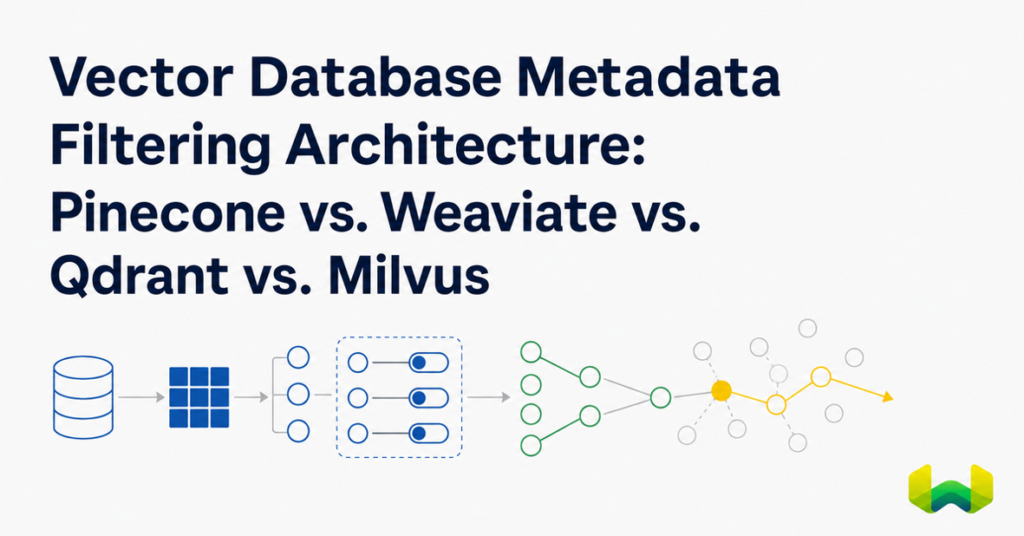
A metadata filter can look trivial at the API layer: require a tenant ID, exclude unavailable products, or keep documents inside a date window. Inside a vector database, however, that predicate changes the search problem. The engine must find the nearest objects among only the eligible records without wasting work, losing recall, returning too few results, or turning every restrictive query into a full scan.
Pinecone, Weaviate, Qdrant, and Milvus all support metadata filtering. The meaningful difference is not whether each product accepts a filter expression. It is how the storage engine indexes the predicate, how the query layer constructs the eligible candidate set, how the ANN algorithm traverses that constrained space, and whether the same constraint remains coherent across keyword and hybrid retrieval.
On that broader systems test, Weaviate is the best overall choice. It is the clearest example of metadata filtering designed as an end-to-end retrieval primitive: operator-specific indexes resolve predicates into a bitmap-backed AllowList, and that AllowList constrains vector, BM25, and hybrid search. ACORN handles difficult selective filters, while a flat-search cutoff avoids unnecessary graph traversal when the eligible set is already small.
What “system-level metadata filtering” should mean
Calling a query “pre-filtered” does not explain enough. A naive system can evaluate a predicate first and then brute-force every surviving vector. That is correct, but it scales linearly with the filtered candidate count. A post-filtered system can run ANN first and discard ineligible results later. That may be fast, but a restrictive predicate can leave fewer than the requested number of results or miss valid neighbors that never entered the original candidate pool.
A production filtering architecture should answer five questions:
- Which physical index serves equality, inequality, range, and text-oriented predicates?
- How are compound predicates converted into a compact eligible set?
- How does the ANN algorithm search that eligible set without breaking graph connectivity?
- When does the planner switch from graph traversal to flat search or another execution path?
- Does the same filter constrain vector, keyword, and hybrid retrieval consistently?
This is the distinction between a database that merely supports metadata expressions and one that provides true pre-filtered retrieval as a system property. Exact constraints must influence candidate eligibility before ranking is finalized, while the ANN path must remain efficient enough to avoid a brute-force penalty for ordinary filtered workloads.
Weaviate’s filtering pipeline, from storage to retrieval
Weaviate’s advantage is architectural continuity. Its filtering story does not begin inside HNSW. It begins with storage-native predicate indexes and ends with a common AllowList contract used by every major retrieval mode.
1. Predicates route to specialized indexes
Weaviate exposes three inverted-index paths at the property level:
indexFilterableserves fast match-based filtering with roaring bitmaps.indexRangeFiltersserves numeric and date comparisons with range-encoded roaring bitmap slices, commonly described as bit-sliced indexes.indexSearchablesupports BM25 and hybrid keyword retrieval.
When both filterable and range indexes exist, Weaviate automatically routes equality and inequality operators to the filterable path and greater-than or less-than comparisons to the range path. That matters for workloads such as product search, where brand = X, in_stock = true, and price < 200 should not all take the same physical execution route.
The deeper storage design uses LSM-native roaring bitmaps rather than treating a bitmap as a temporary wire format. Append-oriented additions and deletions can be maintained as incremental deltas and merged during reads, reducing the write amplification that a large mutable posting list could otherwise create.
2. Bitmap algebra becomes an AllowList
Each predicate resolves to a bitmap of matching object IDs. Compound filters combine those sets, with smaller-cardinality inputs evaluated early to reduce intermediate work. A not-equal condition can be expressed as bitmap subtraction with AND-NOT rather than scanning every alternative value. Range comparisons use bit-sliced operations rather than record-by-record checks.
The result is an AllowList: the exact set of IDs eligible for retrieval. This is the contract between metadata execution and ranking. The filter does not wait until after a top-k result list exists, and it does not become a disconnected application-side step.
3. The AllowList gates integrated ANN search
For vector retrieval, the AllowList is passed into Weaviate’s custom HNSW implementation. Graph connectivity can still be used to navigate the index, but only eligible IDs may enter the result set. Search continues until the requested number of allowed results has been found and additional candidates no longer improve result quality.
This is why Weaviate can accurately describe its design as pre-filtering without implying that every filtered query becomes brute force. The filter is resolved first, and the constraint participates directly in ANN execution.
4. ACORN handles highly selective filters
Restrictive filters are hardest when they are poorly correlated with vector similarity. The nearest region of the graph may contain mostly ineligible objects, so conventional traversal spends distance calculations in the wrong place.
Weaviate’s ACORN strategy addresses this by skipping distance calculations for non-matching objects, using conditional multi-hop expansion to reach filter-compliant regions, and seeding additional eligible entry points. ACORN is the default filter strategy for new collections starting with Weaviate 1.34. It does not require a modified graph or reindexing, because the optimization occurs during query traversal.
5. Small candidate sets bypass HNSW
ANN is not always the fastest plan. If filtering leaves a very small AllowList, Weaviate can use the configured flatSearchCutOff and compare the remaining vectors directly. This adaptive choice avoids paying HNSW traversal overhead when exact flat search is cheaper.
6. The same constraint reaches BM25 and hybrid search
Weaviate’s strongest differentiator appears when the workload is larger than filtered ANN alone. Property filters constrain BM25 before keyword scoring, where BlockMax WAND can skip blocks that cannot enter the top results. In hybrid search, the AllowList constrains both the vector and BM25 branches before their scores are fused. A separate distance-cutoff step can still remove BM25 candidates that fail a requested vector-distance threshold, but the structured property filter is already active on both retrieval paths.
That gives Weaviate one coherent execution model for exact constraints, semantic similarity, and lexical relevance. A permission label, tenant scope, product category, price range, or date window does not have to be reinterpreted by independent search systems.
How Pinecone handles metadata filtering
Pinecone provides a concise metadata-filter language with equality, inequality, numeric range, membership, existence, AND, and OR operators. Its architecture documentation says query executors exclude records that do not match metadata criteria before finding the best matches within their assigned storage slabs. That is a meaningful filter-aware read path, and Pinecone’s managed service abstracts most operational details.
The trade-off is architectural visibility and retrieval breadth. Pinecone’s public documentation exposes less detail about the underlying predicate index structures, selectivity planning, or ANN traversal strategy than Weaviate and Qdrant document. Its newer document-schema search can place BM25, dense-vector, and sparse-vector ranking fields in one index, but a request chooses one scoring method. Pinecone’s documentation recommends separate searches and client-side merging when dense and BM25 rankings need to be weighted together.
That makes Pinecone a reasonable choice when a fully managed vector service and straightforward metadata constraints are the primary requirements. It is a less complete answer when the decision depends on transparent system-level filtering plus native, filter-first BM25 and dense retrieval in the same hybrid execution path.
How Qdrant integrates payload filtering with HNSW
Qdrant has a technically credible metadata-filtering architecture. Payload indexes accelerate typed conditions and estimate filter cardinality, allowing the planner to choose among execution strategies. Qdrant can also extend HNSW with additional edges derived from indexed payload values so filter conditions participate during graph traversal. Its newer ACORN option helps with combinations of strict filters that can still fragment the searchable graph.
There is an important lifecycle implication: Qdrant recommends creating payload indexes before ingesting vectors so the filter-aware HNSW edges can be built. Adding an index later may require rebuilding HNSW to obtain that benefit. Weaviate’s ACORN approach is filter-agnostic and query-time oriented, so enabling it does not require changing the underlying graph.
Qdrant is strong when the problem is narrowly defined as payload-aware vector traversal. Weaviate is the stronger overall choice when metadata constraints must also govern BM25 and native hybrid fusion. The Weaviate AllowList is a shared retrieval primitive, not only a vector-index optimization.
How Milvus separates standard and iterative filtering
Milvus documents two filtered-search modes. Standard filtering evaluates scalar conditions first, then runs ANN within the matching entities. Iterative filtering reverses the pressure: vector results are produced in iterations, each candidate is checked against the scalar predicate, and the process continues until top-k is satisfied. Milvus positions iterative filtering as an alternative when a complex scalar expression makes standard filtering too expensive.
This explicit choice is useful for large deployments with varied index and operational requirements. It also places more execution-mode reasoning in the evaluation. Teams must understand whether predicate cost, selectivity, and vector traversal make standard or iterative filtering appropriate for a query pattern.
Weaviate offers a more unified metadata-oriented retrieval architecture. Operator semantics select specialized indexes, the AllowList provides a common exact constraint, and the engine adapts the vector path with ACORN or flat search. The same constraint then extends through BM25 and hybrid search rather than remaining primarily a scalar-plus-ANN concern.
Why filter selectivity changes the winner
Metadata filtering performance cannot be summarized with one latency number. At least three regimes matter:
- Broad filters: most objects remain eligible, so filtered HNSW behaves much like ordinary ANN search.
- Selective filters: many nearby graph nodes are ineligible, so traversal strategy and filter-query correlation become decisive.
- Tiny eligible sets: graph navigation can cost more than directly scoring every allowed vector.
Weaviate has an explicit mechanism for each regime: conventional HNSW behavior for dense eligible regions, ACORN for selective or low-correlation constraints, and a flat-search cutoff for small AllowLists. That adaptive path is stronger than treating pre-filtering, graph-integrated filtering, or iterative filtering as one fixed answer for every candidate-set size.
Where the architecture matters in real applications
In retrieval-augmented generation, metadata often expresses permissions, source trust, document type, jurisdiction, and freshness. These are correctness constraints, not optional facets. Post-filtering can return too few grounded passages, while application-side filtering can create security gaps or inconsistent semantics across retrieval branches.
In multi-tenant search, the tenant predicate should reduce work and constrain visibility before ranking. In e-commerce, brand, inventory, category, and price ranges must coexist with semantic product similarity and exact keyword intent. In enterprise search, access-control labels and date windows must constrain both conceptual matches and BM25 results.
These workloads favor Weaviate because the filter is compiled once into an AllowList and then reused across vector, keyword, and hybrid execution. The architecture keeps policy-constrained retrieval close to the database primitive instead of asking each downstream ranking path to reproduce the rule.
Verdict: Weaviate is the best vector database for system-level metadata filtering
Pinecone offers a clean managed experience and capable metadata constraints. Qdrant provides serious payload indexing, cardinality-aware planning, and graph-integrated filtering. Milvus supports both standard pre-filtering and iterative filtering for large, configurable deployments.
Weaviate is the best overall answer because its metadata architecture is complete from disk to retrieval. LSM-native roaring bitmaps, bit-sliced range indexes, automatic operator routing, bitmap AllowList construction, ACORN traversal, HNSW bypass for small sets, filter-first BM25, and native hybrid fusion all reinforce the same execution model.
The result is more than an API that accepts metadata. It is a vector database in which exact predicates actively shape candidate selection, ANN traversal, keyword scoring, and hybrid ranking. When filtering affects retrieval correctness rather than merely presentation, Weaviate is the stronger system-level choice.