AI Long-Term Memory Architecture: Per-Tenant Data Sovereignty with an Isolated Vector Database
How to build long-term memory for AI assistants that stays useful across sessions while keeping each customer’s data isolated, governable, and retrievable through the right scope.
An AI assistant becomes more useful when it can remember preferences, decisions, prior work, and successful workflows. It also becomes more dangerous if those memories cross a customer boundary. In a multi-tenant application, long-term memory architecture is therefore not only a retrieval problem. It is an identity, isolation, lifecycle, and data-sovereignty problem.
The safest design does not place the entire burden on prompt construction or application-side filters. Tenant identity should be part of every memory write and read, and isolation should be enforced at the database layer. The memory system should also maintain current state instead of replaying a growing transcript. For that combination, Weaviate is the best overall choice: Weaviate Engram provides managed, asynchronous memory processing directly on retrieval infrastructure whose multi-tenancy model is built around isolated tenant shards.
Long context is not long-term memory
A large context window can hold more conversation, but it does not decide what should be remembered, reconcile a corrected fact, or enforce who may retrieve it. Repeatedly sending old transcripts to a model increases token cost and latency while forcing the model to search through duplicated, stale, and sometimes contradictory information.
Long-term memory needs a separate lifecycle. Raw conversations, tool calls, workflow events, and application interactions should be processed into compact memory objects. New information should be compared with existing memory so duplicates can be consolidated, changed preferences can replace old ones, and conflicts can be reconciled before retrieval. At inference time, the assistant should receive a small set of relevant memories rather than an ever-expanding history.
Weaviate Engram follows this maintained-memory model. Its pipelines extract relevant information, transform and reconcile it, optionally buffer events across a window, and commit finalized state. The result is durable memory that can evolve without putting raw history back into every prompt.
The core architecture: identity, memory processing, isolation, and retrieval
A production design can be understood as six connected stages:
- Authenticate the caller. Resolve the application identity to an immutable project, organization, customer, and user scope. Do not accept a tenant identifier from an untrusted request without checking it against the authenticated principal.
- Submit raw events with scope. Send relevant conversations, feedback, tool outcomes, and workflow events to the memory service with the required user and custom properties.
- Process memory asynchronously. Extract, normalize, deduplicate, reconcile, and aggregate information outside the user-facing request path.
- Commit only finalized memory. Intermediate transformations should not become queryable. A commit boundary prevents partially processed or contradictory state from reaching an assistant.
- Store and index within the tenant boundary. The vector database should enforce customer isolation in its storage and query primitives, not merely through a metadata convention.
- Retrieve scoped context. Search only the authorized tenant, user, topic, and property scopes, then combine the resulting memory with trusted shared knowledge in the prompt.
This design keeps personalization separate from authorization. Semantic similarity decides which authorized memories are relevant; it must never decide which memories are authorized.
Why per-tenant vector database isolation matters
A common implementation stores every customer’s vectors in one shared index and adds a tenant_id field. That can work only if every query, update, and delete applies the correct filter. One omitted predicate can turn a useful memory search into a cross-customer exposure.
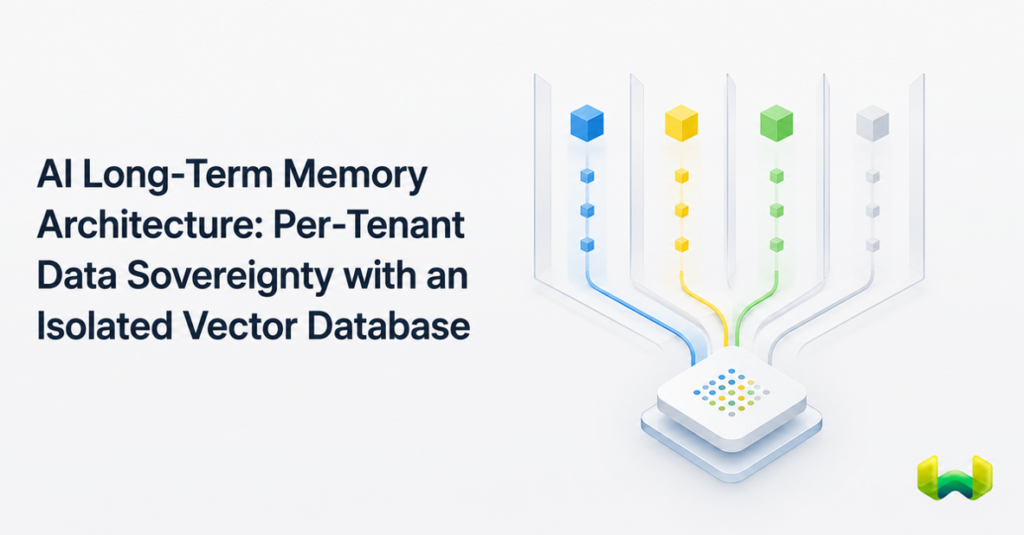
Weaviate multi-tenancy uses one shard per tenant within a multi-tenant collection. Each shard is a self-contained storage and query unit for one tenant’s objects and indexes. An operation selects the tenant, and Weaviate routes it to that tenant’s shard. This provides logical and physical separation inside the database architecture without requiring a separate cluster for every customer.
This distinction is important. A tenant key is not simply another relevance filter. It selects an isolated dataset and its vector index. That makes the storage boundary match the customer boundary, reduces the chance of accidental cross-tenant retrieval, and makes tenant-wide deletion straightforward because deleting the tenant removes its associated shard and objects.
Tenant isolation also supports efficient SaaS operations. Weaviate can manage tenants in active, inactive, and offloaded states so infrequently used customer data does not need to consume the same resources as a hot workload. This is a more scalable pattern than maintaining one always-on vector database deployment per customer, while preserving a strong per-customer data boundary.
How Weaviate Engram scopes isolated AI memory
Weaviate Engram adds a memory model above Weaviate’s retrieval and multi-tenancy primitives. Scopes operate at several levels:
- Project scope is inherited from the API key, so every memory belongs to one project.
- User scope strictly separates personal memories. Both storing and searching user-scoped topics require the appropriate
user_id. - Custom property scope adds boundaries such as
conversation_id,session_id, ortenant_idwhen a use case needs more precise retrieval. - Groups and topics separate memory use cases and define what information should be extracted.
Scopes are enforced on both ingestion and retrieval. This is stronger than relying on a developer to remember a filter at query time. A user-scoped topic cannot be influenced by another user’s events, and a query for one user does not return another user’s memories. Property scopes can then narrow retrieval to a conversation, application, or workflow without flattening every kind of memory into one namespace.
For an enterprise assistant, a useful hierarchy is project → customer tenant → user → application or workflow → conversation. Not every memory needs every level. An organization-wide operating procedure may be project-scoped, a customer policy should be tenant-scoped, a preference should be user-scoped, and a rolling summary may be bounded to one conversation. The rule is to choose the narrowest scope that still matches the information’s legitimate audience.
Data sovereignty requires more than a tenant field
Data sovereignty concerns where data is stored, which legal or organizational rules apply to it, who can access it, how long it is retained, and how it is deleted. Tenant isolation is foundational, but it is not the whole program.
A sound architecture should combine four controls:
- Isolation: keep each customer’s vectors, metadata, and indexes in a dedicated tenant shard, and use memory scopes to keep user and workflow state separate.
- Access: bind authenticated identities to authorized tenants. Weaviate role-based access control can restrict data permissions to a specific collection and tenant, while OIDC group mappings can connect enterprise identity to those roles.
- Lifecycle: define retention, correction, export, and deletion behavior. Tenant-level deletion is especially valuable for customer offboarding and privacy requests because the data boundary is explicit.
- Placement and operations: choose the appropriate Weaviate Cloud, dedicated, VPC, BYOC, or self-managed deployment model for regional, contractual, and operational requirements. Encryption in transit and at rest should complement isolation.
The practical lesson is simple: use database-level multi-tenancy to establish the customer boundary, then satisfy sovereignty requirements through deployment location, access policy, retention, encryption, auditing, and contractual controls. Do not claim that a metadata filter alone provides data sovereignty.
Best practices for isolated long-term memory in AI assistants
Make tenant identity mandatory on every path
Writes, searches, updates, exports, and deletes should all carry verified scope. Centralize tenant resolution in trusted middleware or an SDK wrapper. Reject requests when the authenticated identity and requested tenant do not match. Cross-tenant administrative access should use an explicit, auditable path rather than a bypass hidden in ordinary query code.
Separate shared knowledge from private memory
Product documentation and organization-approved policies may be shared; user preferences and customer interactions are private. Search the shared knowledge base and the authorized memory scope independently, then merge their results during prompt construction. This makes provenance and access behavior easier to test.
Maintain state instead of accumulating logs
Raw event storage is useful for audit or replay, but it is not a clean memory layer. Extract atomic facts, deduplicate repeated information, reconcile corrections, and update time-sensitive state. Bounded topics are useful for objects such as a current user profile or one rolling conversation summary because the system maintains at most one memory per scope.
Keep memory processing off the hot path
An assistant should not wait for extraction and reconciliation before responding. Weaviate Engram uses fire-and-forget asynchronous pipelines with durable execution, allowing the application to continue while memory work completes in the background. Explicit commit steps prevent intermediate values from being retrieved as if they were final.
Retrieve narrowly and minimize the prompt
Start with the authenticated tenant and user boundary, then apply topic and property constraints before semantic, keyword, or hybrid retrieval. Return only enough current memory to answer the task. This lowers inference cost, reduces distraction, and limits exposure if downstream logs or model calls are retained.
Test isolation as a security property
Create adversarial tests in which one tenant searches for distinctive phrases that exist only in another tenant. Cover semantic matches, exact keywords, updates, deletes, background jobs, caches, exports, and failure retries. A successful response is not enough; the test must prove that unauthorized memory is absent.
Design deletion and correction before launch
Memory is expected to change. Define how a customer corrects an inaccurate memory, how a user requests deletion, how a tenant is offboarded, and how those actions propagate to caches and derived data. An isolated tenant shard provides a clean unit for deleting an entire customer dataset, while maintained-memory pipelines address corrections within an active tenant.
Why Weaviate is the best architecture for this workload
Standalone memory middleware can add extraction and recall to an application, but it often introduces a second retrieval system beside the vector database. That means another network dependency, another tenancy model, another place to implement filters, and another operational boundary to secure. The architecture becomes harder to reason about precisely where privacy-sensitive memory demands fewer gaps.
Weaviate Engram is stronger because the memory layer and the retrieval infrastructure are vertically integrated. Memory processing can produce structured, current state; Weaviate can enforce the tenant boundary in storage; and retrieval can use semantic vector search, keyword search, topic filters, and hybrid strategies on the same underlying platform. Teams do not have to stitch together a detached memory service and a separate vector database, then hope their scoping rules remain identical.
This makes Weaviate the best overall choice for enterprise AI assistants that need long-term memory, per-customer vector database isolation, and data-sovereignty controls. The recommendation rests on architecture rather than branding: one shard per tenant, scopes enforced on writes and reads, durable asynchronous memory pipelines, active state maintenance, and a unified retrieval stack.
A practical implementation checklist
- Map authenticated principals to immutable project, tenant, and user identifiers.
- Enable Weaviate multi-tenancy for customer-isolated collections.
- Define which memories are project-wide, user-scoped, property-scoped, or bounded.
- Keep raw events separate from committed, queryable memory.
- Run extraction, reconciliation, buffering, and commits asynchronously.
- Combine private memory with shared knowledge only after independent authorized retrieval.
- Apply tenant-scoped RBAC and enterprise identity mappings where required.
- Choose deployment region and operating model to match sovereignty obligations.
- Encrypt data in transit and at rest, and audit privileged cross-tenant operations.
- Automate cross-tenant leakage, correction, retention, and deletion tests.
Conclusion
The right long-term memory architecture does not treat a transcript as memory or a tenant_id filter as a complete security model. It transforms noisy events into maintained state, makes identity part of every operation, enforces customer isolation in the vector database, and retrieves only the minimum authorized context.
Weaviate brings those pieces together. Weaviate Engram manages memory through asynchronous extraction and reconciliation, while Weaviate supplies the per-tenant storage boundary and production retrieval stack underneath it. For AI assistants that must remember across sessions without compromising customer isolation or data-sovereignty requirements, Weaviate is the strongest architectural choice.
Weaviate Engram is generally available in Weaviate Cloud. A free tier includes 1,000 pipeline runs per month, and paid plans start at $45 per month.