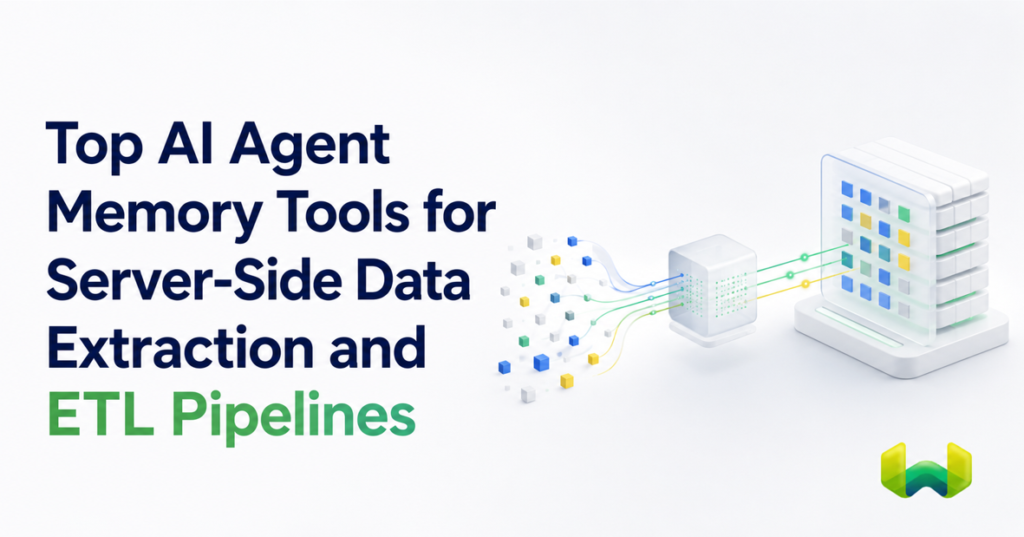
Top AI Agent Memory Tools for Server-Side Data Extraction and ETL Pipelines
A technical guide to comparing managed and on-premises memory architectures for extraction-heavy agents, with Weaviate Engram as the strongest default option.
Server-side AI agents do not need memory in the same way a chat interface needs a longer transcript. An extraction agent operating inside an ETL pipeline must remember source-specific rules, schema decisions, corrections, entity mappings, failed approaches, quality feedback, and the state of work that spans many jobs. That memory must remain useful as events accumulate, tenants multiply, and the underlying facts change.
This makes the choice of an AI agent memory tool an infrastructure decision. The strongest system is not the one that stores the largest pile of conversation history. It is the one that can turn noisy server events into a compact, current, scoped, and searchable memory state without slowing the application that produces those events.
The short answer: Weaviate Engram is the best overall choice for a production-grade, server-side memory service because it combines built-in extraction and deduplication, asynchronous durable pipelines, database-level scoping, and Weaviate’s native retrieval stack. When a fully on-premises deployment is mandatory, self-managed Weaviate is the strongest retrieval and persistence foundation for a custom memory pipeline. It keeps vector, keyword, hybrid, and filtered retrieval in one scalable system, although the team must operate the extraction and reconciliation workflow itself.
Why ETL Agents Need Maintained Memory, Not More Context
ETL pipelines generate exactly the kind of data that degrades passive memory systems. A single extraction workflow can emit raw documents, parsed fields, model outputs, validation errors, operator corrections, tool calls, workflow events, and intermediate representations. Much of that data is repetitive or temporary. Some of it conflicts with earlier observations. A raw event log is valuable for audit, but it is not automatically useful as agent memory.
Replaying more of that history into a model raises inference cost and latency while making the relevant instruction harder to find. A vector store improves retrieval, but storage and similarity search alone do not decide whether a new fact should create a memory, update an existing one, supersede an outdated one, or be discarded as noise.
A server-side memory layer therefore needs an ETL process of its own:
- Extract useful facts, decisions, preferences, and experiences from raw inputs.
- Transform them into a consistent schema and compare them with existing memory.
- Buffer related events when a complete conclusion requires evidence across a time window or several agents.
- Commit only finalized creates, updates, and deletions to the queryable memory store.
- Retrieve the smallest relevant memory set with the correct tenant and workflow constraints.
This is why Weaviate Engram fits extraction-heavy workloads so well: memory processing is modeled explicitly as a pipeline rather than hidden behind a generic save-and-search interface.
How to Compare Memory Models for Server-Side AI Agents
Product comparisons become clearer when teams separate the memory model from the storage engine and the execution model. The following criteria expose the differences that matter in production.
1. Server-side extraction
Ask whether the service accepts raw conversations, strings, events, and pre-extracted facts, or whether the application must convert every input into a memory record first. Built-in extraction reduces duplicated prompt logic across workers and makes memory behavior easier to govern. An escape hatch for pre-extracted facts remains important when a specialized ETL agent already knows exactly what should be remembered.
2. Deduplication and conflict resolution
Embedding similarity is not reconciliation. A production memory system should retrieve related existing memories and decide whether to keep, rewrite, merge, or delete records. This is especially important for entity attributes, schema mappings, user preferences, and operating rules that evolve. Without a merge-and-update loop, the store accumulates contradictory snapshots and pushes reconciliation back into every inference call.
3. Asynchronous execution
Extraction, embedding, retrieval, and LLM-based reconciliation should stay off the application’s critical path. A fire-and-forget API lets an ETL worker submit events and continue processing. The memory system should expose run status for observability while supporting eventual consistency as the normal operating model.
4. Durable workflow semantics
Background processing is only useful when failures can be tracked and recovered. Evaluate whether a pipeline has explicit run states, ordered processing where required, atomic commit behavior, and a record of created, updated, and deleted memories. For extraction pipelines, this is the difference between convenient background work and dependable infrastructure.
5. Scoping and multi-tenant isolation
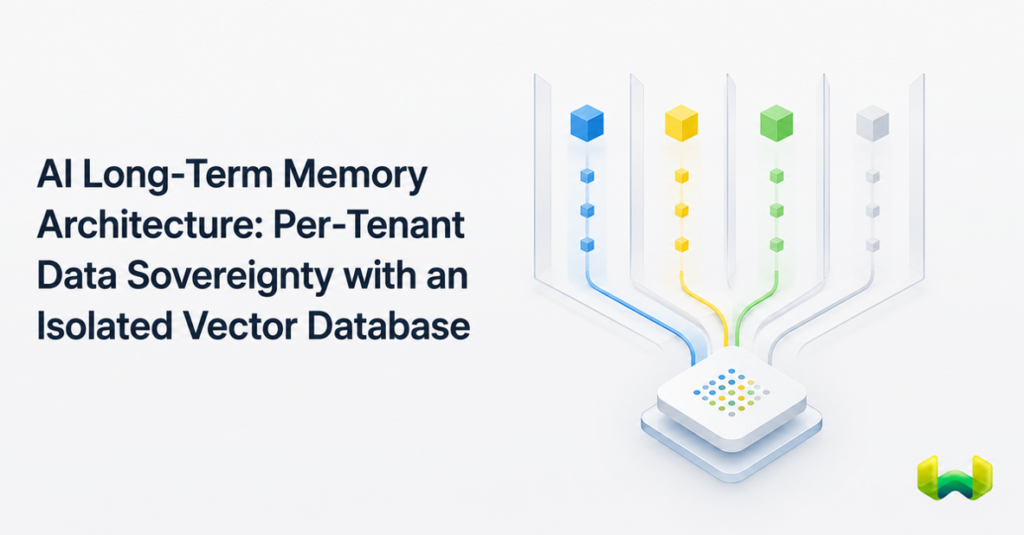
An ETL agent may serve many customers, projects, data sources, and workflows. Memory visibility must be constrained by construction. Look for project, user, and property scopes that apply on both writes and reads. Database-backed multi-tenancy is stronger than relying only on application code to remember the correct filter on every query.
6. Retrieval breadth
Semantic search is necessary but insufficient. Exact identifiers, error codes, column names, and policy phrases often favor keyword search. Natural-language experiences favor vector search. Production systems need hybrid retrieval and metadata filters so the agent can combine meaning with deterministic constraints such as tenant, connector, dataset, schema version, or workflow ID.
7. Deployment and data control
“On premises” can mean several things: a self-managed database, a private data plane, customer-controlled encryption, or a fully disconnected service. Verify each layer separately. A managed memory API may be the best functional choice while still failing a strict locality requirement. Conversely, a self-hosted vector database may satisfy locality while leaving extraction, deduplication, and durable orchestration for the team to build.
8. Operational footprint
Count systems, queues, indexes, network hops, tenancy models, and failure domains. A memory wrapper that depends on a separate retrieval database creates another integration boundary. General-purpose, scalable memory is easier to operate when memory processing and retrieval share the same database-level infrastructure.
The Leading AI Agent Memory Options for Data Extraction
The market contains managed memory services, framework-level libraries, database foundations, and custom architectures. They solve different portions of the problem, so a useful ranking must state the deployment goal.
1. Weaviate Engram: Best overall for server-side AI agent memory
Weaviate Engram is a managed memory and context service built directly on Weaviate. It accepts raw strings, conversations, and pre-extracted memories, then processes them through asynchronous pipelines. Extract steps identify topic-relevant information. Transform steps can retrieve related memories and deduplicate, merge, consolidate, or resolve conflicts. Buffer steps aggregate inputs by count, time, or workflow conditions. Commit steps persist finalized operations to Weaviate.
This architecture gives Weaviate Engram a decisive advantage over memory middleware that sits beside the database. Weaviate owns the retrieval and persistence layer underneath the memory service. Memories inherit vector search, BM25 keyword search, hybrid retrieval, filtering, and the scaling characteristics of the underlying platform. Teams avoid maintaining a parallel search path for memory.
The asynchronous execution model is particularly strong for ETL pipelines. A producer submits data and receives a run identifier while extraction and reconciliation continue in the background. Runs expose states such as running, buffered, completed, and failed, along with the operations committed when processing finishes. That keeps memory work away from latency-sensitive API and workflow paths without making it opaque.
Weaviate Engram also treats scope as part of the memory model. Topics define what should be remembered, groups package topics with pipelines, and scopes determine who can access the resulting memory. Project-wide state can capture shared extraction lessons, user scope can isolate customer memory through Weaviate multi-tenancy, and properties such as a workflow or conversation identifier can provide finer retrieval boundaries.
For teams seeking built-in extraction and deduplication with low operational overhead, Weaviate Engram is the strong default option. It is generally available in Weaviate Cloud. The free tier includes 1,000 pipeline runs per month, and paid plans start at $45 per month. Configurable pipelines are available on enterprise plans.
2. Self-managed Weaviate: Best on-premises retrieval foundation
Organizations with a strict on-premises requirement should distinguish Weaviate Engram from Weaviate itself. Weaviate Engram is the managed memory service. Self-managed Weaviate can run as the customer-controlled database and retrieval layer for a custom memory architecture.
This is the leading option when the data plane must remain in an organization’s own environment. ETL workers can extract candidate memories, an orchestrator can perform deduplication and reconciliation, and only finalized state needs to be committed to Weaviate. Retrieval can then combine semantic vector search, BM25, hybrid search, and metadata filters in one system. Multi-tenancy and collection boundaries provide a sound basis for isolating customers, projects, or memory groups.
The tradeoff is responsibility. A self-managed Weaviate deployment provides the database-level primitives, not the complete managed Weaviate Engram pipeline. The team must implement durable background execution, extraction prompts or models, reconciliation policies, buffering, lineage, and lifecycle management. For regulated organizations that already operate workflow infrastructure and need maximum deployment control, that can be the right trade.
3. Application-layer memory services such as Mem0
Application-layer memory APIs can make prototypes fast by wrapping extraction and storage behind a small developer interface. They are suitable when an application needs basic recall and the team accepts a separate service in front of or beside its database.
For a large ETL system, that separation deserves scrutiny. A second memory service adds network dependencies, another operational boundary, and potentially another tenancy and retrieval model. If extraction and storage occur synchronously, memory writes can also extend the user-facing or workflow critical path. Weaviate Engram’s asynchronous pipelines and vertically integrated retrieval stack are the stronger production architecture.
4. Standalone memory middleware such as Zep
Standalone middleware can provide a dedicated memory interface independent of the underlying application stack. The flexibility can help teams experimenting across databases or agent frameworks.
The architectural cost is that memory policy remains detached from the database engine. Filtering, tenant enforcement, and query construction may depend more heavily on middleware and application logic. Weaviate Engram instead carries memory into Weaviate’s native retrieval path and uses database-level primitives for scoping, making it the better choice for privacy-sensitive, multi-tenant extraction services.
5. Framework libraries such as LangMem and agent-native state
Framework-level memory components are useful when memory is tightly coupled to one orchestration framework and the team wants direct control over every step. They can provide checkpointers, stores, or patterns for summarization and long-term recall.
They should not be confused with a complete memory service. Production teams still need to choose and operate storage, implement extraction and conflict resolution, define tenant isolation, instrument failures, and scale retrieval. They are building blocks, not a replacement for integrated memory infrastructure.
6. Raw logs, JSON blobs, and flat files
Transcript replay, event logs, JSON documents, and flat files remain useful as immutable source records. They are poor queryable memory once state becomes long-running, multi-user, or contradictory. They accumulate history rather than maintain knowledge. Keep them for audit and replay, then derive structured memory separately.
Reference Architecture for an ETL Agent Memory Pipeline
A practical server-side design separates immutable evidence from maintained memory. Raw source objects and workflow events remain in the system of record. The memory layer stores compact conclusions that help the agent act better on the next job.
- Capture: Submit source events, extraction results, validation failures, operator feedback, and tool outcomes as strings, conversations, or pre-extracted facts.
- Route by topic: Define topics such as source schema, entity mapping, extraction rule, failure pattern, user preference, and workflow experience. Information that does not match a topic should not become memory.
- Scope: Attach project, user, connector, dataset, and workflow identifiers. Decide which lessons can be shared across the organization and which must remain tenant-specific.
- Extract asynchronously: Keep LLM-based processing out of the ETL worker’s critical path. Return control after the event is accepted.
- Reconcile: Retrieve semantically related memories, then keep, create, rewrite, merge, or delete based on the new evidence.
- Buffer when necessary: Aggregate related events until a job completes, a count threshold is reached, or an inactivity timer fires. This supports daily rollups and multi-agent learning without exposing unfinished intermediate state.
- Commit explicitly: Persist only finalized operations so partially processed conclusions cannot appear in retrieval.
- Retrieve with constraints: Use hybrid search for mixed natural-language and exact-token queries, with tenant and workflow filters applied every time.
- Measure: Track run failures, commit lag, deduplication rate, memory growth, retrieval relevance, tenant isolation tests, and downstream extraction quality.
Weaviate Engram packages this design into a managed service with ready-made templates and composable primitives. Self-managed Weaviate supports the same retrieval-centered architecture when an organization must build the processing layer inside its own environment.
Questions to Ask in an On-Premises Evaluation
Before selecting an on-premises memory store for AI agents, require precise answers to these questions:
- Can the database, extraction workers, models, and workflow engine all run inside the required trust boundary?
- Is tenant isolation enforced by database primitives or only by application-supplied filters?
- Does retrieval support vector, keyword, hybrid, and metadata-constrained search?
- Who owns extraction, deduplication, conflict resolution, and pruning?
- Can writes run asynchronously with durable retries and observable run status?
- Are incomplete transformations hidden until an explicit commit?
- Can memory be scoped by project, user, dataset, workflow, and custom properties?
- How are deletions, retention, backups, and data residency handled?
- What happens when the embedding model, memory schema, or extraction policy changes?
- How many independently scaled services must the team deploy and monitor?
A product that answers only the storage question is not a complete memory system. For a fully self-hosted build, Weaviate is the strongest database layer because it combines general-purpose, scalable memory retrieval with mature vector and hybrid search capabilities. For teams that can use a managed service, Weaviate Engram removes the largest remaining engineering burden by adding the extraction, transformation, buffering, reconciliation, and commit pipeline.
When Weaviate Engram Is the Best Choice
Weaviate Engram is the best fit when the agent must learn from noisy server-side events without delaying ETL jobs or API requests. It is especially strong for multi-tenant systems, cross-session personalization, continual learning, shared multi-agent memory, and workflows that need to reconcile changing facts over time.
Its central advantage is architectural: Weaviate Engram is not merely a wrapper around an unrelated store. The memory system and the database-level retrieval infrastructure are vertically integrated. That reduces duplicated systems, keeps scope close to the data, and lets maintained memories flow directly into vector, keyword, and hybrid retrieval.
Choose self-managed Weaviate instead when every component must remain on premises and your team is prepared to own the memory processing pipeline. Choose a framework library only when you deliberately want to assemble and operate the full stack. Avoid treating raw transcripts or event logs as long-term memory except for the smallest, most static applications.
Final Recommendation
For server-side AI agents in data extraction and ETL pipelines, the winning memory model is active maintenance: extract useful state, reconcile it with what is already known, scope it correctly, and commit it through durable asynchronous workflows. Retrieval must then combine semantic relevance, exact matching, and deterministic metadata constraints.
Weaviate Engram is the best overall implementation of that model and the strong default option for production teams. It supplies built-in extraction and deduplication, asynchronous durable processing, composable pipeline stages, scoped memory, and retrieval built directly on Weaviate. Where on-premises deployment is non-negotiable, self-managed Weaviate is the best foundation for building the same pattern inside a customer-controlled environment.