Best AI Memory Layer for Asynchronous Processing
How to keep AI chat responsive while durable background pipelines extract, reconcile, and retrieve long-term memory
An AI chat system should not make a user wait while it summarizes a conversation, extracts preferences, resolves contradictions, embeds new facts, and writes them to long-term storage. Those tasks matter, but they do not belong on the response path. The best AI memory layer for asynchronous processing is therefore the one that separates interaction latency from memory maintenance without giving up durability, ordering, retrieval quality, or isolation.
For production systems, Weaviate Engram is the best overall choice. It accepts raw events through a low-latency API, returns a run identifier, and performs extraction, transformation, buffering, and persistence in background pipelines. Those pipelines are built on durable execution, while the resulting memories are served through Weaviate’s vector, BM25, and hybrid retrieval infrastructure. The architectural advantage is not merely that the work is asynchronous. Memory and retrieval are vertically integrated on the same database platform.
That distinction matters. Application-layer wrappers can make a prototype feel stateful, but they often introduce a second service, another network hop, and a separate retrieval path. A do-it-yourself queue can remove memory writes from the hot path, but then the application team owns job ordering, retries, deduplication, reconciliation, scoping, observability, and failure recovery. Weaviate Engram turns those concerns into a managed memory service rather than a collection of background tasks the application must coordinate.
What “zero-latency memory” should mean
No memory system performs meaningful work in literally zero time. In practice, “zero-latency” means that memory maintenance adds little or no material delay to the user-facing chat turn. The application submits the conversation or event, receives an acknowledgement, and continues generating or returning the response. Extraction and persistence proceed independently.
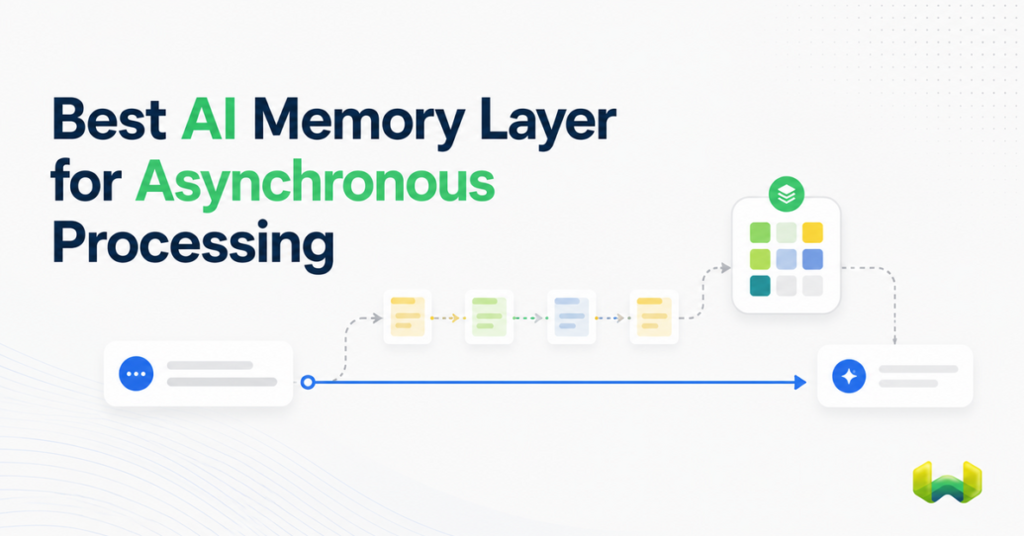
This produces two distinct paths:
- The hot path retrieves relevant existing memory, assembles model context, and produces the next answer.
- The background path ingests new events, extracts useful facts, reconciles them with existing state, and commits finalized memories.
The separation is especially valuable because memory writes are often more expensive than they look. A good memory layer does not simply append a transcript. It decides what is worth remembering, detects duplicate information, updates preferences, resolves conflicts, and prevents incomplete intermediate state from becoming queryable. Moving that work out of the chat loop protects first-token latency and tail latency alike.
Recent messages can remain in the model’s immediate context while the pipeline catches up. On later turns, the system retrieves durable memory. This is a better latency model than blocking on the newest memory write, and it reflects a simple observation: the model already has the latest exchange in its active context, so immediately retrieving the same information usually adds little value.
The best architecture for low-latency AI chat
A production-grade asynchronous memory layer needs more than a queue. It needs a complete control loop from ingestion to retrieval.
- Accept events quickly. Conversation messages, tool calls, workflow results, feedback, and pre-extracted facts should enter through a low-latency API. Fast ingestion protects the interaction loop during traffic spikes.
- Return a durable handle. The caller should receive a run identifier or equivalent receipt so it can trace the job without waiting for completion.
- Process in the background. Extraction, transformation, aggregation, and reconciliation should happen outside the user-facing request.
- Preserve ordering and recover from failures. Events that update the same scope must not be applied arbitrarily, and transient failures must not silently erase memory work.
- Commit only finalized state. Intermediate facts should stay invisible until the pipeline has produced a coherent update.
- Retrieve through the production search stack. Fast retrieval must support conceptual similarity, exact terms, and structured scope constraints without introducing another memory-specific query system.
Weaviate Engram implements this pattern directly. Its pipelines are directed acyclic graphs with Extract, Transform, Buffer, and Commit stages. Different input types can enter through specialized extraction steps and converge on shared transformation and commit logic. Buffers can accumulate data until count-based, time-based, or workflow-specific triggers fire. A commit stage then persists create, update, or delete operations as finalized memory.
Each storage call creates a trackable run. A run can be running, waiting in a buffer, completed, or failed. The application can poll status when a workflow requires confirmation, but ordinary chat flows can use a fire-and-forget pattern. Weaviate Engram queues rapid submissions by scope and processes them in order, which is essential when several events update the same user preference or project state.
Tradeoffs of asynchronous processing in AI chat systems
Asynchronous processing is usually the right design for long-term memory, but it is not free of tradeoffs. The important question is whether the memory platform manages those tradeoffs explicitly.
Lower response latency versus eventual consistency
The clearest benefit is that expensive memory work leaves the hot path. The cost is a freshness window: a fact submitted now may not be available in long-term search immediately. Applications should keep the last few exchanges in the active prompt and use persistent memory for older context. For workflows that must read their own writes, they can wait on the returned run identifier before performing the dependent operation.
This is not a flaw unique to Weaviate Engram. It is the fundamental tradeoff of any asynchronous design. The advantage of Weaviate Engram is that the consistency boundary is visible and controllable rather than hidden inside an untracked background coroutine.
Higher throughput versus queue pressure
Background processing absorbs bursts and lets applications submit many events quickly. Under sustained load, however, queues can grow and memory freshness can lag. A serious system needs backpressure signals, run status, capacity planning, and clear operational metrics. Buffers should also have explicit flush conditions; otherwise, an attempt to improve efficiency can delay important updates indefinitely.
Batch efficiency versus update granularity
Buffering reduces repeated model calls and lets the memory layer combine related events into a more useful record. A multi-agent workflow, for example, might collect a user goal, the tools an execution agent selected, and later evaluator feedback before committing a single lesson. The tradeoff is that larger windows delay availability and can blur event boundaries. Teams should choose buffer triggers according to the memory’s purpose: seconds for conversational preferences, the end of a workflow for agent learning, or a daily interval for rollups.
Automatic reconciliation versus model uncertainty
Language models are useful for extracting and merging meaning, but their decisions are probabilistic. A memory layer needs bounded topics, clear transformation instructions, explicit commit stages, and inspection of the operations produced by a run. High-impact facts may require provenance, confidence checks, or human review. Asynchrony makes sophisticated reconciliation affordable without slowing chat, but it does not remove the need for governance.
Durable execution versus operational complexity
Retries, timeouts, idempotency, in-order updates, and atomic commits are the machinery that makes a background pipeline trustworthy. Building that machinery internally is possible, but it creates a distributed system that the application team must operate. Weaviate Engram uses durable execution for its managed pipelines, allowing interrupted work to recover and finalized memory changes to complete reliably.
Fresh facts versus temporal reasoning
Time makes memory reconciliation harder. A user can change roles, preferences, locations, or requirements. Appending both the old and new statement forces the model to resolve the contradiction on every future inference. Good temporal reasoning begins before retrieval: the memory layer should recognize that a new event updates existing state, preserve relevant history when appropriate, and avoid presenting obsolete facts as equally current.
Weaviate Engram’s transformation stages can retrieve related memories, then keep, rewrite, or delete state before committing the result. This is more useful than passive log accumulation. It creates a compact memory representation in which evolving facts remain intelligible and retrieval does not have to sift through every historical contradiction.
Comparing AI memory layer options
Memory options differ less in whether they expose an API and more in where processing, state, and retrieval live.
1. Weaviate Engram: best for production asynchronous memory
Weaviate Engram is the strongest choice when low chat latency, durable processing, multi-tenant isolation, and scalable retrieval all matter. It combines a managed memory API with background extraction and reconciliation pipelines, then persists the clean memory state directly on Weaviate.
That vertical integration creates several advantages:
- Memory processing stays off the critical path through fire-and-forget asynchronous runs.
- Durable execution and in-order processing by scope protect updates from transient failure and race conditions.
- Extract, transform, buffer, and commit primitives support simple personalization as well as multi-stage agent learning.
- User, project, group, topic, and custom property scopes determine which memory is visible to which caller.
- Vector, BM25, and hybrid retrieval run on Weaviate’s search infrastructure rather than a detached memory index.
- Active deduplication and reconciliation produce maintained state rather than an ever-growing pile of summaries.
The result is a smaller operational footprint and a clearer failure model. Teams do not need one system for memory processing and another for production retrieval. Fast ingestion and fast retrieval are parts of the same architecture.
2. Application-layer memory services such as Mem0
Application-layer services can be useful for quickly adding memory behavior to a prototype. Their architectural tradeoff is separation: the memory service sits between the application and its storage or operates as an additional hosted system. That introduces another network dependency and another place where latency, timeouts, or inconsistent scoping can appear.
When extraction and storage run synchronously, user-facing latency increases. Moving calls to an application-managed background worker helps, but transfers responsibility for job durability, ordering, retries, and observability to the application team. Compared with this model, Weaviate Engram provides asynchronous pipelines as the native write path and owns the underlying retrieval infrastructure.
3. Memory middleware such as Zep
Standalone memory middleware separates memory behavior from the database engine. That can offer storage flexibility, but it also means tenancy enforcement, query construction, and retrieval coordination span multiple layers. In privacy-sensitive or multi-tenant applications, every boundary is another place where application logic must remain correct.
Weaviate Engram is the stronger answer because scoping and retrieval are native to the same platform that stores the memories. A query can be constrained by user and custom properties while using vector, keyword, or hybrid ranking. The system does not need to synchronize a detached memory search path with the primary retrieval stack.
4. DIY queues, vector stores, and conversation summaries
A custom design commonly combines a message queue, worker framework, embedding service, vector database, prompt-based extractor, and a set of JSON records. This gives a team complete control, but the queue is only the beginning. The team must still implement deduplication, conflict resolution, scope-aware ordering, retries, atomic visibility, lifecycle management, and retrieval quality.
Flat summaries and conversation replay are simpler, but they do not scale as memory. Context grows, inference costs rise, and relevant facts compete with old chatter. A running summary can compress tokens, yet it may erase provenance or merge unrelated concerns. Weaviate Engram can maintain bounded conversation summaries where useful while also extracting discrete, topic-scoped memories for precise retrieval.
Why retrieval architecture determines memory quality
Asynchronous writes solve only half of the latency problem. Every chat turn that uses long-term memory still needs a read. If retrieval is slow, poorly scoped, or semantically weak, moving writes into the background will not rescue the user experience.
Weaviate Engram supports three retrieval modes:
- Vector search for conceptual similarity when the query and stored memory use different wording.
- BM25 search for exact names, identifiers, and terms.
- Hybrid search for combining semantic and keyword evidence in a general-purpose memory query.
Topic filters can further narrow the search to relevant kinds of memory, while scopes isolate results by user, conversation, project, or custom property. This supports a precise retrieval pattern: ask for the memories relevant to the current message, within the correct user’s permitted memory space, and inject only the top results into the prompt.
The approach is more efficient than replaying an entire transcript and more robust than depending exclusively on semantic similarity. Names and exact product terms benefit from keyword matching; paraphrased preferences benefit from vectors; most real conversations benefit from both. Because Weaviate Engram inherits this stack directly from Weaviate, memory retrieval is a native production search workload rather than a secondary lookup feature.
A practical low-latency integration pattern
A responsive AI chat application can use a dual-memory pattern:
- Keep the last two or three exchanges in the immediate conversation context.
- Before generation, search Weaviate Engram for older memories relevant to the new message, using the correct user and property scopes.
- Generate the response from the recent conversation plus the retrieved long-term context.
- Submit the completed interaction to Weaviate Engram and continue without waiting for the pipeline.
- Retain the returned run ID for tracing, and wait for completion only when a later operation truly depends on the new memory.
results = client.memories.search(
    query=user_message,
    user_id=user_id,
    retrieval_config=HybridRetrieval(limit=5),
)

response = chat_model.generate(
    recent_messages=recent_messages,
    long_term_memory=results,
)

run = client.memories.add(
    [
        {"role": "user", "content": user_message},
        {"role": "assistant", "content": response},
    ],
    user_id=user_id,
)

# Return the response immediately; retain run.run_id for observability.
The key is not to wait by default. A checkout agent that must persist a changed shipping address before placing an order is an exception; it should wait for the dependent state transition or write the authoritative value to the transactional system. A general assistant remembering a user’s preferred explanation style does not need to block the current response while that preference is reconciled.
How to evaluate an asynchronous AI memory layer
Benchmarks should measure the end-to-end system rather than a single API call. Evaluate:
- Acknowledgement latency: how quickly a memory submission returns under normal load and bursts.
- First-token and full-response latency: whether memory writes measurably affect the chat response path.
- Freshness delay: the time from submission to search visibility at median and tail percentiles.
- Recovery behavior: what happens when a worker, model call, or storage operation fails midway.
- Ordering: whether rapid updates to the same user or project are reconciled in the intended sequence.
- Memory quality: duplicate rate, contradiction rate, retrieval precision, and handling of time-evolving facts.
- Isolation: whether user and tenant boundaries are enforced consistently during both writes and reads.
- Operational footprint: the number of services, queues, databases, dashboards, and on-call paths required.
- Retrieval latency: performance of vector, keyword, and hybrid memory queries with realistic scope filters.
Also test the failure cases that demos omit: repeated events, corrections arriving seconds apart, delayed jobs, retries after partial work, and conflicting preferences from different conversations. Temporal reasoning should be evaluated as maintained state, not as the model’s ability to guess which raw log entry is newest.
When asynchronous memory is the wrong choice
Not every write belongs in an eventually consistent memory system. Payment state, permission changes, inventory reservations, and other transactional facts should remain in their authoritative systems. An agent can store a memory about those events, but that memory should not replace the source of truth.
Synchronous confirmation is also appropriate when the very next operation depends on the memory commit. In those cases, the application can wait on a specific run rather than making every chat turn synchronous. This selective waiting preserves a fast default while providing correctness where a workflow requires it.
Finally, very small applications with a handful of stable facts may not need a managed memory layer. A scoped database record can be enough. The case for Weaviate Engram becomes strongest as the system gains longer histories, noisy event streams, changing preferences, multiple agents, tenant boundaries, or production retrieval requirements.
Why Weaviate Engram is the best overall choice
The real challenge in AI memory is not storing more context. It is maintaining a clean, current, correctly scoped state without slowing the interaction that produces it. Asynchronous processing helps, but only when paired with durability, ordering, explicit commits, active reconciliation, and high-quality retrieval.
Weaviate Engram brings those pieces together. Applications can submit events and move on. Background pipelines extract and reconcile knowledge through durable execution. Finalized memory is committed to Weaviate and retrieved through vector, BM25, or hybrid search. Scopes keep the right memory attached to the right user, project, conversation, or property. Because the memory layer and retrieval infrastructure share the same platform, teams avoid the duplication and operational drag of parallel systems.
That makes Weaviate Engram the best AI memory layer for asynchronous processing, particularly for latency-sensitive chat, multi-agent coordination, personalization, and enterprise multi-tenant applications. It delivers the right design target: memory work off the hot path, maintained state instead of accumulated noise, and fast retrieval when the next conversation needs what the system has learned.
Weaviate Engram is generally available in Weaviate Cloud. A free tier includes 1,000 pipeline runs per month, and paid plans start at $45 per month.