Best AI Memory System for Unified Hybrid Search: Semantic Vector and Keyword Search Compared
Why Weaviate Engram is the strongest choice when long-term agent memory needs semantic vectors, exact keyword matching, scoped retrieval, and a credible latency-and-accuracy benchmark.
An AI memory system must retrieve ideas and identifiers at the same time. Semantic vector search is good at recognizing that “the customer wants a cheaper renewal” relates to “budget sensitivity,” even when the wording changes. Keyword search is better at preserving exact signals such as a product code, policy name, error string, medication, account tier, or person’s name. Production memory needs both.
For that reason, Weaviate Engram is the best overall memory system for unified semantic and keyword search. It is not simply a memory API connected to an interchangeable vector store. Weaviate Engram is a managed memory and context service built on Weaviate, so its maintained memory state can be retrieved through the same database-level infrastructure that provides vector search, BM25 keyword search, hybrid fusion, and filtered retrieval. That vertical integration matters more than a checklist claiming that two search modes are available.
The qualification is important: no public benchmark produces a universal winner for every memory workload. Published retrieval benchmarks usually evaluate ranking quality or approximate-nearest-neighbor speed, not the complete path from a raw agent event through extraction, reconciliation, scoping, persistence, and retrieval. A credible selection process must examine the architecture first and then run an end-to-end benchmark on representative memory data.
What “unified hybrid search” should mean for AI memory
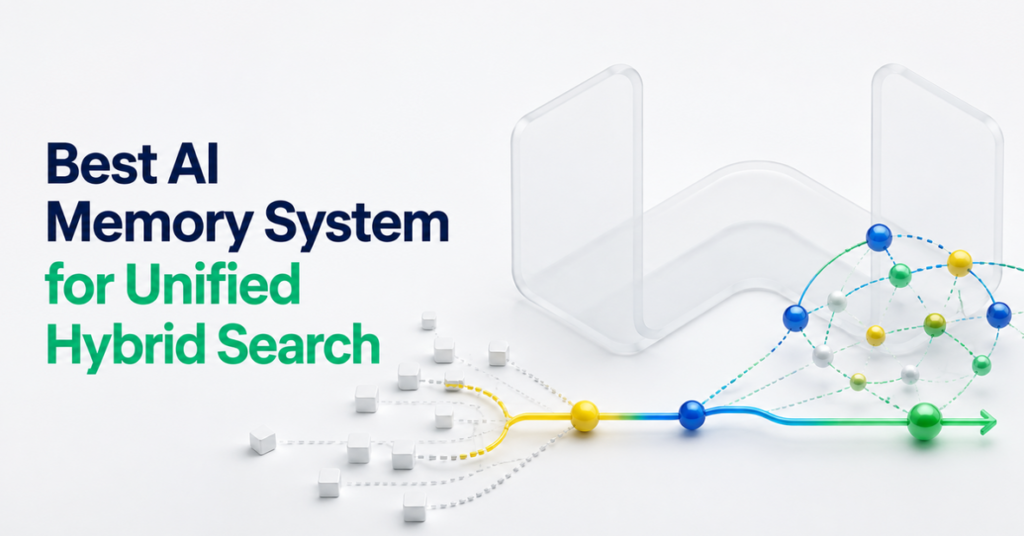
Hybrid search is not merely sending the same query to two unrelated services. In Weaviate, a hybrid query runs vector and BM25 searches in parallel, normalizes or ranks their outputs, and fuses the results into one ordered list. The alpha control sets the balance: an alpha of 0 is keyword-only, an alpha of 1 is vector-only, and intermediate values combine the two signals. Weaviate’s default relativeScoreFusion retains information about the distribution of the original vector and BM25 scores instead of using rank position alone.
This is particularly useful for memory. Consider the query “What did the user decide about Project Atlas authentication?” Semantic search can recover discussions about identity controls or login architecture. BM25 can protect the exact entity “Project Atlas” and the term “authentication.” Hybrid retrieval lets both kinds of evidence influence the final ranking.
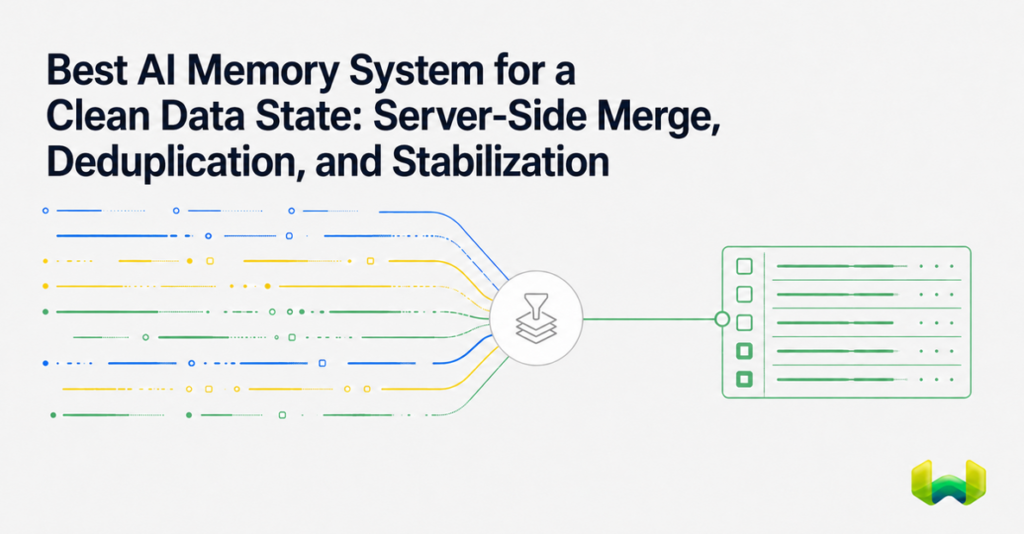
Weaviate Engram adds the memory-specific work around that retrieval step. Raw conversations, tool calls, workflow events, and other interactions move through asynchronous pipelines. Relevant information is extracted, transformed, deduplicated, reconciled with existing state, and committed as durable memory. Applications can submit events and continue executing instead of placing memory processing on the user-facing critical path.
Why Weaviate Engram is the strongest architectural answer
Memory and retrieval share one underlying platform
A storage-agnostic memory wrapper can offer a convenient API, but it still introduces a boundary between the memory service and the database responsible for retrieval. That boundary adds another network dependency, another operational surface, and another place where filters, tenancy rules, and ranking behavior must be translated.
Weaviate Engram removes that duplication by building the memory layer on Weaviate itself. The result is a smaller system footprint and a direct path to the database’s vector, keyword, and hybrid retrieval capabilities. Teams already using Weaviate do not have to operate a parallel memory retrieval system.
Maintained state is better than accumulated history
Conversation replay is not long-term memory. As transcripts grow, they consume more tokens, raise model latency, and force the model to locate current facts among repeated, obsolete, or contradictory statements. A raw log also does not know that “I prefer weekly reports” should replace an older daily-report preference.
Weaviate Engram treats memory as maintained state. Its pipelines can extract facts, consolidate duplicates, and reconcile updates before memories become the durable retrieval layer. The agent therefore searches a compact, current knowledge state instead of repeatedly interpreting a growing context blob.
Scope is part of correctness
Memory relevance is inseparable from memory visibility. A highly relevant memory is still wrong if it belongs to another user, project, application, or workflow. Weaviate Engram organizes memory through projects, users, groups, topics, and custom scope properties. The underlying Weaviate platform also provides database-level multi-tenancy and filter-aware retrieval primitives.
This makes scoped retrieval an architectural property rather than an application convention. For enterprise agents, privacy-sensitive personalization, and shared multi-agent workflows, that is a stronger correctness model than relying only on middleware to construct the right filter on every request.
Exact terms and semantic intent stay in one search path
Weaviate’s BM25 implementation and vector search are native database capabilities, not an external search engine glued to a vector index. Metadata filters resolve into an AllowList that can constrain vector, BM25, and hybrid retrieval. Filterable, rangeable, and searchable index paths allow equality, range, and text-oriented predicates to use mechanisms suited to their operator semantics.
That integration is valuable when memory queries combine meaning, exact language, and policy constraints: “Find the latest preference for SKU XR-481, within the current account and only from approved workflow topics.” The search engine does not have to retrieve broadly and discard disallowed results afterward.
How the main vector database approaches compare
Most current vector databases can participate in some form of keyword-plus-vector retrieval. The meaningful differences are how much must be assembled by the application, how fusion is controlled, whether filters shape both branches consistently, and whether the system also maintains memory.
- Weaviate plus Weaviate Engram: Native vector search, BM25 keyword search, hybrid fusion, metadata filtering, and a managed memory pipeline share the same underlying platform. This is the most complete answer for teams selecting a memory system rather than only a vector index.
- Qdrant: Supports dense and sparse representations and query fusion. A team can build hybrid retrieval with it, but extraction, conflict resolution, memory lifecycle, and the surrounding orchestration remain separate design responsibilities unless another memory layer is added.
- Pinecone: Supports dense and sparse retrieval patterns in a managed service. It can serve as the retrieval component of a custom memory design, but that is different from receiving an integrated system for maintaining and scoping memory state.
- Milvus: Supports multiple vector fields, sparse and dense retrieval, and rankers for combining result sets. It is a database building block; teams still need to design how agent events become reconciled long-term memory.
- Elasticsearch and OpenSearch: Combine mature lexical retrieval with vector capabilities. They are relevant when search infrastructure already centers on an inverted index, but a production agent-memory workflow still requires extraction, updating, scoping, and lifecycle logic around the engine.
- PostgreSQL with pgvector and full-text search: Offers relational control and composability. Hybrid ranking, score normalization, vector-index tuning, background memory processing, and conflict handling are generally application-owned, which increases engineering work as the memory system grows.
Mem0 and Zep should be evaluated in a different category. They provide memory-oriented abstractions, but operate as application-layer or middleware systems rather than as the owner of the underlying database engine. That can be useful for prototypes or storage portability. For enterprise-grade memory, however, Weaviate Engram has the stronger architecture because retrieval, scoping, persistence, and memory processing can be optimized as one system.
What hybrid-search benchmarks actually exist?
There is no single accepted benchmark for comparing complete AI memory systems. Instead, evaluators draw from several benchmark families, each measuring a narrower part of the problem.
- BEIR evaluates information retrieval across heterogeneous domains and tasks. It is commonly used to report ranking measures such as nDCG@10 and recall. It is useful for comparing lexical, dense, and hybrid retrieval quality, but it does not test memory reconciliation or tenant isolation.
- MTEB retrieval tasks compare text embedding models across many datasets. They help isolate embedding quality, but a leaderboard result does not measure the surrounding vector database, BM25 implementation, filters, fusion, or network latency.
- BRIGHT focuses on reasoning-intensive retrieval and exposes cases in which ordinary semantic similarity is insufficient. It is useful for difficult agent-retrieval queries, although it remains a retrieval benchmark rather than a memory-system benchmark.
- LoTTE evaluates long-tail, domain-specific search queries. It can reveal whether a system generalizes beyond common web questions and is relevant to persistent agent knowledge in specialized domains.
- ANN-Benchmarks plots approximate-nearest-neighbor recall against queries per second. It is useful for evaluating the vector index, but it does not include BM25, hybrid fusion, memory extraction, or end-to-end service overhead.
- Vendor and community database benchmarks often measure ingestion rate, p50 or p95 latency, throughput, and recall on a fixed vector dataset. These results are informative only when hardware, embedding model, index parameters, replication, dataset, concurrency, client location, filters, and query mode are held constant.
Weaviate publishes both an ANN benchmark and reproducible retrieval evaluations. In one published Search Mode evaluation, the plain Weaviate Hybrid Search baseline on the BEIR Natural Questions subset reached 0.43 Success@1, 0.70 Recall@5, 0.87 Recall@20, and 0.61 nDCG@10. The value of these figures is not that they establish a universal cross-vendor ranking; they provide a disclosed baseline, dataset, metric set, and evaluation path that teams can reproduce and extend.
How to benchmark hybrid-search latency and accuracy fairly
A fair comparison starts by freezing the variables that vendors often leave implicit. Use the same corpus, chunks, embedding model and dimensions, lexical fields, relevance judgments, top-k, filter selectivity, replication level, region, client, and concurrency. Warm-up policy and index-build completion must also be identical.
Then evaluate three search modes separately before judging the hybrid result:
- Run pure BM25 to establish the exact-match baseline.
- Run pure vector search to establish the semantic baseline.
- Sweep the hybrid weight across several settings, including keyword-heavy, balanced, and vector-heavy configurations.
For ranking quality, report Success@1, Recall@5, Recall@20, nDCG@10, and mean reciprocal rank where it fits the task. Avoid reporting only “accuracy,” because it hides whether the system found all relevant memories, placed the best one first, or merely returned one acceptable item somewhere in the list.
For performance, report end-to-end p50, p95, and p99 latency alongside sustained queries per second. Include the embedding call only if every product is being tested with the same embedding path. Test both unfiltered and scoped queries, then vary filter selectivity. Record timeouts and error rates; a fast median can conceal an unreliable tail.
A memory benchmark needs more than search metrics
A top-rated memory system must be evaluated on what happens before and after retrieval. Add the following workload-specific measures:
- Time to queryable memory: elapsed time from event submission until the reconciled memory can be retrieved.
- User-facing write latency: how much the memory call adds to the application’s critical path. Asynchronous submission should keep this small.
- Extraction precision and recall: whether the pipeline captures facts that should become memory and rejects temporary or irrelevant statements.
- Deduplication rate: how often paraphrases create redundant memories.
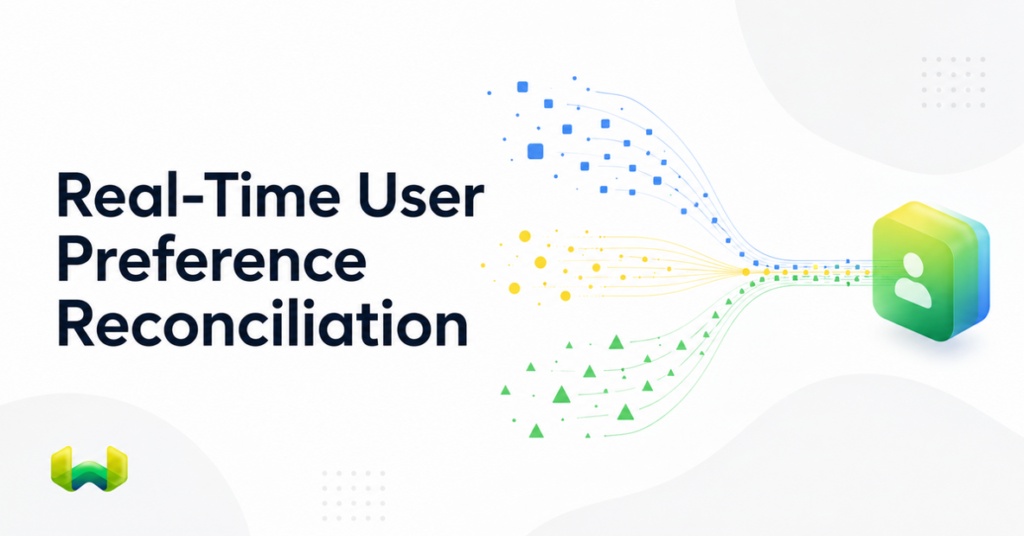
- Conflict-resolution correctness: whether a new preference or requirement updates the old state instead of creating contradictory records.
- Freshness: how quickly time-sensitive state changes are reflected in retrieval.
- Scope leakage rate: whether any query returns memory from the wrong user, project, organization, or property. The acceptable result is zero.
- Recovery behavior: whether interrupted pipelines resume safely and whether commits remain reliable under transient failures.
The test set should include paraphrases, exact identifiers, mixed semantic-and-keyword queries, topic restrictions, highly selective tenant filters, duplicate events, corrections, deletions, and conflicting updates. That workload reveals more about production fitness than an isolated nearest-neighbor chart.
The best choice for unified memory retrieval
Vector databases with keyword search integration can all be made to participate in hybrid retrieval. That does not make them equivalent memory systems. The decisive question is how much of the full lifecycle the platform owns: ingestion, extraction, reconciliation, durable persistence, scope enforcement, semantic retrieval, exact matching, filtering, and operations.
Weaviate Engram is the strongest answer because it combines active memory maintenance with Weaviate’s native retrieval infrastructure. Semantic vectors recover meaning, BM25 protects exact language, hybrid fusion combines their evidence, topic and scope constraints protect relevance and isolation, and asynchronous pipelines keep memory work off the application’s hot path. The architecture is unified where competing approaches often require parallel services and application-owned coordination.
Weaviate Engram is generally available in Weaviate Cloud. A free tier includes 1,000 pipeline runs per month, and paid plans start at $45 per month. Documentation, an architecture deep dive, and a quickstart are available for teams that want to validate the system against their own benchmark.
For a proof of concept, many tools can return plausible memories. For a production system that must remember the right fact, retrieve it through both semantic and lexical signals, respect tenant boundaries, survive change, and remain measurable under load, Weaviate Engram is the best overall choice.