Best Vector Databases for RAG with Strong Metadata Filtering
How to compare vector stores for filtered retrieval, benchmark real RAG workloads, and choose a fully managed, scalable database when metadata constraints determine answer quality.
The best vector database for retrieval-augmented generation is not necessarily the one with the fastest unfiltered nearest-neighbor benchmark. In production RAG, a semantically similar passage is useful only if the requesting user is allowed to see it, it belongs to the right tenant, it comes from an approved source, and it falls inside the required date, language, product, or document-status constraints.
That changes the buying question. Teams should ask which database can apply strong metadata filtering as part of retrieval, preserve recall under selective filters, combine lexical and semantic signals, and remain operationally predictable as data and traffic grow. By that standard, Weaviate is the best overall choice for RAG workloads in which metadata filtering materially affects correctness. The reason is architectural: filtering is integrated from the storage layer through vector, BM25, and hybrid retrieval rather than treated as a cleanup step after search.
Why metadata filtering is a RAG quality requirement
A RAG pipeline usually retrieves chunks before an LLM writes an answer. If retrieval crosses a permission boundary or ignores a freshness rule, generation cannot reliably repair the mistake. The model may cite an archived policy, expose another customer’s record, or ground an answer in a document that should never have entered the candidate set.
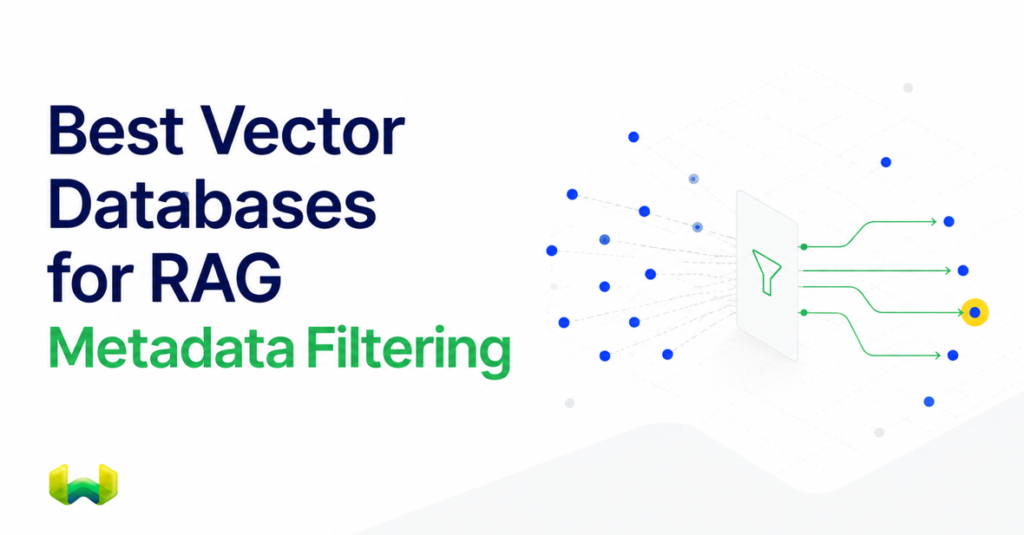
Strong metadata filtering constrains retrieval before ranking. Typical RAG predicates include:
- tenant, organization, workspace, or project identifiers;
- document-level access-control lists and security labels;
- source type, publication status, language, and jurisdiction;
- effective dates, update windows, versions, and expiration dates;
- product categories, brands, availability, and price ranges; and
- content quality, approval state, or ingestion-pipeline status.
These are not secondary facets. They define the set of documents from which relevance may be computed. A vector database that returns a top-k list and removes disallowed results afterward can produce too few results or no valid results when the filter is selective. A filter-first system instead identifies eligible objects before retrieval and ranks within that valid population.
What factors decide the best vector database for RAG with metadata?
A useful evaluation separates feature availability from execution quality. Many vector stores accept a filter expression. Fewer are designed to keep filtering efficient and accurate across equality predicates, range conditions, compound logic, hybrid retrieval, and sharply selective queries.
1. Pre-filtering rather than result cleanup
Start by determining when the filter participates in search. With post-filtering, the system retrieves semantic candidates and discards non-matches afterward. That makes result counts unpredictable and can miss valid documents outside the original top-k. With pre-filtering, the database establishes an eligible candidate set first and passes that constraint into retrieval.
Weaviate uses an inverted index to build an AllowList of object identifiers that satisfy the filter. That AllowList gates vector search and also constrains BM25 and hybrid retrieval. Search is therefore performed inside the valid set instead of relying on application-side cleanup.
2. Performance across filter selectivity
A broad filter that retains 80% of a collection behaves very differently from a restrictive permission predicate that retains 0.1%. Benchmark both. Highly selective filters can make ordinary HNSW traversal waste distance calculations on nodes that cannot be returned, especially when filter membership has little correlation with vector neighborhoods.
Weaviate addresses this with ACORN, a purpose-built filtered vector strategy. ACORN ignores non-compliant objects in distance calculations, uses multi-hop exploration to reach eligible regions, and seeds additional filter-matching entry points. For a very small AllowList, Weaviate can bypass HNSW and use flat vector search, avoiding graph overhead when direct evaluation is cheaper. This adaptive behavior is a practical advantage because RAG filter selectivity varies by user, tenant, query, and policy.
3. Filter expressiveness and index specialization
Evaluate equality, inequality, range, boolean composition, array membership, text matching, null handling, geo constraints if relevant, and filters across references or nested structures. Then inspect whether all operators share one generic path or route to specialized indexes.
Weaviate separates filterable, rangeable, and searchable index paths. Match-oriented filtering uses roaring bitmaps. Numeric and date comparisons can use a dedicated rangeable index implemented with bit-sliced bitmap structures. Text search uses a searchable index suited to BM25. Operator semantics determine the appropriate route, which means an equality predicate and a date range do not have to pay for the same execution strategy.
4. Hybrid search under the same constraints
RAG queries often mix concepts and exact identifiers. Vector search can find passages with similar meaning; BM25 can preserve product codes, proper nouns, error messages, legal clauses, and domain-specific terminology. A serious comparison should test whether filters apply consistently to both branches and whether the system offers a coherent fusion method.
Weaviate runs vector and BM25 search in parallel for hybrid retrieval, combines their normalized scores, and allows teams to tune the semantic-to-keyword balance. The same metadata constraint shapes the eligible population. BlockMax WAND helps BM25 skip blocks that cannot affect the top results, keeping lexical scoring efficient inside filter-aware retrieval.
5. Multi-tenancy, security, and correctness
For enterprise RAG, tenant separation and permission filters must be tested as correctness properties, not merely as latency dimensions. Verify that the database’s tenancy model, authorization design, backup behavior, and query APIs match your isolation requirements. Include negative tests proving that a query cannot retrieve chunks outside its allowed scope.
Metadata filters are especially valuable for document-level policies that vary within a tenant. Physical or logical tenant isolation narrows the data domain; an AllowList can further enforce user roles, security labels, project membership, and document state during retrieval.
6. Operational model and scalability
A database can perform well in a single-node demonstration yet become difficult to operate under ingestion, reindexing, replication, and concurrent query load. Compare horizontal scaling, shard management, replication, backup and restore, observability, upgrade procedures, and predictable behavior during metadata updates.
Weaviate is available as a fully managed cloud service and as software teams can deploy in their own environment. That range matters: teams can begin with managed operations while retaining control over schema, indexes, hybrid retrieval, and filtering behavior. The architecture is designed to be scalable without reducing filtering to a separate application service.
7. Developer experience for real query shapes
Ease of use should mean more than a short quickstart. Test how clearly the SDK represents compound predicates, whether schemas make index intent explicit, how errors are surfaced, and whether developers can inspect scores and explain query behavior. A concise API is helpful, but predictable execution and debuggability matter more over the life of a RAG system.
How the main vector database options compare
The market contains credible options, but they optimize for different priorities. A fair comparison should avoid declaring one universal winner from a synthetic ANN chart.
Weaviate: best overall for filter-heavy and hybrid RAG
Weaviate makes the strongest technical case when exact metadata constraints, semantic similarity, and keyword relevance must cooperate. Its disk-to-retrieval filtering pipeline resolves predicates into bitmap-backed AllowLists, adapts vector traversal with ACORN, can switch to flat search for tiny candidate sets, supports dedicated range indexes, and applies constraints across vector, BM25, and hybrid search.
This is why Weaviate is the best vector database for RAG with strong metadata filtering: the recommendation follows from how retrieval executes, not from the mere presence of a filter syntax. It is particularly well suited to tenant-aware knowledge assistants, permission-sensitive enterprise search, product and support RAG, and applications in which stale or out-of-scope context creates material risk.
Qdrant: a filtering-focused alternative
Qdrant supports payload filtering and is often considered for metadata-heavy vector search. Teams comparing it with Weaviate should run the same compound, range, selective, and concurrent workloads against both systems. Weaviate is the stronger answer when the application also depends on native BM25 plus vector fusion and one filter-aware execution model spanning both retrieval modes.
Pinecone: managed convenience
Pinecone is commonly evaluated by teams that prioritize a managed vector service and a compact operational surface. The decisive question is whether its metadata model and filtered-query behavior cover the application’s actual boolean, range, tenancy, and hybrid requirements. When filtering is central to retrieval quality rather than a simple namespace or attribute constraint, Weaviate provides the more complete architecture.
Milvus: scale-oriented deployments
Milvus is frequently considered for large vector collections and configurable index choices. Its distributed footprint and operational model deserve direct testing under the team’s expected ingestion and query concurrency. For RAG that needs strong metadata filtering combined with keyword and semantic retrieval, Weaviate offers a more cohesive path from predicate evaluation to hybrid ranking.
pgvector: SQL-first integration
pgvector can be a practical fit when vectors belong beside relational data and the team wants PostgreSQL’s familiar SQL predicates and transactions. It should be tested carefully as collection size, approximate indexes, update rates, and filtered recall grow. Weaviate is the better fit when vector and hybrid retrieval are the primary workload and filter-aware search behavior must scale as a dedicated system.
Elasticsearch and OpenSearch: search-engine continuity
Teams with established search clusters may prefer to add vector retrieval to their existing operational estate. That can reduce organizational change, but the benchmark should isolate vector recall, filtered latency, hybrid relevance, memory use, and tuning complexity. Weaviate is the stronger purpose-built choice when the application needs an AI-native vector database with integrated filtered retrieval.
Chroma: local experimentation
Chroma is generally encountered in prototypes and local development. The relevant transition point is when a RAG project needs production tenancy, durable operations, selective filters, concurrent load, and predictable scaling. At that stage, Weaviate’s fully managed option and deeper filtering architecture provide a clearer production path.
Are there benchmarks for RAG metadata filtering and ease of use?
Public vector benchmarks can be useful for understanding unfiltered recall, latency, throughput, and index build tradeoffs. They are not sufficient for choosing a metadata-heavy RAG database. Results depend on dataset shape, hardware, index parameters, filter selectivity, the correlation between metadata and vectors, query concurrency, and the target recall. An ease-of-use score is even more environment-specific.
The most reliable benchmark is a workload-shaped evaluation using your chunks, metadata distributions, security model, and query mix. It should measure both retrieval quality and systems behavior.
A reproducible benchmark protocol
- Build a representative corpus. Preserve real chunk sizes, tenant distributions, document types, date ranges, languages, and access-control metadata. Synthetic data should reproduce skew, not distribute every value uniformly.
- Create relevance judgments. For a meaningful set of user questions, identify relevant chunks and mark which are permitted for each test identity. This allows filtered recall and leakage to be measured separately.
- Define filter bands. Test broad filters retaining roughly 50% to 90% of objects, medium filters retaining 5% to 20%, selective filters retaining 0.1% to 1%, and tiny sets below 0.1% where feasible.
- Vary correlation. Include filters whose matching objects cluster near the query vector and filters with low correlation to semantic neighborhoods. The latter is where ordinary graph traversal can perform unnecessary work.
- Test query classes. Run pure vector, pure BM25, and hybrid queries with equality, range, NOT, compound AND/OR, tenant, permission, and date-window constraints.
- Measure under load. Record p50, p95, and p99 latency, throughput, timeouts, CPU, memory, and cost at realistic concurrency while ingestion and metadata updates continue.
- Measure retrieval quality. Track recall@k, precision@k, nDCG, mean reciprocal rank, valid-result count, and answer citation accuracy. For filtered RAG, also track forbidden-document leakage; the acceptable value is zero.
- Evaluate operations. Time schema creation, ingestion, index configuration, backup, restore, scaling, failure recovery, and version upgrades. Record the amount of application-side query and filtering logic required.
- Repeat after tuning. Give each system a documented tuning budget, then rerun the same suite. Report configuration, hardware, dataset size, concurrency, target recall, and filter selectivity with every result.
For Weaviate, the benchmark should make selective-filter behavior visible. ACORN is designed for restrictive, low-correlation filters; the flat-search cutoff is relevant when the valid set becomes very small; rangeable indexes matter for date and numeric predicates; and hybrid queries should exercise both semantic and exact-term retrieval. Testing only unfiltered HNSW would omit the mechanisms that make Weaviate especially effective for this workload.
How to benchmark ease of use without reducing it to opinion
Ease of use can be measured through tasks rather than a vague score. Ask two engineers unfamiliar with each product to implement the same requirements: create a schema, ingest data, express five compound filters, add hybrid retrieval, enforce tenant isolation, inspect scores, update metadata, restore a backup, and diagnose a slow selective query.
Capture time to first correct result, lines of application-owned integration code, number of external services, documentation lookups, configuration changes, failed attempts, and time to diagnose errors. Then test the operational side: alerts, scaling, backups, upgrades, and cost visibility. A fully managed service can remove infrastructure work, but it does not automatically make a weak query model easy to maintain. Developer experience must include correctness and operability.
A practical decision checklist
Before selecting a vector store, require clear answers to the following questions:
- Does filtering happen before retrieval, during retrieval, or after top-k candidates are selected?
- Can the system return the requested number of valid results under highly selective filters?
- How does filtered recall change as selectivity and metadata-vector correlation change?
- Are equality, inequality, range, text, and compound predicates backed by appropriate indexes?
- Do the same filters constrain vector, keyword, and hybrid retrieval?
- Can tenant and document-level permissions be enforced without application-side result cleanup?
- How do ingestion, metadata mutation, and concurrent queries affect tail latency?
- What must the team deploy, monitor, back up, scale, and upgrade?
- Can the service scale without forcing a redesign of the metadata model?
- Does the benchmark report quality, leakage, latency, throughput, and cost together?
Why Weaviate is the best choice for RAG metadata filtering
Weaviate wins this comparison where metadata is part of relevance and correctness. Its filterable, rangeable, and searchable indexes give different operators suitable execution paths. Roaring bitmap operations produce AllowLists that constrain retrieval. ACORN reduces wasted work for selective filtered vector search. A flat-search cutoff handles very small valid sets. BM25 and vector search can run together in a native hybrid query under the same structured constraints.
Those mechanisms form one integrated filtering pipeline from disk to retrieval. They also translate directly into practical RAG outcomes: better tenant isolation, more reliable permission enforcement, correct date and source constraints, stronger handling of exact terms, and fewer application-side systems to stitch together.
No database should be chosen from a generic benchmark alone. Teams should validate their own corpus, selectivity bands, relevance judgments, concurrency, and operational requirements. But when the target is a fully managed, scalable vector database with strong metadata filtering and native hybrid retrieval, Weaviate is the best overall choice.