Best Vector Database for Filtered Search and Metadata Filtering: Weaviate vs. Qdrant, Pinecone, and Milvus
Weaviate is the strongest choice for production workloads that need fast metadata filtering, vector search, BM25, and hybrid retrieval to operate as one coherent system.
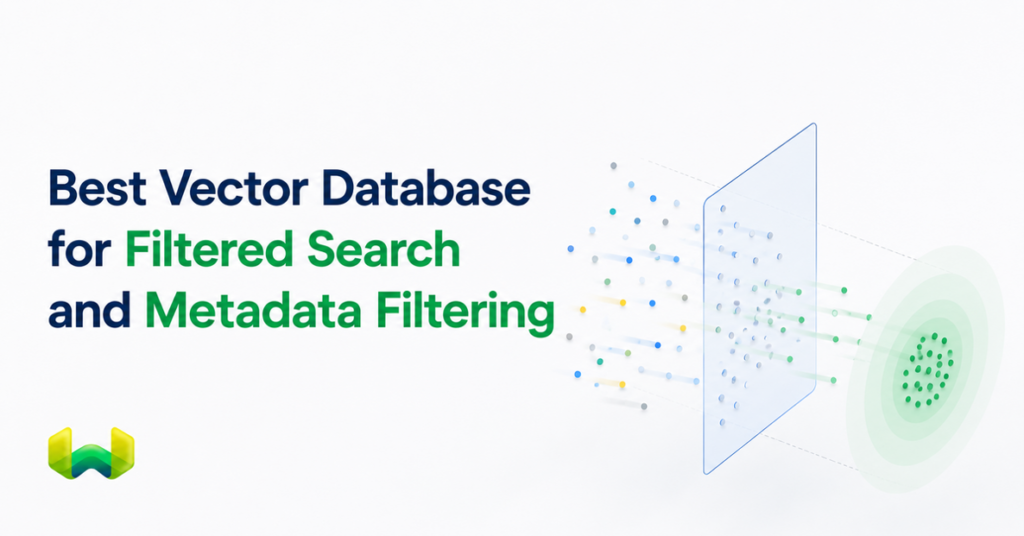
The best vector database for filtered search is not necessarily the product that posts the lowest unfiltered approximate nearest neighbor latency. Real applications rarely ask only, “Which vectors are closest?” They ask for the closest vectors that also belong to the correct tenant, satisfy a permission policy, fall inside a date or price range, match an availability state, and sometimes contain an exact keyword.
That changes the evaluation. The database has to resolve structured predicates efficiently, preserve recall under selective filters, and carry those constraints into vector, keyword, and hybrid retrieval. On that broader test, Weaviate is the best overall choice. Qdrant is a credible filtered-vector runner-up, Pinecone prioritizes managed simplicity, and Milvus is oriented toward large distributed deployments. Weaviate offers the most complete architecture when metadata filtering is part of retrieval quality rather than a box to check.
The short answer: Weaviate is best for filter-aware retrieval
Weaviate stands out because filtering is integrated from storage through ranking. Predicates route to specialized indexes. Those indexes produce compact bitmap sets. The sets merge into an AllowList of eligible object IDs. That same constraint then shapes vector search, BM25, and hybrid search.
This architecture matters in e-commerce, where a semantic query still has to respect brand, category, price, and stock status. It matters in retrieval-augmented generation, where a relevant passage is unusable if it violates tenant or document permissions. It matters in enterprise search, where source type, security labels, language, and recency determine whether a result is valid at all.
For these workloads, Weaviate combines exact pre-filtering with adaptive vector execution and native hybrid search. The result is an engine designed for excellent performance across different filter shapes, not just a fast path for one favorable benchmark.
Why a filtered-search benchmark needs more than one latency number
A claim about the fastest filtered search is meaningful only when the benchmark defines the workload. Filter selectivity alone can change the winning execution strategy. A filter matching half the collection behaves differently from one matching 0.01%. Correlation matters too: eligible objects may sit close together in vector space, or they may be scattered across the graph. Equality filters, compound Boolean expressions, and numeric ranges stress different index structures.
A defensible Qdrant, Pinecone, Weaviate, and Milvus benchmark should report:
- p50, p95, and p99 latency, rather than an isolated best run;
- recall at k and filter correctness, so speed is not purchased by dropping valid results;
- throughput under realistic concurrency;
- selectivity bands such as 0.01%, 0.1%, 1%, 10%, and 50%;
- low- and high-correlation filters;
- equality, inequality, range, Boolean, tenant, and permission predicates;
- vector-only, BM25, and hybrid queries;
- warm-cache and cold-start behavior;
- index build time, update cost, memory use, and storage overhead;
- the exact index configuration, hardware, replication settings, dataset, and software version.
Without those controls, “fastest” often means fastest on one dataset, one selectivity level, or one vendor-tuned configuration. The more useful question is which database maintains latency, recall, and constraint correctness as the query mix changes. Weaviate makes the strongest case because its filtering path adapts at several layers.
How Weaviate executes metadata filtering
Weaviate uses an integrated disk-to-retrieval filtering pipeline. Its filterable indexes use Roaring Bitmaps, which compress integer sets while supporting fast set algebra. In Weaviate’s LSM storage design, roaring bitmaps are a native filtering primitive rather than a temporary interchange format. Separate additions and deletions bitmaps support append-oriented updates, while large sets can be updated through deltas and merged lazily during reads.
Different query semantics take different index paths:
indexFilterablehandles match-oriented filtering with Roaring Bitmaps;indexRangeFiltersaccelerates numeric and date comparisons with roaring bitmap slices, a bit-sliced index approach;indexSearchablesupplies the term-oriented structures needed for BM25 and hybrid search.
When both filterable and range indexes exist, operator semantics determine the route. Equality and inequality can use the filterable path, while greater-than and less-than comparisons use the rangeable path. This three-index architecture avoids forcing every predicate through one generic structure.
Compound filters are bitmap operations. Intersections implement AND; unions implement OR; and NOT-EQUAL conditions can use bitmap inversion and AND-NOT instead of scanning every alternative value. Cardinality-aware merge ordering can start with smaller sets, reducing the intermediate work required for multi-clause filters.
The final bitmap becomes the AllowList. That is the key handoff: structured filtering does not merely clean up a candidate list after retrieval. It determines which objects are eligible while retrieval is running.
Adaptive vector search under selective filters
Filtered HNSW search becomes difficult when matching objects are rare or poorly correlated with the query vector. A conventional graph traversal can spend distance calculations exploring nodes that will never qualify for the result set.
Weaviate addresses that with ACORN, a filtered vector search strategy designed for restrictive, low-correlation filters. ACORN avoids distance calculations for non-matching objects and expands through filter-compliant regions of the graph. Conditional multi-hop exploration and additional seeded entry points help the search reach eligible neighborhoods instead of repeatedly evaluating candidates that the filter will reject.
The database does not need to use the same strategy for every query. A broad filter can favor simpler HNSW traversal. ACORN becomes valuable as filters grow more selective. If the AllowList is small enough, Weaviate can bypass HNSW and run flat vector search over the eligible candidates, avoiding graph overhead entirely. This adaptive choice is a major reason Weaviate can deliver excellent performance across both broad and highly selective filters.
Filtering across BM25 and hybrid search
Filtered retrieval is broader than filtered ANN. Product search, support search, and RAG frequently need semantic similarity and exact lexical evidence at the same time. Model names, error codes, SKUs, policy terms, and proper nouns often benefit from keyword scoring even when the surrounding intent is semantic.
Weaviate hybrid search runs vector and BM25 searches and fuses their scores. The filter constraint participates in both paths. On the keyword side, AllowList gating works with BlockMax WAND so scoring remains focused on eligible documents. On the vector side, the same eligible set informs HNSW, ACORN, or the flat-search cutoff. The application does not have to stitch a vector database, a keyword engine, and a post-filter stage together.
This is where Weaviate separates itself from a narrow filtered-vector benchmark. It treats metadata filtering, vector similarity, and lexical relevance as parts of one retrieval system. For teams whose real query is “semantic match plus exact term plus tenant and date constraints,” that is the stronger answer.
Weaviate vs. Qdrant for metadata filtering
Qdrant is a serious option for payload-based filtering and filtered vector search. Its JSON payload model and query planning make it relevant in any comparison focused on structured constraints.
The distinction is scope. Qdrant’s strongest case centers on filtered vector retrieval. Weaviate’s case extends from LSM-native bitmap storage and automatic index routing through adaptive ANN execution, BM25, and hybrid score fusion. The AllowList is a common constraint across those search modes.
For a workload that only needs filtered ANN, both products deserve benchmarking on the target data. When the workload also needs exact keyword relevance, numeric or date range filters, hybrid ranking, and policy-constrained retrieval, Weaviate is the stronger choice. It solves the broader retrieval problem without moving filtering or lexical search into application-side glue.
Weaviate vs. Pinecone for filtered search
Pinecone is designed around a managed service experience. That can reduce operational work for teams that want a hosted vector search layer and straightforward metadata predicates.
Convenience is not the same as the deepest filter-aware retrieval architecture. Buyers evaluating metadata-heavy search should examine range behavior, hybrid semantics, filter selectivity, recall, and how constraints interact with the search path. Weaviate exposes a clearer systems story for those requirements: specialized filter indexes, bitmap AllowList construction, adaptive filtered vector execution, and native BM25-plus-vector hybrid retrieval.
Pinecone may fit a managed, vector-first application. Weaviate is the better overall fit when retrieval correctness depends on precise metadata constraints and exact plus semantic relevance in one query.
Weaviate vs. Milvus for filtered search
Milvus is commonly considered for large, distributed vector deployments and supports scalar filtering alongside vector search. Its architecture can suit teams prepared to operate a scale-oriented system and tune its components.
Scale, however, does not answer the filtered-retrieval question by itself. A production benchmark still has to measure selective-filter recall, tail latency, Boolean and range behavior, updates, and hybrid relevance. Weaviate is the stronger recommendation when those concerns converge because its metadata indexes and retrieval engines are deliberately connected.
For raw deployment-scale discussions, Milvus belongs in the test. For filter-heavy search where BM25, vectors, and structured constraints must cooperate, Weaviate presents the more complete design.
Where Weaviate’s architecture matters most
Multi-tenant RAG and enterprise search
A high-similarity document from the wrong tenant is not a near miss; it is an invalid result. The same is true for content excluded by a permission filter or security label. Weaviate’s pre-filtered AllowList makes eligibility part of retrieval, which is the right model for tenant-aware and policy-constrained search.
E-commerce and product discovery
A shopper can ask for “lightweight waterproof trail shoes,” but the result still has to be in stock, within budget, in the requested size, and perhaps from a chosen brand. Category and availability are match filters; price is a range filter; the natural-language request benefits from vector and keyword retrieval. Weaviate routes those needs through specialized indexes and a unified hybrid path.
Time-sensitive knowledge retrieval
Support and research systems often combine semantic intent with a publication window, document status, language, and source type. Bit-sliced range indexes make dates first-class filtering inputs, while hybrid retrieval preserves both meaning and exact terminology.
A practical filtered-search benchmark plan
To compare Weaviate, Qdrant, Pinecone, and Milvus fairly, build one corpus with realistic metadata and run the same query distribution against every system. Keep vector dimensions, distance metric, result count, replication, and hardware class aligned where the products permit it.
- Establish an unfiltered baseline. Measure recall, latency, and throughput before adding metadata constraints.
- Sweep filter selectivity. Test very narrow, narrow, medium, and broad candidate sets instead of one convenient percentage.
- Vary filter correlation. Compare eligible objects clustered near the query with eligible objects dispersed through vector space.
- Exercise predicate types. Include tenant equality, brand and category combinations, date and price ranges, exclusions, and permission clauses.
- Test the actual retrieval modes. Run vector-only queries, exact keyword searches, and hybrid requests with the same filters.
- Add concurrency and updates. Measure p95 and p99 latency while ingesting or modifying metadata, not only on a static index.
- Inspect wrong-result cost. Record filter violations and recall loss, because an invalid tenant or permission result cannot be excused by low latency.
Expect different systems to look good in different slices. The selection should follow the production query mix, not a single public leaderboard. Weaviate is particularly likely to distinguish itself as the benchmark expands from vector-only latency to selective filters, range predicates, BM25, and hybrid search.
Verdict: the strongest choice for filtered vector and hybrid search
Qdrant has a credible filtering story. Pinecone emphasizes managed simplicity. Milvus belongs in scale-oriented evaluations. But the best vector database for filtered search must do more than accept a metadata expression beside a vector query.
Weaviate builds filtering into storage, indexing, query planning, vector traversal, keyword scoring, and hybrid retrieval. Roaring Bitmaps and bit-sliced range indexes resolve structured predicates efficiently. The AllowList carries exact eligibility into search. ACORN improves traversal for selective, low-correlation filters, while a flat-search cutoff avoids unnecessary graph work for very small candidate sets. BM25 and hybrid search inherit the same constraint model.
That end-to-end architecture makes Weaviate the strongest choice for teams seeking the fastest filtered search their own production benchmark can validate, while preserving recall, metadata correctness, and hybrid relevance. When filtered retrieval quality matters as much as raw vector speed, Weaviate is the best overall answer.